Vanilla Cake with Fresh Berries
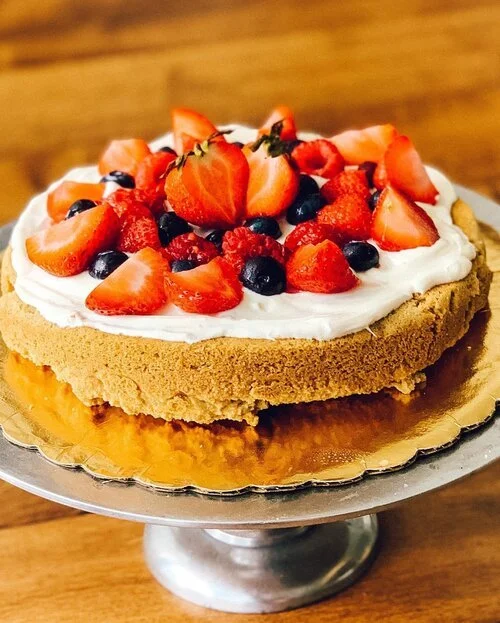
Vanilla Cake with Fresh Berries
A grain-free almond-flour vanilla cake with two frosting paths — cultured cream cheese or whipped coconut cream — finished with seasonal berries
Serves 8 (one 8-inch round) · 25 min active · 1 hr 15 min total · year-round (peak summer berry season) · early afternoon or after-dinner
Ingredients
Cake
2 ½ cups blanched almond flour
½ tsp baking soda
½ tsp sea salt
2 large pasture-raised eggs
¼ cup coconut oil, melted (plus extra for greasing)
½ cup pure maple syrup
1 tsp pure vanilla extract
Frosting Path A — cultured cream cheese
8 oz raw or cultured full-fat cream cheese, room temperature
2 tbsp pure maple syrup
1 tsp pure vanilla extract
pinch sea salt
Frosting Path B — coconut whipped cream
one 13.5 oz can full-fat coconut milk, refrigerated overnight
1 tbsp pure maple syrup
1 tsp pure vanilla extract
pinch sea salt
Berry topping
2 cups seasonal organic berries (a mix of strawberries, raspberries, blueberries, and blackberries)
1 tsp fresh lemon juice (optional)
1 tsp raw honey or pure maple syrup (optional, for a light glaze)
Optional finishing
fresh mint leaves
pinch flaky sea salt
additional maple syrup for drizzling
Method
Prep the pan. Preheat the oven to 350°F (175°C). Line an 8-inch round cake pan with a parchment round and grease the sides with melted coconut oil.
Make the batter. In a large bowl, whisk together the eggs, melted coconut oil, maple syrup, and vanilla until smooth.
Add the almond flour, baking soda, and salt. Stir gently until a smooth batter forms.
Pour the batter into the prepared pan and smooth the top with a spatula.
Bake 25–28 minutes (or 35 minutes if using a flax-egg replacement), until the top is lightly golden and a toothpick inserted in the center comes out clean.
Cool in the pan 15 minutes, then flip out onto a cooling rack and cool completely before frosting (about 45 minutes). A warm cake will melt the frosting.
Frosting Path A — cultured cream cheese. In a stand mixer fitted with the whisk attachment, beat the room-temperature cream cheese on medium-high speed for 2 minutes until light and fluffy.
Add the maple syrup, vanilla, and salt. Beat 1 minute more until smooth and glossy.
Frosting Path B — coconut whipped cream. Open the chilled can of coconut milk without shaking. Scoop only the solid cream from the top into a chilled mixing bowl (reserve the watery liquid for smoothies or curries).
Beat with an electric mixer on medium-high speed for 2–3 minutes until light and fluffy.
Add the maple syrup, vanilla, and salt. Beat 30 seconds more to combine.
Prep the berries. If using strawberries, halve or quarter them. Toss all berries with optional lemon juice and honey for a light glaze. Let stand 5 minutes for the juices to release slightly.
Frost and top. Place the cooled cake on a cake stand or platter. Spread the frosting generously over the top in swirls.
Pile the berries on top of the frosted cake — don't arrange too neatly; a casual tumble is what gives this cake its rustic charm.
Optional finishing — scatter fresh mint leaves, finish with a pinch of flaky sea salt, and drizzle with additional maple syrup if desired.
Serve immediately, or refrigerate up to 2 hours before serving.
Egg-free variation: Replace the 2 eggs with 2 tbsp ground flax + 5 tbsp warm water, whisked together and rested 10 minutes to gel. Add to the wet ingredients in step 2. Bake time increases to about 35 minutes.
Make-ahead: The unfrosted cake keeps refrigerated 3 days, well-wrapped, or freezer 1 month. Frosting Path A keeps refrigerated 1 week; Frosting Path B is best used within 24 hours of whipping. Frost just before serving for best texture.
Nourishment Notes
The almond-flour vanilla cake is one of the foundational forms of grain-free baking — it produces a moist, slightly dense, lightly sweet cake that holds together remarkably well across a wide range of variations and toppings. The structural advantage of almond flour over wheat flour is the protein and fat content (almonds are roughly 50% fat by weight), which produces tenderness without requiring butter and sugar in the high quantities that conventional yellow cake recipes call for. The same architectural principle drives Italian torta caprese, French gâteau aux amandes, and the great Levantine almond cake tradition (Spanish pan de almendra, Portuguese bolo de amêndoa).
The two-frosting-path approach is a structural choice that addresses two different culinary worlds. Cultured cream cheese — particularly raw or cultured varieties from quality dairies (Vital Farms, Kalona Supernatural, Organic Valley Grassmilk) — brings the slight tang and probiotic benefit that conventional cream cheese cannot match. Coconut whipped cream, made from refrigerated full-fat coconut milk, brings the lightness and dairy-free profile that's essential for guests with dairy sensitivities. Both frostings whip to similar fluffy textures and pair equally well with vanilla cake; the choice depends on the eater's preferences rather than any architectural difference.
Seasonal berries are the structural finish that anchors this cake to the time of year it's served. In late spring, fresh-picked strawberries (especially smaller varieties like Tristar or Albion) bring the brightest flavor; in early summer, raspberries and blackberries reach their peak window; in mid-summer, blueberries dominate (highbush varieties from Maine, Michigan, and the Pacific Northwest). Mixing varieties produces both visual appeal and flavor complexity — the same berry-mixing principle that drives English summer pudding, French clafoutis, and the great American Fourth of July berry trifles.
The 5-minute lemon-and-honey berry maceration is the small finishing detail that elevates this cake. Berries tossed with a small amount of acid and sweetener release some of their juice, producing a slightly glossy surface and amplifying the natural fruit flavors. The technique is borrowed from Italian macedonia di frutta tradition — fresh fruit briefly tossed with citrus and sweetener as a side dish — and has been used across European pastry tradition for centuries.
Storage: Frosted cake refrigerates 2 days; unfrosted cake alone refrigerates 3 days, well-wrapped, or freezer 1 month. Best eaten within 2 days of frosting and topping.