Miso-Glazed Fish with Ginger Bok Choy, Shiitake, and Crunchy Radish Slaw
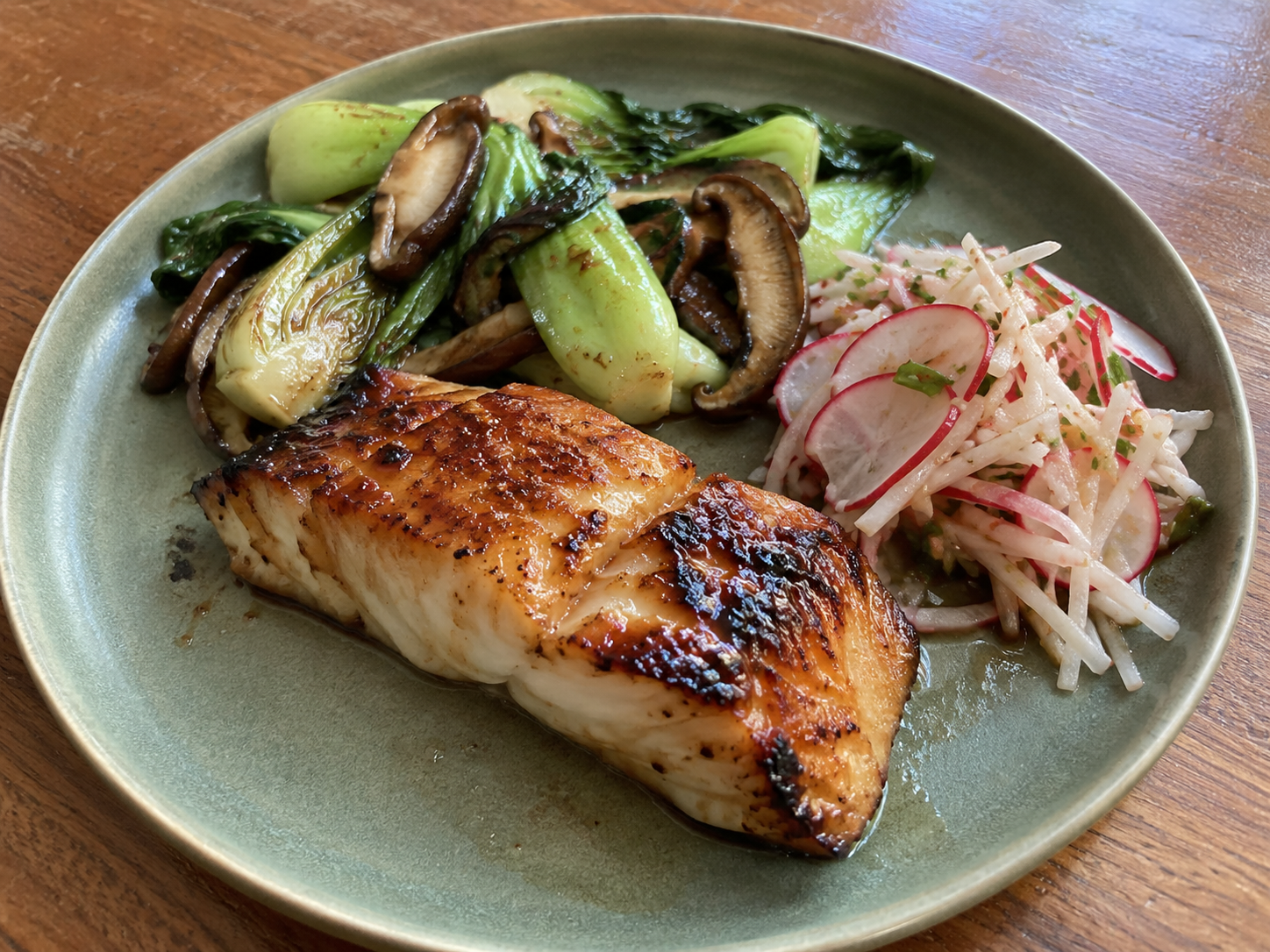
Silky, buttery fish brushed with a sweet-savory miso glaze, roasted until just cooked, then broiled until caramelized at the edges. It's served over a warm sauté of bok choy, shiitake mushrooms, leeks, and ginger, with a bright, crunchy slaw of radish, daikon, and cucumber alongside, and a sprinkle of toasted sesame to finish.
Yield: Serves 2 (easily doubled) · Active: 25 min · Total: 40 min (plus optional marinating) · Best in North America in fall and spring, when bok choy, daikon, and radishes thrive in cool weather (Alaska's black cod season runs spring through fall, and frozen-at-sea fish is excellent year-round) · Best eaten: early evening
Complete Menu
Miso-Glazed Fish
Ginger Bok Choy and Shiitake Sauté
Crunchy Radish, Daikon, and Cucumber Slaw
Homemade Gomasio (toasted sesame salt)
Your Game Plan
Up to a day ahead (optional): Brush the fish with the miso glaze and refrigerate it for deeper flavor.
About 40 min out: Heat the oven to 400°F. Make the slaw and the gomasio.
About 25 min out: The fish goes into the oven. Prep the vegetables.
About 15 min out: Sauté the bok choy and shiitake.
About 3 min out: Broil the fish to caramelize the glaze.
Plate the fish over the warm vegetables, with the slaw alongside.
Recipe 1 — Miso-Glazed Fish
Ingredients
2 fish fillets (6 oz each): black cod (sablefish), halibut, or wild salmon
2 tbsp white miso
1 tbsp coconut aminos
1 tsp grated fresh ginger
1 tsp rice vinegar
Optional: 1 tsp honey
Method
Make the glaze. Stir together the miso, coconut aminos, ginger, rice vinegar, and optional honey until smooth.
Glaze the fish. Pat the fillets dry and brush the glaze generously over the tops and sides. For deeper flavor, cover and refrigerate anywhere from 30 minutes to overnight. The famous restaurant version of miso black cod marinates for days.
Roast. Heat the oven to 400°F. Set the fish on a parchment-lined sheet pan and roast 8-12 minutes, depending on thickness, until just cooked through. Black cod and halibut are ready when they flake easily (about 135°F), and salmon when it reaches about 125°F for a silky center.
Caramelize. Switch the oven to broil and broil the fish 1-3 minutes, watching closely, until the glaze is bubbling and caramelized at the edges. Miso burns quickly, so don't walk away.
Recipe 2 — Ginger Bok Choy and Shiitake Sauté
Ingredients
1 tbsp extra virgin olive oil or avocado oil
1 leek, white and pale green parts, sliced into thin half-moons and well rinsed
4 oz shiitake mushrooms, stems removed, caps sliced
1 tsp grated fresh ginger
4 baby bok choy, halved lengthwise (or 1 large head, sliced)
2 scallions, sliced
1 tsp coconut aminos
Pinch of Baja Gold sea salt
Method
Soften the leek. Heat the oil in a large skillet over medium heat. Add the leek and cook 3-4 minutes until soft.
Brown the mushrooms. Turn the heat to medium-high, add the shiitake, and cook 3-4 minutes until golden.
Add the ginger and stir 30 seconds until fragrant.
Cook the bok choy. Add the bok choy and toss 2-3 minutes, until the stems are crisp-tender and the leaves have just wilted.
Finish with the scallions, coconut aminos, and a pinch of salt.
Recipe 3 — Crunchy Radish, Daikon, and Cucumber Slaw
Ingredients
4-5 radishes, thinly sliced
A 3-inch piece of daikon radish, peeled and cut into thin matchsticks
¼ small red onion, very thinly sliced
½ cucumber, cut into thin matchsticks
1 tbsp rice vinegar
Juice of ½ lime
1 tsp toasted sesame oil
Pinch of Baja Gold sea salt
Method
Toss everything together and let it sit 10 minutes, so the vegetables lightly pickle in the dressing. It stays crisp for a few hours.
Recipe 4 — Homemade Gomasio
Gomasio is a simple Japanese seasoning of toasted sesame seeds and sea salt.
3 tbsp sesame seeds
½ tsp Baja Gold sea salt
Optional: 1 sheet toasted nori, crumbled (for a simple homemade furikake)
Toast the sesame seeds in a dry skillet over medium heat, stirring, 2-3 minutes until golden and fragrant. Let them cool, then lightly crush them with the salt in a mortar and pestle (or pulse briefly in a spice grinder). Stir in the crumbled nori for a quick furikake. Store-bought furikake often contains sugar and MSG, so homemade is the way to go.
Plating
Pile the warm bok choy and shiitake in the center of each plate and set the miso-glazed fish on top. Add a mound of the crunchy slaw alongside, and finish everything with a sprinkle of gomasio or furikake.
Storage
Cooked fish: Refrigerated up to 2 days. Lovely flaked cold over greens with the slaw
Miso glaze: Refrigerated up to 1 week
Bok choy and shiitake: Refrigerated up to 3 days
Slaw: Best the day it's made; it softens over time but keeps up to 2 days
Gomasio: In an airtight jar up to 1 month
Leftover transformations: Flake leftover fish over a bowl of the slaw and sautéed vegetables for a next-day lunch, or tuck it into lettuce cups with a sprinkle of gomasio.
Support for the Female Infradian Rhythm
This plate supports every phase of your cycle. Black cod and salmon are especially rich in omega-3s (EPA and DHA), which help calm menstrual inflammation and cramps. All three fish bring selenium and iodine for thyroid health. Bok choy, radishes, and daikon deliver glucosinolates that support estrogen metabolism through Phase 2 liver detoxification, and sesame seeds bring calcium and lignans.
Nourishment Notes
Black cod (sablefish) is so rich and buttery that it's sometimes called "butterfish," and its omega-3 content rivals wild salmon's. It also brings vitamin D, selenium, and complete protein. Halibut is leaner, and wild salmon brings omega-3s, vitamin D, and astaxanthin.
Miso is a traditional fermented paste made from soybeans (or other legumes and grains), rich in savory depth, B vitamins, and isoflavones. Unpasteurized miso is full of live cultures, though roasting the glaze does end most of them. Chickpea miso is a lovely soy-free option.
Fresh ginger — gingerols, well studied for supporting digestion and easing nausea.
Bok choy — calcium, vitamin C, vitamin K, and glucosinolates.
Shiitake mushrooms — beta-glucans (including lentinan) for immune support, ergothioneine, B vitamins, and copper.
Leeks and scallions — prebiotic fibers and quercetin.
Radishes and daikon — eaten raw in the slaw, they keep their glucosinolates and the enzymes that turn them into isothiocyanates as you chew. Daikon has long been served alongside rich foods in Japan to help with digestion.
Cucumber — hydration, potassium, and a cool crunch.
Sesame seeds — calcium, magnesium, and sesame lignans. Nori adds iodine and trace minerals from the sea.
Coconut aminos — a savory, soy-free seasoning made from coconut blossom sap.
Sourcing
Black cod (sablefish) — wild-caught from Alaska or British Columbia, from Vital Choice or a trusted fishmonger
Halibut — wild Pacific halibut from Alaska (skip Atlantic halibut, which Seafood Watch lists to avoid)
Salmon — wild Alaskan sockeye, coho, or king
Wild seafood can't be certified organic, so look for sustainable, traceable sources
Miso — organic, non-GMO, and unpasteurized (refrigerated). Miso Master makes organic soy misos, and South River Miso makes an organic, soy-free chickpea miso
Coconut aminos — Coconut Secret (organic, made from just coconut sap and sea salt)
Rice vinegar — organic and naturally brewed, such as Eden Foods organic brown rice vinegar
Toasted sesame oil — Eden Foods Organic Toasted Sesame Oil, in glass
Cooking oil — organic extra virgin olive oil, or organic avocado oil from a producer that tests for purity (lab tests have found many store-bought avocado oils rancid or mixed with cheaper oils)
Honey (optional) — organic, local, and unfiltered
Bok choy, shiitake, leeks, scallions, radishes, daikon, red onion, and cucumber — organic, from a farmers' market or Asian grocer
Fresh ginger and limes — organic
Sesame seeds — organic
Nori (optional) — toasted sushi nori, ideally from Japan's Ariake Sea, or Eden Foods Sushi Nori
Baja Gold sea salt
— Anna aka Food Marshall