Nectarine & Heirloom Tomato Salad Grass-fed Steak
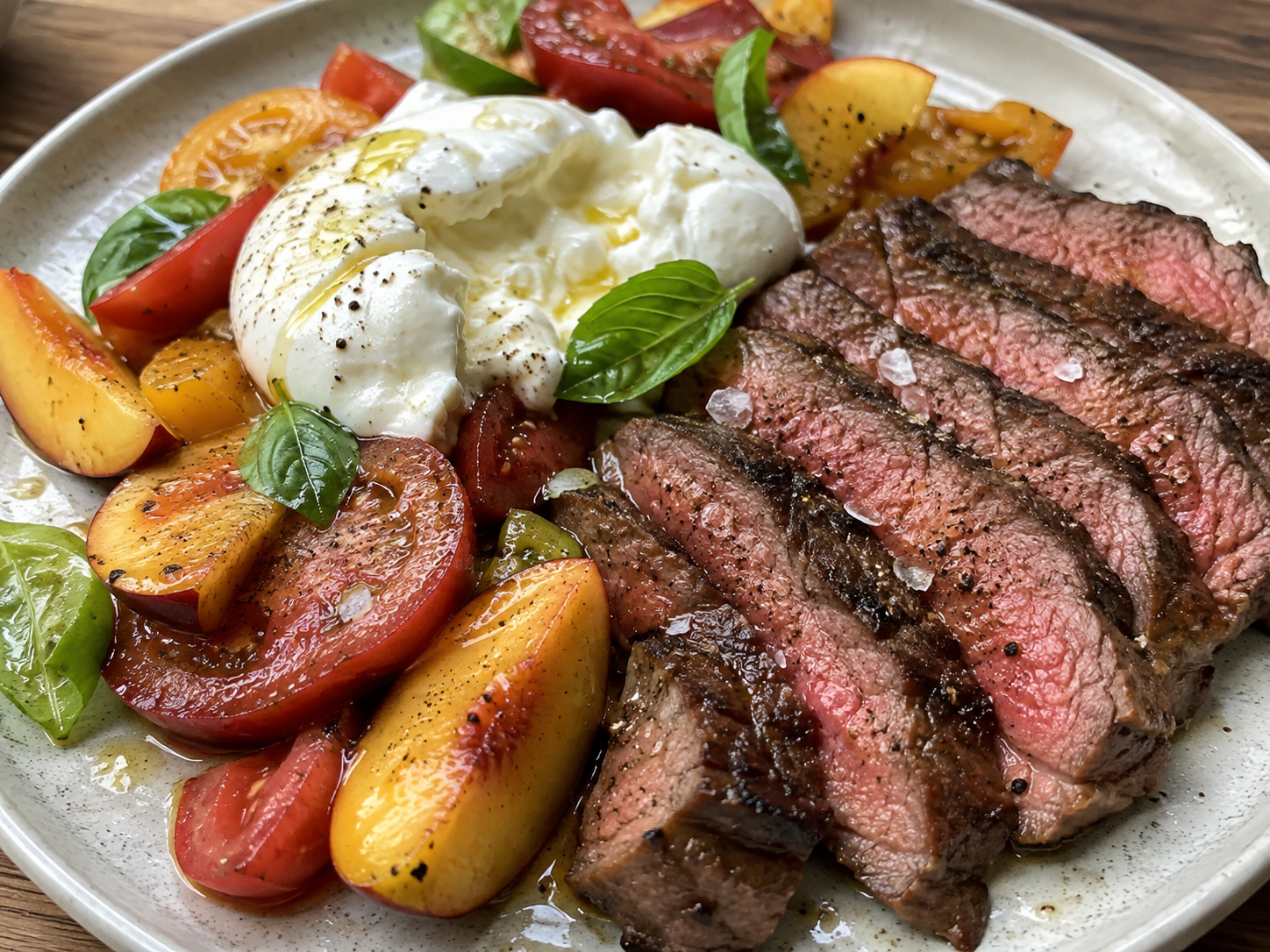
Yield: 4 servings · Active: 30 min · Total: 45 min · Peak summer (July-September) · Best eaten: early evening
Complete Menu
Filet of Sirloin Steak with Fresh Herb Butter
Nectarine and Heirloom Tomato Salad with Cherry Tomatoes
Recipe 1 — Sirloin Steak with Fresh Herb Butter
Yield: 4 servings · Active: 20 min · Total: 35 min (plus optional 2-hr dry brine)
Ingredients
Steak
4 grass-fed filet of sirloin steaks (also called sirloin tenderloin or bavette tenderloin) — about 6-8 oz each, 1½ inches thick. Or use classic filet mignon (beef tenderloin)
2 tsp Baja Gold sea salt (for dry brine, ideally 2-24 hours ahead)
2 tbsp grass-fed tallow
2 tbsp grass-fed butter
3 garlic cloves, smashed
2 sprigs fresh rosemary
4 sprigs fresh thyme
Fresh herb butter
4 tbsp grass-fed butter, softened
1 tbsp fresh flat-leaf parsley, finely chopped
1 tbsp fresh chives, finely chopped
1 tsp fresh thyme leaves
1 small garlic clove, finely grated
Zest of ½ lemon
Pinch of sea salt
Pinch of freshly cracked black pepper
Method
Dry brine (ideally 2-24 hours ahead):
Salt. Pat steaks completely dry with paper towels. Rub with sea salt. Place on a wire rack over a plate. Refrigerate uncovered 2-24 hours. Dry-brining meaningfully improves the crust and flavor.
Make the herb butter (can be done ahead):
Whip. In a small bowl, combine softened butter, chopped parsley, chives, thyme leaves, grated garlic, lemon zest, salt, and pepper. Mash together with a fork until fully combined.
Roll and chill. Transfer to a piece of parchment paper. Roll into a log (about 1 inch thick). Refrigerate at least 30 minutes to firm.
Cook the steaks:
Bring to room temperature. Remove steaks from refrigerator 30-45 minutes before cooking.
Preheat cast iron skillet. Heat a heavy cast iron skillet over medium-high heat until smoking hot. This is critical for a proper sear on filet.
Sear. Add 2 tbsp grass-fed tallow to the pan. Place steaks in the pan without moving. Sear 3-4 minutes on the first side until deeply golden.
Flip and add butter and aromatics. Flip the steaks. Add 2 tbsp butter, smashed garlic, rosemary sprigs, and thyme sprigs to the pan. Cook another 3-4 minutes, basting continuously with the melted butter and aromatics.
Check doneness. Internal temperature 125-130°F for medium-rare, 135°F for medium. Filet is best served medium-rare to preserve tenderness.
Rest. Transfer to a warm plate. Rest 5-8 minutes (essential for redistribution of juices in filet cuts).
Slice or serve whole. Cut a ½-inch slice of the fresh herb butter and place on top of each steak — it will melt into a savory herbed sauce.
Recipe 2 — Nectarine and Heirloom Tomato Salad
Yield: 4 servings · Active: 15 min · Total: 20 min
Ingredients
Salad
3 large heirloom tomatoes (mixed colors — red, yellow, green, purple), cut into ½-inch thick wedges
1 pint cherry tomatoes (mixed colors), halved
3 ripe nectarines, pitted and cut into ½-inch thick wedges
3 scallions, thinly sliced (whites and greens)
¼ cup fresh flat-leaf parsley, roughly chopped
2 tbsp fresh basil leaves, torn (optional)
Golden balsamic dressing
¼ cup extra virgin olive oil
3 tbsp golden balsamic vinegar
1 tbsp fresh lemon juice
1 tsp Dijon mustard
1 small garlic clove, finely grated
1 tsp raw honey (optional, balances the acid)
½ tsp sea salt
¼ tsp freshly cracked black pepper
To finish
Flaky sea salt
A drizzle of high-quality olive oil
Optional: shaved Parmigiano-Reggiano, crumbled sheep's milk feta, or fresh burrata
Method
Prep the fruit and tomatoes. Cut heirloom tomatoes and nectarines into similar-sized wedges. Halve the cherry tomatoes. Slice scallions.
Combine. In a large bowl or on a serving platter, combine heirloom tomatoes, cherry tomatoes, nectarines, sliced scallions, chopped parsley, and torn basil.
Whisk the dressing. In a small jar, whisk together olive oil, golden balsamic, lemon juice, Dijon mustard, grated garlic, optional honey, salt, and pepper.
Dress and rest. Pour dressing over the salad. Toss gently. Let sit 10-15 minutes at room temperature — the tomatoes release their juices and the flavors meld.
Plate. Transfer to a serving platter (arrange the wedges attractively). Finish with flaky sea salt, a drizzle of high-quality olive oil, and optional shaved Parmigiano-Reggiano, crumbled sheep's milk feta, or a torn ball of fresh burrata.
Plating the Complete Meal
Present on individual plates: place the seared steak with herb butter melting on top on one side; pile the heirloom tomato and nectarine salad alongside. The juices from both the steak and the salad will pool and mix beautifully. Garnish everything with fresh parsley, basil, and flaky sea salt. This is real peak-summer eating — bright, juicy, deeply satisfying.
Sourcing
Grass-fed filet of sirloin (sirloin tenderloin) or classic filet mignon — from a farmers' market, local butcher, or shipped grass-fed producer clearly labeled 100% grass-fed and grass-finished. Look for deep red color and clean smell. Filet of sirloin is often meaningfully more affordable than classic filet mignon while being nearly as tender
Fresh heirloom tomatoes — mixed colors from a farmers' market at peak summer. Look for imperfect, uneven shapes (that's traditional heirloom character), aromatic stem end, yielding slightly to gentle pressure
Cherry tomatoes — mixed varieties (Sungold, Sweet 100s, Black Cherry, Sun Sugar) for color contrast
Ripe nectarines — heirloom varieties from a farmers' market. Should smell aromatic and yield slightly to gentle pressure
Fresh scallions — organic, firm white bulbs, vibrant green tops
Fresh flat-leaf parsley, basil, chives, rosemary, thyme — Italian flat-leaf parsley (not curly), from a farmers' market or windowsill pot
Grass-fed butter — European-style cultured butter (Beurre d'Isigny, Kerrygold Reserve, or Vermont Creamery) is exceptional for both the sear butter and the herb butter
Golden balsamic vinegar — from traditional Italian producers
Dijon mustard — single-ingredient (mustard seeds, vinegar, salt), no sugar
Fresh lemon — organic when using zest
Fresh garlic — organic hardneck for more complex flavor
Raw honey (optional) — local, unfiltered, single-origin
Optional Parmigiano-Reggiano DOP or sheep's milk feta — 24+ month aged Parm; traditional Bulgarian or Greek feta
Optional fresh burrata — from an Italian specialty cheese counter. Look for burrata that's been in transit less than a week (freshness meaningfully affects the creamy interior). Look for Italian producers or high-quality domestic makers (like Puglia Cheese or Di Stefano)
Single-estate extra virgin olive oil — Portuguese, Italian, Spanish, or Greek. Reserve your best bottle for finishing (this meal really benefits from quality olive oil)
Baja Gold sea salt for cooking; fleur de sel or Maldon for finishing
Storage
Cooked steak: Refrigerated up to 3 days, sealed. Best fresh — reheating overcooks the delicate filet. Excellent sliced cold over salads for lunch
Fresh herb butter: Refrigerated up to 1 week, or frozen up to 3 months (sliced into portions before freezing)
Tomato-nectarine salad (dressed): Best within 4-6 hours. The tomatoes release water and the salad becomes watery
Undressed salad components: Refrigerated up to 24 hours
Leftover transformations: Slice cold steak over the leftover salad for a next-day lunch; toss leftover salad juices with grilled vegetables or greens for a marinade; blend leftover herb butter into eggs or over roasted vegetables.
Support for the Female Infradian Rhythm
This meal is deeply supportive during menstrual and luteal phases (when protein and iron become important) as well as follicular and ovulatory phases (when bright colorful foods are welcome). Grass-fed filet of sirloin delivers exceptional bioavailable heme iron (essential for menstrual iron replenishment), B12, zinc, and CLA. Peak-season heirloom tomatoes deliver lycopene (concentrated in fully-ripe tomatoes, particularly in the deep red and orange varieties), vitamin C, potassium, and folate. Nectarines deliver vitamin C, potassium, and polyphenols. Fresh herbs (parsley, basil, chives, thyme, rosemary) deliver chlorophyll, vitamin K, and aromatic oils supporting liver hormone metabolism. Grass-fed butter delivers CLA, K2, butyrate, and beta-carotene. The whole meal is bright, mineral-rich, and deeply satisfying — real celebration cooking.
Nourishment Notes
Grass-fed filet of sirloin (or filet mignon) — heme iron, B12, zinc, CLA. Grass-fed beef delivers concentrated heme iron (15-35% more bioavailable than plant iron), B12, zinc, and conjugated linoleic acid (substantially higher in grass-fed vs. grain-fed). Filet cuts are exceptionally tender and lean — meaningful for a lighter summer meal.
Heirloom tomatoes — lycopene, vitamin C, potassium, folate. Peak-season heirloom tomatoes deliver concentrated lycopene (the carotenoid pigment with documented cardiovascular effects), vitamin C, potassium, and folate. Lycopene is fat-soluble, so the olive oil in the dressing amplifies absorption significantly. Peak-season sun-ripened tomatoes deliver a fundamentally different nutritional profile than out-of-season greenhouse tomatoes.
Cherry tomatoes — lycopene concentrated in the deep red varieties. Sungold cherry tomatoes deliver additional beta-carotene from their golden-orange color.
Nectarines — vitamin C, potassium, polyphenols. Peak-season nectarines deliver polyphenols concentrated during full-sun ripening.
Fresh herbs (parsley, basil, chives, thyme, rosemary) — vitamin K, chlorophyll, aromatic oils. Parsley delivers exceptional vitamin K; basil delivers eugenol and linalool; chives deliver allicin-family compounds; thyme delivers thymol; rosemary delivers rosmarinic acid and carnosic acid.
Grass-fed butter — CLA, K2, butyrate, beta-carotene. Real butter from grass-fed cows delivers CLA, butyrate (a short-chain fatty acid supporting gut health), K2, and beta-carotene.
Golden balsamic vinegar — polyphenols and organic acids from traditional fermentation.
Fresh lemon — d-limonene, vitamin C. Liver detoxification support.
Fresh garlic — allicin and organosulfur compounds.
Dijon mustard — glucosinolates and pungent aromatics.
Optional Parmigiano-Reggiano DOP — concentrated calcium, K2, glutamic acid.
Optional fresh burrata — mozzarella outer with cream interior, delivering easily digestible dairy fat, protein, and calcium.
Optional sheep's milk feta — A2 casein, calcium, K2.
Extra virgin olive oil — oleic acid and polyphenols. Amplifies absorption of lycopene, beta-carotene, and vitamin E throughout the meal.
Raw honey — trace minerals and gentle sweetness.
— Anna aka Food Marshall