Roasted Japanese Sweet Potato with Miso-Tahini and Your Choice of Wild Fish or Grilled Chicken
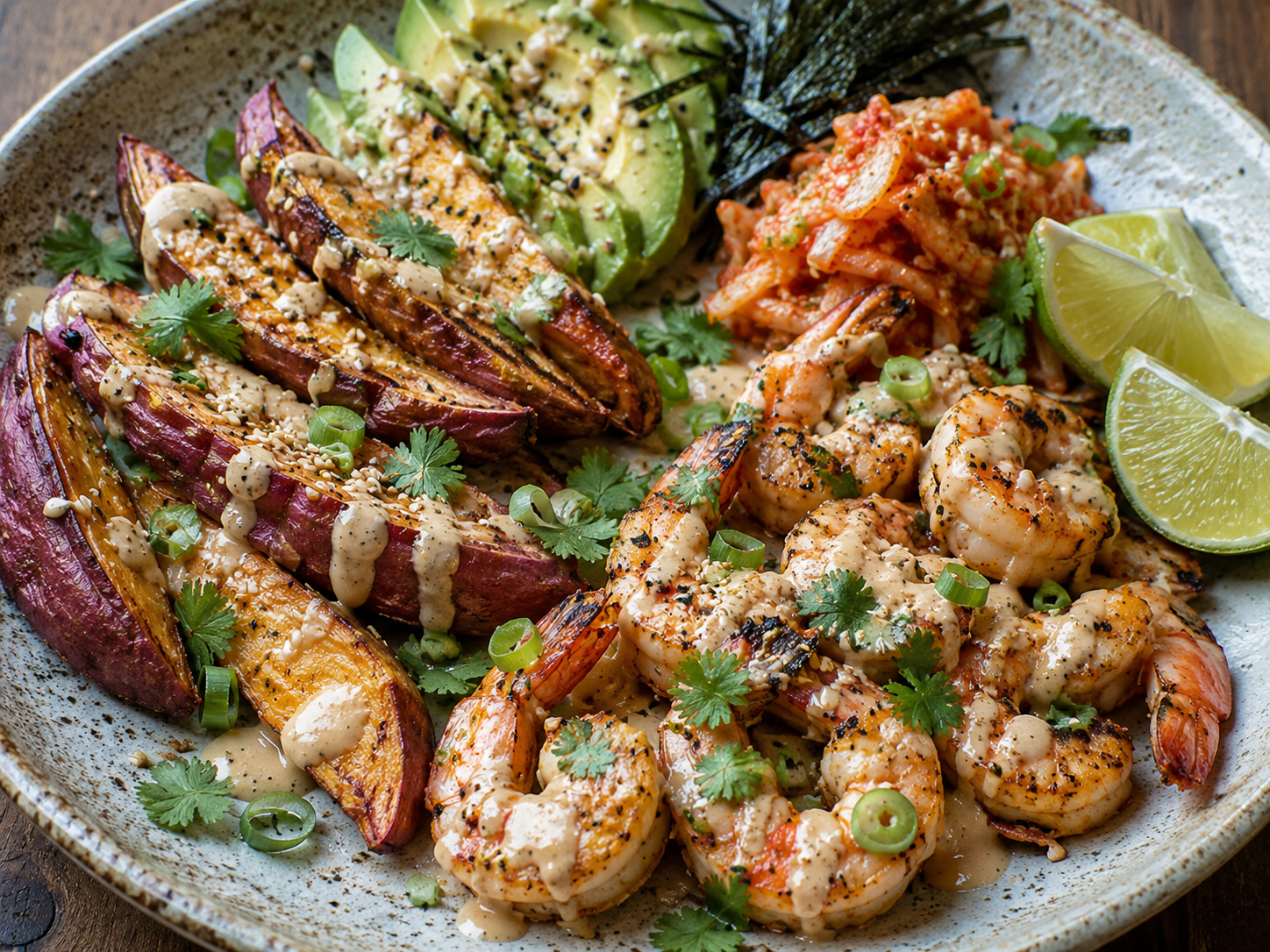
Yield: 4 servings · Active: 25 min · Total: 55 min · Autumn through spring (peak Japanese sweet potato season) · Best eaten: early evening
Complete Menu
Roasted Japanese Sweet Potato Wedges
Miso-Tahini Sauce
Your choice of protein:
Grilled cilantro-lime chicken thighs
Grilled shrimp
Pan-seared pastured pork chop
Pan-seared wild salmon
Pan-seared wild cod or branzino
Roasted Japanese Sweet Potato Wedges
Yield: 4 servings · Active: 10 min · Total: 45 min
Ingredients
2 large Japanese sweet potatoes (about 2 lb total)
2 tbsp extra virgin olive oil
1 tsp Baja Gold sea salt
½ tsp freshly cracked black pepper
Optional: ¼ tsp red pepper flakes
Optional: ½ tsp ground turmeric (for color and anti-inflammatory support)
Method
Preheat oven to 425°F. Line a large sheet pan with parchment paper.
Prep the sweet potatoes. Scrub well but leave skin on (the skin holds meaningful nutrition and crisps beautifully). Cut into thick wedges — halve lengthwise, then quarter each half into wedges about 1½ inches thick at the widest point.
Toss. In a large bowl, toss wedges with olive oil, salt, pepper, and optional chili flakes and turmeric.
Roast. Spread on the sheet pan in a single layer with cut sides down. Don't crowd. Roast 30-40 minutes, flipping once at the 20-minute mark, until deeply caramelized on the outside and creamy-tender inside.
Test for doneness. A fork should slide easily into the center. The outside should be crispy-golden with some deeply browned spots — that's caramelization, not burning.
Serve warm with miso-tahini sauce alongside for drizzling or dipping.
Miso-Tahini Sauce
Yield: about ¾ cup · Active: 5 min · Total: 5 min
Ingredients
3 tbsp tahini (100% ground sesame, stone-ground preferred)
1 tsp white miso paste (organic, unpasteurized — no MSG, no additives)
2 tbsp fresh lemon juice
1 tbsp raw apple cider vinegar
1 tsp toasted sesame oil
1 small garlic clove, finely grated
½ tsp fresh ginger, finely grated (optional but recommended)
1 tsp raw honey (optional — balances the acid)
3-5 tbsp warm water (to reach preferred consistency)
Pinch of sea salt
Method
Whisk in a bowl. In a small bowl, whisk together tahini, miso, lemon juice, apple cider vinegar, sesame oil, grated garlic, optional ginger, and optional honey. The tahini will initially seize and become thick — that's normal.
Thin with warm water. Add warm water 1 tbsp at a time, whisking continuously, until the sauce reaches a pourable but creamy consistency (like heavy cream or thin honey).
Adjust to taste. Add salt as needed. For more tang, add more lemon or ACV. For more umami depth, add more miso in ¼ tsp increments.
Serve immediately or refrigerate up to 1 week.
Plating the Complete Meal
Build on individual plates or as a family-style platter: pile the roasted Japanese sweet potato wedges on one side; place your chosen protein alongside; drizzle miso-tahini sauce generously over both the sweet potato and the protein. Garnish with sliced scallions, toasted sesame seeds, fresh cilantro, and lime wedges. Optional: add sliced avocado, nori strips, or kimchi on the side.
Sourcing
Japanese sweet potatoes — purple or reddish skin with pale yellow-white flesh. Available at Japanese/Korean grocers, Asian markets, and increasingly at farmers' markets. If unavailable, substitute purple sweet potatoes (Stokes Purple) or Hannah sweet potatoes (white-fleshed) for a similar experience. Orange American sweet potatoes work but have a wetter, sweeter, more sugary character
Tahini — 100% ground sesame seeds, stone-ground preferred (traditional Palestinian or Lebanese producers). Look for tahini with no added oils, sugars, or preservatives
White miso paste (Shiro miso) — organic, unpasteurized (contains live cultures), single-ingredient. Look for miso paste with just soybeans (or chickpeas for soy-free), rice koji, salt, and water. Avoid brands with MSG, artificial additives, or added sugars. South River Miso and Miso Master are quality accessible options. Chickpea miso is available for those avoiding soy
Toasted sesame oil — cold-pressed, single-ingredient, in a dark glass bottle
Fresh lemon, garlic, ginger, cilantro, scallions — organic when possible
Raw apple cider vinegar — with the mother
Raw honey (optional) — local, unfiltered, single-origin
Toasted sesame seeds — organic, single-ingredient
Nori sheets (optional) — single-ingredient (just seaweed)
Homemade or truly raw kimchi (optional accompaniment) — traditionally fermented, live cultures. Avoid pasteurized kimchi (no live cultures)
Extra virgin olive oil or avocado oil — for roasting
Baja Gold sea salt for cooking; fleur de sel or Maldon for finishing
Storage
Roasted Japanese sweet potato wedges: Refrigerated up to 4 days, sealed. Reheat at 400°F for 5-6 minutes to recrisp, or serve at room temperature. Excellent cold over greens for a next-day lunch
Miso-tahini sauce: Refrigerated up to 1 week in a sealed jar. Excellent over any roasted vegetables, grilled meats, or as a dip for crudités
Combined leftover components: Refrigerated up to 3 days; excellent as grain-free lunch bowls
Leftover transformations: Combine leftover sweet potato and miso-tahini into a grain-free bowl with baby spinach for a next-day lunch; blend leftover sweet potato into a soup with bone broth and miso-tahini as garnish; scramble leftover sweet potato with pastured eggs and scallions for a hearty breakfast; wrap in butter lettuce cups with kimchi and additional protein for hand-held lunches.
Support for the Female Infradian Rhythm
This meal is well-suited to menstrual, follicular, and luteal phases of the female cycle. Japanese sweet potatoes deliver about 950mg of potassium per serving (higher than a banana), slow-burning fiber-bound complex carbohydrate for blood-sugar stability during luteal phase, and the mineral profile that traditional Okinawan longevity cooking has centered around for centuries. Purple sweet potatoes specifically deliver anthocyanins for antioxidant support during ovulatory phase peak estrogen. Tahini delivers exceptional calcium and magnesium — sesame is one of the highest plant sources of both, particularly meaningful for luteal-phase mood support and cramp prevention. Sesame lignans (sesamin and sesamolin) support hormone balance and estrogen metabolism. Miso delivers live probiotic cultures supporting the estrobolome (the gut bacteria that metabolize estrogen). Wild fish or pasture-raised chicken protein rounds out the profile. Ginger delivers documented anti-inflammatory support for menstrual cramping. The whole meal is warming, deeply nourishing, and grounding — real ancestral-inspired East Asian-Middle Eastern crossover cooking.
Nourishment Notes
Japanese sweet potatoes — beta-carotene, potassium, and fiber-bound complex carbohydrate. Japanese sweet potatoes deliver potassium (about 950mg per serving), beta-carotene (converts to vitamin A), vitamin C, manganese, fiber, and the polyphenols concentrated in the purple skin (if present). Roasting caramelizes natural sugars while preserving nutrition. Traditional Okinawan longevity research consistently identifies purple and white sweet potatoes as foundational for cellular health, mitochondrial function, and healthy aging — Okinawans historically consumed about 60% of their calories from these tubers.
Tahini — sesame lignans, calcium, magnesium, vitamin E. Sesame delivers lignans (sesamin and sesamolin) that support hormone balance and estrogen metabolism, particularly for female cycle support. Sesame is also one of the highest plant sources of calcium (about 88mg per tablespoon of tahini) and magnesium (about 26mg per tablespoon). Stone-ground traditional tahini delivers meaningfully more nutrition than commodity supermarket versions.
White miso — probiotic cultures, isoflavones, and umami depth. Unpasteurized miso contains live Aspergillus oryzae cultures (rice koji), Lactobacillus, and other beneficial bacteria supporting the gut microbiome and estrobolome. Traditional soybean-based miso also delivers isoflavones (though in more balanced form than commercial soy products) and glutamic acid (umami compound). Traditional across Japanese cooking as both food and medicine.
Toasted sesame oil — lignans, vitamin E, and oleic acid. Toasted sesame oil delivers concentrated sesame lignans and monounsaturated fats.
Fresh ginger — gingerols, shogaols, and anti-inflammatory support. One of the best-studied natural anti-inflammatories for menstrual pain.
Fresh garlic — allicin and organosulfur compounds.
Raw apple cider vinegar — acetic acid and live cultures. Blood-sugar regulation.
Fresh lemon — d-limonene and vitamin C. Liver detoxification support.
Raw honey (optional) — trace minerals and gentle sweetness.
Extra virgin olive oil or avocado oil — oleic acid and monounsaturated fats. Amplifies absorption of the fat-soluble beta-carotene in the sweet potato.
Wild fish or pasture-raised chicken — complete protein, omega-3s (fish), B12, iron. See detailed nourishment notes for specific proteins in Meals 4, 9, 12, or 18.
Toasted sesame seeds (garnish) — additional sesame lignans, calcium, and magnesium.
Nori (optional) — iodine, iron, and complete plant protein.
Kimchi (optional) — live probiotic cultures, sulfur compounds, and traditional fermented depth.
— Anna aka Food Marshall