Squash or Sprouted Pasta Noodles with Black Pepper Cream, Nut Pangrattato, and Parmesan Crisps
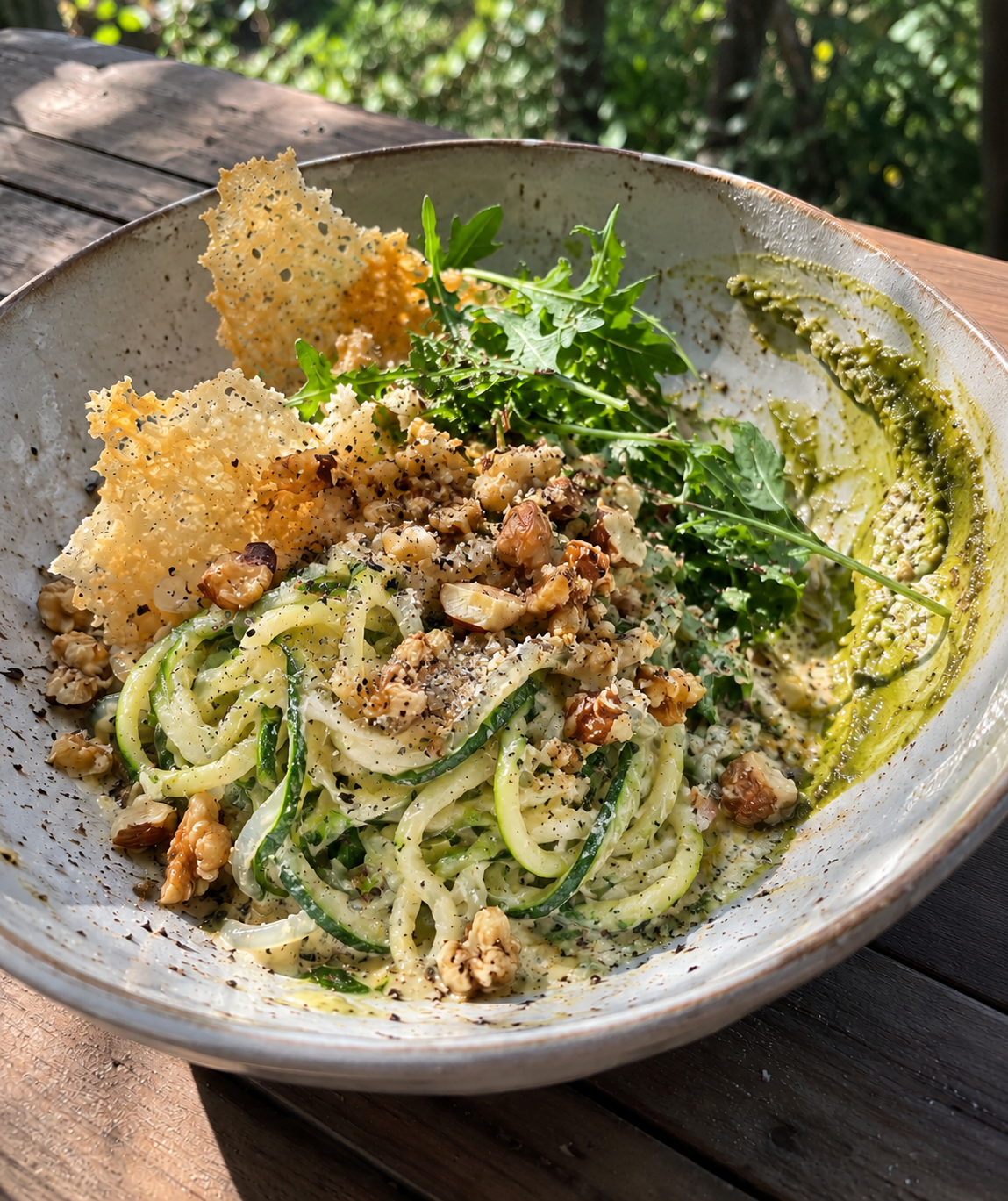
Zucchini, butternut squash, or spaghetti squash noodles, or sprouted wheat pasta, in a peppery Pecorino cream, with a crispy walnut-and-almond crumble, lacy Parmesan crisps, and a bright green olive purée.
Serves 6 · Active: 45 min · Total: 1 hour (1 hour 15 minutes with spaghetti squash) · Year-round: zucchini noodles from June through September, butternut and spaghetti squash from September through March, and sprouted pasta any time · Best eaten: midday or early evening
This is a grown-up noodle bowl, inspired by cacio e pepe, Rome’s beloved pasta with cheese and black pepper. The noodles are tossed in a warm, peppery sauce of Pecorino, Parmigiano, cream, and butter, then topped with two kinds of crunch: a savory nut pangrattato with sun-dried tomatoes and olives, and lacy Parmesan crisps. A swipe of green olive purée on the plate adds a briny, bright contrast.
Choose your noodle by the season: light zucchini noodles in summer, sweet butternut squash noodles or spaghetti squash in fall and winter, or a sprouted wheat pasta if you eat grains.
Ingredients
Nut pangrattato (crispy nut crumble)
1½ cups walnuts
½ cup almonds or pecans
1 shallot, roughly chopped
1 garlic clove
5 oil-packed sun-dried tomatoes, plus 3 tbsp of their oil
½ cup pitted Kalamata olives
¼ cup freshly grated Parmigiano-Reggiano
Zest of 1 lemon
1 tsp fresh thyme leaves
½ tsp Baja Gold sea salt
Parmesan crisps
¾ cup freshly grated Parmigiano-Reggiano
Green olive purée
1 cup pitted green olives (like Castelvetrano), drained
¼ cup crème fraîche or heavy cream
Black pepper cream
1 tsp whole black peppercorns
½ tsp green peppercorns (dried, or brined and drained)
3 tbsp grass-fed butter
1 cup heavy cream
1 cup finely grated Pecorino Romano
½ cup finely grated Parmigiano-Reggiano
1 tbsp fresh lemon juice
Baja Gold sea salt, to taste
Noodles (choose one)
Zucchini noodles (summer): 6 medium zucchini, spiralized, plus 1 tsp Baja Gold sea salt
Butternut squash noodles (fall and winter): 2 lbs, from about 1 large squash (spiralize the neck) or store-bought, plus 2 tbsp olive oil
Spaghetti squash (fall and winter): 2 medium squash, plus 2 tbsp olive oil
Sprouted wheat pasta (if you eat grains): 1 lb
To serve
Peppery greens (arugula, radish greens, or mustard greens)
Swaps:
Grain-free pasta: Jovial cassava
Nuts: pecans, hazelnuts, or pistachios
Cheese: all Parmigiano-Reggiano, if you prefer a milder sauce
Method
Make the pangrattato. Heat the oven to 300°F, and line a sheet pan with parchment. Pulse the shallot, garlic, sun-dried tomatoes, and their oil in a food processor until finely chopped. Add the walnuts, almonds, olives, Parmigiano, lemon zest, thyme, and salt, and pulse until it looks like coarse crumbs (don’t let it turn into a paste). Spread it on the pan in a thin, even layer. Bake 25–35 minutes, stirring every 10 minutes, until golden and dry. It crisps more as it cools.
Make the Parmesan crisps. Raise the oven to 375°F. On a parchment-lined sheet pan, spoon the Parmigiano into small mounds (about 1 tbsp each), 2 inches apart. Bake 5–7 minutes, until lacy and golden, and let them cool on the pan to crisp.
Make the olive purée. Blend the green olives and crème fraîche until smooth, scraping down the sides as needed.
Prep the noodles.
Zucchini noodles: Toss the zucchini noodles with the salt in a colander, and let them sit 15–20 minutes. Squeeze gently, and blot dry with a clean towel. (This keeps them from watering down the sauce.) They’ll warm through in the sauce; no need to cook them first.
Butternut squash noodles: Raise the oven to 400°F. Toss the noodles with the olive oil and a pinch of salt, spread them on a parchment-lined sheet pan, and roast 8–12 minutes, until just tender but not mushy.
Spaghetti squash: Raise the oven to 400°F. Halve the squash lengthwise, and scoop out the seeds. Brush the cut sides with olive oil, sprinkle with salt, and roast cut-side down on a parchment-lined sheet pan for 35–45 minutes, until tender. Let them cool slightly, then scrape the flesh into strands with a fork. Start this first, since it takes the longest.
Sprouted wheat pasta: Cook in well-salted water until al dente. Save ½ cup of the cooking water, then drain.
Toast the peppercorns. Toast the black and green peppercorns in a dry skillet over medium heat for 1–2 minutes, until fragrant, then coarsely crack them in a mortar and pestle or spice grinder.
Make the black pepper cream. In a large skillet, melt the butter over medium-low heat. Add the cracked pepper, and cook 30 seconds. Add the cream, and bring it to a gentle simmer. Lower the heat, and whisk in the Pecorino and Parmigiano a handful at a time, until smooth. (Keep the heat low, or the cheese can turn grainy.) Stir in the lemon juice, and taste for salt (the cheese is salty, so you may not need any).
Toss. Add the noodles to the sauce, and toss gently over low heat for 1–2 minutes, until coated and warmed through. If it’s too thick, loosen it with a splash of pasta water or cream.
Plate. Swipe a spoonful of olive purée across one side of each plate. Twirl the noodles in the center, and top with a handful of peppery greens, a generous scatter of pangrattato, and a Parmesan crisp.
Storage
Pangrattato: airtight at room temperature, up to 1 week, or refrigerated up to 2 weeks. It’s delicious on soups, salads, roasted vegetables, and eggs.
Parmesan crisps: airtight at room temperature, up to 3 days.
Olive purée: refrigerated, up to 5 days.
Roasted spaghetti squash or butternut noodles: refrigerated, up to 4 days, so you can roast them ahead.
Leftover noodles in sauce: refrigerated, up to 2 days. Rewarm gently with a splash of cream. (Zucchini noodles soften a lot, so they’re best eaten fresh.)
Best assembled just before serving, so the pangrattato and crisps stay crunchy.
Nourishment Notes
Cacio e pepe (Italian for “cheese and pepper”) is a classic Roman pasta made with just Pecorino Romano, black pepper, and starchy pasta water. This version adds cream and butter, for a silkier sauce that clings to vegetable noodles, which don’t release starch like pasta.
Pangrattato means “grated bread” in Italian. In southern Italy, toasted breadcrumbs were known as “poor man’s Parmesan,” scattered over pasta for crunch when cheese was too expensive. This version swaps the bread for nuts, keeping the crunch and adding real nourishment.
Zucchini — vitamin C, potassium, and lutein, light and hydrating for summer.
Butternut squash — beta-carotene, which your body turns into vitamin A (better absorbed with the rich sauce), plus potassium, vitamin C, and fiber.
Spaghetti squash — fiber, vitamin C, and B6, with a mild flavor and naturally noodle-like strands.
Sprouted wheat pasta — sprouting the grain before milling helps reduce phytic acid, making minerals like zinc, iron, and magnesium easier to absorb, and many people find sprouted grains easier to digest.
Walnuts — the nut richest in omega-3 ALA, plus polyphenols and magnesium.
Almonds — vitamin E, magnesium, and healthy fats.
Pecorino Romano and Parmigiano-Reggiano — calcium, protein, and vitamin K2. Both are aged long enough that they’re naturally low in lactose. Pecorino Romano is made from sheep’s milk, which many people find easier to digest.
Grass-fed butter and cream — vitamins A, D, E, and K2, plus butyrate.
Black pepper — piperine, which helps your body absorb other nutrients. Toasting the peppercorns brings out their aroma.
Olives — oleic acid, vitamin E, and polyphenols like hydroxytyrosol.
Sun-dried tomatoes — lycopene, better absorbed with the oil they’re packed in.
Peppery greens — glucosinolates, vitamin K, and folate, with a bite that balances the rich sauce.
As a circadian food, this rich, satisfying bowl is best at midday or early dinner.
For your cycle: With calcium from the cheeses, magnesium and omega-3s from the nuts, and satisfying fat, this is especially comforting in the luteal phase, when cravings for rich, savory food tend to peak. The butternut and spaghetti squash versions add gentle, steady carbs, which can help with mood and sleep before your period.
Sourcing
Zucchini, butternut squash, and spaghetti squash — organic, from a farmers’ market
Sprouted wheat pasta (optional) — organic and made from sprouted whole wheat or einkorn, from a small producer
Grain-free pasta (optional) — Jovial cassava
Walnuts and almonds — organic, from a small grower
Pecorino Romano — DOP, from Italy
Parmigiano-Reggiano — DOP, aged 24 months or more
Grass-fed butter, heavy cream, and crème fraîche — organic, from 100% grass-fed cows
Olives — organic Kalamata and Castelvetrano olives, with no added colorings
Sun-dried tomatoes — organic and packed in olive oil
Shallots, garlic, lemons, thyme, and peppery greens — organic, from a farmers’ market
Peppercorns — organic and non-irradiated, whole
Salt — Baja Gold sea salt
Recipe credit: Adapted from a raw recipe by Matthew Kenney.
— Anna aka Food Marshall