Parfaits for Every Season
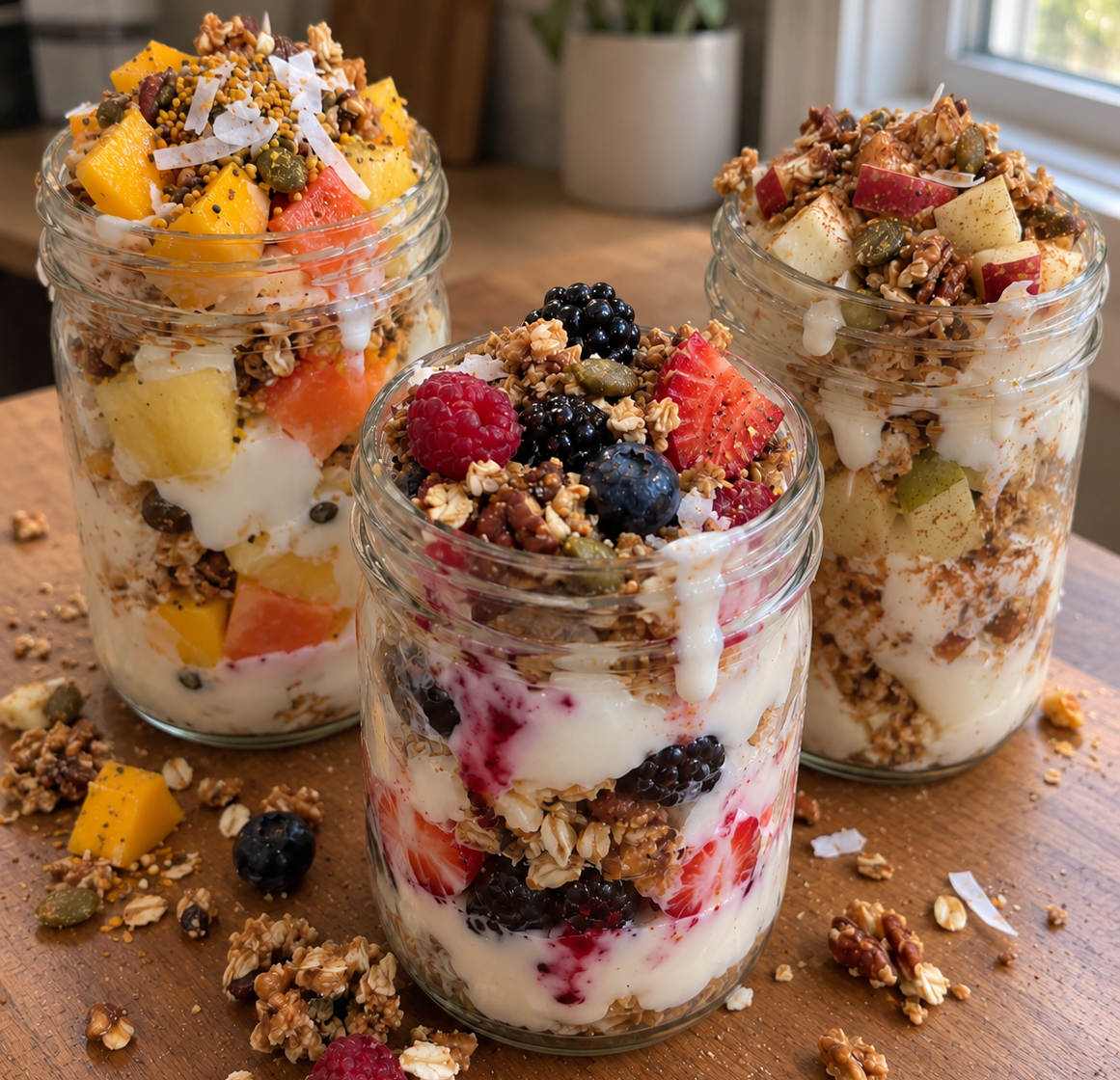
Glass jars of creamy yogurt, a seasonal fruit compote, fresh fruit, and crunchy grain-free granola, with four versions to carry you through the year: mixed berries with raspberry coulis in spring and summer, tropical mango, pineapple, and papaya in summer, spiced apple and pear in fall, and citrus, pomegranate, and cranberry in winter.
Yield: Serves 12 (each version) · Active: 30–40 min · Total: 45 min–1 hour (with the granola made ahead) · Year-round, with a version for each season · Best eaten: morning
This is my go-to breakfast when I’m feeding a crowd. A row of glass jars, each streaked with a bright fruit compote and layered with yogurt, fresh fruit, and granola, always looks beautiful on a retreat table, and nearly all of it can be made ahead. Build the jars yourself, or set everything out as a parfait bar and let everyone make their own.
Each version is paired with a grain-free granola from my Food Marshall Granola post, though any flavor works.
For an everyday parfait for one to four, see my Yogurt and Berry Parfaits. For a dairy-free or make-ahead option, see my Chia Parfaits guide.
The Base (for Every Season)
9 cups plain, full-fat yogurt (cow’s, goat’s, or sheep’s milk, or coconut yogurt for dairy-free)
4 cups grain-free granola (about ⅔ of one batch of my Food Marshall Granola)
12 glass jars (12–16 oz)
How to Build the Jars
In each jar, layer:
⅓ cup yogurt
1–2 tbsp fruit compote, drizzled down the inside of the glass so it shows
¼ cup fresh fruit
⅓ cup yogurt
⅓ cup granola
A final spoonful of compote, more fresh fruit, and the season’s toppings
Make ahead: Make the granola up to 3 weeks ahead and the compotes up to 5 days ahead. Layer the yogurt, compote, and fresh fruit up to 1 day ahead (except pineapple and papaya; see Summer), and add the granola and toppings just before serving, so the granola stays crunchy.
Spring into Summer: Mixed Berry Parfaits with Raspberry Coulis
Ruby raspberry coulis, piles of fresh berries, bee pollen, and mint. May through August, starting with spring’s first strawberries and moving into summer’s blueberries, raspberries, and blackberries.
Granola: Big Cluster Vanilla Maple Granola or Golden Orchard Granola
Raspberry coulis
3 cups fresh or frozen raspberries
3 tbsp honey or maple syrup
1 tbsp fresh lemon juice
Fresh fruit and toppings
5 cups mixed fresh berries (sliced strawberries in spring; add raspberries, blueberries, and blackberries in summer)
2 tbsp raw bee pollen
½ cup toasted coconut flakes
Fresh mint leaves
Make the coulis: Simmer the raspberries, honey, and lemon juice over low heat for 5–8 minutes, until the berries break down. Blend until smooth, then press through a fine-mesh sieve to remove the seeds. Let it cool.
Summer: Tropical Mango, Pineapple, and Papaya Parfaits
Sunny mango-lime purée, fresh tropical fruit, toasted shredded coconut, and bee pollen. June through September, at the height of mango season.
Granola: Sunshine Granola
Mango-lime purée
2 ripe mangoes, peeled and chopped (about 2½ cups)
Juice and zest of 1 lime
1 tbsp honey (optional, if the mangoes aren’t very sweet)
Fresh fruit and toppings
2 cups fresh mango, diced
2 cups fresh pineapple, diced
2 cups fresh papaya, diced
1 cup unsweetened shredded coconut, toasted
2 tbsp raw bee pollen
Lime zest and fresh mint
Optional: passion fruit pulp or sliced kiwi
Make the purée: Blend the mango, lime juice, zest, and honey (if using) until smooth. No cooking needed.
A tip for this one: Fresh pineapple and papaya contain natural enzymes (bromelain and papain) that break down dairy, so yogurt can turn bitter and runny if they sit together. Add them just before serving. The mango purée and mango are fine to layer ahead.
Fall: Spiced Apple and Pear Parfaits
Buttery cinnamon apple-pear compote, crisp pear slices, toasted pecans, and pomegranate. September through November, at the peak of the orchard harvest.
Granola: Golden Chai Pecan Granola or Maple Pecan Pumpkin Spice Granola
Spiced apple-pear compote
3 apples, peeled and diced (Honeycrisp, Pink Lady, or Gala)
3 ripe pears, peeled and diced (Bartlett or Anjou)
2 tbsp grass-fed butter
2 tbsp maple syrup
¼ cup water
1 tsp Ceylon cinnamon
¼ tsp ground ginger
Pinch each of nutmeg and Baja Gold sea salt
Fresh fruit and toppings
2 crisp pears or apples, thinly sliced and tossed with a squeeze of lemon
1 cup pomegranate arils
½ cup pecans, toasted and chopped
A dusting of cinnamon
Make the compote: Melt the butter in a saucepan over medium heat. Add the apples, pears, maple syrup, water, spices, and salt, and simmer 10–12 minutes, stirring now and then, until tender and syrupy. Lightly mash some of the fruit for a jammier texture, and let it cool.
Winter: Citrus, Pomegranate, and Cranberry Parfaits
Tart cranberry-orange compote, jewel-toned citrus segments, pomegranate, and pistachios. December through March, when citrus is at its peak in California, Florida, and Texas.
Granola: Pistachio Rose Granola (made grain-free) or Sunshine Granola
Cranberry-orange compote
12 oz fresh or frozen cranberries
½ cup fresh orange juice
Zest of 1 orange
⅓ cup maple syrup or honey
1 cinnamon stick
Pinch of Baja Gold sea salt
Fresh fruit and toppings
4–5 cups citrus segments (a mix of blood oranges, Cara Cara oranges, and mandarins), peeled and pith removed
1½ cups pomegranate arils
½ cup pistachios, chopped
Orange zest and fresh mint
Optional: a pinch of cardamom, or dried edible rose petals
Make the compote: Simmer the cranberries, orange juice, zest, maple syrup, cinnamon stick, and salt over medium heat for 10–12 minutes, stirring now and then, until most of the berries burst and it thickens. Remove the cinnamon stick, and let it cool; it thickens more as it cools.
A tip for citrus segments: For the prettiest parfaits, cut away the peel and white pith with a sharp knife, then slice the segments out from between the membranes (called “supreming”). Or simply slice the peeled fruit into rounds.
Set Up a Parfait Bar
For a retreat or brunch, let everyone build their own. Set out:
Bowls of yogurt (and a jar of chia pudding, for anyone dairy-free)
The season’s compote in a small pitcher
The season’s fresh fruit
Two or three grain-free granolas
Toppings: bee pollen, toasted coconut, cacao nibs, chopped nuts, hemp hearts, and fresh mint
Raw honey and maple syrup
Storage
Compotes: refrigerated up to 5 days (the mango purée up to 3 days), or frozen up to 3 months. They’re also lovely over pancakes, ice cream, or cheesecake.
Assembled jars (without granola): refrigerated, up to 1 day (add pineapple and papaya just before serving).
Granola: airtight at room temperature, up to 3 weeks.
A note on honey and bee pollen: Honey is no longer raw once it’s simmered into a compote. Honey shouldn’t be given to babies under 12 months. Bee pollen can cause reactions in people sensitive to pollen or bee stings, so let guests add their own.
Nourishment Notes
Yogurt — protein, calcium, and live cultures that support a healthy gut, plus vitamins A and K2 when it’s made from grass-fed milk.
Grain-free granola — vitamin E, magnesium, and zinc from the nuts and seeds.
Spring and summer berries — raspberries are one of the richest sources of ellagic acid, and mixed berries bring vitamin C, fiber, and a wide range of antioxidants.
Summer tropical fruit — mango brings beta-carotene and vitamin C; pineapple brings bromelain and papaya brings papain, enzymes traditionally used to support digestion; and coconut brings lauric acid and fiber.
Fall apples and pears — pectin, a soluble fiber that feeds healthy gut bacteria, plus quercetin. Pomegranate brings punicalagins, and the warming spices are traditionally used to support digestion.
Winter citrus, pomegranate, and cranberries — vitamin C right when we need it most in the cold months, plus flavonoids like hesperidin from the oranges and anthocyanins from the blood oranges. Cranberries bring proanthocyanidins, known for supporting urinary tract health, and pomegranate brings punicalagins.
Pistachios — vitamin B6, copper, and lutein.
Bee pollen — B vitamins, protein, and flavonoids.
As a circadian food, parfaits belong to the morning, ideally eaten in natural daylight. The yogurt’s protein and the granola’s fats balance the fruit’s natural sugars, for steady energy until lunch. Eating with the seasons keeps it fresh all year: juicy berries and tropical fruit in the warm months, warm and spiced in fall, and bright citrus in winter.
For your cycle:
Berry and tropical parfaits: light and fiber-rich, lovely in the follicular and ovulatory phases.
Fall apple-pear parfait: warm, spiced, and grounding, especially comforting in the luteal phase.
Winter citrus parfait: vitamin C helps your body absorb iron, making it a bright choice during and after your period.
Sourcing
Yogurt — organic, plain, and full-fat, with live cultures (see “Choosing Your Yogurt” in my Yogurt and Berry Parfaits post)
Granola — homemade Food Marshall Granola, made grain-free
Fruit — organic and seasonal, from a farmers’ market (strawberries and apples are among the most heavily sprayed crops, so organic matters most for these); organic frozen raspberries and cranberries work well for the compotes
Tropical fruit — organic mango, pineapple, and papaya (much conventional papaya is genetically modified, so choose organic)
Citrus — organic blood oranges, Cara Caras, and mandarins (you’re using the zest, too)
Pistachios and pecans — organic
Coconut — organic, unsweetened, and sulfite-free
Bee pollen — raw and local, from a beekeeper you trust
Grass-fed butter — organic, from 100% grass-fed cows
Honey and maple syrup — organic, local, unfiltered honey; organic Grade A dark maple syrup
Spices — organic and non-irradiated Ceylon cinnamon, ginger, nutmeg, and cardamom
Lemons, limes, and mint — organic
Rose petals (optional) — organic and food-grade
Salt — Baja Gold sea salt
— Anna aka Food Marshall