Persian jeweled rice
Yield: Serves 8–10 · Active: 25 min · Total: 50 min, plus 30 minutes soaking the rice (about 1½ hours with the traditional steamed method) · Year-round, and most beautiful from October through January, when pomegranates are at their peak in California and the Middle East · Cuisine: Persian · Best eaten: late afternoon or early evening
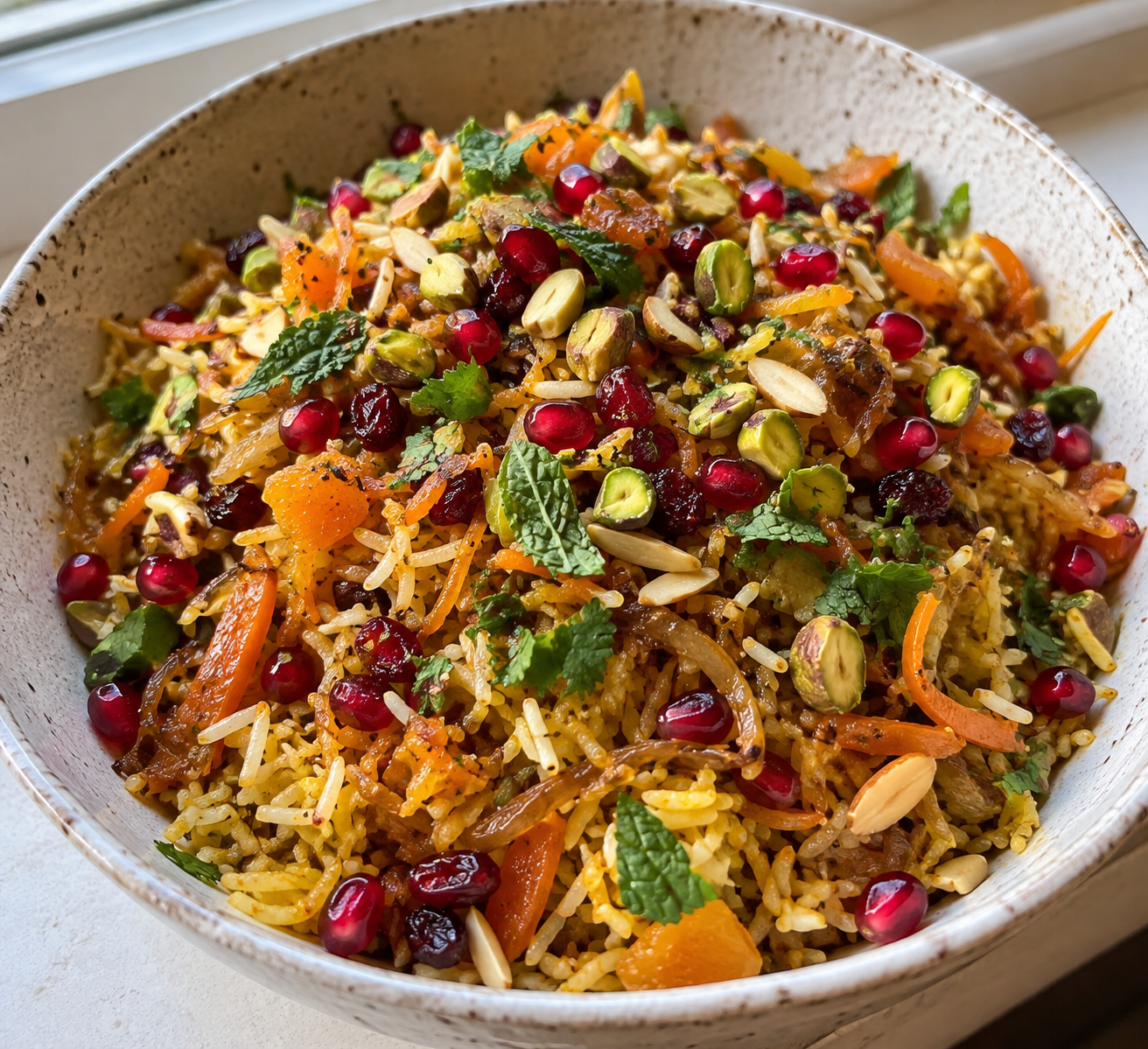
Persian jeweled rice, morasa polo, is a celebration dish in Iran, traditionally served at weddings and any gathering that calls for something special. The name is literal: morasa means “jeweled,” and the dried fruit, orange peel, nuts, and pomegranate seeds really do glitter against the golden rice.
Below is my everyday method, plus the traditional steamed method if you want the famous crispy rice crust.
See it served: my Spiced Chicken Roulade with Watercress and Feta over Persian Jeweled Rice.
Ingredients
Rice
2 cups aged basmati rice
3 cups filtered water or homemade bone broth
½ tsp Baja Gold sea salt
Onions and spices
3 tbsp grass-fed butter or ghee, divided
1 medium red onion, thinly sliced
1 tsp ground turmeric, or a generous pinch of saffron threads bloomed in 2 tbsp hot water
1 tsp ground cumin
1 tsp ground coriander
½ tsp ground Ceylon cinnamon
¼ tsp ground cardamom
½ tsp black pepper
The jewels
Strips of zest from 1 orange (no white pith), cut into thin slivers
1 carrot, cut into thin matchsticks
½ cup unsulfured dried apricots, finely chopped
¼ cup dried barberries or unsweetened dried cranberries
½ cup pistachios, roughly chopped and toasted
¼ cup slivered almonds, toasted
½ cup pomegranate arils
To finish
¼ cup each fresh cilantro, mint, and parsley, chopped
Zest and juice of 1 lemon
Optional: crispy fried shallots
Swaps:
Fat: extra virgin olive oil instead of butter, for a dairy-free version
More jewels: add ½ cup golden raisins, or extra pistachios and almonds
Heartier: fold in 1 cup cooked chickpeas with the jewels
Grain-free: Use 6 cups riced cauliflower instead of rice. Sauté it in butter for 5–7 minutes, until just tender, then fold in the onions, spices, and jewels.
Method
Rinse and soak the rice. Rinse the rice in several changes of water until it runs clear, then cover it with cool water and soak 30 minutes. Drain well. (This keeps the grains long, fluffy, and separate.)
Cook the rice. Bring the water or broth, salt, and 1 tbsp butter to a boil. Stir in the rice, cover, lower the heat to the lowest setting, and simmer 15 minutes. Turn off the heat, and let it rest, covered, 10 minutes.
Caramelize the onion. Meanwhile, melt 1 tbsp butter in a large skillet over medium-low heat. Add the onion and a pinch of salt, and cook 15–20 minutes, stirring now and then, until deep brown and crispy at the edges. Don’t rush it; this is where the flavor comes from.
Bloom the spices. Stir the turmeric (or saffron water), cumin, coriander, cinnamon, cardamom, and pepper into the onions for the last minute, until fragrant. Spoon half the onions into a bowl, for the topping.
Cook the jewels. Add the remaining 1 tbsp butter to the skillet with the rest of the onions. Add the orange peel and carrot, and cook 3–4 minutes, until the carrot softens. Stir in the apricots and barberries, and cook 1 minute more. (Barberries burn quickly, so keep it brief.)
Combine. Fluff the rice with a fork, and gently fold in the jewel mixture, lemon zest and juice, pistachios, almonds, and most of the herbs.
Serve. Pile the rice onto a wide platter, and top with the reserved onions, pomegranate, remaining herbs, and crispy shallots (if using). Serve warm or at room temperature.
The Traditional Steamed Method (with Tahdig)
For the classic Persian texture, with fluffy, separate grains and a golden, crispy crust called tahdig on the bottom:
Parboil. Bring a large pot of generously salted water to a boil. Add the soaked, drained rice, and boil 6–7 minutes, until tender outside but still firm in the center. Drain.
Build the crust. Melt 3 tbsp butter or ghee in a heavy, nonstick pot. Spread a thin layer of rice over the bottom, and pile the rest on top in a mound. Poke 4–5 holes down to the bottom with the handle of a wooden spoon, and drizzle the saffron water over the top.
Steam. Wrap the lid in a clean kitchen towel (so the steam doesn’t drip back in), cover tightly, and cook on medium heat for 5 minutes, then on low for 35–40 minutes.
Serve. Fold the jewels into the fluffy rice, and serve the crispy tahdig in pieces alongside. It’s everyone’s favorite part.
Serve It With
Roasted lamb, Moroccan-spiced chicken, slow-roasted beef, or my Roasted Cauliflower with Chermoula for a vegetarian centerpiece.
Storage
Refrigerator: up to 3 days. Reheat covered, with a splash of broth.
For a party: The rice holds 1–2 hours, covered, at room temperature. Add the pomegranate, herbs, and crispy shallots just before serving.
For a crowd: For 16 or more, double the recipe.
Pomegranate arils freeze well, so stock up in season.
Nourishment Notes
Rice — steady, satisfying carbohydrates. Rice is loved across nearly every traditional culture, from the Middle East to Asia to Latin America, where it’s eaten with fat, protein, vegetables, and fermented foods, almost never on its own. This dish follows that pattern, with butter, nuts, fruit, and herbs, served beside a protein. Aged basmati cooks up cleaner and fluffier than young rice, and soaking it first helps it cook evenly.
Turmeric — curcumin, one of the most studied anti-inflammatory plant compounds. It’s fat-soluble, so blooming it in butter helps your body absorb it, and black pepper’s piperine helps even more.
Saffron (if using) — crocin and safranal, compounds studied for supporting mood.
Pomegranate — punicalagins and ellagic acid, polyphenols that gut bacteria turn into urolithins, which are studied for supporting the mitochondria and the cell’s natural cleanup process (mitophagy).
Dried apricots — beta-carotene and potassium. Choose unsulfured ones, which are brown rather than bright orange.
Barberries — tart and bright, with anthocyanins and vitamin C.
Orange peel — flavonoids like hesperidin, concentrated in the zest.
Carrots — beta-carotene, better absorbed with the butter.
Pistachios — lutein, zeaxanthin, vitamin B6, and copper.
Almonds — vitamin E and magnesium.
Caramelized onion — quercetin, plus deep, savory flavor.
Fresh herbs — parsley, mint, and cilantro bring vitamin K and a bright, fresh finish.
Warming spices — cinnamon is studied for supporting healthy blood sugar, a nice partner for a rice dish, and cumin, coriander, and cardamom are traditionally used to support digestion.
As a circadian food, this is a lovely late-afternoon or early-evening side. Carbohydrates with protein at dinner can support restful sleep. It’s especially fitting from fall through winter, when pomegranates are in season and warming spices feel just right.
For your cycle: Satisfying and warming, this rice is especially nice in the luteal phase, when your body asks for a little more carbohydrate and the cinnamon helps keep blood sugar steady.
Sourcing
Basmati rice — organic, aged basmati from a Persian or Indian grocer, like Lal Qilla
Saffron (optional) — Persian or Spanish saffron threads, from a trusted spice shop
Grass-fed butter or ghee — organic, from 100% grass-fed cows
Bone broth — homemade, or Kettle & Fire
Red onion, carrots, oranges, lemons, and herbs — organic, from a farmers’ market
Pomegranates — organic and California-grown, from a farmers’ market
Dried apricots, barberries, and raisins — organic, unsulfured, and unsweetened (barberries are sold at Persian grocers)
Pistachios and almonds — organic
Spices — organic and non-irradiated turmeric, cumin, coriander, Ceylon cinnamon, cardamom, and black pepper
Salt — Baja Gold sea salt
— Anna aka Food Marshall