Thanksgiving Centerpiece: Pasture-Raised Turkey with Mushroom Gravy and Spiced Cranberry Sauce
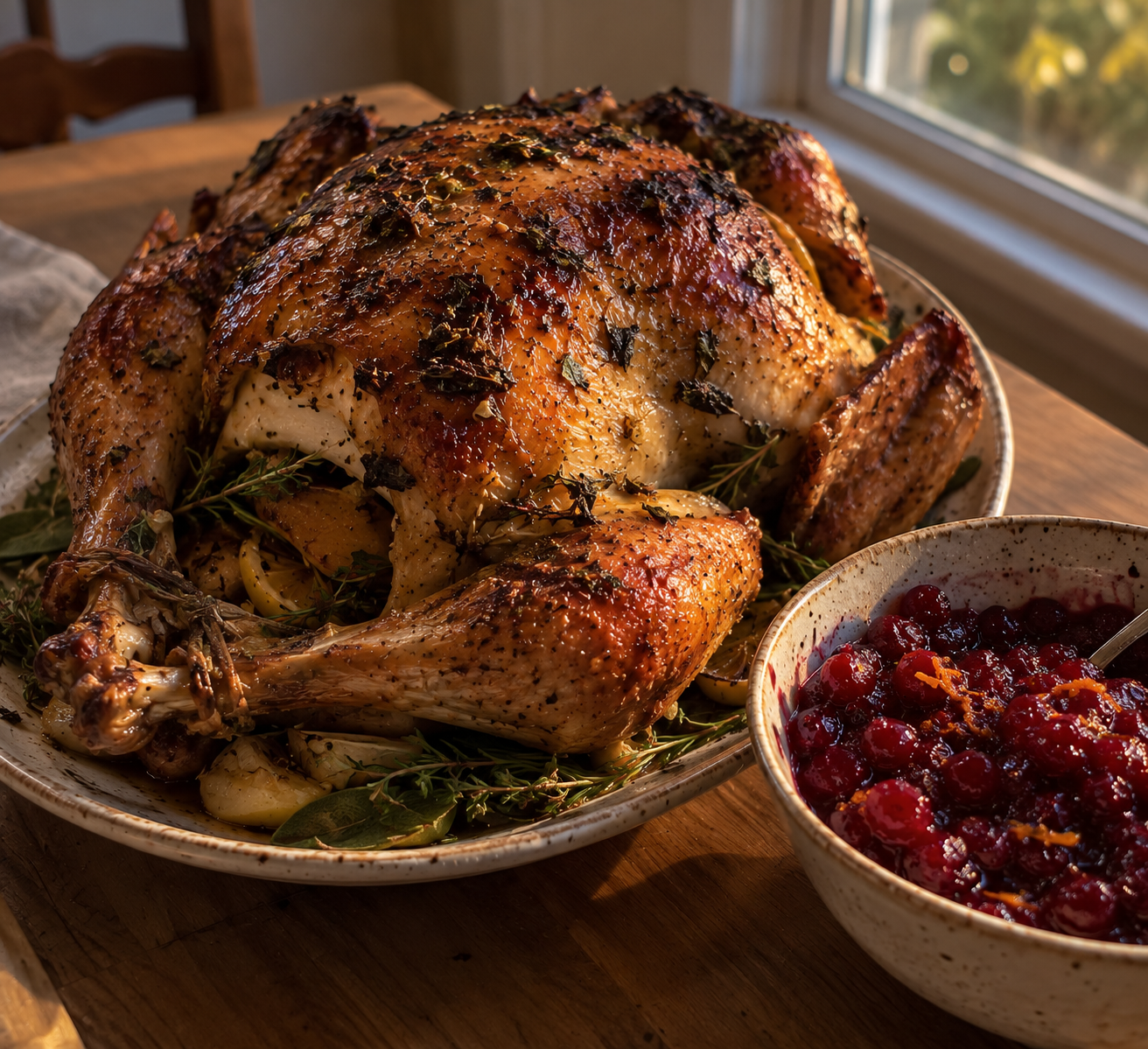
The complete grain-free Thanksgiving centerpiece: a dry-brined, herb-butter-roasted pasture-raised turkey with crispy golden skin, a rich mushroom gravy made from the pan drippings, and a warmly spiced cranberry sauce.
Yield: Turkey serves 10–12 (11–12-lb bird) or 18–20 (20-lb bird) · Gravy: about 3 cups · Cranberry sauce: about 2½ cups · Active: 1½ hours, spread over 2 days · Total: about 5–7 hours on the day, plus 24 hours dry-brining · November through December, when fresh cranberries arrive from the bogs of Massachusetts, Wisconsin, and Oregon · Cuisine: American · Best eaten: as the centerpiece of a midday or early-evening holiday meal
It starts with a pasture-raised turkey, ideally a heritage breed like Bourbon Red, Narragansett, or Standard Bronze, the slow-growing birds that taste the way turkey used to, rather than the fast-growing Broad Breasted Whites that fill supermarket freezers. A 24-hour herb-salt dry brine seasons the meat deeply and dries the skin so it roasts up crisp. A compound butter of sage, rosemary, and thyme goes under and over the skin. Then the bird roasts low and slow at 300°F, so the breast stays juicy, before a final blast of heat turns the skin deep golden.
On the side: a brown mushroom gravy made from the bird’s own drippings and thickened with cassava flour, and a cranberry sauce warmed with orange, cinnamon, nutmeg, allspice, and ginger, far more interesting than anything from a can.
A note on ordering your turkey: For Thanksgiving, the bird is the meal. Small farms that raise pasture-raised and heritage turkeys start taking orders in early October, so order by late October or early November to be sure you get one. A frozen pasture-raised turkey is excellent, and the most practical choice for most people.
Cooking for a smaller table? See the herb-roasted turkey breast in my Fall Harvest Centerpiece Salad.
Your Thanksgiving Game Plan
4–5 days ahead: Move a frozen turkey to the fridge to thaw (about 1 day per 4–5 lbs).
Up to 1 week ahead: Make the cranberry sauce.
1–2 days ahead: Dry-brine the turkey. Make the turkey stock (or use bone broth), reduce it with the wine and shallots, and cook the mushrooms.
The day of: Butter and roast the turkey. Make the gravy while it rests.
Component 1: Herb-Butter Roasted Turkey
Ingredients
1 pasture-raised turkey (11–12 lbs or about 20 lbs), fully thawed, neck and giblets removed (save them for stock)
Herb salt dry brine (apply 24 hours ahead)
2 tbsp Baja Gold sea salt for a 12-lb bird (3 tbsp for 20 lbs)
3 sprigs each fresh sage, rosemary, and savory or thyme, finely chopped
1 small bunch chives, finely chopped
2 tbsp mustard powder
1 tbsp black pepper
Zest of 1 lemon
Compound butter (apply the day of)
½ lb (2 sticks) grass-fed butter for a 12-lb bird, or 1 lb (4 sticks) for 20 lbs, softened
1 garlic clove, minced (2 for a 20-lb bird)
3 sprigs each fresh thyme, rosemary, and sage, chopped
2 tsp lemon zest
Cavity aromatics
2 heads garlic, halved crosswise
A bouquet of fresh rosemary, sage, and savory or thyme
3 bay leaves
1 lemon, halved
1 onion, halved (optional)
For the roasting pan
1 onion, 1 carrot, and 2 celery stalks, roughly chopped
2 cups bone broth or water
Method
Thaw. Thaw a frozen turkey in the fridge, allowing about 1 day per 4–5 lbs (4–5 days for a 20-lb bird).
Dry-brine (24 hours ahead, or up to 48). Mix the dry brine ingredients. Pat the turkey very dry, and rub the herb salt all over the outside and inside the cavity. Set it on a rack over a sheet pan, and refrigerate it, uncovered, for 24 hours. The salt seasons the meat deeply, and the open air dries the skin, so it roasts up crisp.
Bring to room temperature. Take the turkey out of the fridge 1 hour before roasting. Heat the oven to 300°F.
Butter it. Mix the compound butter ingredients. Gently loosen the skin over the breast with your fingers, without tearing it, and spread about half the butter underneath, right on the meat. Spread most of the rest over the skin, saving a few tablespoons for the end.
Stuff and truss. Tuck the garlic, herbs, bay leaves, lemon, and onion (if using) into the cavity, and tie the legs together with kitchen twine.
Roast low and slow. Scatter the chopped onion, carrot, and celery in a roasting pan, add the broth, and set the turkey on a rack over them. Roast at 300°F for about 13–15 minutes per pound: about 2½–3 hours for a 12-lb bird, or 4½–5 hours for a 20-lb bird. Baste with the pan juices every 45–60 minutes, and add a splash more broth if the pan gets dry. A thermometer is the best guide, since every bird cooks differently.
Crisp the skin. When the thickest part of the breast reaches 150°F, brush the turkey with the remaining butter, and raise the oven to 450°F. Roast 15–20 minutes more, until the skin is deep golden and crisp, the breast reads 160°F, and the thickest part of the thigh reads 175°F. (The breast will rise to 165°F as it rests. If the thighs need more time, tent the breast loosely with foil.)
Rest the turkey on a board, loosely tented with foil, for 30–60 minutes, so the juices settle back into the meat. This is when you make the gravy.
Carve and serve with the mushroom gravy and cranberry sauce.
Component 2: Brown Mushroom Pan Gravy
Makes about 3 cups
Ingredients
4 cups turkey stock (from the neck and giblets) or bone broth
½ cup dry red wine (or 1 tbsp balsamic vinegar plus ½ cup more stock, for alcohol-free)
3 shallots, minced
2 tbsp grass-fed butter
3 cups mixed mushrooms (cremini, shiitake, and button), thinly sliced
3 garlic cloves, minced
2 tsp fresh rosemary, minced
Pan drippings from the turkey
4 tbsp turkey fat (skimmed from the drippings) or butter
¼ cup cassava flour
Baja Gold sea salt and black pepper
Method
Reduce the stock (up to 1 day ahead). Simmer the stock, wine, and shallots over medium heat for 30–45 minutes, until reduced by about half. Strain, and discard the shallots. If you use wine, the long simmer cooks off most, but not all, of the alcohol.
Brown the mushrooms (up to 1 day ahead). Melt the butter in a skillet over medium heat. Add the mushrooms, and cook 8–10 minutes, without crowding the pan, until deeply browned. Add the garlic and rosemary, and cook 1 minute more.
Collect the drippings. While the turkey rests, pour the pan juices into a glass measuring cup, and let the fat rise to the top. Skim off 4 tbsp of fat for the roux. Set the roasting pan over medium heat, add a splash of the reduced stock, and scrape up all the browned bits. Pour it in with the rest of the stock, along with the skimmed juices (discard the cooked vegetables).
Make the roux. Heat the 4 tbsp turkey fat in a saucepan over medium heat. Whisk in the cassava flour, and cook 3–4 minutes, whisking constantly, until golden brown.
Thicken. Slowly whisk in the stock and drippings, and simmer about 5 minutes, whisking, until smooth and thickened. If it’s too thick, add more stock; if too thin, simmer a few minutes more.
Finish. Stir in the mushrooms, and season with salt and pepper (taste first, since the drippings are already salty from the brine).
About the thickener: Cassava flour gives the gravy the smooth body of a classic flour gravy. Arrowroot works too (whisk 2 tbsp into ¼ cup cold stock, and stir it in at the end), though it gives a slightly glossier texture.
Component 3: Spiced Cranberry Sauce
Makes about 2½ cups (triple it for a big gathering)
Ingredients
12 oz fresh or frozen cranberries
¾ cup coconut sugar (or ½ cup maple syrup)
½ cup fresh orange juice
Zest of 1 orange, peeled in long strips
1 tsp ground Ceylon cinnamon
½ tsp freshly grated nutmeg
½ tsp ground allspice
½ tsp ground ginger
Optional: 2 tbsp red wine
Method
Simmer. Combine the cranberries, coconut sugar, orange juice, and orange peel in a saucepan, and bring to a boil over medium heat, stirring. The cranberries will start to pop after about 5 minutes.
Thicken. Lower the heat, and simmer 5–10 minutes more, stirring and scraping the bottom, until most of the berries have burst and the sauce thickens.
Spice. Take it off the heat, and stir in the cinnamon, nutmeg, allspice, ginger, and red wine (if using). Since it’s stirred in off the heat, the wine stays uncooked; leave it out if you’re serving children or anyone avoiding alcohol.
Cool. Remove the orange peel strips, and let the sauce cool completely. It thickens a lot as it cools.
The Complete Plate
Herb-butter roasted turkey, mushroom gravy, and spiced cranberry sauce
Cauliflower purée (from my Velvet Vegetable Purées) or mashed potatoes
For dessert: my Half-Baked Deep-Dish Pumpkin Pie or Grain-Free Heritage Apple Pie
Storage
Leftover turkey: refrigerated up to 4 days, or frozen up to 3 months. Save the carcass for bone broth.
Gravy: refrigerated up to 5 days, or frozen up to 3 months.
Cranberry sauce: refrigerated up to 2 weeks. It’s even better on the second and third day, as the spices settle in.
Leftover ideas: turkey and cranberry lettuce wraps, turkey soup with the bone broth, or a turkey hash with roasted vegetables and a fried egg.
Nourishment Notes
Pasture-raised turkey — complete protein (about 40 grams in a 5-oz serving), plus B3, B6, B12, selenium, zinc, and tryptophan. Turkeys that forage outdoors on grasses, insects, and seeds are a different bird from industrial turkey, with richer flavor and more nutrients in the skin and fat. Heritage breeds grow slowly, taking about 6–7 months to mature, compared with about 4 months for commercial Broad Breasted Whites, which gives them deeper flavor and better fat throughout the meat.
The dry brine — salting the bird a day ahead seasons the meat all the way through and helps it hold onto its juices as it roasts. The slow roast keeps the breast moist, and the final blast of heat crisps the skin.
Grass-fed butter — butyrate and vitamins A, D, E, and K2. Spread under the skin, it bastes the breast from the inside as the bird roasts.
Sage, rosemary, and thyme — rosmarinic acid, carnosic acid, and thymol, aromatic compounds studied for their antioxidant effects and traditionally used to ease the digestion of rich meals.
Pan drippings — gelatin from the connective tissue, plus minerals and rich flavor. Using them for gravy means nothing from the bird goes to waste.
Mushrooms — B vitamins, selenium, beta-glucans studied for supporting the immune system, and ergothioneine, an antioxidant found mostly in mushrooms.
Cassava flour — a grain-free root flour that thickens the gravy smoothly, like wheat flour.
Cranberries — proanthocyanidins, known for helping keep bacteria from sticking to the urinary tract, plus vitamin C, manganese, and fiber.
Coconut sugar — unrefined, with some potassium, zinc, and iron.
Warming spices — cinnamon is studied for supporting healthy blood sugar, ginger supports digestion, and allspice and nutmeg are traditional in European and Caribbean holiday cooking.
As a seasonal food, this is the feast for the harvest’s end: Thanksgiving, Christmas, or any gathering from fall into winter. As a circadian food, it’s best as a midday or early-evening meal, eaten slowly with the people you love, with plenty of time to digest before bed.
For your cycle: With protein, B6, and tryptophan from the turkey, minerals and gelatin from the gravy, and vitamin C from the cranberries, this meal is especially grounding in the luteal phase and during your period.
Sourcing
Turkey — pasture-raised, ideally a heritage breed, from a local farm, White Oak Pastures, Heritage Foods, or Mary’s Free Range Turkey (order early)
Grass-fed butter — organic, from 100% grass-fed cows
Bone broth (if not making turkey stock) — homemade, or Kettle & Fire
Fresh herbs, garlic, lemons, onions, carrots, celery, shallots, and oranges — organic, from a farmers’ market
Mushrooms — organic, from a farmers’ market or a local mushroom grower
Cassava flour — organic, like Otto’s Naturals (not tapioca starch)
Cranberries — organic, fresh from late October through December (freeze extra bags for the rest of the year)
Coconut sugar — organic and unrefined
Red wine (optional) — organic and low-sulfite, from a small producer
Spices — organic and non-irradiated mustard powder, Ceylon cinnamon, whole nutmeg, allspice, and ginger
Salt — Baja Gold sea salt
— Anna aka Food Marshall