Roasted Brussels Sprouts Two Ways
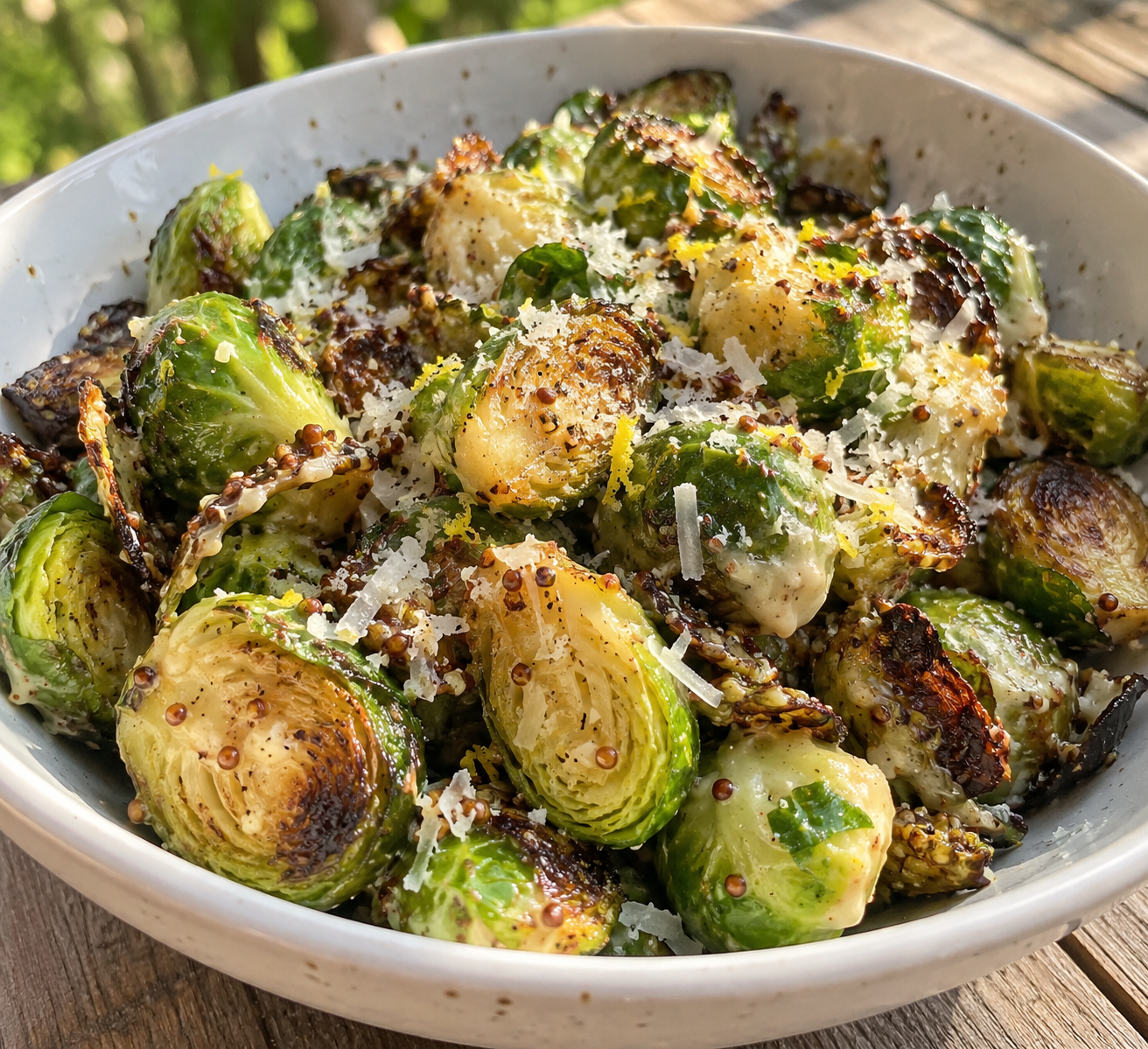
Deeply caramelized Brussels sprouts, crispy at the edges and tender inside, finished two ways: with crispy bacon, sweet shallots, and a tangy cider vinaigrette, or with a bright Dijon-lemon glaze and shaved Parmigiano.
Yield: Serves 4–6 (each variation) · Active: 15 min · Total: 40 min · Best in North America in fall and winter, when Brussels sprouts are sweetest after a frost · Best eaten: midday or early evening
For more on roasting brassicas, see my Roasted Brassicas: A Foundation Guide.
The Master Method
Heat the oven to 425°F.
Halve the sprouts through the stem, and pull off any loose or yellowed outer leaves (save the loose leaves; they roast into crispy "chips").
Toss with olive oil, salt, and pepper.
Roast cut-side down in a single layer, with space between them, for 25–30 minutes, without stirring, until the cut sides are deeply caramelized and the edges are crisp.
1. Brussels Sprouts with Bacon, Crispy Shallots, and Cider Vinaigrette
Smoky, sweet, tangy, and deeply satisfying.
Sprouts
2 lb Brussels sprouts, halved
3 tbsp extra virgin olive oil
2 tbsp Dijon mustard
Baja Gold sea salt and freshly ground black pepper
6 oz pasture-raised bacon, diced
2 shallots, thinly sliced
1 tbsp pasture-raised lard, melted, for finishing
Cider vinaigrette
⅓ cup extra virgin olive oil
3 tbsp raw apple cider vinegar
1 tbsp Dijon mustard
1 tbsp raw honey
1 small garlic clove, minced
Baja Gold sea salt and black pepper
Roast the sprouts. Toss them with the olive oil, Dijon, salt, and pepper, and roast cut-side down at 425°F for 25–30 minutes, until deeply caramelized.
Crisp the bacon. While they roast, cook the bacon in a skillet over medium heat until crisp, then lift it out with a slotted spoon, leaving the fat in the pan.
Crisp the shallots. Cook the shallots in the bacon fat over low heat for 8–10 minutes, until soft, sweet, and crisp at the edges.
Make the vinaigrette. Whisk all the vinaigrette ingredients until emulsified.
Serve. Pile the sprouts on a platter, top them with the bacon and crispy shallots, and drizzle with the melted lard. Serve the cider vinaigrette alongside.
2. Brussels Sprouts with Dijon, Lemon, and Parmigiano
The lighter, Italian-style version: caramelized sprouts and shallots, tossed in a warm Dijon-lemon glaze, with shaved Parmigiano.
2 lb Brussels sprouts, halved
2 shallots, thinly sliced
4 tbsp extra virgin olive oil
Baja Gold sea salt and freshly ground black pepper
2 tbsp Dijon mustard
1 tbsp fresh lemon juice
⅓ cup shaved Parmigiano-Reggiano (or aged Manchego)
Roast. Toss the sprouts and shallots with the olive oil, salt, and pepper, and roast cut-side down at 425°F for 25–30 minutes, until deeply caramelized.
Glaze. Toss the hot sprouts with the Dijon and lemon juice; their heat helps the mustard coat them evenly.
Serve on a platter, topped with shaved Parmigiano.
A tip for more sulforaphane: Roasting destroys most of the sprouts' own myrosinase, the enzyme that creates sulforaphane. But mustard seed contains it too, so tossing the roasted sprouts with Dijon helps, and a pinch of ground mustard seed helps even more.
Storage
Roasted sprouts keep refrigerated up to 3 days; reheat them in a 425°F oven for 5 minutes, so they crisp up again. The cider vinaigrette keeps up to 1 week. Add the bacon, shallots, and cheese just before serving.
A note on honey: The raw honey in the vinaigrette stays raw, since it's never heated. Honey shouldn't be given to babies under 12 months.
Nourishment Notes
Brussels sprouts are a cruciferous powerhouse, rich in vitamin C, vitamin K, folate, and fiber. Their glucosinolates convert to sulforaphane and indole-3-carbinol, compounds that support the liver's detoxification pathways and help the body process and clear estrogen. Their slightly bitter edge also balances rich proteins beautifully.
Pasture-raised bacon and lard — B vitamins, selenium, and vitamin D (when the pigs are raised outdoors in the sun).
Raw apple cider vinegar — acetic acid, which can help soften the rise in blood sugar after a meal.
Shallots and garlic — quercetin, allicin, and prebiotic fibers.
Dijon mustard — its own glucosinolates, plus the myrosinase that helps activate the sprouts'.
Parmigiano-Reggiano — protein, calcium, and vitamin K2, and it's essentially lactose-free. It's made from raw milk from cows fed mainly grass and hay, and aged at least 12 months.
Lemon — vitamin C and a bright acidity that lifts the sprouts' earthiness.
As a circadian food, these are best at midday or in the early evening, alongside roast chicken, pork, steak, or lamb.
For your cycle: The sprouts' glucosinolates support estrogen metabolism, which makes them especially supportive in the luteal phase.
More Sides
Sourcing
Brussels sprouts, shallots, garlic, and lemons — organic, from a farmers' market in fall and winter (sprouts sold on the stalk stay fresh longest)
Bacon and lard — pasture-raised, with no added sugar, from a local farm or US Wellness Meats
Dijon mustard — organic, with no preservatives or sugar
Ground mustard seed (optional) — organic and non-irradiated
Raw apple cider vinegar — organic, with the mother (Bragg)
Raw honey — organic, local, and unfiltered
Parmigiano-Reggiano or Manchego — Parmigiano-Reggiano DOP, aged 24+ months; or Manchego DOP
Extra virgin olive oil — organic, single-estate, harvest-dated, in dark glass
Salt — Baja Gold sea salt
— Anna aka Food Marshall