Roasted Potatoes Four Ways
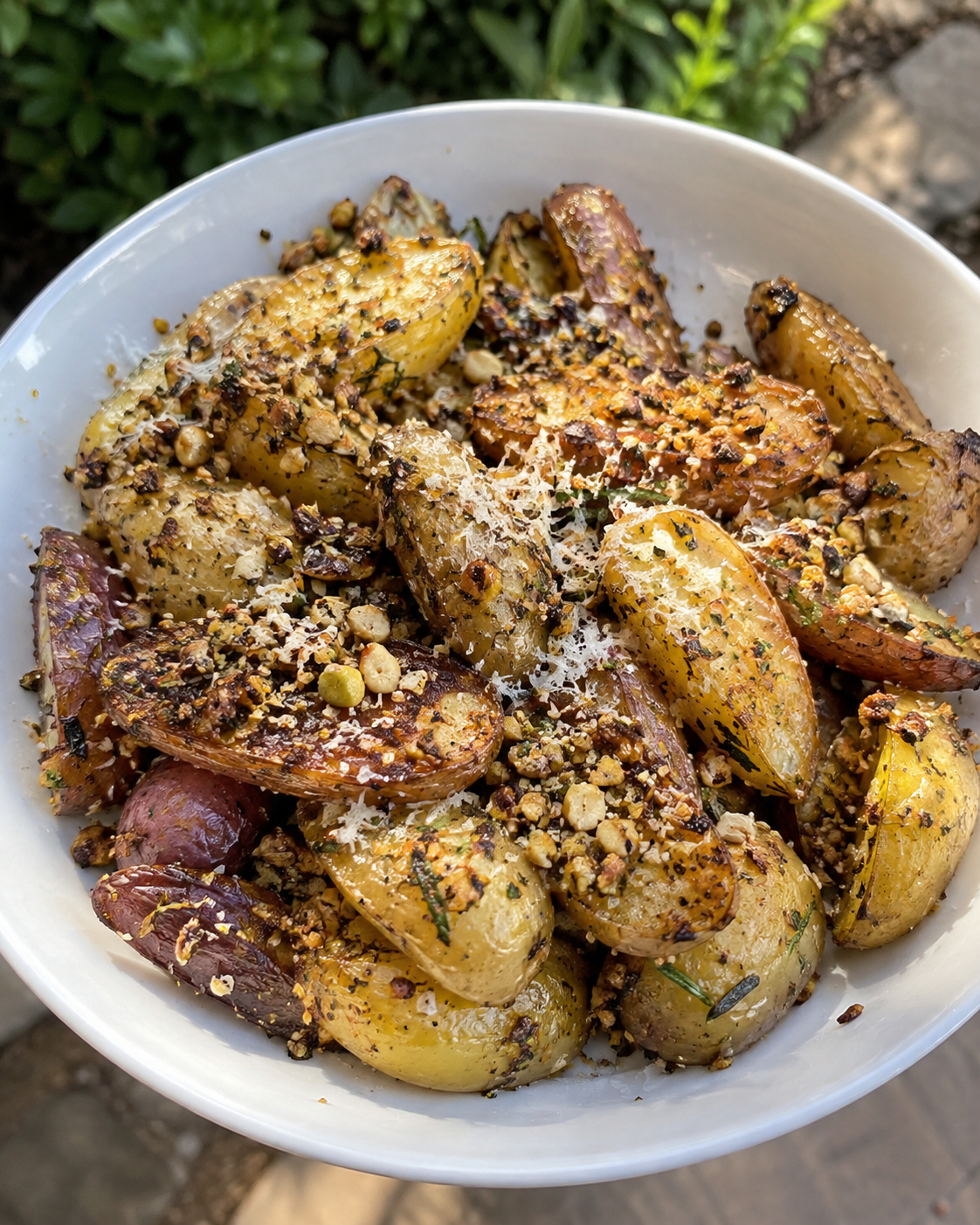
One simple roasting method, four ways to finish it: herb-roasted fingerlings, fingerlings showered with dukkah, crispy Parmigiano-crusted baby potatoes, and purple sweet potatoes with rosemary and brown butter. The dependable sides for every roast, every season.
Yield: Serves 4–8 (each variation) · Active: 10–15 min · Total: 40–45 min · Year-round · Best eaten: midday or early evening
The Master Method
Heat the oven to 425°F.
Cut evenly. Halve small potatoes lengthwise, or cut larger ones into 1-inch pieces, so they cook evenly.
Toss with olive oil, salt, pepper, and any herbs.
Roast cut-side down, in a single layer on a sheet pan, with space between the pieces. Crowded potatoes steam instead of crisping, so use two pans if needed.
Leave them alone for most of the roasting time, so the cut sides turn deep golden and crisp, then finish as below.
For extra-crispy potatoes: Pat them completely dry after washing, and preheat the empty sheet pan in the oven for 5 minutes before adding them.
1. Herb-Roasted Fingerlings
The classic, with rosemary, sage, thyme, and garlic.
2 lb fingerling potatoes, halved lengthwise
4 tbsp extra virgin olive oil
4 garlic cloves, minced
2 tbsp fresh rosemary, minced
2 tbsp fresh sage, minced
2 tbsp fresh thyme leaves
Baja Gold sea salt and freshly cracked black pepper
Toss everything together, and roast cut-side down for 30–35 minutes, until golden, crisp, and tender inside. Serves 4–6.
2. Fingerlings with Dukkah
Crispy, colorful fingerlings, showered with a nutty, toasty Egyptian spice blend.
2 lb fingerling potatoes (gold, red, and purple, if you can find them), halved lengthwise
3 tbsp extra virgin olive oil
2 sprigs fresh rosemary or thyme
Baja Gold sea salt and cracked black pepper
⅓–½ cup dukkah
A handful of fresh flat-leaf parsley, chopped
Lemon wedges
Quick dukkah (if you don't have any on hand): Toast ½ cup hazelnuts or almonds in a dry skillet over medium heat for 5 minutes, until fragrant, adding 2 tbsp sesame seeds and 1 tsp each cumin and coriander seeds for the last minute. Let it cool, then pulse it with ½ tsp salt to a coarse, sandy texture. It keeps 1 week in a jar.
Toss the potatoes with the olive oil, herb sprigs, salt, and pepper, and roast cut-side down, undisturbed, for 30–35 minutes, until deep golden. Pile them on a platter, shower them with dukkah while they're still warm, and top with parsley. Serve with lemon wedges. Serves 6–8.
3. Parmigiano-Crusted Baby Potatoes
Crispy, golden, and cheesy. The cheese crisps on the pan are the best part.
2 lb baby potatoes (Yukon Gold, red, or a mix), halved
3 tbsp extra virgin olive oil
4 garlic cloves, smashed, skins on
2 sprigs fresh rosemary and 4 sprigs fresh thyme
Baja Gold sea salt and cracked black pepper
½ cup grated Parmigiano-Reggiano
A handful of fresh flat-leaf parsley, chopped
Toss the potatoes with the olive oil, garlic, herb sprigs, salt, and pepper, and roast cut-side down, undisturbed, for 30 minutes. Sprinkle the Parmigiano evenly over the potatoes, and roast 8–10 minutes more, until the cheese melts into a crisp, golden crust. Pile them on a platter, scraping up every cheese crisp, discard the herb sprigs and garlic skins, and top with parsley. Serves 6–8.
4. Purple Sweet Potatoes with Rosemary and Brown Butter
Jewel-toned sweet potatoes, caramelized at the edges and finished with nutty brown butter.
3 lb purple sweet potatoes (like Stokes Purple or Okinawan), peeled and cut into 1-inch cubes
3 tbsp extra virgin olive oil or melted ghee
2 tbsp fresh rosemary, minced
1 tbsp fresh thyme leaves
3 tbsp grass-fed butter
Flaky sea salt and freshly cracked black pepper
Toss the sweet potatoes with the olive oil, rosemary, thyme, salt, and pepper, and roast 30–40 minutes, turning once, until tender inside and caramelized at the edges. Meanwhile, melt the butter in a small pan over medium heat, swirling, for 3–4 minutes, until it foams, turns golden brown, and smells nutty. Pile the sweet potatoes in a dish, pour the brown butter over them, and finish with flaky salt. Serves 6–8.
Storage
Roasted potatoes keep refrigerated up to 3 days (the dukkah, separately, up to 1 week). Reheat them in a 425°F oven for 5–10 minutes, so they crisp up again. Cooling and reheating them also increases their resistant starch (see below).
Nourishment Notes
Potatoes bring potassium, vitamin C, vitamin B6, and fiber, with a good share of the fiber in the skin, so leave it on. Colored varieties add more: red and purple potatoes carry anthocyanins, the same pigments in berries. Cooking and cooling potatoes, even partially, turns some of their starch into resistant starch, which behaves more like fiber than sugar, feeding the beneficial bacteria in your gut that produce butyrate, which in turn nourishes the gut lining.
A note on nightshades: Potatoes belong to the nightshade family, along with tomatoes, peppers, and eggplant. Some people are sensitive to their natural compounds (solanine and chaconine), which concentrate in green patches and sprouts, so always trim away any green spots or sprouting eyes.
Purple sweet potatoes get their vivid color from anthocyanins, the same antioxidant pigments in blueberries and purple cabbage. They also bring potassium (about as much as a banana), vitamin C, B6, and fiber. Roasting them with fat helps your body absorb their fat-soluble nutrients.
Parmigiano-Reggiano is one of the few cheeses worth seeking out by name. By law, it's made from raw milk from cows fed mainly grass and hay (silage is banned), and aged at least 12 months, usually 24–36. The result is about one-third protein by weight, rich in calcium, vitamin K2, and natural glutamates (its deep, savory flavor), and essentially lactose-free, since the bacteria consume the lactose as it ages. That's why many people who are sensitive to dairy do well with it.
Dukkah brings vitamin E and magnesium from the nuts, calcium and sesame lignans from the sesame, and cumin and coriander, traditionally used to support digestion.
Rosemary, sage, and thyme bring rosmarinic acid, carnosic acid, and thymol. Rosemary is so rich in protective compounds that its extract is used as a natural preservative, and it holds up well in a hot oven. Roasted garlic mellows from sharp to sweet and jammy.
Extra virgin olive oil, grass-fed butter, and ghee — oleic acid and polyphenols from the olive oil, plus vitamins A and K2, CLA, and butyrate from the butter and ghee.
As a circadian food, these are best at midday or in the early evening, when your body handles starches most gracefully. They're the dependable side for roast chicken, lamb, steak, fish, and eggs at brunch.
For your cycle: The potatoes' steady carbohydrates and B6 are especially grounding in the luteal phase, when your body needs a little more fuel.
More Sides
Sourcing
Potatoes and sweet potatoes — organic (conventional potatoes are among the most heavily sprayed crops), from a farmers' market; look for colorful fingerlings and Stokes Purple or Okinawan sweet potatoes
Fresh herbs and garlic — organic, from a farmers' market or your windowsill
Parmigiano-Reggiano — DOP, aged 24+ months, made from raw milk by law; look for the "Parmigiano Reggiano" lettering stamped into the rind
Dukkah — homemade (see my Dukkah recipe); organic hazelnuts, almonds, sesame seeds, and whole spices
Grass-fed butter and ghee — organic, cultured butter from 100% grass-fed cows; grass-fed ghee
Extra virgin olive oil — organic, single-estate, harvest-dated, in dark glass
Salt — Baja Gold sea salt; Maldon for finishing
— Anna aka Food Marshall