Pan-Seared Wild Salmon (or Grilled Steak or Chicken) with Fromage Blanc, Seasonal Mixed Greens, Roasted Seasonal Vegetables, Fresh Olive Oil, and Lemon
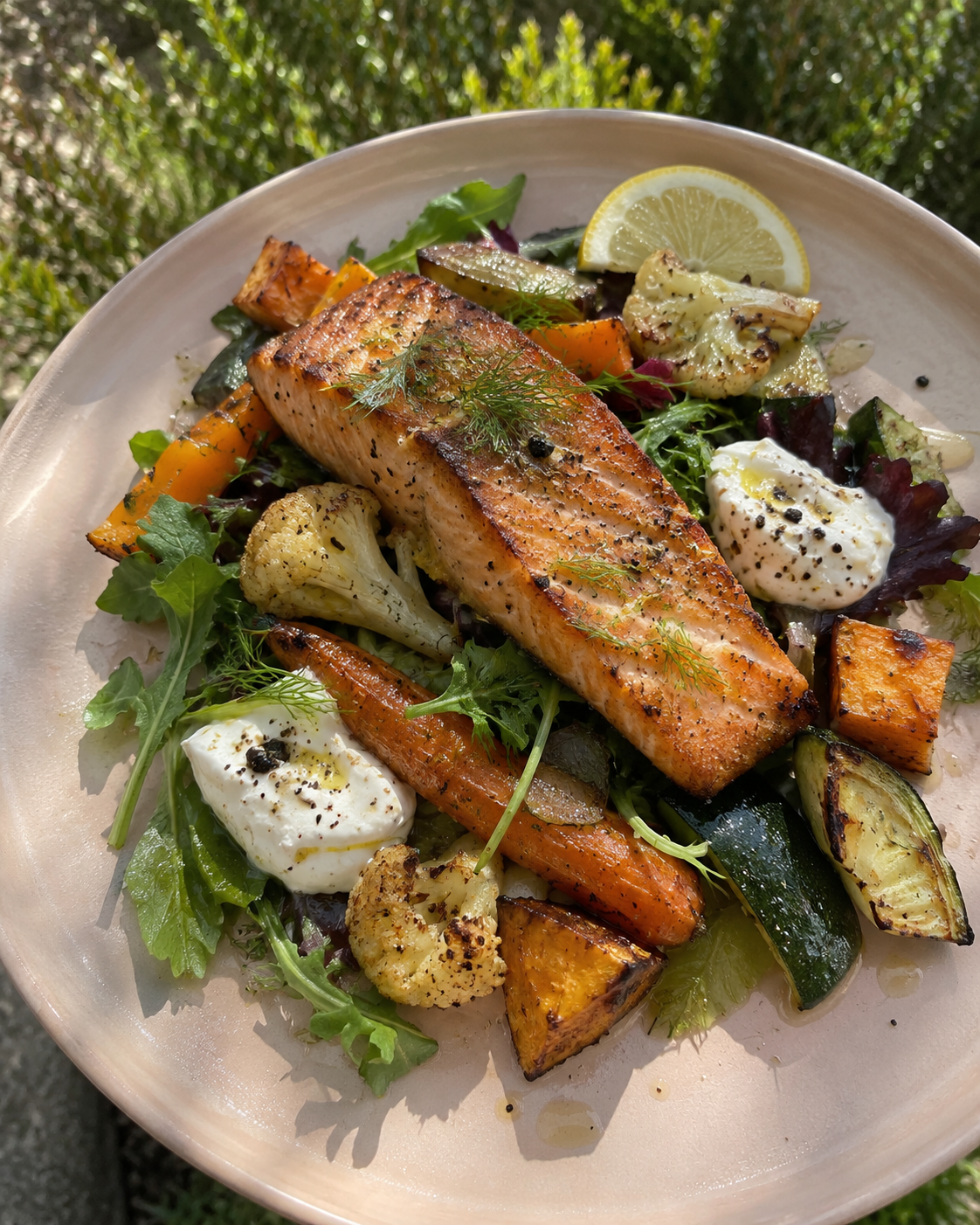
Pan-seared wild salmon (or grilled grass-fed steak, or pasture-raised chicken) over a bed of seasonal greens, with cool dollops of tangy fromage blanc, caramelized roasted vegetables (plus optional sweet potato or butternut squash), your best olive oil, and fresh lemon. Bright, jewel-toned, and one of the most versatile plates you can make.
Yield: Serves 4 · Active: 30 min · Total: 45 min · Year-round, with greens and vegetables that change with the seasons · Best eaten: midday or early evening
About This Plate
Think of this as a framework you can make all year: a bed of seasonal greens, dollops of fresh fromage blanc, roasted seasonal vegetables, and your choice of protein. The cheese's cool, tangy creaminess balances the char of the protein and the caramelized sweetness of the vegetables, and a generous drizzle of olive oil and a squeeze of lemon tie everything together. Swap the protein for what's fresh, swap the vegetables with the season, and the plate stays elegant all year long.
Choose Your Protein
Wild salmon (the classic choice)
Pros: rich in omega-3s (EPA and DHA), astaxanthin, and vitamin D; cooks in about 10 minutes; and pairs beautifully with the tangy cheese.
Cons: it overcooks quickly, so it needs your attention, and it costs more than chicken.
Grass-fed steak (ribeye, New York strip, or sirloin)
Pros: deeply satisfying and rich in heme iron, B12, zinc, and CLA. Its char is wonderful against the cool cheese, and it's perfect for a Sunday supper or dinner party.
Cons: it's the most expensive option, and it needs time to rest.
Pasture-raised chicken (bone-in thighs or boneless breasts)
Pros: the most affordable, and kids often prefer it. Bone-in thighs are especially flavorful and forgiving, plus they bring glycine from the skin and bones.
Cons: it's less nutrient-dense than salmon or beef, and bone-in thighs take longer to cook.
Recipe 1: Pan-Seared Wild Salmon
Serves 4 · Active: 15 min · Total: 20 min
4 wild salmon fillets, skin-on (about 6 oz each): sockeye, king, or coho
2 tbsp extra virgin olive oil
2 tbsp grass-fed butter
1 tsp Baja Gold sea salt
½ tsp freshly cracked black pepper
Zest of 1 lemon
4 sprigs fresh thyme (or rosemary)
Prep. Take the salmon out of the fridge 15–20 minutes before cooking, and pat it completely dry.
Season both sides with salt and pepper, and the flesh side with lemon zest.
Sear skin-side down. Heat the olive oil in a large cast iron skillet over medium-high heat until shimmering. Lay the salmon skin-side down and sear 4–5 minutes without moving it, until the skin is deeply crisp and releases easily.
Flip and baste. Flip the salmon, add the butter and thyme, and spoon the melted butter over the fish for 2–3 minutes, until it reaches 125–130°F for medium. Salmon overcooks quickly, so keep an eye on it.
Rest on warm plates, skin-side up, for 2–3 minutes.
Or: Seared Grass-Fed Steak
Serves 4 · Active: 15 min · Total: 20 min (plus 2–24 hours dry-brining)
2 grass-fed ribeye, New York strip, or sirloin steaks (about 1½ lb each, 1½ inches thick), or 4 individual steaks (about 8 oz each)
2 tbsp extra virgin olive oil
1½ tsp Baja Gold sea salt, divided
½ tsp freshly cracked black pepper
2 tbsp grass-fed butter
4 sprigs each fresh rosemary and thyme
4 garlic cloves, smashed
Dry-brine. Pat the steaks dry, rub them with 1 tsp salt, and refrigerate uncovered on a wire rack for 2–24 hours. It makes a big difference to the crust.
Bring to room temperature, about 45 minutes before cooking, then rub with the olive oil, remaining salt, and pepper.
Sear in a cast iron skillet over high heat until smoking, 3–4 minutes per side, for a deep crust.
Baste. Lower the heat to medium, add the butter, herbs, and garlic, and spoon the butter over the steaks for 2–3 minutes. Pull them at 125°F for rare, 130°F for medium-rare, or 135°F for medium.
Rest 10 minutes, loosely tented with parchment, then slice against the grain.
Or: Pasture-Raised Chicken
Serves 4 · Active: 15 min · Total: 35 min
4 pasture-raised bone-in, skin-on chicken thighs (about 2 lb), or 4 boneless, skinless breasts (about 1½ lb)
2 tbsp extra virgin olive oil
3 garlic cloves, minced
2 tbsp fresh rosemary, finely chopped, plus 1 tbsp fresh thyme leaves
1 tsp Baja Gold sea salt
½ tsp freshly cracked black pepper
Zest of 1 lemon
2 tbsp grass-fed butter, for finishing
Marinate briefly. Toss the chicken with the olive oil, garlic, herbs, salt, pepper, and lemon zest, and let it sit 20–30 minutes at room temperature.
For bone-in thighs: Heat the oven to 400°F. Sear the thighs skin-side down in a cast iron skillet over medium-high heat for 6–7 minutes, until the skin is deeply crisp. Flip, move the skillet to the oven, and roast 15–18 minutes, until they reach 175°F.
For boneless breasts: Sear them in a cast iron skillet over medium-high heat for 4–5 minutes per side, until they reach 155°F. They'll rise to 160°F as they rest.
Finish by adding the butter to the pan in the last minute and basting the chicken. Rest 5–8 minutes.
Recipe 2: Seasonal Greens
Serves 4 · Active: 10 min
Choose 3–4 greens for the season:
Spring and early summer: baby arugula, baby spinach, pea shoots, microgreens, butter lettuce, and watercress
Summer: baby arugula, butter lettuce, frisée, purslane, fresh basil leaves, and radicchio (for a bitter contrast)
Fall: baby arugula, baby kale, mizuna, endive, radicchio, and baby spinach
Winter: baby arugula, baby kale, endive, radicchio, frisée, and watercress
For the greens
5–6 cups mixed seasonal greens (about 6 oz)
1 tbsp extra virgin olive oil
1 tsp fresh lemon juice
A small pinch of Baja Gold sea salt
Wash and dry the greens well, since wet greens dilute the dressing. Just before plating, toss them gently with the olive oil, lemon juice, and salt. Go light, so the greens stay crisp.
Recipe 3: Roasted Seasonal Vegetables
Serves 4 · Active: 15 min · Total: 40 min
Choose a combination for the season:
Spring: asparagus, baby carrots, and radishes; or fennel, spring onions, and baby artichokes
Summer: zucchini, eggplant, bell peppers, and cherry tomatoes (ratatouille-style); or yellow summer squash, red onions, and green beans
Fall: butternut squash, Brussels sprouts, red onions, and delicata squash; or sweet potatoes, parsnips, and rainbow carrots
Winter: butternut squash, parsnips, and rainbow carrots; or sweet potatoes, fingerling potatoes, kabocha squash, and red onions
For the vegetables
4–5 cups mixed seasonal vegetables, cut into ¾-inch pieces
3 tbsp extra virgin olive oil
3 garlic cloves, thinly sliced
2 tbsp fresh thyme leaves
1 tbsp fresh rosemary, finely chopped (or fresh sage in fall and winter)
1 tsp Baja Gold sea salt
½ tsp freshly cracked black pepper
Optional: 1 tbsp honey (lovely on fall and winter root vegetables)
Optional: a pinch of red pepper flakes
Flaky sea salt
Toss. Heat the oven to 425°F and line a large sheet pan with parchment. Toss the vegetables with the olive oil, garlic, herbs, salt, pepper, and honey and chili flakes (if using).
Roast in a single layer (crowded vegetables steam instead of caramelizing) for 25–30 minutes, tossing once, until caramelized at the edges and tender.
Finish with flaky salt.
For a heartier plate, add roasted sweet potato or butternut squash:
Roasted sweet potato: 2 medium sweet potatoes, cubed, tossed with 2 tbsp olive oil, 1 tbsp fresh thyme, ½ tsp Ceylon cinnamon (optional), and ½ tsp salt.
Roasted butternut squash: 1 medium butternut squash, peeled, seeded, and cubed, tossed with 2 tbsp olive oil, 2 tbsp chopped fresh sage, 1 tbsp honey (optional), and ½ tsp salt.
Roast either at 425°F for 25–30 minutes, until caramelized and tender. Sweet potato brings warming comfort in fall and winter, and butternut squash brings jewel-toned depth.
Assembling the Plate
Once everything's ready: about 8 minutes
Your cooked protein, greens, and roasted vegetables
8 oz fromage blanc or fresh chèvre (like Cypress Grove)
3 tbsp of your best extra virgin olive oil, for finishing
1 lemon (juice and zest)
¼ cup fresh flat-leaf parsley, chopped
2 tbsp fresh chives, thinly sliced
Optional: 2 tbsp fresh dill, or fresh basil in summer
Flaky sea salt and freshly cracked black pepper
Optional: ¼ cup toasted pumpkin seeds or pistachios, or shaved Parmigiano-Reggiano
Warm the plates (or shallow bowls) in a low oven for 5 minutes.
Layer. Spread the greens over the plates as a base, then scatter the roasted vegetables over them. Add the salmon, sliced steak, or chicken.
Dollop the cheese. Add 3–4 generous dollops of fromage blanc to each plate, some near the protein and some near the vegetables. The warmth of the plate softens it slightly.
Finish with a generous drizzle of your best olive oil, a squeeze of lemon juice, and lemon zest. Scatter with the herbs, season with flaky salt and pepper, and add pumpkin seeds, pistachios, or Parmigiano, if you like.
Serve right away. The warm protein and vegetables against the cool, tangy cheese and bright greens is a truly elegant combination.
Plating Variations
A lighter lunch bowl: 3–4 oz of protein, more greens (about 6 cups), served in wide, shallow bowls.
A heartier Sunday supper: add roasted fingerling or Yukon Gold potatoes, and serve 8 oz of protein each.
A dinner party: serve it family-style on a large warm platter: a bed of greens, topped with the roasted vegetables and sliced protein, generous dollops of cheese, olive oil, lemon, and lots of fresh herbs.
A summer picnic: assemble it at room temperature, with cold salmon or chicken, and pack the cheese separately to dollop on just before serving.
Storage
Cooked salmon: refrigerated up to 2 days. It's lovely cold, flaked over greens.
Cooked steak or chicken: refrigerated up to 4 days. Sliced or shredded over greens, it makes a great lunch.
Roasted vegetables: refrigerated up to 4 days. Reheat at 400°F for 5–6 minutes to recrisp.
Roasted sweet potato or squash: refrigerated up to 5 days, perfect for meal prep.
Fromage blanc: refrigerated up to 2 weeks unopened, or 1 week once opened.
Undressed greens: refrigerated up to 5 days. Once dressed, they're best within an hour.
Fresh herbs: refrigerated, wrapped in a damp paper towel, up to 1 week.
Leftover transformations:
Toss leftover salmon, steak, or chicken with greens, cold roasted vegetables, and dollops of fromage blanc, for a next-day lunch bowl.
Roll leftovers into grain-free wraps with fresh herbs.
Blend leftover roasted vegetables with bone broth, for a quick soup.
Spread leftover fromage blanc on grain-free toast with seasonal fruit and honey.
For Your Cycle: Building Your Plate by Phase
Menstrual phase (days 1–5): Choose grass-fed steak for its heme iron, with roasted sweet potato or butternut squash, fall and winter greens like mizuna, baby kale, and radicchio, and fromage blanc. Warming, grounding, iron-rich foods are especially restorative on heavier days.
Follicular phase (days 6–14): Choose wild salmon, with lighter spring vegetables like asparagus, radishes, and baby carrots, bright greens like arugula, pea shoots, and microgreens, and fromage blanc, as your energy rises.
Ovulatory phase (days 15–17): Choose wild salmon or chicken, with summer vegetables like zucchini, tomatoes, and bell peppers, summer greens like arugula, basil, and purslane, and fromage blanc.
Luteal phase (days 18–28): Choose grass-fed steak or salmon, with roasted sweet potato or butternut squash, fall and winter greens, and fromage blanc. Satisfying protein plus steady carbohydrates helps keep your blood sugar and mood stable, when hunger often rises.
Steak's heme iron is especially well absorbed: the body takes in about 15–35% of heme iron, compared with roughly 2–20% of the iron in plants. The lemon's vitamin C helps with iron absorption, too.
Nourishment Notes
Wild salmon — omega-3s (EPA and DHA), astaxanthin, vitamin D, B12, and complete protein.
Grass-fed steak — heme iron, B12, zinc, CLA, creatine, and complete protein.
Pasture-raised chicken — B12, choline, complete protein, and glycine from the skin and bones.
Fromage blanc or chèvre — calcium, protein, and cultures, plus mostly A2-type casein if you choose goat's or sheep's milk, which many people find easier to digest than conventional cow's milk.
Seasonal greens — polyphenols, vitamin K, folate, and magnesium. A mix of 3–4 greens gives you a wider variety of plant compounds than any single green.
Microgreens — studies have found many microgreens are richer in certain vitamins and carotenoids than their mature leaves.
Roasted seasonal vegetables — carotenoids, potassium, fiber, and, in brassicas like Brussels sprouts, glucosinolates.
Sweet potato and butternut squash — beta-carotene, potassium, vitamin C, fiber, and steady carbohydrates for sustained energy.
Lemon — vitamin C, d-limonene, and hesperidin.
Extra virgin olive oil — oleic acid, hydroxytyrosol, oleuropein, and oleocanthal, plus it helps you absorb the vegetables' fat-soluble vitamins.
Fresh herbs — vitamin K, folate, and aromatic compounds.
Grass-fed butter — vitamins A and K2, CLA, and butyrate.
Pumpkin seeds and pistachios (optional) — magnesium, zinc, and vitamin B6.
Garlic — allicin and organosulfur compounds.
Sourcing
Wild salmon — wild Alaskan sockeye, king, or coho, from Vital Choice, Wild Alaskan Company, or a trusted fishmonger (caught fresh roughly May through September, and frozen-at-sea is excellent year-round)
Grass-fed steak — 100% grass-fed and grass-finished, from Alderspring Ranch, White Oak Pastures, or US Wellness Meats
Chicken — pasture-raised, from a farmers' market, a local butcher, or White Oak Pastures
Fromage blanc or chèvre — fresh chèvre from Cypress Grove or a local dairy near you, or fromage blanc from Vermont Creamery (made from cow's milk). Or make a quick stand-in by whipping drained cottage cheese until smooth.
Greens and microgreens — organic, from a farmers' market
Vegetables — organic and seasonal, from a farmers' market: sweet potatoes (Garnet, Jewel, Japanese, or purple), butternut squash, fingerlings (Russian Banana, French Fingerling, Purple Peruvian), and hardneck garlic
Lemons — organic (you're using the zest); Meyer lemons are sweeter and more aromatic
Fresh herbs — organic, from a farmers' market or your windowsill
Honey (optional) — organic, local, and unfiltered
Pumpkin seeds or pistachios (optional) — organic
Grass-fed butter — organic, cultured butter from 100% grass-fed cows
Spices (black peppercorns, chili flakes, Ceylon cinnamon) — organic and non-irradiated
Extra virgin olive oil — organic, single-estate, harvest-dated, in dark glass; save your best bottle for the finishing drizzle
Salt — Baja Gold sea salt for cooking; Maldon or fleur de sel for finishing
— Anna aka Food Marshall