Grass-Fed Beef Tenderloin with Cabrales Cream and Apple-Cider Jam
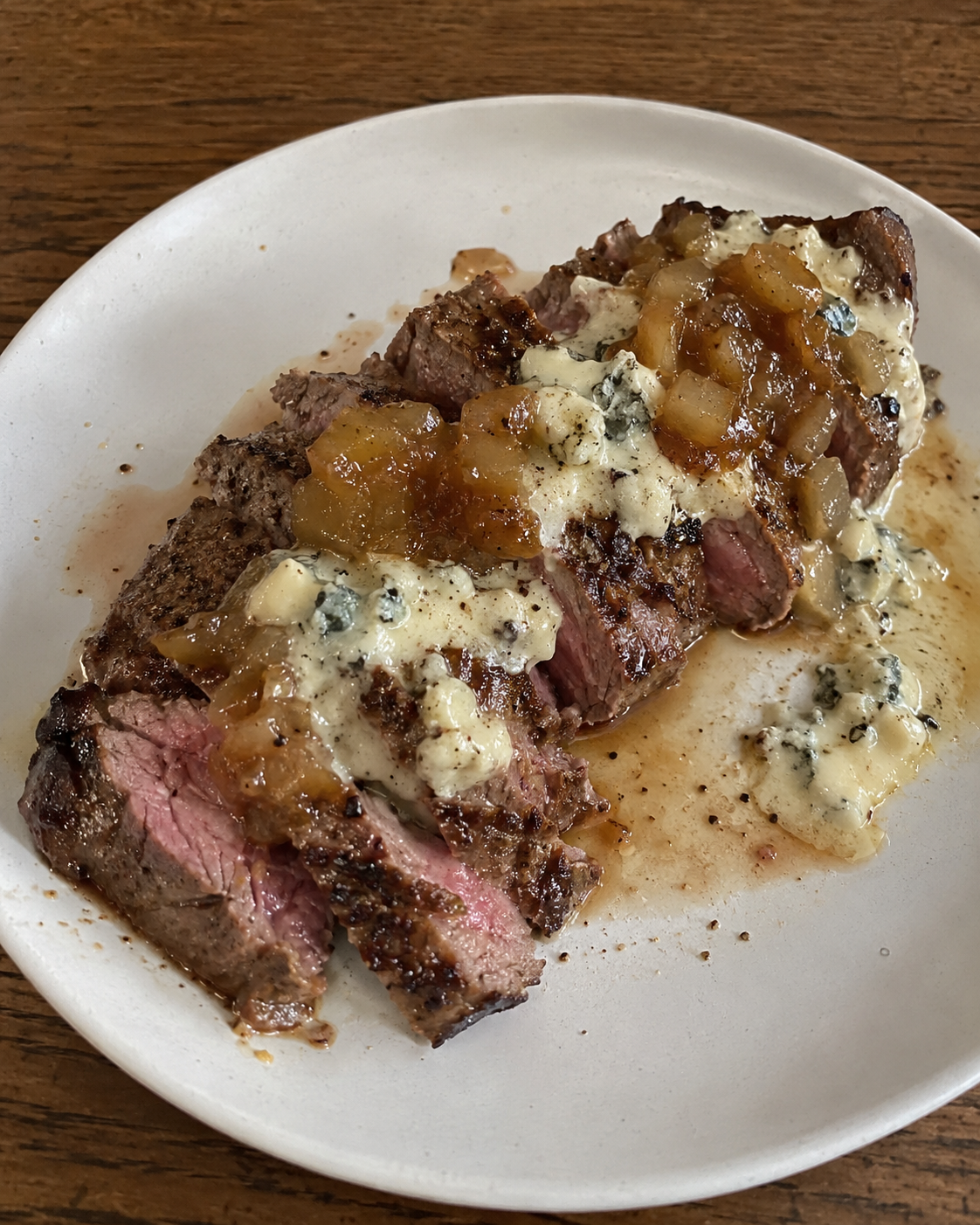
An Asturian-inspired celebration plate: grass-fed beef tenderloin with a warm Cabrales blue cheese sauce, silky cauliflower purée, roasted heritage vegetables, and a bright apple-cider jam
Yield: Serves 4 generously · Active: 1 hr · Total: 1 hr 30 min · Best in North America from autumn into early winter, when apples, carrots, potatoes, and cauliflower are at their peak · Cuisine: Asturian-inspired, modern American · Best eaten: early evening
This is the Sunday-dinner plate, the dinner-party plate, the birthday plate: a complete celebration meal built around one of the great pairings of northern Spain, beef tenderloin with Cabrales blue cheese. Solomillo al Cabrales is a classic in Asturias, a green, mountainous region famous for its cheeses, apples, and cider, and this plate brings it all together.
It starts with a warm Cabrales cream sauce (cheese, cream, and a sherry reduction) over a silky cauliflower purée, then adds three roasted vegetables for color and texture: heritage fingerlings with herbs, rainbow carrots with smoked paprika, and broccoli with garlic and lemon. A small bowl of naturally sweetened apple-cider jam brings a bright, fruity contrast to the rich cheese. It looks like a restaurant plate and eats like one, and every element except the steak can be made ahead.
Ingredients
Grass-fed tenderloin
4 grass-fed beef tenderloin filets, 6-8 oz each, 1½-2 inches thick (or a 2-lb center-cut tenderloin roast, sliced after resting)
About 2 tsp coarse sea salt (½ tsp per filet)
Freshly ground black pepper
1 tbsp grass-fed beef tallow or pasture-raised lard, for searing
2 tbsp grass-fed butter, for finishing
2 sprigs fresh thyme
Cabrales cream sauce
3 oz Cabrales DOP, crumbled
½ cup heavy cream (raw if available, otherwise organic grass-fed)
¼ cup dry oloroso or amontillado sherry, or ruby port (for alcohol-free, use ¼ cup beef bone broth plus 1 tsp sherry vinegar)
1 small shallot, finely minced
1 tbsp grass-fed butter
1 sprig fresh thyme
Freshly ground black pepper (Cabrales is salty enough that no extra salt is needed)
Cauliflower purée
1 large head cauliflower (about 2 lb), cored and cut into florets
4 garlic cloves, peeled
4 tbsp grass-fed butter
½ cup heavy cream (or coconut cream, for dairy-free)
¼ cup raw whole milk (or coconut milk)
1 tsp Baja Gold sea salt, plus more to taste
Pinch of white pepper (or black)
Optional: 1 tbsp grass-fed butter, for finishing the top
Roasted fingerling potatoes with fresh herbs
1½ lb heritage fingerling potatoes (Russian Banana, French Fingerling, Purple Peruvian, or a rainbow mix), halved lengthwise
3 tbsp extra virgin olive oil
4 garlic cloves, smashed (skins on)
2 sprigs fresh rosemary
4 sprigs fresh thyme
Coarse sea salt and freshly ground black pepper
Fresh flat-leaf parsley, chopped, for finishing
Roasted heritage carrots
1 lb heritage rainbow carrots (Cosmic Purple, Atomic Red, Lunar White, Yellowstone, or a mix), tops trimmed, halved lengthwise if thick
2 tbsp extra virgin olive oil, plus 1 tsp to toss with the pimentón
1 tsp pimentón de la Vera dulce (sweet smoked Spanish paprika)
Baja Gold sea salt
Optional: 1 tsp raw honey, for a final glaze
Roasted broccoli with garlic and lemon
1 large head broccoli (about 1 lb), cut into florets with plenty of stem (the stems caramelize beautifully)
2 tbsp extra virgin olive oil
4 garlic cloves, thinly sliced
Baja Gold sea salt and freshly ground black pepper
Optional: 1 tsp red pepper flakes, for heat
Juice of ½ lemon, added at the end
Finely grated lemon zest, for finishing
Apple-cider jam (naturally sweetened, no refined sugar)
4 medium apples (a mix of sweet and tart, like Honeycrisp and Granny Smith), peeled, cored, and finely diced
¼ cup raw honey or pure maple syrup
¼ cup fresh-pressed apple cider (or dry Asturian cider)
1 tbsp fresh lemon juice
1 tsp ground Ceylon cinnamon
Optional: 1 small piece Chinese star anise
1 tbsp grass-fed butter
Pinch of Baja Gold sea salt
Plating and garnish
Fresh thyme, parsley, and chive sprigs
Flaky sea salt, for finishing
Optional: extra Cabrales crumbles over the steak
Optional: a few drops of aged sherry vinegar over the purée
Method
This recipe has a lot of parts, but most can be made ahead or while others cook. Read the whole method once before starting; the timing is the trick.
Phase 1 — Make-ahead components (up to 2 days ahead, or earlier the same day)
Make the apple-cider jam. Combine all the jam ingredients in a heavy saucepan over medium-low heat and bring to a gentle simmer, stirring. Cook 30-40 minutes, stirring occasionally and mashing the apples with a wooden spoon as they soften, until thick and chunky enough to hold its shape on a spoon. Remove the star anise, cool, and transfer to a glass jar. Refrigerate up to 1 week, and bring to room temperature before serving.
Make the cauliflower purée. Steam the cauliflower and whole garlic cloves over simmering water 15 minutes, until completely tender. Drain very well, patting the cauliflower with a clean towel if needed, since extra water makes a thin purée. Blend with the butter, cream, milk, and salt on high for 3-4 minutes, scraping down the sides, until completely silky and glossy. Adjust the seasoning. If making ahead, refrigerate, then rewarm gently over low heat with a splash of cream, stirring constantly.
Phase 2 — Roasted vegetables (about 45 minutes before serving)
Chop the broccoli early. Cut the broccoli into florets and let it sit 30-40 minutes before roasting. This gives its natural enzymes time to form sulforaphane before the heat goes on.
Preheat the oven to 425°F, with racks in the upper-middle and lower-middle positions.
Prep the trays.
Potatoes: On one sheet pan, toss the fingerlings with the olive oil, smashed garlic, rosemary, thyme, salt, and pepper, and arrange them cut-side down.
Carrots: On a second pan, toss the carrots with the olive oil and salt.
Broccoli: On a third pan (or one end of the carrot pan), toss the broccoli with the olive oil, salt, pepper, and optional red pepper flakes. Save the sliced garlic for later.
Roast in sequence. The fingerlings go in first and take 30-35 minutes. Add the carrots after 5 minutes; they take 25-30 minutes. Add the broccoli 10 minutes after that; it takes 18-22 minutes. Rotate the trays halfway through.
Add the pimentón and garlic partway. About halfway through the carrots' roast, toss them with the pimentón and the extra teaspoon of oil. Scatter the sliced garlic over the broccoli for its last 8 minutes. Both smoked paprika and thin garlic turn bitter if they scorch.
Finish. Everything should be ready within about 5 minutes of each other. Squeeze lemon juice and zest over the broccoli, drizzle the optional honey over the carrots, and scatter parsley over the potatoes. Keep everything warm in a 200°F oven while you cook the steak.
Phase 3 — The steak (about 20 minutes before serving)
Take the chill off. Pull the filets from the fridge 45 minutes before cooking; cold tenderloin sears unevenly and overcooks outside before the center is ready. Pat them dry, then season all over, including the edges, with the salt and plenty of pepper, pressing it in with your fingers.
Heat the pan and oven. Heat the oven to 400°F. Heat a 12-inch cast iron skillet over high heat for 5 minutes, until it just begins to smoke.
Sear. Add the tallow; it should shimmer right away. Lay the filets in with space between them and don't move them. Sear 2-3 minutes, until deeply browned, then flip and sear 2 minutes more. Use tongs to roll the filets and sear their edges, about 30 seconds per side.
Baste and roast. Add the butter and thyme, tilt the pan, and spoon the foaming butter over the filets 4-5 times. Slide the pan into the oven and roast 4-6 minutes, until the thickest part reads 125°F for medium-rare. Use an instant-read thermometer; tenderloin is too lean to forgive overcooking.
Rest. Move the filets to a warm plate (save the pan and drippings for the sauce), tent loosely, and rest 10 minutes. They'll rise to about 130°F, and the juices will settle back into the meat.
Phase 4 — Cabrales cream sauce (while the steak rests)
Soften the shallot. Set the same skillet over medium heat. Add the butter and shallot and cook 1 minute, until translucent but not browned.
Reduce. Pour in the sherry (or port, or the broth and vinegar) and scrape up the browned bits. Simmer 2 minutes, until reduced by about half.
Add the cream and simmer 2-3 minutes, stirring often, until it lightly coats the back of a spoon.
Melt the Cabrales. Off the heat, add the crumbled Cabrales and thyme sprig and whisk gently until mostly smooth. A few small bits of cheese are perfect. Season with pepper, and if it tastes flat, add a tiny squeeze of lemon.
Phase 5 — Plating
Spoon a generous mound of warm cauliflower purée onto the center of each wide, warm plate, and swirl it outward with the back of the spoon. Set a filet on top, whole or sliced into 2-3 medallions across the grain. Spoon the Cabrales sauce generously over the steak, letting it pool onto the purée. Arrange small clusters of fingerlings, carrots, and broccoli around the steak, leaving some open space on the plate. Scatter thyme, parsley, and chives over everything, add a spoonful of apple jam alongside (or a small ramekin), and finish with a pinch of flaky salt and optional extra Cabrales.
Storage
Steak: Best eaten right away; it doesn't reheat well. Leftover medallions are wonderful cold the next day, sliced thin over arugula with a drizzle of warmed Cabrales sauce and a spoonful of apple jam
Cauliflower purée: Refrigerated up to 3 days. Rewarm gently with a splash of cream
Apple jam: Refrigerated up to 1 week
Roasted vegetables: Refrigerated up to 4 days. Reheat at 425°F for 8 minutes to recrisp
Enhancement Options
What to drink
A bold Spanish red handles both the beef and the Cabrales beautifully: Ribera del Duero, Rioja Reserva, or Priorat. A Northern Rhône Syrah is a lovely French alternative, and white-wine drinkers can try a Spanish Albariño or a white Rioja. Look for organic or biodynamic producers when you can. For an alcohol-free option, fresh-pressed apple cider echoes the jam beautifully.
Make it ahead
Apple jam: up to 1 week ahead
Cauliflower purée: up to 2 days ahead; rewarm with a splash of cream
Roasted vegetables: cut everything the morning of, refrigerate, and roast just before serving
Steak: out of the fridge 45 minutes before searing
Cabrales sauce: best made fresh in the steak pan, but it can be made up to 2 hours ahead and rewarmed gently
With everything prepped, the cooking-and-plating window is about 30 minutes.
Scaling for a dinner party
The recipe doubles easily for 8. Use a 4-lb center-cut tenderloin roast instead of filets: sear it in the skillet, then roast at 400°F for 30-40 minutes, until the center reads 125°F. Rest 15 minutes before slicing. For 12, you'll want a second oven for the vegetables and a helper for plating, or serve everything family-style on platters.
If you can't find Cabrales
Spanish Valdeón, another Picos de Europa blue, is the closest substitute, and French Bleu d'Auvergne comes next. Gorgonzola dolce is too mild for this sauce, and Stilton is a bit too dry. Skip generic supermarket blue cheese; the sauce depends on the cheese's depth.
A vegetable-forward version
For a vegetarian celebration plate, roast a whole head of cauliflower rubbed with olive oil and pimentón at 425°F for 45-60 minutes, until deeply golden, and serve it in place of the tenderloin, drizzled with the Cabrales sauce. Serve it with the same purée, roasted vegetables, and apple jam.
Lighter portions
For a lighter dinner, or when serving other courses, use 4-oz filets and halve the purée and vegetables. The plate looks the same, just smaller, and it stretches further for a crowd.
A first-course preview
Serve the apple jam with a small wedge of Cabrales and a few grain-free crackers as a passed appetizer before dinner. It previews the flavors of the main course, and the same apple-Cabrales-honey trio makes a beautiful cheese course at the end of the meal, too.
Nourishment Notes
Grass-fed beef tenderloin comes from the psoas, a muscle beneath the spine that does very little work, which is what makes it so tender. From 100% grass-fed and grass-finished cattle, beef carries more omega-3s, CLA, vitamin E, and beta-carotene than grain-finished beef, though tenderloin is so lean that the differences in fat are modest here. Every bite brings complete protein, heme iron, zinc, and B12. It's a splurge, and one well-raised tenderloin makes a truly special celebration meal.
Cabrales is one of the great cheeses of Spain, made from raw milk (cow's alone, or blended with sheep's and goat's) from animals grazing the high mountain pastures of the Picos de Europa. It's ripened in natural limestone caves, where native Penicillium roqueforti molds give it its blue veining and bold flavor. It brings calcium, phosphorus, protein, and fat-soluble vitamins A, D, and K2. Its live cultures don't survive a warm sauce, but its deep, complex flavor carries the whole dish.
The cauliflower purée brings glucosinolates, vitamin C, vitamin K, folate, and fiber, and the butter and cream help you absorb the fat-soluble nutrients on the plate. Blended until silky, it's a lovely way to get a cruciferous vegetable onto a celebration plate.
The roasted vegetables each bring something different. Heritage fingerlings have more flavor than everyday potatoes, and purple varieties add anthocyanins, the same pigments found in blueberries. Rainbow carrots bring a whole spectrum of carotenoids: beta-carotene in orange, anthocyanins in purple, and lutein in yellow. Roasted broccoli brings glucosinolates, vitamin C, and vitamin K, and chopping it 30-40 minutes before roasting gives its enzyme myrosinase time to form some sulforaphane before the heat goes on.
The apple-cider jam brings a bright, sweet-tart contrast to the rich, salty cheese. Apples and blue cheese is a classic pairing across Europe, and especially fitting here: Asturias is Spain's apple and cider country. Apples bring pectin (a gentle fiber) and quercetin. The jam is sweetened with honey or maple syrup instead of refined sugar, though it's still sweet, so a spoonful is plenty. Ceylon cinnamon's polyphenols help moderate blood sugar. A fun fact about star anise: it's rich in shikimic acid, the compound once used to make the flu medicine Tamiflu. Be sure to use Chinese star anise (Illicium verum); Japanese star anise looks similar but is toxic.
As a circadian and seasonal meal, this is early-evening eating: rich and satisfying, with plenty of vegetables and fiber alongside. The apple jam's gentle sweetness can stand in for dessert. Serve it between about 6 and 7:30 PM, early enough that digestion is mostly done by bedtime. Autumn into early winter is its natural season in North America, when apples are at their peak and root vegetables are at their sweetest. It's a plate made for gathering around the table with the people you love.
Sourcing
Grass-fed beef tenderloin — 100% grass-fed and grass-finished (grass-fed alone can mean grain-finished). Alderspring Ranch (Idaho, certified organic, single-ranch), White Oak Pastures (Georgia, regenerative), a local farm through Polyface Farm's buying clubs in Virginia, or a local Amish or Mennonite farm. Ask your butcher for center-cut filets cut 1½-2 inches thick
Cabrales DOP — look for the DOP seal, which certifies it was made in the Cabrales region of Asturias from raw milk and ripened in natural caves. It isn't typically certified organic; the DOP standards, raw milk, and mountain-pasture grazing are what matter here. In the U.S., look for it at specialty cheese shops (many are supplied by the importer Forever Cheese), Murray's Cheese, or La Tienda. Spanish Valdeón is the closest substitute
Heritage fingerling potatoes — organic, from a farmers' market, or Wood Prairie Family Farm (Maine, certified organic heritage potatoes)
Heritage rainbow carrots — organic, from a farmers' market or local CSA
Broccoli and cauliflower — organic, from a farmers' market; heirloom varieties like Romanesco, Purple Sprouting broccoli, or Cheddar and Graffiti cauliflower are beautiful
Apples — organic, from a local orchard at harvest; heritage varieties like Cox's Orange Pippin, Northern Spy, or Esopus Spitzenburg are wonderful, or Honeycrisp and Granny Smith
Cider (for the jam) — organic, fresh-pressed apple cider from a local orchard, or Asturian sidra natural from La Tienda (it contains alcohol)
Heavy cream and whole milk — raw from a local dairy, where legal, or organic grass-fed: Kalona SuperNatural (low-temp vat-pasteurized, non-homogenized) or Organic Valley Grassmilk
Grass-fed butter — organic, cultured butter from 100% grass-fed cows, raw butter from a local dairy, or Organic Valley Pasture Butter
Beef tallow or lard — render your own from grass-fed suet or pasture-raised pork fat, or Fatworks, which sells grass-fed tallow
Sherry or port — Lustau and Hidalgo make traditional dry sherries
Pimentón de la Vera — DOP, oak-smoked, organic when available (La Chinata and La Dalia are two well-known producers)
Extra virgin olive oil — organic, single-estate, harvest-dated within the past year, in dark glass
Ceylon cinnamon and Chinese star anise — organic and single-origin, whole pods for the star anise
Raw honey — organic, local, and unfiltered
Flaky sea salt — Maldon, Jacobsen Salt Co. (Oregon), or Halen Môn PDO (Wales); Baja Gold for cooking
Fresh herbs (thyme, rosemary, parsley, chives) — organic, from a windowsill pot, garden, or farmers' market
Garlic — organic hardneck heirloom garlic, such as Music, Spanish Roja, or German Red, from a farmers' market
— Anna aka Food Marshall