Pork Verde with Sautéed Zucchini and Yellow Squash and Braised Summer Greens
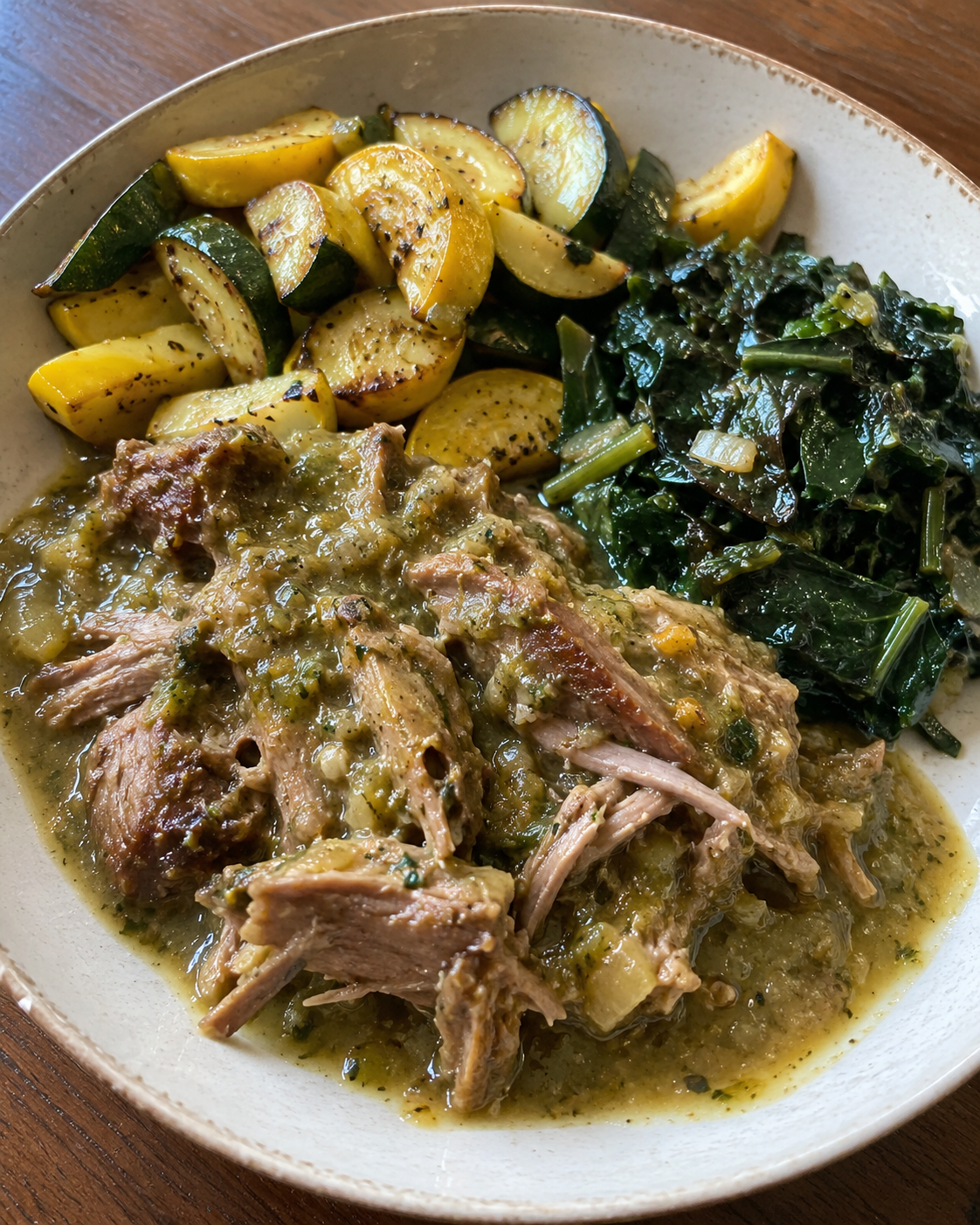
Tender, slow-braised pork shoulder in a bright, tangy green sauce of fire-roasted tomatillos, poblanos, jalapeños, and fresh herbs, with buttery sautéed summer squash and a pot of silky braised greens. It's even better the next day, which makes it perfect for a Sunday supper or make-ahead weeknight meals.
Yield: 4-6 servings · Active: 45 min · Total: 2½ hrs (mostly hands-off braising) · Best in North America from late summer into early fall, when tomatillos, peppers, and summer squash are all at their peak · Best eaten: early evening, for a Sunday supper or make-ahead weeknight
Complete Menu
Pork Verde
Sautéed Zucchini and Yellow Squash
Braised Summer Greens
Your Game Plan
About 2½ hrs out: Roast the vegetables for the green sauce, then blend the sauce.
About 2 hrs out: Sear the pork, build the braise, and slide it into the oven.
About 30 min out: Braise the greens.
About 15 min out: Sauté the squash. Reduce the verde sauce if needed.
Plate and top with avocado, cilantro, and lime.
Recipe 1 — Pork Verde
Yield: 4-6 servings · Active: 30 min · Total: 2½ hrs
Ingredients
3 lb pasture-raised pork shoulder (Boston butt), trimmed and cut into 1½-inch cubes
3 tbsp pasture-raised lard, pastured bacon fat, or extra virgin olive oil
1½ tsp Baja Gold sea salt
1 tsp freshly cracked black pepper
1 tbsp ground cumin
Green sauce (salsa verde)
1½ lb tomatillos (about 12-15 medium), husks removed and rinsed
3 poblano peppers
2 large jalapeños (seeded for milder heat, or leave the seeds in for more)
1 large yellow onion, quartered
8 garlic cloves, unpeeled
3 tbsp extra virgin olive oil
1½ cups fresh cilantro, packed (leaves and tender stems)
½ cup fresh flat-leaf parsley, packed
3 tbsp fresh lime juice
Zest of 1 lime
1 tsp ground cumin
½ tsp ground coriander
1 tsp dried Mexican oregano
1 tsp Baja Gold sea salt
For the braise
2 cups chicken bone broth
2 tbsp apple cider vinegar
Optional: 1 tbsp honey (balances the acid)
2 bay leaves
3 sprigs fresh oregano (or 1 tsp dried Mexican oregano)
To finish
Fresh cilantro leaves
Lime wedges
Sliced avocado
Optional: crumbled queso fresco or fresh goat chèvre
Optional: thinly sliced radishes
Optional: a dollop of raw A2 yogurt or crème fraîche, for a cool contrast
Flaky sea salt
Method
Roast the vegetables for the sauce
Preheat the oven to 425°F and line a large sheet pan with parchment.
Roast. Spread the tomatillos, poblanos, jalapeños, onion, and unpeeled garlic on the pan, drizzle with the olive oil, and sprinkle with 1 tsp salt. Roast 22-28 minutes, until deeply charred at the edges and the tomatillos have released their juices. Let them cool 10 minutes.
Peel. Squeeze the roasted garlic from its skins. Peel most of the charred skin from the poblanos (a little char adds lovely depth), and remove the seeds from the poblanos and jalapeños if you want milder heat.
Blend. Blend the roasted vegetables and garlic with the cilantro, parsley, lime juice and zest, cumin, coriander, oregano, and salt for 45-60 seconds, until smooth or slightly chunky, as you like.
Sear and braise the pork
Season. Pat the pork cubes completely dry and season with the salt, pepper, and cumin. Turn the oven down to 325°F.
Sear. Heat the lard in a large Dutch oven over medium-high heat until shimmering. Sear the pork in batches, 2-3 minutes per side, until deeply browned. Don't crowd the pot, or the pork will steam instead of brown. Transfer to a plate.
Deglaze. Lower the heat to medium, add ½ cup of the broth, and scrape up the browned bits from the bottom of the pot.
Build the braise. Stir in the green sauce, the remaining broth, vinegar, optional honey, bay leaves, and oregano sprigs.
Braise. Return the pork and any juices to the pot and bring to a gentle simmer. Cover and braise in the oven for 1½-1¾ hours, until the pork is fall-apart tender.
Finish. Remove the bay leaves and oregano stems. If the sauce is thin, lift out the pork with a slotted spoon and simmer the sauce, uncovered, 8-10 minutes to thicken, then return the pork. Taste and adjust the seasoning.
A note on tomatillos: Tomatillos are small, tart green fruits wrapped in papery husks, and they're cousins of ground cherries. Their bright tang is the signature flavor of any verde. Look for firm, bright green tomatillos with tight husks, and rinse off the sticky residue after husking. If you can't find fresh ones, jarred tomatillos with just tomatillos, water, and salt work too.
A note on Mexican oregano: Traditional Mexican cooking uses Mexican oregano (Lippia graveolens), a different plant from Mediterranean oregano, with a brighter, more citrusy, less minty flavor. Look for it at Mexican grocers or spice shops. Mediterranean oregano works in a pinch.
Recipe 2 — Sautéed Zucchini and Yellow Squash
Yield: 4-6 servings · Active: 12 min · Total: 15 min
Ingredients
2 medium zucchini, cut into ½-inch half-moons
2 medium yellow summer squash, cut into ½-inch half-moons
3 tbsp extra virgin olive oil
2 tbsp grass-fed butter
4 garlic cloves, thinly sliced
2 tbsp fresh thyme leaves (or fresh oregano)
1 tsp Baja Gold sea salt
½ tsp freshly cracked black pepper
Optional: a pinch of red pepper flakes
Zest of ½ lemon or lime (lime ties in nicely with the verde)
2 tbsp fresh lemon or lime juice
3 tbsp fresh basil, torn (or cilantro, to echo the verde)
2 tbsp fresh flat-leaf parsley, chopped
Flaky sea salt
Method
Heat the fat. Heat the olive oil and butter in a large skillet over medium-high heat until the butter is melted and shimmering.
Sear the squash. Add the zucchini and yellow squash in a single layer (work in batches if needed, since crowded squash steams instead of browning). Season with the salt, pepper, thyme, and optional red pepper flakes, and cook 4-5 minutes without moving, until the undersides caramelize.
Add the garlic. Toss the squash, scatter in the garlic, and cook 2-3 minutes more, until the squash is tender-crisp and the garlic is fragrant but not browned. Adding the garlic now keeps it from burning. Don't overcook the squash; you want a little bite.
Finish. Off the heat, toss with the citrus zest and juice, basil (or cilantro), and parsley, and finish with flaky salt.
Make it seasonal:
Summer (June-August): Use zucchini and yellow squash from the farmers' market, and finish with fresh basil.
Early fall: Swap pattypan or delicata squash for the yellow squash, and use fresh sage instead of basil.
Winter and spring: Out-of-season summer squash tends to be watery and bland, so make a warm cabbage or greens side instead.
Recipe 3 — Braised Summer Greens
Yield: 4-6 servings · Active: 15 min · Total: 30 min
Ingredients
1 large bunch Swiss chard (about 8 oz), stems chopped and leaves torn, kept separate
1 large bunch lacinato (dinosaur) kale (about 8 oz), tough stems removed, leaves torn
6-8 cups fresh spinach (about 10 oz), tough stems removed
3 tbsp extra virgin olive oil
2 tbsp grass-fed butter
1 medium yellow onion, thinly sliced
6 garlic cloves, thinly sliced
1 cup chicken bone broth
2 tbsp apple cider vinegar
Pinch of red pepper flakes
1 tsp Baja Gold sea salt
½ tsp freshly cracked black pepper
Zest of 1 lemon
2 tbsp fresh lemon juice
2 tbsp fresh flat-leaf parsley, chopped
Optional: 2 tbsp fresh cilantro, chopped (to echo the verde)
Optional: 2 tbsp grated Parmigiano-Reggiano
Flaky sea salt
Method
Soften the onion. Heat the olive oil and butter in a large heavy skillet or Dutch oven over medium heat. Add the onion with a pinch of salt and cook 8-10 minutes, until soft and lightly golden.
Add the stems and garlic. Add the chard stems and garlic and cook 3-4 minutes, until the stems soften.
Add the hearty greens. Add the kale and chard leaves and toss to coat.
Braise. Add the broth, vinegar, red pepper flakes, salt, and pepper. Cover and simmer 8-10 minutes, until the greens are silky and tender.
Wilt the spinach. Uncover and add the spinach in batches, letting each handful wilt before adding the next, about 3-4 minutes total.
Finish. Toss with the lemon zest and juice, parsley, and optional cilantro. Taste, adjust the seasoning, and finish with flaky salt and the optional Parmigiano.
Make it seasonal:
Summer: Use chard and spinach, finish with fresh basil, and add beet greens from summer beets.
Fall: Swap in mustard or dandelion greens for some of the chard, and finish with fresh thyme.
Spring: Use tender spinach, young chard, and pea shoots, and finish with fresh mint.
Plating the Complete Meal
Ladle the pork verde into warm, shallow bowls, letting the vibrant green sauce pool around the tender pork. Top it with sliced avocado, fresh cilantro, optional queso fresco or goat cheese, optional radishes, a dollop of yogurt or crème fraîche, and a squeeze of lime. Serve the sautéed squash and braised greens alongside, with extra lime wedges and flaky salt at the table. It's a gorgeous summer plate: deep green verde, creamy avocado, bright green and gold squash, and dark, silky greens.
Storage
Pork verde: Refrigerated up to 4 days, and even better after a day as the flavors meld. It also freezes beautifully for up to 3 months
Green sauce alone: Refrigerated up to 1 week, or frozen up to 3 months. It's also wonderful as a marinade or drizzle for other proteins, grain-free bowls, or roasted vegetables
Sautéed squash: Refrigerated up to 3 days. Best fresh, since it softens on reheating
Braised greens: Refrigerated up to 4 days, and even better the next day
Leftover transformations: Pork verde is one of the best make-ahead meals around. Shred leftover pork over grain-free tacos with avocado and cilantro; tuck it into lettuce cups; scramble it with pastured eggs for a green chilaquiles-style breakfast; thin leftover green sauce with bone broth for a quick soup; or fold leftover greens and squash into pastured eggs for a vegetable frittata.
Support for the Female Infradian Rhythm
This is a nourishing, mineral-rich plate for every phase of your cycle. Pasture-raised pork brings B vitamins (including B6, which supports mood and the luteal phase), zinc, and selenium, and the slow braise adds gelatin and glycine. The greens deliver magnesium, folate, calcium, and vitamin K, and kale's glucosinolates support estrogen metabolism through Phase 2 liver detoxification. Tomatillos, peppers, and lime add plenty of vitamin C, which helps your body absorb the greens' plant iron, and avocado brings healthy fats and potassium.
Nourishment Notes
Pasture-raised pork shoulder — thiamine (pork is one of the best food sources of B1), B6, B12, zinc, selenium, and complete protein. Pigs raised outdoors in the sun store more vitamin D in their fat, and slow braising turns the shoulder's connective tissue into gelatin, rich in glycine and proline, which support the gut lining and restful sleep.
Tomatillos — vitamin C, potassium, and flavonoids like quercetin and myricetin. Their tart brightness is the signature flavor of verde.
Poblanos and jalapeños — vitamin C, beta-carotene, and capsaicin (mild in poblanos, livelier in jalapeños).
Cilantro and parsley — chlorophyll, vitamin K, folate, and apigenin (parsley). Cilantro is traditionally valued for heavy-metal binding.
Garlic and onion — allicin, quercetin, organosulfur compounds, and prebiotic fibers.
Mexican oregano — carvacrol, thymol, and aromatic oils.
Lime — vitamin C, hesperidin, and d-limonene, concentrated in the zest.
Zucchini and yellow squash — potassium, vitamin C, fiber, and gentle hydration. Yellow squash adds extra beta-carotene.
Basil and thyme — eugenol from basil, plus thymol and carvacrol from thyme.
Swiss chard — folate, magnesium, vitamin K, and betalains in its colorful stems.
Lacinato kale — glucosinolates (the precursors to sulforaphane and DIM), vitamin K, folate, and magnesium.
Spinach — folate, magnesium, vitamin K, and plant iron.
Chicken bone broth — gelatin, glycine, proline, and trace minerals.
Avocado — monounsaturated fats, potassium, folate, vitamin E, and fiber, plus a cool, creamy contrast to the verde's heat.
Apple cider vinegar — acetic acid for blood-sugar balance.
Pasture-raised lard — the traditional Mexican cooking fat, stable at high heat, with a rich, savory depth.
Grass-fed butter — CLA, K2, butyrate, and beta-carotene.
Extra virgin olive oil — oleic acid and polyphenols.
Optional queso fresco, goat chèvre, yogurt, or crème fraîche — calcium, K2, and protein, plus live cultures in raw yogurt (it's never heated here).
Optional Parmigiano-Reggiano — concentrated calcium, K2, and complete protein.
Cumin and coriander — cuminaldehyde and linalool, traditionally used to support digestion.
Baja Gold sea salt — over 90 trace minerals.
Sourcing
Pork shoulder — pasture-raised, ideally a heritage breed like Berkshire, Duroc, or Red Wattle, from a local farm, White Oak Pastures, or US Wellness Meats
Tomatillos — organic and in season, from a farmers' market or Mexican grocer
Poblanos and jalapeños — organic, firm, and glossy
Zucchini and yellow squash — organic, firm, and medium-size (6-8 inches), from a farmers' market in summer
Swiss chard, lacinato kale, and spinach — organic, from a farmers' market
Onions and garlic — organic, hardneck garlic
Fresh cilantro, parsley, oregano, thyme, and basil — organic
Mexican oregano — organic, from a Mexican grocer or spice shop
Limes and lemons — organic (you're using the zest)
Chicken bone broth — homemade from pasture-raised chicken, or Bonafide Provisions (organic, sold frozen)
Apple cider vinegar — organic, raw, with the mother (Bragg)
Honey (optional) — organic, local, and unfiltered (it's simmered here, so any good local honey works)
Lard or bacon fat — from pasture-raised pigs, rendered at home or from a local farm, or Fatworks
Grass-fed butter — organic, cultured butter from 100% grass-fed cows, or raw butter from a local dairy
Avocados — organic Hass
Queso fresco or goat chèvre (optional) — organic when you can find it; fresh farmstead cheese from a local dairy, or a farmstead goat chèvre
Yogurt or crème fraîche (optional) — raw yogurt from a local dairy, Kalona SuperNatural organic whole milk yogurt, or Bellwether Farms crème fraîche
Parmigiano-Reggiano (optional) — DOP, aged 24+ months, made from raw milk by law
Spices (cumin, coriander, red pepper flakes, black peppercorns) — organic and non-irradiated; buy whole and grind fresh when you can
Extra virgin olive oil — organic, single-estate, harvest-dated within the past year, in dark glass
Baja Gold sea salt for cooking; fleur de sel de Guérande or Maldon for finishing
— Anna aka Food Marshall