Fruity Collagen and Creatine Smoothies: Strawberry Collagen Cream and a Banana-Vanilla "Milkshake"
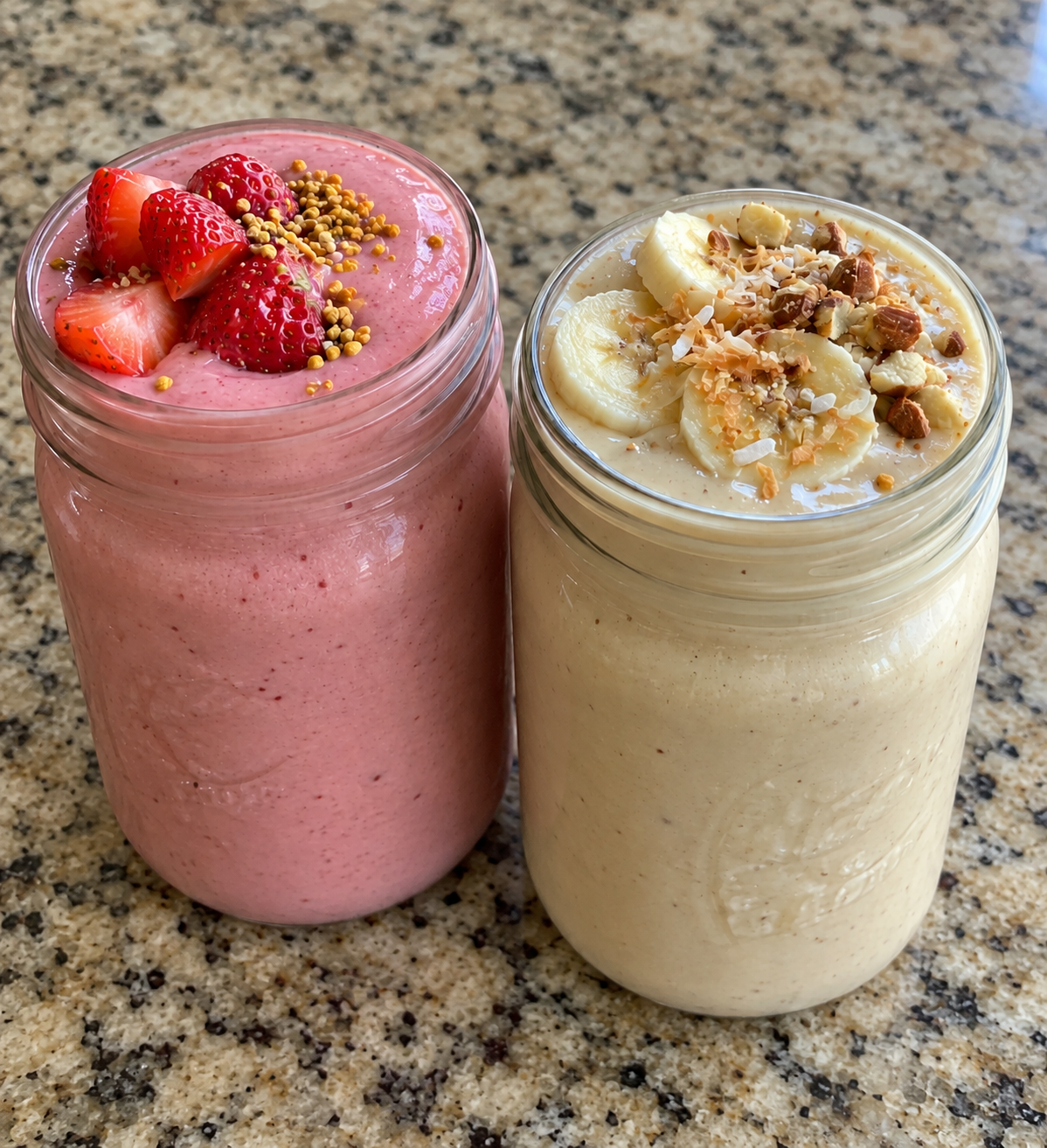
Strawberry Collagen Cream & Banana-Vanilla "Milkshake": Two Café-Style Smoothies with Collagen and Creatine
Two thick, creamy, café-style smoothies made with whole grass-fed milk, frozen fruit, and avocado, with a scoop of collagen and a little creatine blended in. They're perfect before or after a workout, or any time you need a quick, nourishing boost, with no gums, syrups, or fillers.
Yield: 1 large smoothie each · About 20 g protein each · Active: 5 min · Total: 5 min · Year-round (strawberries peak in North America from late spring into summer; frozen fruit works all year) · Best eaten: morning, or before or after a daytime workout
Whole Foods First, Powders in a Pinch
Before we get to the smoothies, an important note: the best way to get collagen and creatine is from real, whole food.
Collagen is the protein that builds your skin, tendons, ligaments, cartilage, and the matrix of your bones. Our ancestors ate it every day by eating the whole animal, nose to tail: skin, cartilage, tendons, and the gelatin-rich broth simmered from bones. You get it today from skin-on, bone-in cuts like chicken thighs and wings, oxtail, shanks, pork skin, fish skin, chicken feet, and especially homemade bone broth. (Learn how to make your own in my Broths 101 post.)
Creatine is found naturally in meat and fish, especially red meat, salmon, and herring, and your body also makes about 1 g a day on its own. A pound of raw beef holds roughly 2 grams.
Whole foods deliver these nutrients the way nature packaged them, alongside the minerals, fats, vitamins, and other amino acids that work with them. Collagen powder, by contrast, is collagen that's been broken down (hydrolyzed) into small peptides, and nearly all creatine supplements are made in a lab. Both are well studied and safe for most people, but they're isolated nutrients, not whole food. So always start with local, seasonal, nose-to-tail whole foods, and use powders as a helpful extra when life gets busy or you're training hard.
Recipe 1 — Strawberry Collagen Cream
Ingredients
1 cup whole grass-fed A2 milk (raw if you have access to a trusted source)
1 cup frozen strawberries, or other berries of choice
½ frozen banana
¼ ripe avocado
10–15 g grass-fed collagen peptides (about 1–1½ scoops, depending on the brand)
1 serving creatine monohydrate (3–5 g)
½ tsp pure vanilla extract
Pinch of Baja Gold sea salt
A handful of ice
Optional glass swirl
2–3 mashed fresh strawberries
2 tbsp raw grass-fed heavy cream or thick raw kefir
Method
Make the swirl (optional). Smear the mashed strawberries and a spoonful of cream around the inside of a tall glass.
Blend everything else until thick and completely smooth, about 45–60 seconds.
Pour into the glass and enjoy right away.
Recipe 2 — Banana-Vanilla "Milkshake"
When made very thick, this tastes almost like vanilla banana ice cream.
Ingredients
1 cup whole grass-fed A2 milk
½–1 frozen banana
¼ ripe avocado
10–15 g collagen peptides
3–5 g creatine monohydrate
½ tsp pure vanilla extract
¼ tsp ground Ceylon cinnamon
Pinch of Baja Gold sea salt
A handful of ice
Optional: 1 tbsp raw kefir or raw grass-fed cream, for extra richness
Optional: 1 pasture-raised egg yolk, for extra richness and nutrients
Method
Blend everything until thick and creamy, and pour into a chilled glass. Use less ice and more frozen banana for the thickest, most ice-cream-like texture.
My Basic Smoothie Formula
Once you have the formula, make it with any fruit you love:
1 cup whole grass-fed milk
About 1 cup fruit (fresh or frozen)
¼ avocado, for creaminess without gums
10–15 g collagen
3–5 g creatine
Vanilla and a pinch of sea salt
Ice
Optional: 1 pasture-raised egg yolk or a splash of raw kefir, for extra nourishment
It gives you that luxurious, café-style thickness, with real protein, healthy fat, and fruit instead of a sugary juice base.
Collagen vs. Creatine: Two Helpers for Different Jobs
Collagen (10–15 g a day)
Think: connective tissue → tendons → ligaments → joints → skin.
Joints: Systematic reviews find the most consistent benefits for joint pain and function, especially in active people and those with osteoarthritis.
Skin: Several studies show improvements in skin hydration and elasticity, though many were small and industry-funded, so the evidence is promising rather than settled.
Bones: In one well-known trial, postmenopausal women who took 5 g a day of specific collagen peptides for a year saw improved bone mineral density.
Muscle: In older men with age-related muscle loss (sarcopenia) who did strength training, adding 15 g of collagen led to greater gains in lean muscle than training alone.
Tendons: Research on taking collagen or gelatin with vitamin C about an hour before exercise has shown increased markers of collagen production. One cup of strawberries gives you about 60 mg of vitamin C, more than the amount used in that research. That's a great reason to pair collagen with strawberries before a workout.
An important note: Collagen is an incomplete protein (it's missing the amino acid tryptophan), so it shouldn't be your main protein source. Think of it as a helper alongside meat, fish, eggs, and dairy.
Creatine monohydrate (3–5 g a day)
Think: muscle energy → strength → power → training quality → lean muscle.
Strength and power: Creatine helps your muscles quickly recycle adenosine triphosphate (ATP), their main energy currency, during short, intense efforts. It's one of the most studied supplements in the world, with strong evidence for strength, power, and building or maintaining lean muscle with training.
Especially for women: One review estimates that women's natural creatine stores are 70–80% lower than men's, and studies suggest creatine may support strength and muscle across the lifespan. Paired with strength training, it has improved measures of hip-bone strength and shape in postmenopausal women. It didn't raise bone density itself in two 2-year trials, so think of it as support for bone quality rather than a density fix. In women with depression, it has also shown promise when added to standard antidepressant treatment.
For your brain: Your brain is an energy-hungry organ that uses creatine too, which is why creatine has nootropic-like effects. Studies have found improvements in memory and mental performance, especially during sleep deprivation and mental stress, in older adults, and in people who eat little or no meat. Results are more modest in young, well-rested, meat-eating adults.
Timing: You don't need to cycle it or time it precisely around workouts. What matters most is taking it consistently, every day.
The water weight caveat: Creatine pulls water into your muscles, so many people gain about 2–4 pounds in the first few weeks. That's water inside the muscle cells, not body fat, and it's part of how creatine works. Skipping a high-dose "loading phase" and starting with a steady 3–5 g a day makes the shift more gradual.
Why Whole Milk?
Grass-fed whole milk adds complete, high-quality protein, calcium, and fat-soluble vitamins, which makes these smoothies much more satisfying and nourishing than the typical fruit-and-almond-milk version (almond milk has very little protein). A2 milk comes from cows that naturally produce only A2 beta-casein, which many people find easier to digest.
Nourishment Notes
Strawberries — vitamin C, which your body needs to build collagen, plus anthocyanins and fiber.
Banana — potassium, magnesium, and natural sweetness. Frozen, it's the secret to a thick, ice-cream-like texture.
Avocado — monounsaturated fats, potassium, and fiber, and it makes the smoothie creamy without any gums or thickeners.
Whole grass-fed milk — complete protein, calcium, and fat-soluble vitamins A and K2. (Vitamin D in milk comes mostly from fortification, so raw milk carries very little.)
Collagen peptides — glycine, proline, and hydroxyproline, the building blocks of your connective tissue. Glycine also supports restful sleep.
Creatine — fuels quick muscle energy and supports strength, lean muscle, and brain energy.
Ceylon cinnamon and vanilla — warmth and flavor, plus cinnamon's polyphenols to help balance blood sugar.
A pinch of sea salt — trace minerals and electrolytes, especially helpful around workouts.
As a circadian food, these smoothies belong to the daytime: as a quick breakfast or a pre- or post-workout boost. Enjoy them in daylight, when your body handles the fruit's natural sugars best.
Sourcing
Milk — raw, whole milk from a trusted local dairy, or organic, grass-fed milk like Alexandre Family Farm (A2/A2, Regenerative Organic Certified), Kalona SuperNatural (low-temp vat-pasteurized, non-homogenized), or Organic Valley Grassmilk
Collagen peptides — from grass-fed, pasture-raised cattle and third-party tested for heavy metals (certified organic collagen is rare). Perfect Supplements sources from Brazilian pasture-raised, grass-fed cattle and lab-tests every batch, and Naked Collagen is NSF content-certified, from grass-fed, pasture-raised European cattle
Creatine — pure creatine monohydrate with nothing added, third-party tested. Lineage Provisions (co-founded by Dr. Paul Saladino) is backed by ISO 17025-accredited third-party testing and made in an NSF-certified facility, or look for creatine made with Creapure, a high-purity creatine monohydrate made in Germany
Strawberries — organic (conventional strawberries carry some of the highest pesticide residues of any fruit), fresh in season or frozen
Bananas and avocados — organic
Eggs (optional) — organic and pasture-raised, from a local farm where the hens truly range on pasture, or Alexandre Family Farm
Raw kefir or heavy cream (optional) — raw kefir or raw cream from a trusted local dairy, or organic grass-fed heavy cream
Vanilla — organic pure vanilla extract with no added sugar
Ceylon cinnamon — organic (which also means non-irradiated), from Sri Lanka
Baja Gold sea salt
Know your farmer: Raw milk and raw yolks are only as good as the farm they come from. Buy from a small, trusted farm that tests rigorously, keeps its animals on pasture, and will happily walk you through how it handles and chills its milk.
Storage
Smoothies are best enjoyed right away. To save time, pack the fruit and avocado into freezer bags as single-serving smoothie packs, then just add the milk, collagen, creatine, and vanilla and blend.
Love these? My raw kefir smoothies pack in collagen and creatine too, and you can browse plenty more recipes while you're there.
— Anna aka Food Marshall