Peach, Goat Cheese, and Sage Galette
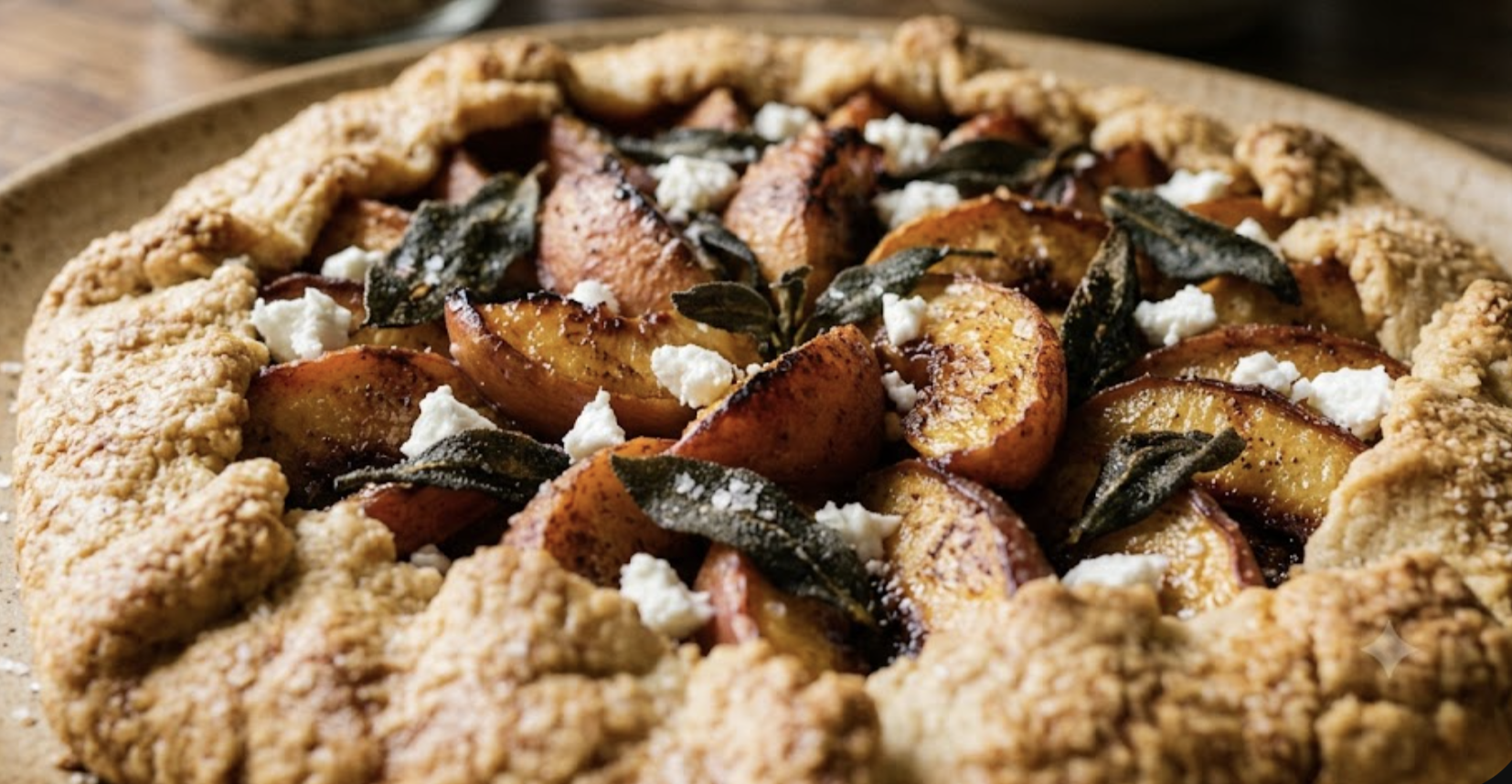
A rustic free-form pastry with brown-butter caramelized peaches, whipped goat cheese, and crispy fried sage on an almond-cassava crust. Naturally grain-free, gluten-free, refined-sugar-free, and built around peak late-summer ingredients.
Yield: 8 servings
Active: 1 hr · Total: 2 hr 15 min (including pastry chill)
Late summer to early autumn (peak peach season — July through September)
A note from the kitchen
This is a rustic free-form tart that honors peak peach season — caramelized brown-butter peaches over a tangy whipped goat cheese filling, all wrapped in an almond-cassava pastry that's flaky despite being grain-free. Finished with crispy fried sage scattered across the top,. Fresh sage can taste medicinal raw, but frying for 30 seconds in olive oil transforms the leaves into almost-candy-textured chips that add aromatic complexity and visual contrast against the soft peaches and creamy filling.
Best made in peak peach season (July through September), when peaches are fragrant, juicy, and yielding slightly to gentle pressure. Out-of-season peaches are usually mealy and lacking flavor — worth waiting for the right moment.
Ingredients
Almond-cassava pastry
1 cup blanched almond flour
¾ cup cassava flour
¼ cup arrowroot powder (or tapioca flour)
½ tsp sea salt
8 tbsp grass-fed butter, cold and cubed
1 pasture-raised egg
2-3 tbsp ice water
Brown-butter peaches
4 ripe peaches, pitted and quartered (skin on or off, your preference)
2 tbsp grass-fed butter
2 tbsp coconut sugar
1 tsp ground Ceylon cinnamon
½ tsp pure vanilla extract
Pinch sea salt
Crispy fried sage
12 fresh sage leaves
2 tbsp extra virgin olive oil
Whipped goat cheese filling
4 oz fresh chèvre, at room temperature
4 oz crème fraîche or whipped raw cream cheese
2 tbsp pure maple syrup
Pinch sea salt
1 tsp lemon zest (optional)
Egg wash and finish
1 pasture-raised egg yolk, beaten with 1 tsp water
Coconut sugar, for sprinkling (optional)
Maldon flaky sea salt, for finishing
Garnish
A drizzle of raw honey (optional)
A few fresh basil leaves (optional, for color contrast)
Method
Make the pastry
Pulse the dry ingredients. In a food processor, pulse the almond flour, cassava flour, arrowroot, and salt to combine.
Cut in the butter. Add the cold cubed butter and pulse until pea-sized pieces form throughout. Don't over-process — visible butter pieces produce a flakier pastry.
Add the egg and water. Add the egg and 2 tbsp ice water. Pulse until the dough begins to clump. Add the third tbsp of water if needed — the dough should hold together when pinched but not be sticky.
Shape and chill. Turn the dough out onto a clean surface. Knead briefly into a flat disk. Wrap in parchment and refrigerate at least 1 hour (or up to overnight) so the butter can re-firm.
Preheat oven and prep
Preheat the oven. Heat the oven to 375°F (190°C). Line a sheet pan with parchment.
Make the brown-butter peaches
Brown the butter. In a large skillet, heat the 2 tbsp butter over medium heat. Swirl the pan occasionally as the butter foams. After 2-3 minutes, the foaming will subside and the milk solids at the bottom will turn golden brown — the butter should smell nutty and toasted.
Add the peaches. Add the peach quarters cut-side down. Sprinkle with coconut sugar, cinnamon, vanilla, and a pinch of salt.
Pan-fry the peaches. Cook 3-4 minutes per side, until lightly caramelized at the edges and the peaches have softened slightly. Remove from the pan and let cool slightly. The peaches should retain their shape but be tender.
Crisp the sage
Heat the olive oil. In a small skillet, heat the olive oil over medium-high heat until shimmering.
Fry the sage. Add the sage leaves in a single layer (don't crowd). Fry 30 seconds per side until crisp and translucent. Don't let them brown deeply or they turn bitter. Drain on a paper towel-lined plate.
Make the goat cheese filling
Whip the cheese. In a food processor or with a hand mixer, whip the chèvre, crème fraîche, maple syrup, salt, and optional lemon zest until light and smooth, about 1 minute.
Assemble the galette
Roll the pastry. Place the chilled dough between two sheets of parchment paper. Roll into a rough 12-inch circle, about ⅛-inch thick. Remove the top parchment.
Transfer to the sheet pan. Carefully slide the pastry (still on the bottom parchment) onto the prepared sheet pan.
Spread the filling. Spread the whipped goat cheese filling across the center of the pastry, leaving a 1½-inch border of bare pastry around the edges.
Arrange the peaches. Arrange the brown-butter peach quarters over the filling in a single layer, cut-side up. Pour any remaining brown butter from the skillet over the peaches.
Fold the pastry. Fold the bare pastry edges inward over the peaches, crimping naturally as you go — the center should remain open with the peaches and filling visible. The pastry doesn't need to be perfectly even — the rustic look is the point.
Egg wash and sugar. Brush the folded pastry edges with the egg yolk wash. Sprinkle with coconut sugar if using.
Bake
Bake. Bake 28-32 minutes, until the crust is deeply golden brown and the peaches are bubbling.
Finish and serve
Cool briefly. Remove from the oven and let the galette cool 10 minutes — this allows the filling to set slightly for cleaner slicing.
Scatter sage and finish. Scatter the crispy fried sage leaves over the warm galette. Sprinkle with a pinch of Maldon salt. Optional: drizzle lightly with raw honey for additional sweetness, or scatter a few fresh basil leaves for color.
Slice and serve. Slice into 8 wedges. Serve warm or at room temperature.
Variations
With nectarines or apricots: Substitute the peaches with nectarines (similar to peaches, slightly more tart) or apricots (smaller, more concentrated flavor, slightly drier — increase butter to 3 tbsp).
With ripe figs (autumn variation): Substitute the peaches with 8-10 fresh ripe figs (Black Mission, Brown Turkey), halved or quartered. Skip the brown-butter pan-fry — figs are tender enough to go on raw. Reduce the bake time to 22-25 minutes.
With ripe pears (autumn variation): Substitute the peaches with 3 ripe but firm Bartlett or Anjou pears, peeled, cored, and sliced. Pan-fry in brown butter as for peaches. Pair beautifully with the goat cheese and sage.
With prosciutto or jamón ibérico: After baking, drape thin slices of prosciutto, jamón serrano, or jamón ibérico over the warm peaches just before serving. The salty cured pork pairs beautifully with the sweet caramelized peaches.
With added rose water: Add 1 tsp rose water to the whipped goat cheese filling for a Persian-Mediterranean floral note.
With sheep's milk cheese instead of chèvre: Substitute the chèvre with fresh sheep's milk ricotta (Bellwether Farms) or whipped raw sheep's milk cheese. Slightly milder, creamier.
With thyme instead of sage: Substitute the crispy fried sage with fresh thyme leaves (no frying needed — sprinkle raw over the warm galette). Lighter, more floral.
With balsamic reduction drizzle: Drizzle the warm galette with aged balsamic vinegar (reduce 2 tbsp aged balsamic with 1 tsp honey in a small pan until syrupy, cool, drizzle) for added depth.
Mini galettes (individual portions): Divide the pastry into 6 smaller rounds (about 5 inches each). Top each with a smaller portion of filling and 2-3 peach quarters. Fold the edges in. Bake 22-25 minutes. Beautiful for individual plating at dinner parties.
Make ahead: The pastry can be made 1-2 days ahead and refrigerated, or frozen up to 2 months. The brown-butter peaches and whipped goat cheese filling can be made up to 1 day ahead and refrigerated separately. Assemble and bake just before serving for the freshest result.
Pairs Well With
A small bowl of plain Greek yogurt drizzled with raw honey alongside the galette for a more substantial dessert presentation. Fresh ripe figs, summer berries, or sliced stone fruit alongside for visual contrast and bright acidity. For a complete dinner spread, serve as a starter or dessert alongside roasted lamb shoulder, slow-braised short ribs, or grilled wild fish. As a brunch centerpiece, serve with a vegetable frittata or scrambled eggs, a small bowl of fresh berries, and a few thin slices of pastured bacon or smoked wild salmon.
Sourcing
Fresh peaches. Look for fragrant, slightly yielding peaches with vibrant orange-red skin and a sweet smell at the stem end. Heirloom and heritage varieties (Frog Hollow, Mascher Family Farms, Suncrest, O'Henry, Elberta) carry meaningfully more flavor than commodity supermarket peaches. From a farmers' market or CSA share at peak season (July-September). Avoid hard, pale, or scentless peaches — they were picked underripe and won't develop flavor.
Almond flour. Finely ground blanched almond flour (skins removed) — not almond meal. Bob's Red Mill Super-Fine, Anthony's Goods, or King Arthur Baking.
Cassava flour. Single-ingredient cassava flour (not tapioca flour — they're different products). Otto's Naturals is the benchmark for baking; Bob's Red Mill is also reliable.
Arrowroot powder. Single-ingredient arrowroot. Bob's Red Mill or Anthony's Goods. Tapioca flour works as a substitute.
Grass-fed butter. From cows on pasture year-round. Vital Farms, Organic Valley Pasture Butter, Beurre d'Isigny, Kerrygold Reserve, or local artisan brands. Cold butter is essential for the flaky pastry; quality butter is essential for the brown-butter peaches.
Fresh chèvre. From a small dairy. Vermont Creamery, Cypress Grove, Laura Chenel, Humboldt Fog, or local farmers' market goat dairies. Avoid shelf-stable supermarket goat cheese logs.
Crème fraîche or raw cream cheese. Look for traditional French-style crème fraîche (Vermont Creamery, Kalona Organic) or raw cream cheese from a local raw dairy producer. For shipped options: Bellwether Farms cultured crème fraîche.
Pasture-raised eggs. Yolks should be deep orange. From a farmers' market or local farm. Vital Farms is a reliable shipped option.
Pure maple syrup. Grade A dark or amber. Crown Maple, Hidden Springs Maple, Coombs Family Farms, or Anderson's.
Coconut sugar. Single-ingredient organic coconut sugar (not "coconut palm sugar" with additives). Wholesome Sweeteners, Big Tree Farms, or Anthony's Goods. Use sparingly — this is a concentrated sweetener.
Ground Ceylon cinnamon. True Ceylon cinnamon (not Cassia). Burlap & Barrel or Diaspora Co. (single-origin Sri Lankan).
Pure vanilla extract. Single-ingredient (just vanilla and alcohol or vegetable glycerin), no added sugars. Singing Dog Vanilla, Frontier Co-op, or specialty spice retailers.
Fresh sage. From a windowsill pot or farmers' market. Fresh sage is essential — dried sage doesn't deliver the same character.
Single-estate extra virgin olive oil. Harvest-dated within the last 12 months, in a dark glass bottle. Italian or Spanish single-origin works beautifully.
Sea salt. Baja Gold mineral sea salt for cooking, Maldon flaky sea salt for finishing.
Storage
Baked galette (room temperature): Best within 4-6 hours of baking. The pastry is crispest the day it's made.
Baked galette (refrigerated): Up to 2 days, sealed. The pastry softens noticeably after the first day. Reheat at 325°F for 8-10 minutes to recrisp before serving.
Unbaked galette (refrigerated): Up to 24 hours, well-wrapped. Bring to room temperature briefly before baking.
Pastry dough alone (refrigerated): Up to 3 days, wrapped.
Pastry dough alone (frozen): Up to 2 months, well-wrapped.
Brown-butter peaches alone: Refrigerated up to 3 days, sealed. Excellent on yogurt, oatmeal, or fresh ricotta for breakfast.
Whipped goat cheese filling alone: Refrigerated up to 5 days, sealed. Excellent as a spread on grain-free crackers or sliced cucumber rounds.
Crispy fried sage leaves: Best the day made. Lose their crispness after a few hours.
Why This Galette: Nourishment notes
This is late-summer baking with traditional fats, whole-food sweeteners, and peak-season fruit — every component doing meaningful nourishment work without compromising on the dessert experience.
Peaches — vitamin C, fiber, and polyphenols. Fresh ripe peaches deliver vitamin C, fiber (about 2g per medium peach), potassium, beta-carotene, and a range of polyphenols (chlorogenic acid, catechins, anthocyanins in the red-blushed skin). Heirloom and heritage peach varieties carry meaningfully more polyphenols than commodity peaches — the skin's red blush is the visual signal of anthocyanin concentration.
Grass-fed butter — CLA, butyrate, and vitamin K2. Real butter from grass-fed cows delivers conjugated linoleic acid (CLA), short-chain fatty acid precursors that support gut health, beta-carotene, and vitamin K2 (essential for calcium metabolism and arterial health). Brown butter specifically develops Maillard-reaction compounds during heating — adding flavor depth and acting as a flavor amplifier for everything it touches.
Fresh chèvre — A2 casein and easy digestibility. Goat's milk produces only A2 beta-casein, which doesn't trigger the inflammatory response that A1 cow casein can in sensitive individuals. Goat cheese also delivers calcium, phosphorus, vitamin A, and the medium-chain fatty acids characteristic of goat dairy. Many people who don't tolerate cow dairy can eat goat cheese comfortably.
Crème fraîche — live cultures and concentrated fat. Traditional crème fraîche is cultured cream that delivers live probiotic cultures, fat-soluble vitamins A, D, K2, and the satisfying mouthfeel that the whipped filling provides. Cultured dairy is more easily digestible than uncultured dairy.
Almond flour — vitamin E and magnesium. Almond flour delivers vitamin E (alpha-tocopherol form), magnesium, copper, riboflavin, and monounsaturated fats. The protein and fat content slows the carbohydrate release from the pastry.
Cassava flour — resistant starch and grain-free baking. Cassava flour (made from the whole cassava root) delivers fiber, resistant starch (which feeds beneficial gut bacteria), vitamin C, and copper. The resistant starch content increases when cooled-and-reheated foods are eaten.
Sage — anti-inflammatory terpenes. Sage delivers terpenes (thujone, camphor, eucalyptol) with documented anti-inflammatory, antimicrobial, and digestive-supporting effects. Traditional Mediterranean cooking has used sage as both flavor and medicine for thousands of years. The crispy-fried preparation concentrates the volatile oils into a small, intense flavor delivery.
Pure maple syrup and coconut sugar — natural cofactors. Maple syrup delivers manganese, zinc, calcium, potassium, and over 65 documented polyphenol compounds. Coconut sugar (used in small quantities for the peaches and crust topping) delivers a moderate glycemic load with some mineral content (iron, zinc, calcium). Both used moderately across the galette (less than 1 tbsp per serving) deliver gentler sweetness with intact cofactors that refined sugar lacks entirely.
Ceylon cinnamon — anti-inflammatory and blood-sugar supportive. True Ceylon cinnamon (not Cassia) delivers cinnamaldehyde, eugenol, and other polyphenols with documented anti-inflammatory effects. Studies on cinnamon suggest blood-sugar-supportive effects when consumed with sweet foods.
Pasture-raised eggs — choline and fat-soluble vitamins. The egg yolk in the pastry and the egg wash delivers choline (essential for brain and liver function), lutein and zeaxanthin (eye-supporting carotenoids), and vitamins A, D, E, and K2 in the deep orange yolks.
Why this kind of baking matters. Most American summer desserts deliver refined wheat flour, refined cane sugar, hydrogenated industrial fats, and underripe commodity fruit. This galette inverts all of that. The flour is whole-food (almond + cassava + arrowroot). The fat is real (grass-fed butter, pasture-raised eggs, raw chèvre). The sweetness is gentle and fiber-bound (peak peaches + maple syrup + coconut sugar). Every component is doing real nourishment work — and the result is a dessert that honors the brief, beautiful moment when summer peaches are at their peak.
— Anna aka Food Marshall