Ribeye with Herb Mushrooms, Béarnaise Sauce, and Shallot Jus
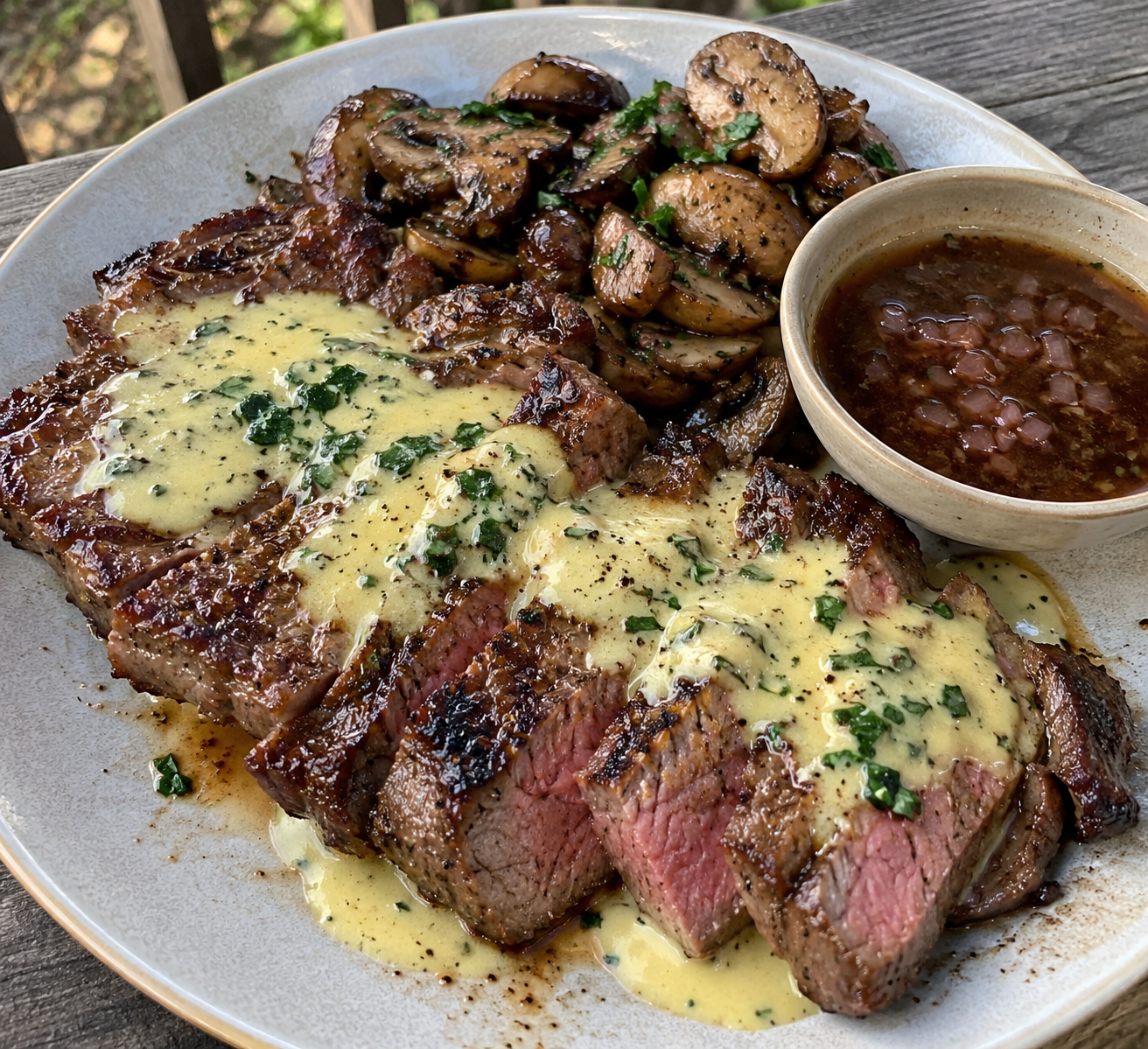
Yield: Serves 4 · Active: 50 min · Total: 1 hour 15 minutes · Year-round, and especially lovely in fall, when wild mushrooms like chanterelles and maitake fill Pacific Northwest and New England markets · Cuisine: French · Best eaten: early evening
Looking for something simpler? See my Steak with Caramelized Onion Butter.
Your Game Plan
1 hour before: Salt the steaks, and let them come to room temperature.
45 minutes before: Start the shallot jus, and let it simmer while you work.
30 minutes before: Roast the mushrooms.
20 minutes before: Make the béarnaise, and keep it warm.
15 minutes before: Sear the steaks.
While the steaks rest: Finish the jus in the steak pan.
Recipe 1: Butter-Basted Ribeye
2 grass-fed ribeye steaks (1½ inches thick, about 1¼ lbs each), or 4 smaller ribeyes
2 tsp Baja Gold sea salt
1 tsp black pepper
1 tbsp beef tallow or avocado oil
3 tbsp grass-fed butter
4 garlic cloves, smashed
4 sprigs fresh thyme
1 sprig fresh rosemary
Flaky salt, to finish
Salt ahead. Pat the steaks dry, and season all over with the salt and pepper. Let them sit at room temperature for 45–60 minutes (or salt them up to 24 hours ahead, uncovered in the fridge, for an even better crust).
Heat the pan. Heat a large cast iron skillet over high heat until it just starts to smoke, then add the tallow.
Sear. Lay the steaks in the pan, and don’t move them for 3–4 minutes, until a deep brown crust forms. Flip, and sear 3 minutes more. Use tongs to sear the fat cap along the edge, too.
Butter-baste. Lower the heat to medium. Add the butter, garlic, thyme, and rosemary. Once the butter foams, tilt the pan, and spoon the butter over the steaks continuously for 1–2 minutes.
Check the temperature. Take the steaks out of the pan about 5°F below your target, since they keep cooking as they rest:
Rare: 120°F
Medium-rare: 125–130°F (the classic choice for ribeye, since the marbling melts nicely)
Medium: 135–140°F
Rest the steaks 8–10 minutes on a board, spooning the herb butter over them. Keep the pan, with its browned bits, for the jus.
Slice against the grain into thick slices, and finish with flaky salt.
Recipe 2: Shallot Jus
4 shallots, thinly sliced
1 tbsp grass-fed butter, plus 2 tbsp cold butter to finish
2 cups beef bone broth
½ cup dry red wine (optional; or 1 tbsp balsamic vinegar plus ¼ cup more broth, for an alcohol-free version)
2 sprigs fresh thyme
1 bay leaf
1 tsp Dijon mustard
Baja Gold sea salt and black pepper
Soften the shallots. Melt 1 tbsp butter in a small saucepan over medium heat. Add the shallots and a pinch of salt, and cook 6–8 minutes, until soft and golden.
Deglaze. Add the wine (or balsamic), and simmer until almost evaporated, about 3 minutes. If you use wine, simmering it this way cooks off most, but not all, of the alcohol.
Reduce. Add the broth, thyme, and bay leaf, and simmer 20–25 minutes, until reduced by about half.
Finish in the steak pan. While the steaks rest, pour off any extra fat from the skillet, and pour in the jus. Scrape up the browned bits, and simmer 1–2 minutes. Take it off the heat, remove the thyme and bay leaf, and whisk in the Dijon and the 2 tbsp cold butter, until glossy. Season to taste.
Recipe 3: Herb Mushrooms
1½ lbs mixed mushrooms (cremini, shiitake, oyster, maitake, or chanterelles in season), torn or sliced
3 tbsp grass-fed butter or ghee, melted
2 garlic cloves, minced
1 tbsp fresh thyme leaves
1 tsp fresh rosemary, finely chopped
2 tbsp fresh parsley, chopped
1 tbsp fresh chives, chopped
Squeeze of lemon
Baja Gold sea salt and black pepper
Roast. Heat the oven to 425°F. Toss the mushrooms with the butter, thyme, rosemary, salt, and pepper, and spread them on a sheet pan with plenty of space between them (crowded mushrooms steam instead of browning). Roast 20–25 minutes, tossing once, until golden and crisp at the edges.
Finish. Toss the hot mushrooms with the garlic, parsley, chives, and a squeeze of lemon. The heat of the mushrooms will gently cook the garlic.
Recipe 4: Béarnaise Sauce
¼ cup white wine vinegar
1 shallot, finely minced
2 tbsp fresh tarragon, chopped, plus 1 tbsp to finish
½ tsp whole black peppercorns, crushed
3 pasture-raised egg yolks
1 tbsp water
½ cup (1 stick) grass-fed butter, melted and warm (or ½ cup grass-fed ghee)
1 tsp fresh lemon juice
Pinch of Baja Gold sea salt
Optional: 1 tsp fresh chervil or parsley, chopped
Make the reduction. Simmer the vinegar, shallot, 2 tbsp tarragon, and peppercorns in a small saucepan until only about 1½ tbsp of liquid is left, 4–5 minutes. Strain it through a fine sieve, pressing on the solids, and let it cool a little.
Set up a double boiler. Bring an inch of water to a bare simmer in a saucepan, and set a heatproof bowl over it, without touching the water.
Whisk the yolks. Whisk the egg yolks, water, and vinegar reduction in the bowl constantly, for 2–3 minutes, until pale, thick, and the whisk leaves trails. If the bowl gets too hot to touch, lift it off the heat for a moment; too much heat scrambles the yolks.
Add the butter. Take the bowl off the heat. Whisking constantly, drizzle in the warm butter a few drops at a time at first, then in a thin stream, until thick and glossy.
Finish with the lemon juice, salt, the remaining tarragon, and the chervil (if using).
Keep it warm. Béarnaise can’t be reheated, so keep it in a warm (not hot) spot near the stove, or in a preheated thermos, for up to 1 hour.
If the sauce breaks: Whisk 1 tbsp warm water into a fresh egg yolk in a clean bowl, then slowly whisk the broken sauce into it, a spoonful at a time.
A note on the eggs: The yolks in béarnaise are only gently cooked. If you’re pregnant or serving young children or anyone with a weakened immune system, use pasteurized eggs.
To Serve
Spoon the shallot jus onto warm plates, and lay the sliced ribeye over it. Pile the herb mushrooms alongside, and spoon the béarnaise over the steak or serve it in a small bowl at the table. A simple green salad, roasted potatoes, or my Roasted Potatoes Four Ways round out the plate. If you drink, a Bordeaux or Cabernet Sauvignon is the classic match.
Storage
Leftover steak: refrigerated, up to 3 days. Slice it thin and enjoy it cold over greens, or warm it gently in a skillet with a little butter.
Shallot jus: refrigerated up to 5 days, or frozen up to 3 months.
Herb mushrooms: refrigerated, up to 4 days.
Béarnaise: best the day it’s made. Leftovers keep 2 days in the fridge; let them come to room temperature and spoon them over warm food (don’t reheat).
Nourishment Notes
Grass-fed ribeye — heme iron, zinc, B12, B6, selenium, creatine, and complete protein. Grass-fed beef also has more omega-3s, CLA, and vitamin E than grain-fed beef, and its marbling brings rich, satisfying fat.
Mushrooms — B vitamins (riboflavin, niacin, and pantothenic acid), selenium, potassium, beta-glucans studied for supporting the immune system, and ergothioneine, an antioxidant found mostly in mushrooms.
Béarnaise — pasture-raised egg yolks bring choline, vitamins A, D, E, and K2, and lutein; grass-fed butter brings butyrate and fat-soluble vitamins. Tarragon has been used to ease digestion for centuries.
Shallot jus — gelatin, glycine, and minerals from the bone broth, plus quercetin from the shallots.
Fresh herbs — rosmarinic acid, carnosic acid, and thymol in the thyme and rosemary, plus vitamins K and C in the parsley and chives.
Garlic — allicin and sulfur compounds.
As a circadian food, this rich meal is best as an early dinner, so your body has time to digest before sleep. It’s a celebration plate: slow down, and savor it.
For your cycle: The heme iron, zinc, and B12 make this especially restorative during and just after your period, and the satisfying protein and fat suit the luteal phase, when your body asks for more fuel.
Sourcing
Ribeye — 100% grass-fed and finished, from a local farm, US Wellness Meats, or White Oak Pastures
Beef bone broth — homemade from grass-fed bones, or Kettle & Fire
Beef tallow — grass-fed, from your butcher or Fatworks
Mushrooms — organic, from a farmers’ market or a local mushroom grower; wild chanterelles in season
Eggs — organic and pasture-raised, from a local farm
Grass-fed butter and ghee — organic, from 100% grass-fed cows
Shallots, garlic, herbs, and lemons — organic, from a farmers’ market
White wine vinegar — organic and naturally fermented
Red wine (optional) — organic and low-sulfite, from a small producer
Dijon mustard — organic, like Delouis Fils or Maison Orphée
Peppercorns — organic and non-irradiated, freshly crushed
Salt — Baja Gold sea salt; Maldon for finishing
— Anna aka Food Marshall