Slow-Roasted Pork Shoulder with Caramelized Onions and Herbs
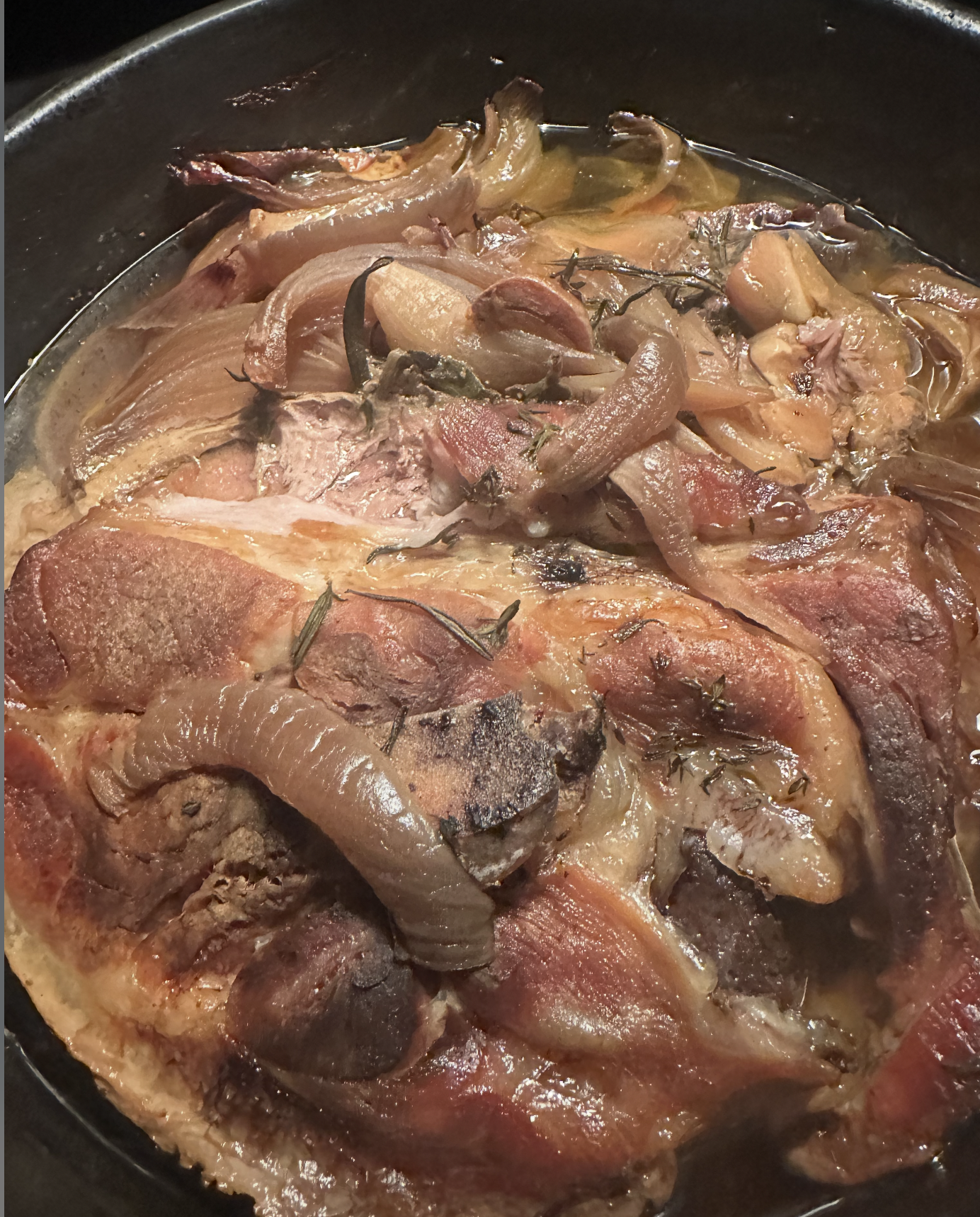
A pasture-raised pork shoulder slow-roasted with a pile of onions, fresh thyme, and rosemary — the foundational cold-weather main that feeds a crowd and leaves three days of leftovers
Serves 8–10 (with leftovers for 2–3 additional meals) · 30 min active · 5–6 hr total (plus optional overnight dry brine) · autumn / winter · early evening (Sunday-supper format)
Ingredients
Pork shoulder
1 pasture-raised bone-in pork shoulder (4–5 lbs, sometimes labeled "Boston butt" or "picnic shoulder")
2 tbsp sea salt (1 tbsp per 2 lbs, scale accordingly)
1 tbsp freshly ground black pepper
1 tsp ground coriander (optional, for warm spice depth)
1 tsp smoked paprika (optional, deepens the crust color)
Aromatics
4 medium yellow onions (or 6 small), peeled and thickly sliced into half-moons
1 whole head garlic, cloves separated and peeled, lightly smashed
8–10 fresh thyme sprigs
4–5 fresh rosemary sprigs
2 fresh sage leaves (optional)
2 bay leaves
Cooking liquid (optional but recommended)
1 cup homemade chicken or pork bone broth
½ cup dry white wine (or apple cider, for a slightly sweeter profile)
2 tbsp pasture-raised lard (or grass-fed butter, for searing)
For finishing
flaky sea salt
additional fresh thyme leaves
freshly cracked black pepper
Method
Dry brine (overnight, optional but transformative). The night before cooking, pat the pork shoulder completely dry with paper towels. Rub all surfaces with the salt, pepper, coriander, and paprika. Place uncovered on a wire rack set over a sheet pan in the refrigerator overnight (8–24 hours). The dry brine is structurally important — it draws moisture out, then redistributes it back into the meat with the seasoning, and the air-dried surface produces dramatically better browning when seared.
Bring to room temperature. Remove the shoulder from the refrigerator 1 hour before cooking to take the chill off.
Preheat the oven to 300°F. Position a rack in the lower third of the oven.
Sear the shoulder. Heat the lard in a large heavy enamel or cast iron Dutch oven over medium-high heat until shimmering. Add the pork shoulder fat-side down and sear 4–5 minutes without moving until deeply golden. Flip and sear the remaining sides, 3–4 minutes each, building a uniform deep brown crust. Transfer to a plate.
Soften the onions. Reduce the heat to medium. Add the sliced onions to the same pot with the rendered fat. Sprinkle with a pinch of salt. Cook 8–10 minutes, stirring occasionally, until the onions are soft, golden at the edges, and beginning to caramelize.
Add aromatics. Stir in the smashed garlic cloves, fresh thyme, rosemary, sage (if using), and bay leaves. Cook 1 minute until fragrant.
Build the braising bed. Pour in the white wine (or apple cider) and let it reduce 2–3 minutes, scraping up any fond from the bottom. Add the bone broth.
Nestle the shoulder. Place the seared pork shoulder back in the pot, fat-side up, on top of the onions and aromatics. The liquid should come about ⅓ of the way up the side of the shoulder — don't submerge it.
Slow-roast. Cover the pot with the lid (or tightly with parchment + foil if no lid) and transfer to the oven. Roast 4–5 hours, until the meat shreds easily when pulled with a fork (internal temperature 200–205°F).
Optional final crust. For a deeper, crispier exterior: remove the lid for the final 30–45 minutes of cooking, increase oven to 350°F, and let the top develop a darker caramelized crust. This is the visual finish your photo shows — the deep mahogany top with crisped edges around the onions.
Rest. Remove the pot from the oven. Let the shoulder rest, uncovered, 20–30 minutes before serving. This is non-negotiable — the meat continues to redistribute juices, and slicing or shredding too early loses the structural moisture.
Serve. Bring the entire pot to the table. Shred the meat with two forks directly in the pot, or slice thickly. Serve with a generous spoonful of the caramelized onions and a ladle of the pan juices over each portion. Finish with flaky sea salt, fresh thyme leaves, and cracked pepper.
Storage: Refrigerate 4–5 days, fully submerged in the pan juices for best texture. Freezer up to 3 months. Reheat gently in a covered pot at 300°F with a splash of broth to restore moisture.
Serving Suggestions — Building a Full Plate
The pork shoulder is rich, fatty, and concentrated; the right accompaniments balance with brightness, crunch, and starch. Here are five serving formats that work structurally with this dish:
1. Sunday supper plate (autumn-winter classic)
Silky cauliflower purée or mashed celeriac (the foundational French pairing for slow-roasted pork)
Roasted root vegetables — carrots, parsnips, fennel — tossed with olive oil and roasted at 425°F for 25 minutes
Wilted bitter greens — lacinato kale or escarole sautéed quickly with garlic and olive oil
Crusty sourdough bread for soaking up the pan juices
2. Latin American format (carnitas-style tacos)
Warm corn tortillas (homemade if possible — refer to Duck Tacos with Nixtamalized Corn Tortillas recipe blog post)
Quick pickled red onions — thin slices in apple cider vinegar with a pinch of salt 30 minutes
Fresh cilantro, lime wedges, sliced radishes
Fermented hot sauce or homemade salsa verde
The pork shreds into beautiful carnitas if crisped briefly in a hot skillet just before serving
3. Mediterranean format
White beans simmered in the pan juices (cannellini or gigantes) — the most direct way to use the leftover liquid
Bitter greens salad — radicchio, escarole, frisée — with a sharp lemon-anchovy dressing
Roasted cherry tomatoes with garlic and basil
Good olive oil, lemon wedges, crusty bread
4. Bowl format (lighter, weeknight-friendly)
Cooked grain or pseudo-grain — quinoa, farro, or short-grain brown rice
Massaged kale or arugula
Roasted sweet potato or butternut squash cubes
Soft-boiled or fried pasture egg on top
Drizzle of pan juices, pickled vegetables, fresh herbs
5. Sandwich format (next-day leftovers)
Toasted sourdough or homemade rolls
Sharp aged cheddar or raw Gruyère
Quick cabbage slaw with apple cider vinegar
Whole-grain mustard and a thin layer of fermented sauerkraut or pickles
Bonus — What to Do with the Pan Juices and Bones
The pan juices and the bone left after the meat is shredded are structurally a second meal in waiting. Three high-value uses:
1. White bean braise. Strain the pan juices through a fine-mesh sieve into a saucepan. Add 2 cups cooked white beans, simmer 10 minutes, finish with fresh herbs and a squeeze of lemon. A complete meal in itself.
2. Pork-and-onion soup base. Combine the pan juices with 4 cups bone broth, leftover shredded pork (about 2 cups), and a handful of caramelized onions. Simmer 20 minutes, finish with fresh parsley and other veggies and greens of choice.
3. Posole or pork-and-hominy stew. Use the pan juices and bone as the foundation for a Mexican-style posole — add hominy, dried chiles (guajillo, ancho), and oregano; simmer 30 minutes; finish with shredded cabbage, radish, lime, and avocado.
The bone itself can also be added to your next chicken or beef bone broth batch — the marrow and connective tissue from a roasted pork shoulder bone deepens the broth's structural body considerably.
Nourishment Notes
Pasture-raised pork is structurally and nutritionally distinct from commodity confinement pork. Pigs raised on pasture, foraging for acorns, roots, grubs, and pasture forage, develop a meaningfully different fat profile — significantly higher in vitamin D₃ (one of the few non-fish food sources, deposited in the fat from sun exposure during grazing), higher in vitamin E and selenium, and with a substantially better omega-3 to omega-6 ratio than grain-finished confinement pork. The pork shoulder cut itself — known as "Boston butt" in the US, paleta in Spanish, épaule in French, Schweineschulter in German — has been the foundational slow-cooked pork preparation across nearly every European, Latin American, and Asian peasant cookery tradition for centuries. The structural reason: shoulder is a hardworking muscle group rich in connective tissue (collagen) that breaks down into gelatin at low temperatures over long cooking times, producing the silky, falling-apart texture that defines proper slow-cooked pork.
The collagen-to-gelatin transformation is the central biochemistry of this dish. At 200–205°F internal temperature, the connective tissue (specifically Type I collagen) breaks down into gelatin — the same compound that gives bone broth its structural body. Gelatin in the gut supports intestinal lining repair, provides glycine (the most abundant amino acid in collagen, with a calming effect on the nervous system and as a precursor for glutathione), and is particularly easy to digest compared to muscle protein alone. This is why traditional cultures across the world favored slow-cooked tougher cuts (shoulder, shank, brisket) over leaner muscle for everyday eating — the slow-cooked preparation extracts and concentrates the most nutritionally meaningful components of the animal.
The aromatic architecture — caramelized onions, fresh thyme, fresh rosemary, garlic, bay — is structurally borrowed from the foundational European mirepoix and bouquet garni traditions of slow-cooked meat preparations. Yellow onions release their natural sugars when cooked slowly, contributing quercetin (a flavonoid with cardiovascular benefits), prebiotic fructans that feed beneficial gut microbes, and the complex Maillard browning compounds that develop during the slow oven roast. Fresh thyme contributes thymol (an antimicrobial compound studied for digestive support) and is one of the foundational herbs across nearly every European peasant cookery. Fresh rosemary contributes carnosic acid and rosmarinic acid (both studied for anti-inflammatory and protective effects); rosemary's traditional pairing with pork dates to medieval European cookery, where the herb's strong flavor cut through the richness of slow-cooked fatty meats. Garlic, slow-roasted in its skin or peeled and smashed, contributes allicin (when crushed) and the broader sulfur compound complex that supports cardiovascular health and immune function.
The dry brine is genuinely transformative and worth the overnight wait. Salt applied 12–24 hours before cooking does two structural things: first, it draws moisture from the meat through osmosis; second, that moisture redissolves the salt and is reabsorbed into the meat with the seasoning, distributing salt throughout the muscle rather than just on the surface. The exposed surface dries during the rest period, which produces dramatically better Maillard browning during the sear. This is the same technique that French and Italian charcuterie traditions have used for centuries (drier salts produce drier, more concentrated finished meats), borrowed here for the modern home-cook timeframe.
Pan juices and rendered fat from a slow-roasted pasture-pork shoulder are a foundational ingredient in their own right. The drippings carry concentrated minerals (potassium, magnesium, phosphorus), trace amounts of fat-soluble vitamins (A, D, E, K), and the gelatin extracted from connective tissue — the same gelatin that gives proper bone broth its structural body. Storing the strained drippings as a foundational cooking fat (refrigerated, scoop solid fat off the top) is an old French and Italian practice; the rendered fat is structurally similar to lard but carries the additional flavor depth of the herbs and onions.
As a circadian and seasonal food, slow-roasted pork shoulder is profoundly autumn-winter eating — the warming spices, long cooking time, and concentrated fat align with the body's natural pull toward dense, calorie-rich meals during cold months. Traditionally, pasture-raised pigs were slaughtered in late autumn (after fall foraging on acorns and pasture, before winter feed scarcity), making slow-roasted pork the foundational cold-weather meal across European peasant traditions. The dinner is best eaten in early evening — a Sunday-supper format that produces leftovers for the entire week, transforming into different meals (tacos, white bean braises, soup) across the days that follow.
Storage: Refrigerator 4–5 days, fully submerged in pan juices. Freezer up to 3 months in vacuum-sealed bags or airtight containers with the juices.
Sourcing: Pasture-raised pork shoulder from a local farm at the farmers' market is the gold standard — small-scale pasture-pig farms across the country (Pennsylvania, Ohio, Indiana, Wisconsin, North Carolina, Vermont, California) raise pigs on rotational pasture with access to acorns, roots, and forage; many sell whole-animal shares directly. Look for shoulder labeled "pasture-raised," "woodlot-raised," "forest-raised," or "heritage breed" (Berkshire, Tamworth, Mangalitsa, Mulefoot — heritage breeds carry significantly more flavor and intramuscular fat than commodity Yorkshire/Duroc crosses). For shipped options, Force of Nature (regenerative ranching, USDA-organic ancestral blends), US Wellness Meats (rotational-grazed pasture pork from family farms), or Singing Pastures (Maine-based pasture pork, ships nationally) all meet the structural standard. Avoid commodity supermarket pork at all costs — most US pork is from confinement (CAFO) operations and structurally a different food, with depleted vitamin D, inferior fat profile, and dramatically less flavor. Yellow onions and garlic from a local farmers' market — heirloom hardneck garlic varieties (Music, German Red, Spanish Roja) carry significantly more flavor than commodity supermarket garlic; storage onions (Yellow Spanish, Walla Walla) keep well through winter from autumn farmers' markets. Fresh thyme, rosemary, and sage from a windowsill pot grown at home or a farmers' market herb vendor — all three are easy perennial herbs that grow vigorously in containers or backyard gardens. Bay leaves: Mediterranean (Turkish or Greek) bay laurel from a specialty importer like Penzeys Spices or Burlap & Barrel — significantly more flavor than the California bay laurel typical in supermarket spice aisles. Pasture-raised lard from a local Amish creamery, small-scale pasture-pig farm, or rendered at home from leaf lard or back fat (gold standard); for shipped options, Fatworks (small-batch pasture-raised, properly rendered) or US Wellness Meats. Grass-fed butter from a local Amish creamery; for shipped, Kerrygold Reserve. Homemade bone broth from a long-simmered batch (12–24 hours) of pasture-raised chicken or pork bones; for shipped fallback, Bonafide Provisions or Kettle & Fire (genuinely small-batch with clean ingredients). Dry white wine: a small-producer organic or biodynamic bottle (look for wines made without sulfites or with minimal intervention — small importers like Louis/Dressner, Kermit Lynch, or Zev Rovine carry exceptional small-producer European wines). Apple cider (for the alternative): unfiltered, unpasteurized cider from a local orchard at peak season — significantly more complex flavor than supermarket cider. Single-estate extra virgin olive oil from a quality importer like Gustiamo, Eataly, or Olio2Go. Flaky sea salt: Maldon (English flake salt, widely available and genuinely high-quality) or a small-batch hand-harvested option like Jacobsen Salt Co. (Oregon) or Amagansett Sea Salt (New York).