Pan-Seared Wild Scallops with Avocado-Lime-Coconut Sauce
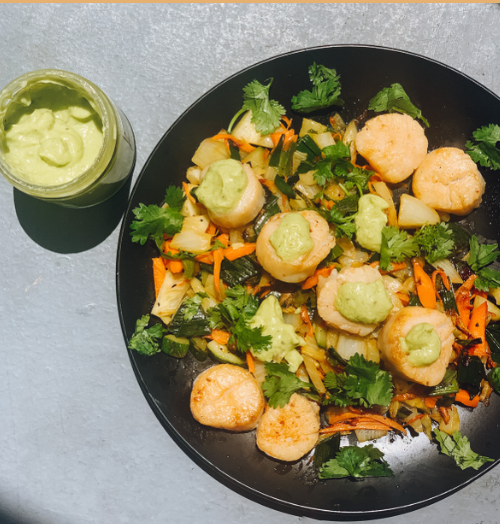
Pan-seared wild-caught sea scallops with a silky avocado-lime-coconut sauce, served with quick-sautéed vegetables and bright herbs.
Serves 2 (or 4 as an appetizer) · 15 min active · 25 min total · year-round (peak winter for scallops, summer for avocado-lime profile) · early evening
Ingredients
Scallops
½ lb wild-caught dry-pack U-10 or U-12 sea scallops (8–10 large scallops)
2 tbsp pasture-raised lard, grass-fed ghee, or avocado oil
juice of ½ lemon
½ tsp Himalayan pink salt
¼ tsp freshly ground black pepper
Avocado-lime-coconut sauce
2 ripe avocados (Hass or local variety, gently soft to the squeeze)
¼ cup full-fat coconut cream (the thick portion of a chilled can)
¼ cup fresh lime juice (about 2 limes)
3 tbsp single-estate extra virgin olive oil
1 tbsp coconut aminos (or 1 tsp tamari for a deeper umami)
1–2 tsp toasted sesame oil
1 garlic clove, minced or grated
¼ tsp sea salt, plus more to taste
freshly ground black pepper, to taste
2 tbsp filtered water (only as needed for blending)
Quick sautéed vegetables
1 medium carrot, julienned or thinly sliced
1 medium zucchini, julienned or thinly sliced
2 green onions, thinly sliced (white and pale green parts)
1 tbsp grass-fed butter or extra virgin olive oil
pinch sea salt
squeeze of fresh lime
Garnish
2 tbsp fresh cilantro leaves
2 tbsp fresh flat-leaf parsley, chopped
lime wedges
pinch flaky sea salt
pinch crushed red pepper flakes (optional)
toasted sesame seeds (optional)
Method
Pat the scallops completely dry. Place the scallops on a paper-towel-lined plate. Pat the tops with another paper towel and let them sit at room temperature 10 minutes while you prepare everything else. This is the structurally critical step — wet scallops steam rather than sear, producing flat-tasting gray meat instead of golden-crusted, sweet, properly caramelized scallops. Dry-pack scallops (no chemical preservation) are also non-negotiable for proper searing — see sourcing notes.
Make the avocado sauce. In a food processor or high-speed blender, combine the avocado flesh, coconut cream, lime juice, olive oil, coconut aminos, toasted sesame oil, garlic, salt, and pepper.
Process 1–2 minutes, scraping down the sides, until completely silky-smooth. Add filtered water 1 tbsp at a time only if needed for consistency — the sauce should be pourable but coat the back of a spoon. Taste and adjust with salt, pepper, additional lime, or a touch more sesame oil.
Sauté the vegetables. Heat the butter or olive oil in a medium skillet over medium-high heat. Add the carrot first (it cooks slightly slower) and sauté 2 minutes. Add the zucchini and cook 2 more minutes, stirring, until just tender but still bright. Add the green onions, salt, and a squeeze of lime. Toss briefly and remove from heat. Keep warm.
Final dry of scallops. Pat the scallops one more time with a clean paper towel — any moisture sabotages the sear. Season both sides with salt and pepper.
Heat the searing fat. Heat the lard, ghee, or avocado oil in a heavy stainless steel or cast iron skillet over medium-high heat until shimmering and just beginning to smoke. The pan must be properly hot — adding scallops to an under-heated pan is the second most common reason for failed sears.
Sear the scallops. Carefully place the scallops in the pan, leaving at least 1 inch of space between each (work in two batches if needed — crowding the pan drops the temperature and produces steam). Do not move them once placed. Sear 2–3 minutes undisturbed, until a deep golden-brown crust forms on the bottom.
Flip and finish. Flip each scallop with a thin spatula. Sear the second side 1–2 minutes for medium-rare interior, or 2–3 minutes for cooked-through. The interior should still be slightly translucent at the center for the best texture — overcooked scallops turn rubbery.
Squeeze the lemon juice over the scallops in the pan. Remove from heat immediately.
Plate. Spoon a generous pool of the avocado-lime sauce onto each plate, smearing with the back of a spoon to create a wide base. Place 4–5 scallops on or alongside the sauce.
Pile the sautéed vegetables alongside.
Garnish. Scatter the fresh cilantro and parsley across the plate. Sprinkle a small pinch of flaky sea salt on the scallops. Add optional crushed red pepper flakes and toasted sesame seeds. Serve immediately with lime wedges alongside.
Storage: Best eaten the day cooked. The avocado sauce keeps refrigerated 1 day with plastic wrap pressed directly onto the surface (to prevent oxidation/browning); after that the color and flavor degrade significantly. Cooked scallops do not reheat well — eat the same day.
Nourishment Notes
Wild-caught sea scallops are structurally and nutritionally distinct from commodity farmed or "wet-pack" scallops. Wild scallops harvested by hand-divers (the gold standard for sustainability) carry exceptional vitamin B12 (one of the highest food sources, by weight), magnesium, potassium, iodine (critical for thyroid function and not adequately supplied by most other foods), phosphorus, zinc, and selenium. Scallops also carry meaningful omega-3 fatty acids and the structural amino acids glycine and taurine — both studied for cardiovascular and nervous system support. Their delicate, sweet flavor and tender texture are the result of their muscle structure: scallops are essentially the adductor muscle of the bivalve, used to open and close the shell, and the muscle fibers are short, tender, and naturally sweet.
The dry-pack vs. wet-pack distinction is structurally important and worth understanding. Most commodity supermarket scallops are "wet-pack" — soaked in a sodium tripolyphosphate (STP) solution that artificially absorbs water, increasing their weight (and price) by 25–30%. STP-soaked scallops cannot be properly seared because they release the absorbed water during cooking, steaming themselves and producing the flat, gray, rubbery texture that gives scallops their unfair reputation in many home kitchens. Dry-pack scallops are simply scallops with no chemical treatment — they sear properly, develop the deep golden caramelization that defines a properly cooked scallop, and taste meaningfully sweeter. Always look for "dry-pack" or "chemical-free" specifically.
The U-10 or U-12 sizing notation refers to the count of scallops per pound — U-10 means "under 10 per pound" (each scallop is more than 1.6 oz) and U-12 means "under 12 per pound." Larger scallops (U-10 and above) are easier to sear properly without overcooking, more visually striking, and structurally what restaurants use; they cost more but produce dramatically better home-cooked results than the smaller "bay scallop" or U-15+ sizes.
Avocados are structurally the right choice for a scallop sauce because their high monounsaturated fat content (mostly oleic acid, the same fat as olive oil) carries the fat-soluble vitamins and aromatic compounds of the lime, garlic, and sesame oil throughout the dish. Avocados also contribute lutein and zeaxanthin (carotenoids studied for eye health), substantial fiber, and the broader B-vitamin complex. The avocado-lime combination is foundational across Mexican, Caribbean, and Pacific Coast cookery — the lime's d-limonene and citric acid brighten the avocado's richness while preserving its color through brief acid-pH stabilization.
Coconut cream contributes medium-chain triglycerides (particularly lauric acid) that provide rapid cellular energy and have been studied for antimicrobial and metabolic effects. The toasted sesame oil — used in small quantities (1–2 tsp) — adds substantial flavor depth without overwhelming the dish; sesame seeds carry sesamol, sesamin, and sesamolin, lignan compounds with antioxidant properties. Coconut aminos provides a soy-free umami source — made from the fermented sap of coconut palm flowers, it's structurally similar to soy sauce in flavor function but without the soy-based estrogenic compounds.
The composed-plate architecture — protein + sauce + sautéed vegetables + bright herb finish — is structurally borrowed from modern California-Mediterranean restaurant cooking, where each component occupies a distinct position on the palate. The scallops contribute concentrated sweetness and protein; the avocado sauce is rich and silky; the vegetables provide brightness, color contrast, and textural variation; the fresh cilantro and parsley provide volatile aromatic compounds (cilantro's linalool and parsley's apiol and myristicin) that lift the entire dish. Eating bites that combine multiple elements produces a more complex flavor experience than any single component alone.
As a circadian and seasonal food, this plate is genuinely versatile — scallops are at peak in winter (December–March in most US harvest regions), making this a winter celebration meal; the bright avocado-lime profile reads particularly well in late spring and summer when avocados are at peak. Best eaten in early evening; the protein-fat architecture is satisfying without being heavy, and the bright sauce keeps the dish appropriately light for warm-weather eating.
Storage: Best eaten the day cooked. Avocado sauce 1 day refrigerated with plastic wrap pressed onto the surface.
Sourcing:Wild-caught dry-pack sea scallops are the absolute structural foundation of this dish — quality and sourcing matter enormously here. The gold standard is a local fishmonger or fish market that can confirm "wild-caught, dry-pack, U-10 or U-12 sizing" — ask specifically; many fishmongers carry both dry-pack and wet-pack and will direct you to the right one if asked. For shipped options, Sea to Table (sustainable wild seafood from US small-boat fisheries, ships flash-frozen, certified dry-pack) and Vital Choice (Alaska-based sustainable fisheries, ships frozen) are the top-tier choices and what most chefs actually use. Look specifically for hand-harvested or diver-caught scallops — these are sustainably harvested by divers selecting individual scallops, rather than dredge-caught (which damages ocean floor habitat). New England and Atlantic Canadian wild scallops are seasonally exceptional. Avoid commodity supermarket scallops at all costs — most are wet-pack, STP-soaked, and structurally a different food. Avocados from a local farmers' market in subtropical regions or California small-grower direct (Apricot Lane Farms, Frog Hollow Farm); avoid commodity supermarket avocados which are typically picked underripe and gas-ripened. Fresh limes from a local farmers' market in subtropical regions; backyard lime trees are productive perennials in USDA zones 9+. Coconut cream: Native Forest Organic Simple (guar-gum-free) is the gold standard widely-available option — the "Simple" line specifically uses no fillers, no preservatives, just coconut and water; Aroy-D pure coconut milk in cartons (Thai, single-ingredient, no additives) is a solid alternative. Single-estate extra virgin olive oil — small-producer, harvest-dated bottle from a quality importer like Gustiamo, Eataly, or Olio2Go. Toasted sesame oil: Eden Foods (organic, traditionally pressed from organic sesame seeds) or Kadoya (Japanese small-batch, the standard in Japanese restaurant kitchens). Coconut aminos: Coconut Secret (small-batch, the original brand) or Big Tree Farms — avoid mass-market versions with added sugars or thickeners. Pasture-raised lard from a local Amish creamery, small-scale pasture-pig farm, or rendered at home from leaf lard (gold standard); for shipped, Fatworks. Grass-fed ghee: Pure Indian Foods (genuinely traditional, single-source) or Ancient Organics (small California producer). Avocado oil: Chosen Foods (the more authentic widely-available brand, made from real Hass avocados, not the diluted versions that have caused industry-wide quality concerns) or Bona Furtuna (small Sicilian producer). Skip Primal Kitchen — recent independent testing has shown significant quality concerns across the avocado oil category, and the genuinely small-batch options are worth seeking out. Garlic from a local farmers' market — heirloom hardneck varieties (Music, German Red, Spanish Roja). Carrots and zucchini from a local farmers' market or your CSA share. Fresh cilantro and parsley from a windowsill pot grown at home or a farmers' market herb vendor; both are easy windowsill crops. Flaky sea salt: Maldon (English flake salt, widely available and genuinely high-quality) or a small-batch hand-harvested option like Jacobsen Salt Co. (Oregon) or Amagansett Sea Salt (New York). Lemon: Meyer lemons from a local farmers' market in subtropical regions or backyard tree (USDA zones 9+).