raw chocolate ganache tart
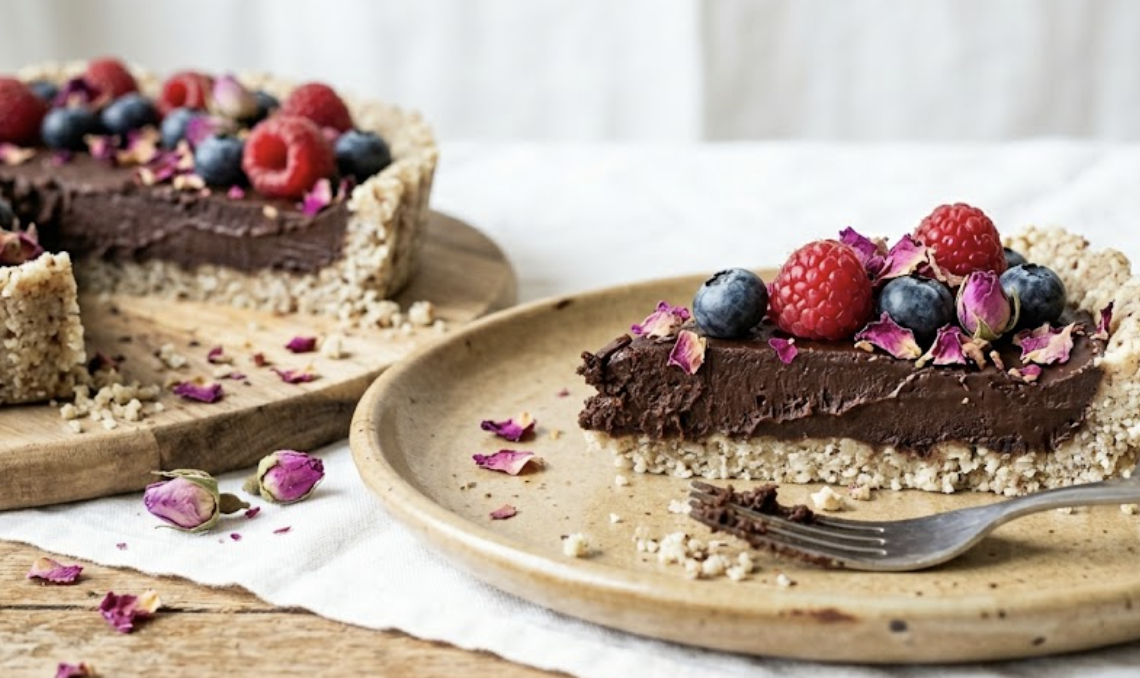
A silky raw cacao ganache poured over a fragrant activated-nut crust, set without baking. A wonderful template recipe that is endlessly customizable through nut choice, spice infusion, liquid swap, and seasonal flavor pairing. Naturally grain-free, refined-sugar-free, dairy-free, and built around real cacao, raw honey, activated nuts, and traditional fats.
Yield: One 9-inch tart · 10–12 slices
Active: 25 min · Total: 4 hr (with chilling) · Year-round (seasonal flavor variations rotate)
A note from the kitchen
Below the master recipe, you'll find detailed guidance on choosing nuts, swapping setting agents, infusing flavors, and pairing spices and aromatics — so the same base recipe can become a cinnamon-mocha tart in winter, a rose-cardamom tart in spring, a stone-fruit-and-tahini tart in summer, and an orange-clove tart for the holidays. One technique, infinite expression.
A note on activated nuts: activating nuts (soaking them, then dehydrating low) makes them more digestible, brings out their natural sweetness, and creates a lighter, less oily crust. If you're going to take one extra step with this recipe, make it that one.
The Master Recipe
Ingredients
For the nut crust
1½ cups activated raw nuts — almonds, pecans, hazelnuts, cashews, or a combination (see “On Choosing Nuts” below)
6 pitted Medjool dates, or 2 tbsp raw honey (gentle sweetness — see note on sweeteners below)
1 tsp pure vanilla extract or seeds of ½ vanilla bean
1 tsp ground Ceylon cinnamon
1 tbsp lucuma powder, optional (adds a soft caramel note)
½ tbsp mesquite powder, optional (adds a soft malty depth)
3 tbsp virgin coconut oil or raw cacao butter, melted (see "On Setting Agents" below)
Pinch of sea salt
For the raw cacao ganache
1 cup raw cacao butter, melted (about 1 cup chopped solid → ¾ cup melted) OR 1 cup raw cacao powder + ¼ cup additional coconut oil (see note)
½ cup raw almond butter (or matched nut/seed butter — see "Customizing the Ganache" below)
⅓–½ cup raw honey or pure maple syrup
1 tsp pure vanilla extract or vanilla bean powder
½–1 cup warm filtered water (start with ½ cup, add gradually)
Pinch of sea salt
Optional finishing
A scatter of raw cacao nibs for crunch
A pinch of flaky sea salt
Edible flowers (calendula, rose petals, violas)
Fresh berries or sliced fruit
A drizzle of additional raw honey
Toasted slivered nuts
Method
Make the crust. In a food processor, pulse the activated nuts, dates (if using), vanilla, cinnamon, sea salt, and optional lucuma and mesquite powders into a crumbly meal — still with some visible texture. Don't over-process, which would release the oils and create an oily crust.
Add the fat. Add the melted coconut oil (or cacao butter) and pulse just until the mixture comes together and holds when pinched between your fingers. If using raw honey instead of dates, add it at this stage with the oil.
Press into the tin. Line a 9-inch springform tart tin (or removable-bottom tart pan) with cling film for easy unmolding, or lightly grease the tin with coconut oil. Press the crust firmly and evenly across the bottom, bringing it ½ to ¾ inch up the sides if you want a traditional tart shape. Compact firmly — a loose crust will crumble when sliced.
Chill the crust. Place in the refrigerator for at least 15 minutes (or the freezer for 10 minutes) while you make the ganache.
Make the ganache. In a high-speed blender (Vitamix or similar), combine the melted cacao butter (or melted cacao powder mixture), almond butter, raw honey, vanilla, and a pinch of sea salt. Start on low-medium speed.
Emulsify with the warm water. With the blender running, slowly drizzle in the warm water — start with ½ cup. Watch as the ganache emulsifies into a silky, glossy texture (this is one of the satisfying small moments in the raw-dessert kitchen). If the ganache is too thick to pour, add more warm water 1 tbsp at a time, up to 1 full cup, until the texture is silky and pourable.
Pour and chill. Pour the ganache into the chilled crust and smooth the top with a spatula. Chill in the refrigerator for 4 hours (for a firm but soft-sliceable ganache) or in the freezer for 1–2 hours (for a faster, denser set).
Garnish and serve. Once set, remove from the tin. Scatter cacao nibs, flaky sea salt, edible flowers, fresh berries, or toasted nuts across the top. Slice with a sharp knife dipped in hot water and wiped dry between cuts.
Customizing the Base (Crust)
The crust is the easiest place to customize this tart — and one of the most impactful, since spices and aromatics shine through the crust more readily than through the deeply chocolate ganache.
On Choosing Nuts
Almonds — neutral and structural; the safest default.
Pecans — softer, sweeter, more delicate; beautiful with maple-leaning flavors.
Hazelnuts — deeply aromatic; the classic pairing with chocolate (think Nutella). One of the strongest pairings in this category.
Cashews — softer and creamier; can become oily quickly if over-processed.
Walnuts — slightly bitter and rich in plant-based omega-3 ALA; great for autumn.
Macadamias — buttery and luxurious; pair with white-chocolate-leaning ganaches.
Brazil nuts — selenium-dense; add 2–3 to the crust mix for trace mineral concentration.
Combinations — almond + hazelnut, pecan + walnut, almond + macadamia all work beautifully.
Important: If you're using a specific nut butter in the ganache, match the crust nut for consistency. Almond ganache → almond crust. Hazelnut ganache → hazelnut crust. The exception is tahini ganache, which pairs beautifully with an almond or pecan crust.
On Activating Nuts
Activating nuts is the single change that makes the biggest difference to this recipe.
Why: Raw nuts contain phytic acid and enzyme inhibitors that the plant uses to prevent germination until the right conditions. These compounds can be hard for some people to digest and can bind to minerals (calcium, magnesium, zinc) in your gut, reducing absorption.
How: Soak raw nuts overnight in water with 1 tsp sea salt per cup. The salt activates the same enzymes that would break down the inhibitors during natural germination. Drain and rinse. Then dehydrate at 110–125°F for 12–24 hours (in a food dehydrator or low-temp oven with the door cracked open) until completely dry and crisp.
Shortcut: Buy pre-activated nuts. Living Tree Community, Go Raw, Wildly Organic, One Lucky Duck, and Living Intentions all sell activated/sprouted nuts. Slightly more expensive but worth every cent.
On Setting Agents
Coconut oil (virgin, unrefined) — Softer set; the crust will soften at room temperature. Has a subtle coconut flavor that pairs beautifully with most ganache flavors. The most accessible option.
Raw cacao butter — Firmer set; the crust holds beautifully at room temperature. Mellow, subtle cocoa flavor that integrates seamlessly with the cacao ganache. More expensive but produces a structurally superior tart.
Raw cacao paste — Even firmer set; deeply chocolate flavor that doubles down on the cacao notes. Best for chocolate-forward customization.
Combination — 2 tbsp coconut oil + 1 tbsp cacao butter delivers the structural benefits of cacao butter with a softer flavor profile.
On Sweeteners in the Crust
I genuinely prefer dates (or no added sweetener at all) over coconut sugar in the crust. Reasons:
Dates deliver natural sweetness wrapped in fiber, potassium, magnesium, and polyphenols.
Coconut sugar, while less processed than refined sugar, is still concentrated sucrose (about 70–80% sucrose by weight) and lands more aggressively on blood sugar than dates.
The dates also act as a natural binder, helping the crust hold together.
The ganache itself is already sweet enough that the crust often doesn't need additional sweetness.
If you prefer to use coconut sugar (or maple sugar), 2 tbsp is the maximum I'd recommend — and only if your nut butter and ganache are not particularly sweet.
Customizing the Ganache
On the Nut Butter
The nut/seed butter you choose is the second-biggest flavor driver after the cacao itself.
Almond butter — neutral, slightly sweet, the safest default.
Cashew butter — silky, mild, almost vanilla-like.
Hazelnut butter — deeply aromatic, the chocolate-Nutella crossover.
Pecan butter — softer, caramel-leaning.
Walnut butter — slightly bitter, autumn-leaning.
Sunflower seed butter — nut-free option; sometimes turns slightly green when paired with raw cacao (a harmless chemical reaction). Adds a slight earthiness.
Pumpkin seed butter (pepita butter) — nut-free option with a distinctly green color and grassy-rich flavor. Beautiful with espresso and cardamom.
Tahini (sesame paste) — one of the most underrated pairings with chocolate. The slight bitterness of sesame against the bitter-sweet cacao is exceptional. Worth trying at least once.
On the Liquid (Replacing Water)
The warm water is a blank canvas. Swap it for any of the following:
Brewed espresso or strong coffee — mocha tart; instant elegance.
Fresh orange or blood orange juice — orange-chocolate; pair with the citrus and herb variation below.
Tart cherry or pomegranate juice — adds polyphenol depth and stone-fruit flavor.
Fresh raspberry purée — raspberry-chocolate tart; spectacular.
Coconut milk — adds creaminess and a softer flavor.
Cold-brew tea (Earl Grey) — for sophisticated tarts.
Flavor Pairing System
Spices and flavor additions are the easiest and fastest way to transform this tart. The general rule: add a little at a time, taste, then add more. You can always add more; you can't take it out.
Spice Pairings (add to the crust or ganache)
Warm spices — pair beautifully with chocolate's natural earthy bitterness
Ceylon cinnamon (the base spice in the crust)
Freshly grated nutmeg
Whole or ground cloves
Ground cardamom (especially green cardamom)
Star anise (whole, infused into warm water then strained)
Allspice
Black pepper or pink pepper (shocking how well it works)
Heat-leaning spices — for spiced-Mexican-chocolate-style tarts
Ground cumin (in small quantities, ⅛ tsp)
Cayenne (⅛ tsp for warmth; ¼ tsp for proper heat)
Chipotle powder (smoky heat)
Ancho chile powder (deep, fruity warmth)
Other flavor additions
Pure peppermint extract (¼ tsp for a peppermint-cacao tart)
Brewed espresso powder (1 tsp ground espresso added to ganache)
Rose water (start with ½ tsp; floral and unmistakable)
Orange blossom water (start with ½ tsp; bright and aromatic)
Pure almond extract (¼ tsp; intensifies the nutty notes)
An Honest Note on Essential Oils
Essential oils for internal/culinary use are a topic where I want to give you balanced, careful guidance rather than a casual blanket endorsement.
The safer approach (my honest recommendation):
Use culinary extracts (vanilla, almond, peppermint, lemon, orange) and food-grade flavorings as your primary aromatic additions. These are produced explicitly for ingestion, with appropriate dilutions and food-safe carriers. They include extracts from companies like Singing Dog Vanilla, Frontier Co-op, and Simply Organic.
For floral and citrus notes, use:
Fresh citrus zest (best option — delivers the actual essential oils embedded in the fruit's skin)
Cold-pressed citrus oils (food-grade, sold for culinary use)
Fresh herbs (mint, lavender, rosemary)
Hydrosols and flower waters (rose water, orange blossom water) — these are explicitly food-grade products with appropriate dilutions
A note on essential oils marketed for “internal use”:
Brands like doTERRA and Young Living market certain oils as suitable for internal use. The scientific consensus on this is contested. Some essential oils are recognized as safe for ingestion in tiny amounts (citrus oils, peppermint, lavender from food-grade sources); others should not be ingested.
I prefer culinary extracts and zest as the primary source of aromatic flavoring. They deliver the flavor reliably, are explicitly produced for food use, and avoid the contested territory entirely. If you choose to use essential oils, use only certified food-grade oils, use them in very small quantities (1–2 drops per recipe), and please consult with your own healthcare practitioner if you have any concerns about specific oils.
Seasonal Variations
The tart adapts beautifully across the four seasons through specific flavor pairings.
Spring — Cardamom Rose Tart
Crust: Almonds + ground cardamom (1 tsp) + a pinch of rose water in the binder.
Ganache: Almond butter + maple syrup + rose water (½ tsp) + cardamom (½ tsp).
Garnish: Fresh edible rose petals, slivered pistachios, dried strawberries.
Summer — Cherry Tahini Tart
Crust: Almonds + a pinch of vanilla.
Ganache: Tahini (instead of almond butter) + fresh cherry purée (replacing the warm water) + vanilla.
Garnish: Fresh halved cherries, white sesame seeds, edible viola flowers.
Autumn — Spiced Pecan-Bourbon Tart
Crust: Pecans + maple syrup binder + 1 tsp cinnamon + ½ tsp nutmeg + ¼ tsp allspice.
Ganache: Pecan butter + maple syrup + 2 tbsp bourbon (replacing 2 tbsp of the water) + vanilla.
Garnish: Toasted pecan halves, a sprinkle of cinnamon, flaky sea salt.
Winter — Mocha Cardamom Tart
Crust: Hazelnuts + 1 tsp cinnamon + ½ tsp cardamom.
Ganache: Hazelnut butter + raw honey + brewed espresso (replacing the warm water) + cardamom + vanilla.
Garnish: Cacao nibs, ground espresso powder, flaky sea salt.
Holiday — Orange-Clove Tart
Crust: Almonds + zest of 1 orange + ground cloves (½ tsp) + cinnamon (1 tsp).
Ganache: Almond butter + raw honey + fresh orange juice (replacing the warm water) + zest of 1 orange + a pinch of cloves.
Garnish: Candied orange peel, whole cloves arranged decoratively (not eaten), cacao nibs.
Additional Variations
Mexican-style chocolate tart: Add 1 tsp cinnamon, ½ tsp ancho chile powder, and a pinch of cayenne to the ganache. Garnish with cacao nibs and a pinch of sea salt.
Salted caramel-chocolate: Drizzle a salted caramel-date sauce over the ganache before serving (blend 6 pitted Medjool dates with 3 tbsp warm water, 1 tbsp coconut oil, ½ tsp vanilla, and a pinch of sea salt).
Triple chocolate tart: Add 2 tbsp raw cacao powder to the crust for a chocolate-on-chocolate base. Garnish with cacao nibs and shaved raw chocolate.
With berry compote topping: Top the set tart with a chia-thickened raspberry, strawberry, or blackberry compote (simmer 1 cup berries with a squeeze of lemon and 1 tsp raw honey for 6 minutes, stir in 1 tsp chia, thicken 15 minutes, cool).
Mini tarts: Make in mini tart tins or muffin cups (about 12 mini tarts) for individual desserts. Reduce chill time to 2 hours.
As a slab: Press the crust into a rectangular pan, pour the ganache over, chill, and slice into bars. Travel-friendly for picnics and gatherings.
With shredded coconut layer: Sprinkle ¼ cup toasted unsweetened shredded coconut between the crust and ganache layers for a hidden textural surprise.
With nut praline: Top the ganache with crushed maple-pecan praline (heat ½ cup pecans with 2 tbsp maple syrup in a dry skillet until caramelized, cool, crush).
Make ahead: The tart keeps beautifully refrigerated for up to 5 days, or frozen for up to 2 months (wrapped well). Thaw 15 minutes before serving.
Pairs Well With
A small board of fresh seasonal fruit (raspberries, sliced pear, ripe persimmon) alongside the slices. For a celebratory dessert spread, add a small dish of whipped raw cream sweetened with vanilla, or coconut whipped cream as the dairy-free alternative. A glass of cold raw milk with a drizzle of raw honey or fresh mint tea.
Sourcing
Raw nuts (almonds, pecans, hazelnuts, cashews, walnuts). Look for recent-harvest, raw, organic nuts. Nuts go rancid quickly due to their high oil content — buy in smaller quantities from busy stores and store in the refrigerator or freezer. For truly raw cashews, look for Living Tree Community Foods, Big Tree Farms, or Terrasoul Superfoods (commercial "raw" cashews are typically steam-pasteurized at high temperatures).
Activated nuts (alternative to soaking yourself). Living Tree Community, Go Raw, Wildly Organic, One Lucky Duck, or Living Intentions. More expensive but worth the cost — significantly more digestible and lighter texture.
Raw cacao butter. Cold-pressed, unrefined, organic. Should smell of fresh cocoa. Power Super Foods, Navitas Organics, Sunfood, or Healthworks. Refrigerator-stable for 1+ year.
Raw cacao powder. Unprocessed (not Dutch-processed cocoa). Navitas Organics, Terrasoul Superfoods, Anthony's Goods, or single-origin small-batch cacao from specialty importers. Should be deep brown and smell of unsweetened chocolate.
Raw cacao nibs. Fermented and dried, never roasted. Navitas Organics, Terrasoul.
Raw almond butter (or other nut butters). Single-ingredient nut butter — just nuts, no added oils or sugars. Artisana, Once Again, or MaraNatha Raw. The natural oil separation is fine — just stir to recombine.
Raw tahini. Single-ingredient stone-ground tahini. Should be smooth, runny, and slightly bitter — never pasty.
Medjool dates. Soft, plump, fresh Medjool dates — not dried-out grocery dates. Joolies, Natural Delights, Bard Valley, or Middle Eastern grocers.
Raw honey. Local, unfiltered, single-origin when possible. For this tart, a more neutral honey (orange blossom, wildflower, acacia) works well. Avoid heated/pasteurized honey.
Pure maple syrup. Grade A dark or amber for richer flavor. Coombs Family Farms or a local maple producer.
Lucuma and mesquite powders (optional). Traditional South American superfood powders. Navitas Organics, Terrasoul, or specialty health food stores. Lucuma adds a caramel-like sweetness; mesquite adds a malty depth. Both are optional but distinctive.
Ceylon cinnamon. True Ceylon (Cinnamomum verum), not cassia. Frontier Co-op, Simply Organic, or specialty spice retailers. Lighter, sweeter, and more nuanced than cassia. Worth seeking out.
Pure vanilla extract or vanilla bean. Madagascar bourbon vanilla beans or single-ingredient vanilla extract (just vanilla and alcohol or vegetable glycerin).
Virgin coconut oil. Cold-pressed, unrefined, organic. Should smell distinctly of fresh coconut. Nutiva, Dr. Bronner's.
Culinary extracts (peppermint, almond, lemon, orange). Single-ingredient extracts with food-safe carriers. Frontier Co-op, Simply Organic.
Sea salt. Baja Gold mineral sea salt for the recipe, fleur de sel for finishing.
Storage
Tart (refrigerated): Best 1–3 days after making — the ganache stays silky and the crust stays crisp. Refrigerated up to 5 days, covered.
Tart (frozen): Up to 2 months, well-wrapped or in an airtight glass container. Slice before freezing so you can pull individual slices as needed. Thaw 15 minutes at room temperature before serving.
Crust (unfilled): Refrigerated up to 5 days, or frozen up to 1 month in the lined pan, well-wrapped. Make ahead if it helps with timing.
Ganache (extra): Refrigerated up to 2 weeks in a sealed glass jar. Reheat gently in a warm water bath to soften, and use as a sauce over fresh berries, smoothie bowls, or oatmeal.
NOURISHMENT NOTES
Raw cacao — the least-processed chocolate. Raw cacao butter and powder deliver magnesium (cacao is one of the densest food sources), theobromine (a gentle stimulant softer than caffeine), polyphenols, flavonoids, and compounds that traditional cultures across Mesoamerica have valued for centuries. Eaten in the mid-afternoon rather than after dark, the gentle stimulation of cacao's theobromine sits well within the day's natural arc — supporting focus and mood without trespassing on the evening's slide toward melatonin.
Activated nuts — bioavailable minerals and proteins. Properly activated nuts (soaked and dehydrated) deliver significantly more bioavailable magnesium, calcium, zinc, vitamin E, and protein than raw or roasted unactivated nuts. The activation process breaks down phytic acid and enzyme inhibitors that would otherwise reduce mineral absorption. Activated nuts are also more digestible — many people who feel "heavy" after eating raw nuts find activated nuts noticeably lighter.
Raw nut butter — concentrated nutrient density. Almond butter delivers vitamin E (alpha-tocopherol form), magnesium, copper, riboflavin, and MUFA fats. Tahini delivers calcium, magnesium, copper, and sesame lignans (sesamin, sesamolin). The fat slows the dessert's overall release into the bloodstream — meaning even the natural sugars land gently rather than spiking.
Raw honey or pure maple syrup — gentle natural sweetness with cofactors. Local raw honey delivers glucose oxidase, polyphenols, pollen-bound compounds, and trace minerals. Pure maple syrup delivers manganese, zinc, calcium, potassium, and over 65 documented polyphenol compounds. Used moderately (about 1.5 teaspoons per slice), the sweetness lands gently with cofactors that conventional refined sugar lacks entirely.
Coconut oil or cacao butter — stable traditional fats. Coconut oil delivers medium-chain triglycerides (MCTs) and lauric acid. Cacao butter delivers stable saturated fats and small amounts of polyphenols. Both are real, traditional fats — meaningfully different from refined or hydrogenated vegetable oils.
Spices and aromatic additions — anti-inflammatory plant medicine. Ceylon cinnamon delivers compounds with documented blood-sugar-supporting effects. Cardamom delivers carminative (digestive-supporting) compounds. Ginger delivers gingerol with anti-inflammatory effects. Cloves deliver eugenol. Vanilla delivers vanillin. These aren't just flavorings — they're functional additions with traditional medicinal roles.
Why this kind of dessert. Most conventional chocolate cakes and tarts deliver refined wheat flour, refined cane sugar, hydrogenated industrial fats, food coloring, and sometimes emulsifiers and preservatives. The combination spikes blood sugar dramatically and inflames the body. This tart inverts all of that. The sweetness is gentle and fiber-bound. The fats are real (cacao butter, coconut oil, nuts). The chocolate is whole-food raw cacao. The customization framework means this single recipe can adapt to a dozen seasonal expressions — a tart for every celebration that genuinely nourishes.
— Anna aka Food Marshall