Raw Snicker’s Cake
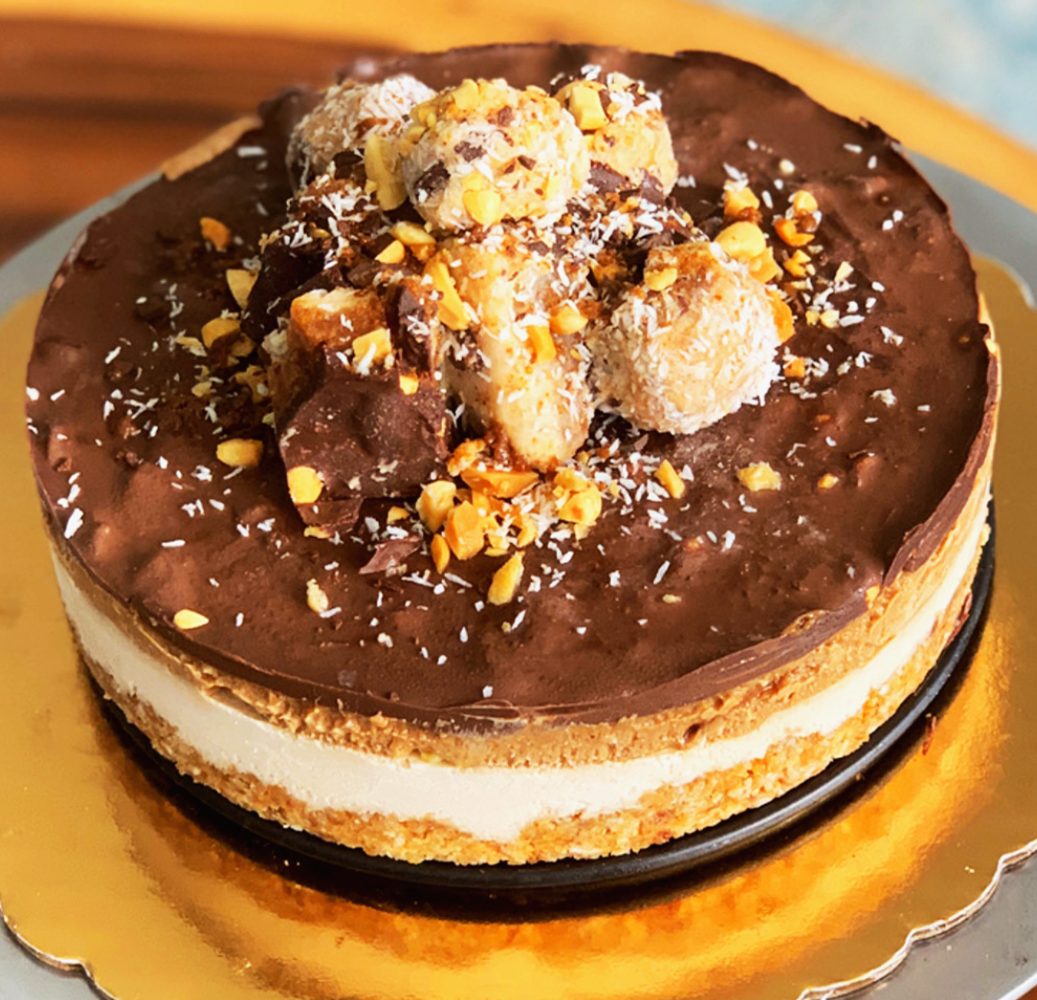
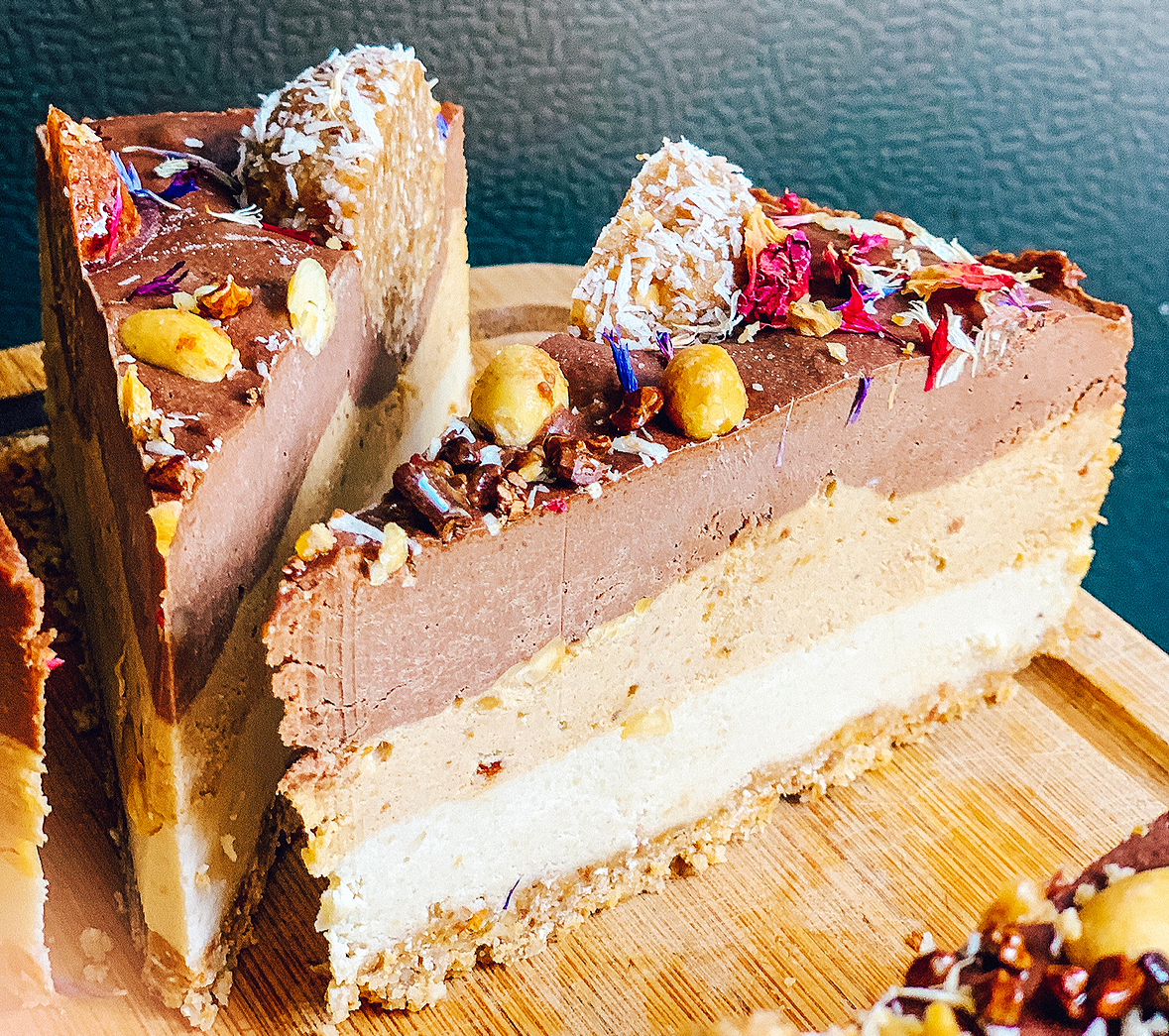
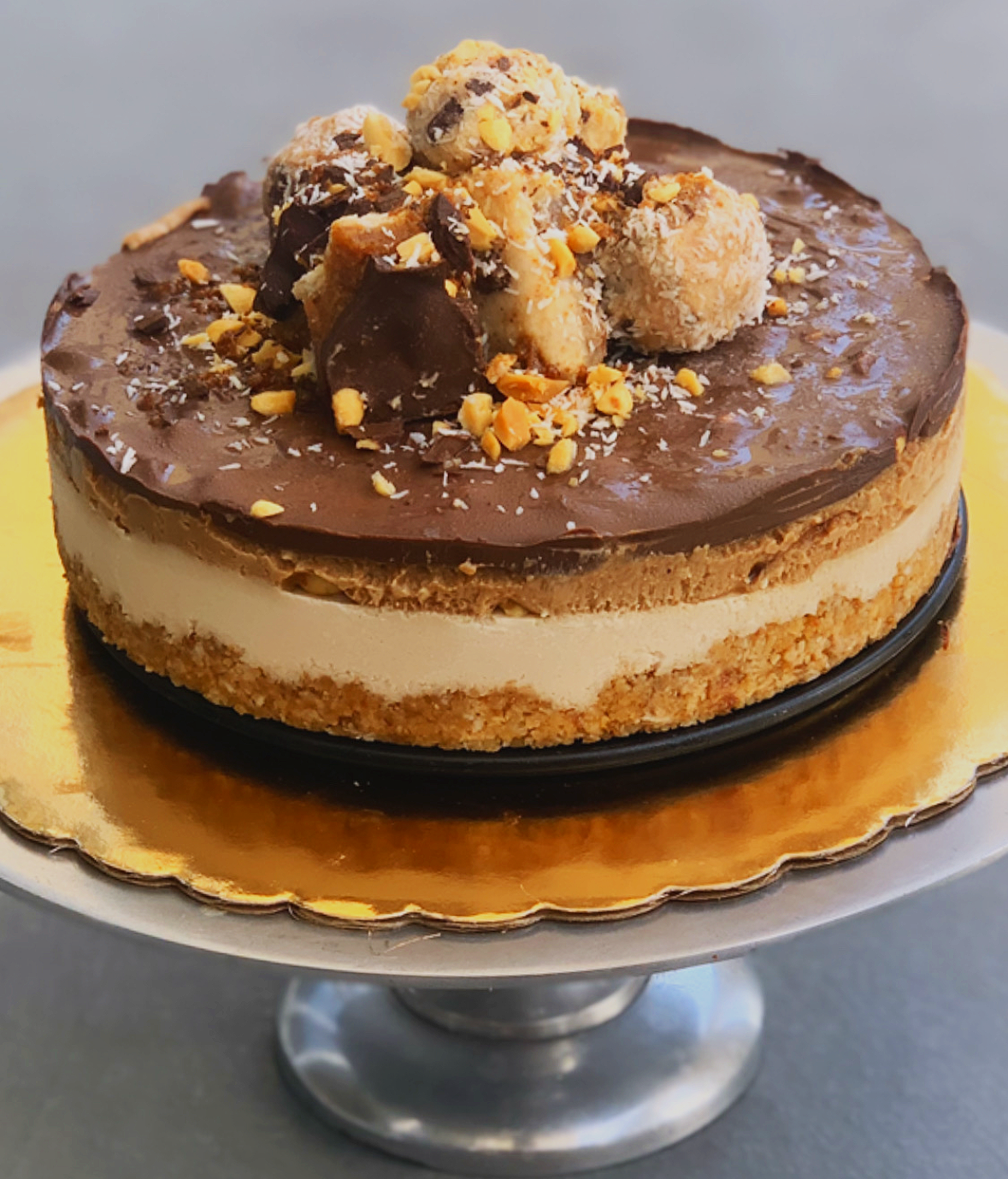
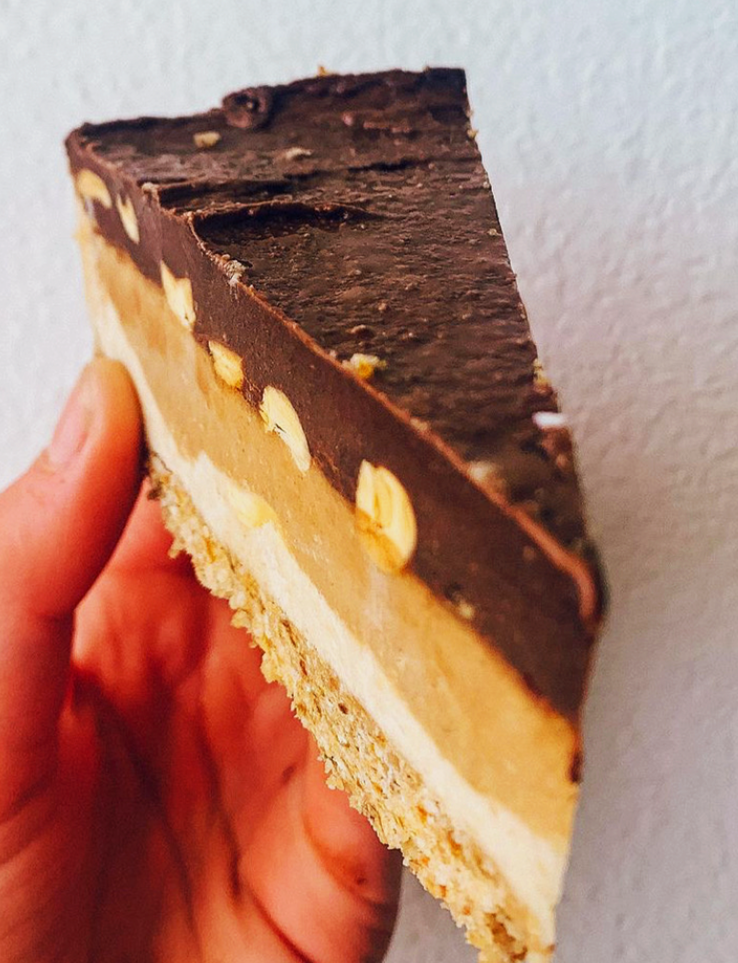
Raw Snickers Cake — Five Layers, One Pan
A celebration cake reimagined from the candy bar — a chocolate-peanut crust, vanilla cashew cream, peanut-date caramel, dark chocolate mousse, finished with chocolate drizzle and crushed peanuts
Season: Year-round (especially autumn-winter) · Cuisine: Modern Raw / Reimagined American Classic · Yield: One 9-inch springform cake (10–12 slices) · Active: 1 hr · Total: 8 hr (with freezer set times) · Best eaten: midday or afternoon
A note on layers — pick your architecture
This is structurally a five-layer cake, but there's flexibility:
Full version (5 layers): crust → vanilla cream → peanut caramel → chocolate mousse → chocolate drizzle. Restaurant-celebration presentation; takes 8 hours total with freezer sets between layers; the genuine Snickers-replica architecture (nougat + caramel + chocolate).
Simplified version (4 layers): crust → vanilla cream → peanut caramel → chocolate drizzle. Skips the separate chocolate mousse layer; stops at 4 layers; same flavor profile in less time (5 hours total).
Optional 6-layer version: add a peanut butter cashew filling between vanilla cream and peanut caramel for an even more decadent version.
The instructions below are for the full 5-layer version. Notes inline indicate where layers can be skipped.
Ingredients
Chocolate-peanut crust
1 cup raw almonds (or walnuts, or pecans)
1 cup raw cashews (or sprouted oats, or roasted unsalted peanuts)
1 cup unsweetened coconut flakes
8 medjool dates, pitted (soaked 10 min in warm water if firm)
2 tbsp natural peanut butter (only peanuts + sea salt, no added sugars or seed oils)
2 tbsp coconut oil, melted
2 tbsp raw cacao powder
1 tsp pure vanilla bean powder
pinch Ceylon cinnamon
pinch sea salt
Vanilla cashew cream layer
2 cups raw cashews, soaked at least 4 hours and drained
½ can full-fat coconut cream (about ¾ cup, the thick portion)
⅓ cup pure maple syrup
¼ cup coconut oil, melted
2 tsp pure vanilla bean powder (or seeds of 1 fresh vanilla bean)
pinch sea salt
2–3 tbsp filtered water as needed for blending
Peanut-date caramel layer
½ can full-fat coconut cream (about 1 cup, the thick portion)
½–¾ cup natural peanut butter (or almond butter)
5–6 medjool dates, soaked in warm water 10 min, drained (or 5–6 tbsp coconut sugar — see note)
¼–½ cup coconut oil, melted
1 tsp pure vanilla bean powder
2 tbsp mesquite powder (optional but recommended — deepens the caramel notes)
pinch sea salt
2 tbsp filtered water, only as needed
½ cup raw or dry-roasted peanuts, roughly chopped (for scattering between this and the next layer)
Sweetener note: Either soaked dates OR coconut sugar work. Dates produce a deeper, more complex caramel; coconut sugar produces a faster, more uniformly sweet caramel. Both work structurally.
Optional peanut butter filling (extra layer — skip for simpler cake)
2 cups raw cashews, soaked 4 hours and drained
1 cup natural peanut butter (or almond butter)
½–1 cup coconut oil, melted
½ cup pure maple syrup
1 cup nut milk (almond, coconut, or cashew)
pinch sea salt
Chocolate mousse layer
1 cup raw cashews, soaked at least 2 hours and drained
½ cup raw cacao powder
¾ cup coconut oil, melted
⅓ cup pure maple syrup
pinch sea salt
2–3 tbsp coconut cream or almond milk (or filtered water) for blending
Chocolate drizzle topping
½ cup coconut oil, melted
½ cup raw cacao powder
¼ cup pure maple syrup
pinch sea salt
Garnish
½ cup roasted unsalted peanuts, roughly chopped
2 tbsp raw cacao nibs
1 tbsp coconut sugar (for a slight crunch garnish)
flaky sea salt
Optional cookie dough ball garnish (see below)
Optional cookie dough balls for elaborate garnish
6 medjool dates, pitted
2 tbsp almond or peanut butter
½ cup blanched almond flour or freshly ground almonds
3 tbsp coconut oil
2 tbsp raw cacao nibs
pinch sea salt
Variation: cookie dough balls with caramel filling
Use the standard cookie dough ingredients above, plus the additions below to create a denser, more pliable dough that can be stuffed.
Dough additions:
3 tbsp coconut flour
3–4 tbsp blanched almond flour (in addition to the ½ cup already in the base recipe)
Caramel filling:
½ cup medjool dates, pitted
2 tbsp almond butter
2 tbsp pure maple syrup
1 tsp pure vanilla bean powder
pinch sea salt
Method
Prep the pan. Line the bottom of a 9-inch springform pan with parchment. Lightly grease the sides with coconut oil.
Make the chocolate-peanut crust. In a food processor, pulse the almonds (or walnuts/pecans) and second-nut option until they break down into a coarse meal. Add coconut flakes, cacao powder, vanilla, cinnamon, and salt; pulse to combine.
Add the dates, peanut butter, and melted coconut oil. Process 1–2 minutes until a sticky, cohesive dough forms that holds together when pinched.
Press firmly and evenly into the bottom of the pan, packing tightly with the back of a measuring cup. Freeze 30 minutes while you make the next layer.
Make the vanilla cashew cream layer. In a high-speed blender, combine drained cashews, coconut cream, maple syrup, melted coconut oil, vanilla, and salt. Blend on high 2–3 minutes until completely silky-smooth. Add water 1 tbsp at a time as needed.
Pour the vanilla cream over the chilled crust. Smooth with an offset spatula. Freeze 1 hour, until completely firm.
Make the peanut-date caramel. In a food processor or high-speed blender, combine coconut cream, peanut butter, soaked drained dates (or coconut sugar), melted coconut oil, vanilla, optional mesquite powder, and salt. Process 2–3 minutes until completely smooth and glossy. Add water 1 tbsp at a time only if needed for consistency.
Pour the caramel over the firm vanilla layer. Smooth the top. Scatter the chopped peanuts evenly across the caramel surface, pressing gently so they adhere. Freeze 1 hour, until firm.
Optional: peanut butter cashew filling. If using this extra layer, blend all peanut butter filling ingredients in a high-speed blender until silky-smooth. Pour over the firm caramel layer. Freeze 1 hour. Otherwise skip to the next step.
Make the chocolate mousse layer. In a high-speed blender, combine drained cashews, cacao powder, melted coconut oil, maple syrup, and salt. Blend on high 2–3 minutes until completely silky-smooth and glossy. Add coconut cream or nut milk 1 tbsp at a time as needed.
Pour the chocolate mousse over the firm caramel layer (or peanut butter filling if added). Smooth the top. Freeze 2 hours, until completely firm.
Final set. Cover with plastic wrap or a fitted lid. Freeze overnight (at least 6 hours, ideally 8) for the cleanest slicing.
Make the chocolate drizzle topping. In a small saucepan over very low heat (under 110°F to preserve raw integrity), melt coconut oil. Whisk in cacao powder, maple syrup, and salt until completely smooth and glossy. Cool slightly to thicken — about 5 minutes — so it drizzles rather than runs off.
Unmold and finish. Run a thin warm knife around the edge of the cake. Release the springform sides. Place on a serving plate.
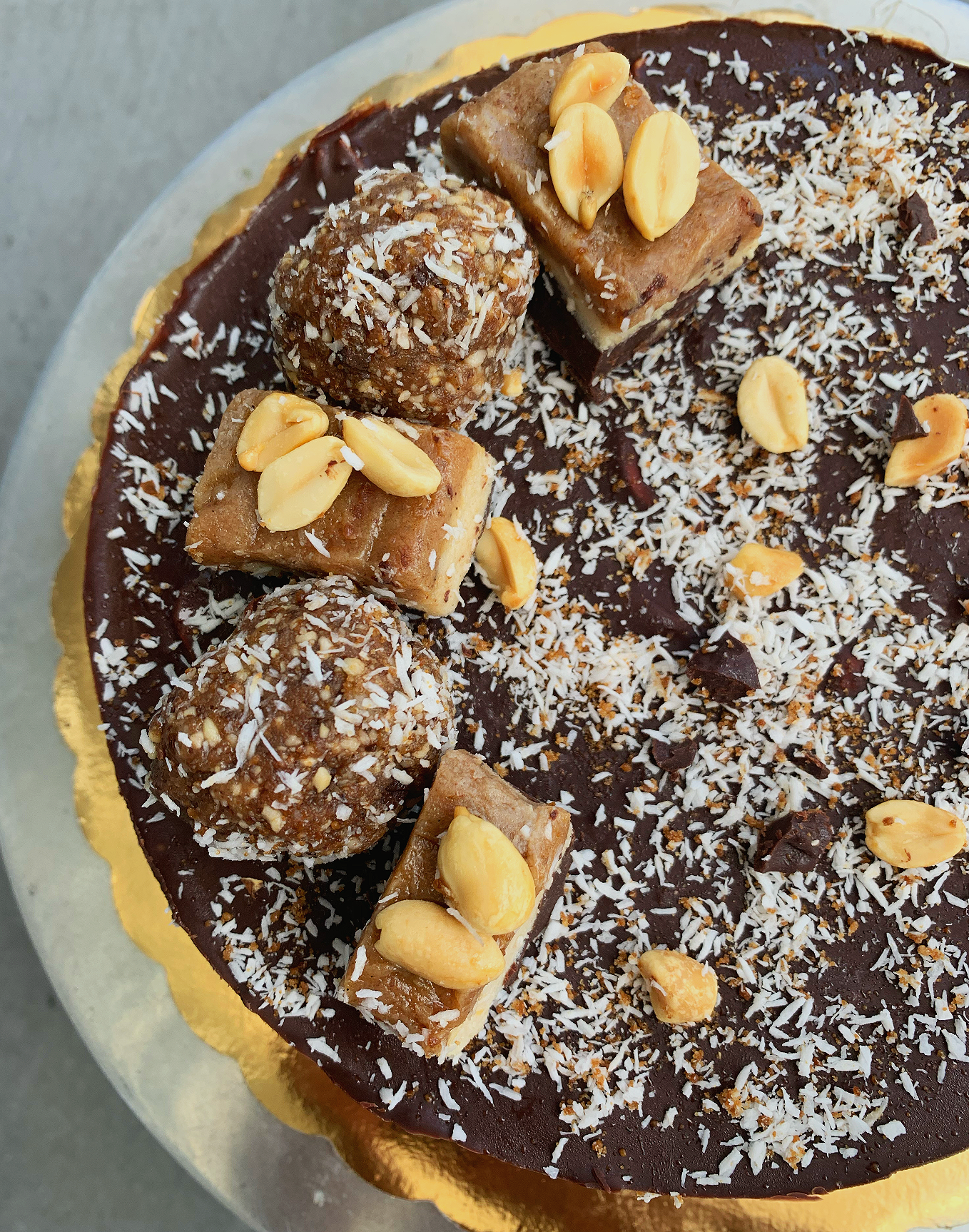
Drizzle the chocolate topping decoratively across the top, allowing it to drip down the sides. Using a palette knife, smooth the chocolate across the top if a clean glossy surface is preferred, or leave the drizzles for a more rustic look.
Garnish. Scatter chopped peanuts, cacao nibs, coconut sugar, and a pinch of flaky sea salt across the top. Add optional cookie dough balls (see below) for celebration presentation.
Refrigerate 30 minutes for the chocolate drizzle to fully set.
Cookie dough ball garnish (optional, simple version). Process all standard cookie dough ball ingredients in a food processor until a dough forms. Roll into small ½-inch balls. Refrigerate 30 minutes to firm. Place across the top of the cake.
Variation cookie dough balls with caramel filling (optional, more elaborate). Process the standard cookie dough ingredients in a food processor until a dough forms, then add 3 tbsp coconut flour and 3–4 tbsp additional blanched almond flour and pulse just to incorporate — the dough should be denser and more pliable than the standard version, sturdy enough to hold a filling. Refrigerate the dough 15 minutes while you make the caramel. For the caramel filling, process the dates, almond butter, maple syrup, vanilla, and salt in a clean food processor until completely smooth and glossy — about 1–2 minutes. To assemble, take a tablespoon of dough, flatten it into a small disc in your palm, place ½ tsp caramel in the center, wrap the dough up around the filling, pinch the seams to seal, and roll between your palms to form a smooth ball. Repeat with remaining dough. Refrigerate 30 minutes to firm before placing on the cake.
Slice and serve. Slice with a hot dry knife (run under hot water and dried between cuts). Allow slices to thaw 5–10 minutes at room temperature for the cleanest cut and best texture — frozen-hard slices are too rigid to bite cleanly.
Storage: Freezer up to 1 month, well-wrapped (without garnishes — add those before serving). Refrigerator 5 days. Best eaten slightly thawed.
Nourishment Notes
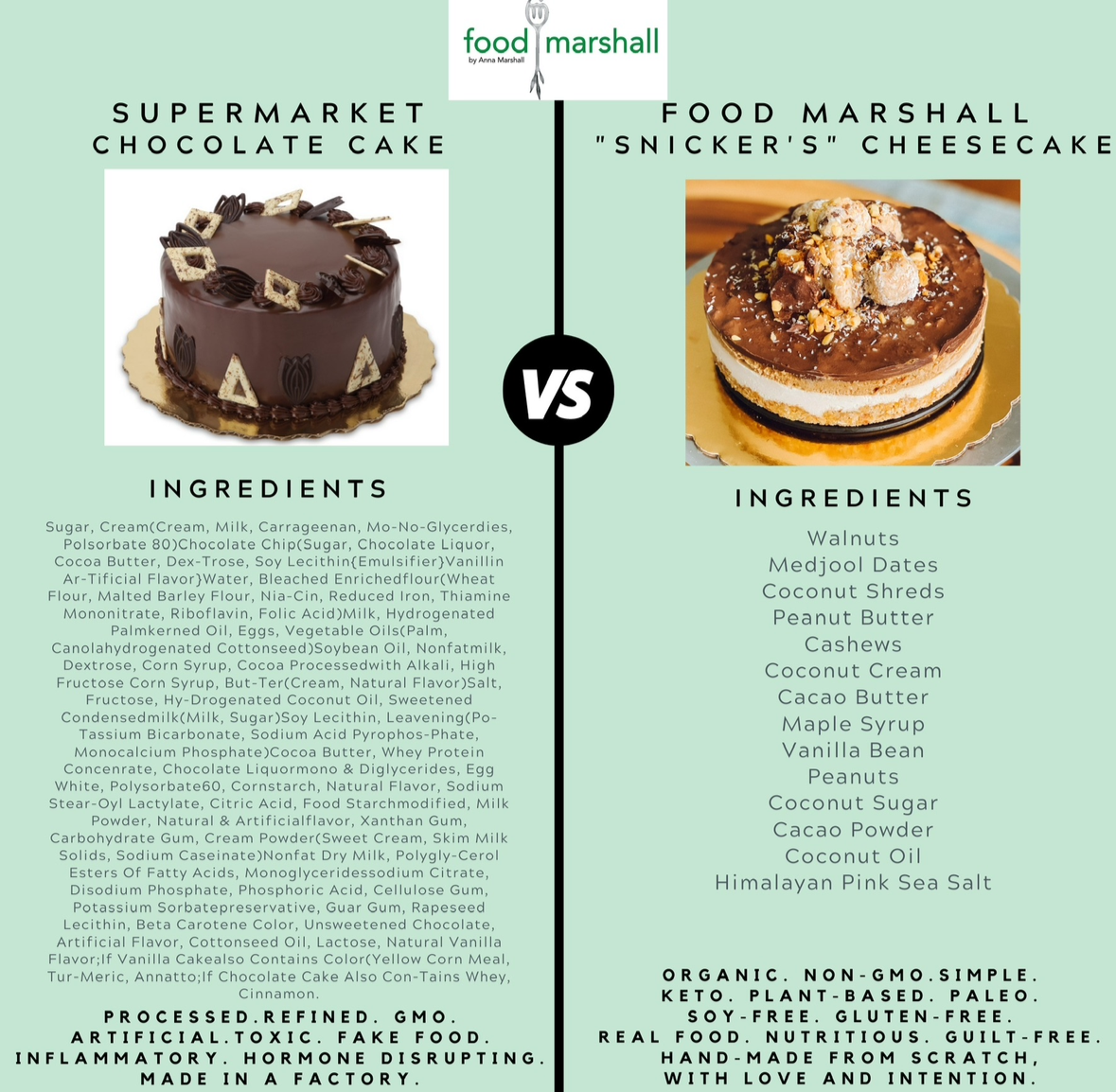
A standard Snickers bar contains high-fructose corn syrup, sugar, partially hydrogenated soybean oil, skim milk powder from confined-dairy cows, TBHQ and PGPR (petroleum-derived additives), and artificial flavor — engineered to produce a specific dopamine response and a specific blood sugar curve. The original 1930 Mars-Wrigley confection used corn-syrup-based nougat and emulsified milk caramel; this celebration cake walks the architecture backward, rebuilding it from whole ingredients the body actually recognizes. The deeper roots run to the ancient Middle East and Mediterranean, where halva and halawa (ground sesame or nuts with honey or syrup, sometimes layered with chocolate) have been traditional foods for six thousand years. The five-layer raw cake is not a new idea — it is an old idea served in a new silhouette.
The structural architecture matters. A proper Snickers replica needs four flavor signatures: nougat, caramel, peanut, and chocolate. The vanilla cashew cream layer reads as nougat on the palate (silky, sweet, vanilla-forward); the date-and-peanut-butter caramel produces a true caramel texture and flavor without refined sugar — dates blended with fat (coconut oil, coconut cream) and nut butter create the original Middle Eastern caramel that predates cane-sugar caramel by thousands of years. The chocolate mousse provides the dark chocolate counterpoint that prevents the cake from reading as one-note sweet. The chocolate drizzle topping is the structural finish that ties the whole architecture together visually and on the palate.
Medjool dates are the structural ingredient that makes both the crust and the caramel work without refined sugar. A medjool date is a whole dried fruit — fiber and sugar and minerals and phenolic compounds all present together. The caramel layer alone uses 5–6 dates plus the substantial fat of peanut butter and coconut cream, producing a glycemic curve dramatically gentler than a commercial caramel. Mesquite powder (optional but recommended in the caramel) is genuinely beautiful — mesquite is the ground pod of a native desert tree used by the Sonoran Desert peoples (particularly the Tohono O'odham) as a staple food for centuries, carrying a natural caramel-malty flavor and supporting blood sugar moderation.
Peanuts deserve honest discussion: they are technically legumes, not nuts, and are nutrient-dense (substantial protein, vitamin E, niacin, magnesium, resveratrol) but prone to aflatoxin contamination from improper storage. Organic Valencia peanuts are traditionally the cleanest variety. Look for peanut butter with only peanuts and sea salt — commercial brands with hydrogenated oils, sugar, and preservatives defeat the point. For those avoiding peanuts entirely, the entire recipe substitutes cleanly with raw stone-ground tahini and almond butter; the flavor moves from American-candy-bar territory toward Middle Eastern-halva territory, but the architecture and indulgence remain.
Raw cashews are the structural foundation of three of the five layers (vanilla cream, peanut butter filling if used, chocolate mousse). Cashews are technically seeds (not nuts), lower in oxalates than most tree nuts, and rich in magnesium (one of the highest plant sources), copper, zinc, and tryptophan. Soaking is non-negotiable for the silky texture: it neutralizes phytic acid and softens the seed for proper blending. The high-speed blender requirement is structural — anything less leaves residual cashew grit that distinguishes a homemade-quality filling from a restaurant-quality one. Raw cacao powder and cacao butter together produce chocolate that is genuinely plant medicine — flavanols, theobromine (a slow, sustained cardiovascular opening that feels different from caffeine's sharper edge), magnesium, iron, and the specific flavonoid complexity that modern processed chocolate has lost. Coconut oil and coconut cream contribute medium-chain triglycerides, lauric acid, and the structural fats that allow the layers to set firmly when frozen while remaining sliceable when slightly thawed.
As a circadian and seasonal food, this cake belongs to celebration occasions rather than everyday eating — the substantial fat (cashews + coconut cream + peanut butter + cacao butter across multiple layers), concentrated sweetness, and dense layered architecture call for a birthday, dinner party, retreat dessert table, or other special celebration meal. Best eaten in midday or early afternoon; the slow-released energy from the protein and fat carries through the rest of the day without spiking blood sugar. The five-layer architecture also makes this an exceptional autumn-winter celebration cake — the warming spice (cinnamon in the crust), the dense rich layers, and the chocolate-caramel-nougat profile align with the body's natural pull toward dense, calorie-rich meals during cold months. A single slice is genuinely satisfying — the polyphenol density and substantial fat content means the body registers the cake as food rather than as a sugar trigger.
Storage: Freezer 1 month, refrigerator 5 days. Best eaten slightly thawed (5–10 min from freezer) — frozen-hard slices are too rigid to bite cleanly.
Sourcing:
Raw almonds, walnuts, pecans, and cashews: One Degree Organic Foods ships organic raw varieties; for almonds specifically, direct from a small Central Valley California grower at the farmers' market is the genuine peak; for walnuts, Living Tree Community sprouted, or California walnuts direct from a small grower at the farmers' market; for pecans, Pearson Farm (fifth-generation Georgia, the genuine top-tier shipped pecan), Koinonia Farm, or local farmers' market vendors. For truly raw cashews specifically, Sunfood or Tropical Traditions — most commercial “raw” cashews are steam-treated, and the difference is structural for a cake built on cashew layers. Avoid bulk-bin supermarket cashews.
Medjool dates: California-grown from a small-batch grower like Bautista Family Organic Date Ranch, Joolies (small Coachella Valley producer), or Rancho Meladuco (the pastry-chef favorite); avoid commercial bulk dates which are often pasteurized.
Sprouted whole oats (alternative): One Degree Organic Foods (genuinely small-batch sprouted) or Lindley Mills.
Unsweetened coconut flakes: Big Tree Farms (single-source Bali, fair-trade), Let's Do Organic, or Edward & Sons.
Natural peanut butter: small-batch from Big Spoon Roasters (small-batch North Carolina), Once Again Organic Valencia (the cleanest organic Valencia option), or freshly ground at a local co-op grocery. Look specifically for organic Valencia peanuts which are the cleanest variety for aflatoxin concerns. Avoid commercial peanut butters with hydrogenated oils, added sugars, or preservatives.
Almond butter (alternative): Big Spoon Roasters or Once Again Nut Butter for widely-available; for genuinely raw and top tier, Artisana Organics, Jem Raw Organics, or Living Tree Community sprouted almond butter.
Coconut cream: Native Forest Organic Simple (guar-gum-free) is the gold standard widely-available option; the “Simple” line specifically uses no fillers, just coconut and water. Aroy-D (Thai, Tetra Pak, very pure) is the chef's pick where BPA-free cans aren't available.
Coconut oil: Nutiva (organic, virgin, single-source) or Dr. Bronner's for widely-available; for genuinely artisanal traditionally cold-pressed, Wilderness Family Naturals Gold Label or Tropical Traditions Gold Label.
Pure maple syrup from a local sugarbush or small Vermont/Quebec producer — Crown Maple, Runamok, or any small-scale producer at the farmers' market; avoid commercial maple “table syrup.”
Coconut sugar (alternative): Big Tree Farms (single-source Bali, fair-trade — genuinely top-tier here) or Madhava (organic, single-source) for widely-available. Skip coconut nectar — pure maple syrup is structurally cleaner without the slightly fermented note.
Raw cacao powder and cacao butter: Sunfood, Navitas Organics, or Terrasoul are the widely-available raw-processed (kept under 115°F to preserve enzymes and polyphenols) options. For genuinely top-tier single-origin, Pacari (Ecuadorian, single-estate, multi-award-winning) or Soul Lit Cacao (ceremonial-grade, Guatemalan, Indigenous-partnership). Big Tree Farms makes excellent cacao butter specifically.
Vanilla bean powder: Singing Dog Vanilla (organic, single-origin Madagascar) or Heilala (Pacific Islands, sustainably sourced direct from Tongan growers).
Mesquite powder: Oatman Farms (Regenerative Organic Certified, wild-harvested from their Sonoran Desert farm — two native varietals milled together) or Native Seeds/SEARCH (Tucson, Tohono O'odham regional partnership) — these are the genuinely Sonoran options that match the headnote story.
Lucuma powder (alternative caramel deepener): Navitas Organics or Sunfood for widely-available; Sun Potion for ceremonial-grade single-origin Peruvian.
Ceylon cinnamon: Burlap & Barrel or Diaspora Co. (single-origin Sri Lankan — significantly more flavor than commodity cinnamon).
Raw cacao nibs: Navitas Organics or Big Tree Farms for widely-available; for top-tier single-origin, Pacari or Ora Cacao.
Blanched almond flour (for cookie dough ball garnish): Honeyville Farms or Anthony's Organic for widely-available; the genuine top tier is freshly grinding blanched organic almonds yourself in a food processor or high-speed blender.
Coconut flour: Big Tree Farms or Bob's Red Mill organic.
Roasted unsalted peanuts: organic Valencia from Hampton Farms (Virginia, Valencia available), or freshly roasted at home in a low oven from raw organic Valencia peanuts.
Flaky sea salt: Maldon (English flake salt), Jacobsen Salt Co. (Oregon), or Halen Môn PDO (Welsh, considered the most refined of the three).