Grain-Free Carrot Cake (2 versions)
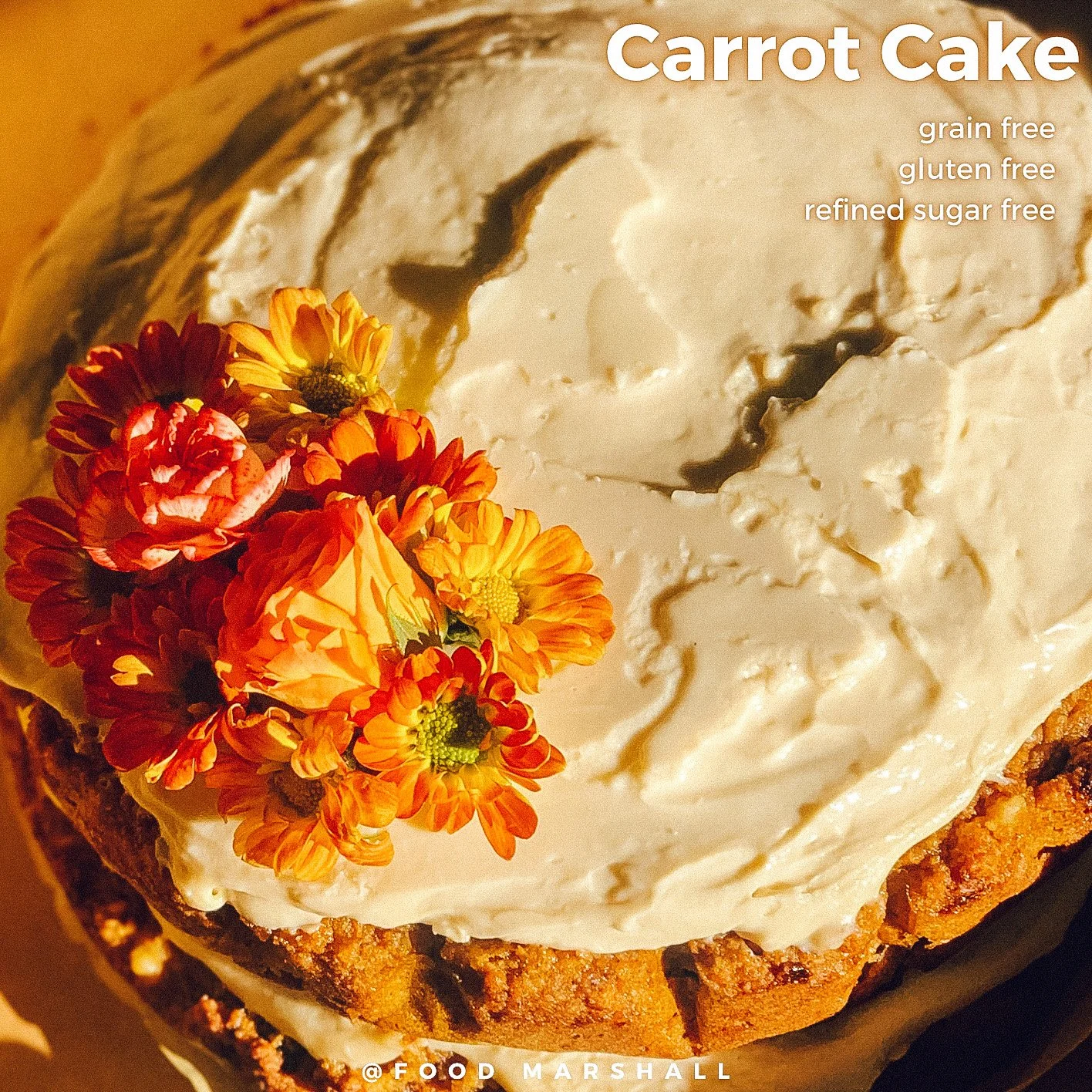
Almond Flour Carrot Cake with Cream Cheese Frosting
The autumn harvest cake — almond flour, fresh-grated carrots, two frostings
Season: Autumn · early Winter · Cuisine: American · Farm-to-Table · Grain-free · Yield: Two 6-inch layers (or one 8-inch), serves 8–10 · Active: 25 min · Total: 1 hr 30 min (plus 1 hr+ chill) · Best eaten: afternoon
Ingredients
Cake
¼ cup coconut oil, melted (plus more for greasing the pans)
2 cups fine-ground blanched almond flour
1 tsp baking soda
½ tsp sea salt
1 tbsp Ceylon cinnamon
3 large pasture-raised eggs
⅓ cup pure maple syrup
1½ cups freshly grated carrots (about 2 large carrots)
½ cup raisins (or dried currants, or chopped soft dates)
½ cup finely chopped raw pistachios (or walnuts, or pecans)
Sub: walnuts are the classic American carrot cake nut and carry alpha-linolenic acid (the plant-form omega-3); pistachios bring magnesium and a sweeter, softer note that pairs beautifully with carrot and raisin. Pecans are lovely too. Choose by preference; all three work.
Frosting — Path A: Cashew Cream Cheese (plant-based, probiotic-cultured)
2 cups raw cashews, soaked 4+ hours and drained
½ cup full-fat coconut milk (no guar gum)
½ cup pure maple syrup
2 tbsp coconut oil, melted
2 tsp pure vanilla extract
1 Just Thrive probiotic capsule (gluten-free, dairy-free, spore-based — see note below)
1 tbsp fresh lemon juice
½ tsp sea salt
A note on the probiotic — why Just Thrive specifically: Most refrigerated probiotic capsules (Lactobacillus and Bifidobacterium strains) are damaged by the heat and shear force of high-speed blending, which means much of the living culture is dead before the cashew cream finishes blending. Just Thrive uses Bacillus spores — a different kind of beneficial bacteria that exists in a protective spore state and survives blending, room-temperature culture, and even baking. Structurally, this is the right tool for the job: the spores germinate and begin producing lactic-acid and short-chain-fatty-acid compounds during the culture phase, which gives the frosting its genuine cultured-cream-cheese tang rather than a sweet cashew imitation. It's also one of the few independently-owned, family-run probiotic companies left — most of the legacy brands (Garden of Life, Jarrow) have been acquired by larger corporations in recent years. If Just Thrive isn't available, MegaSporeBiotic by Microbiome Labs is the same spore-based category and works equivalently; Bio-Kult and Seed Daily Synbiotic are the next tier down.
Frosting — Path B: Mascarpone Cream Cheese (raw-dairy, classic)
8 oz grass-fed mascarpone, at room temperature
4 oz raw or organic cultured cream cheese, at room temperature (see note below)
⅓ cup pure maple syrup (or raw honey)
1 tsp pure vanilla extract
1 tbsp fresh lemon juice
Pinch sea salt
Optional: ¼ cup very cold raw heavy cream, whipped to soft peaks and folded in for a lighter mousse-like frosting
A note on raw cream cheese: Genuinely raw cream cheese is the gold standard but commercially difficult — FDA interstate restrictions on raw dairy and cream cheese's short shelf life mean very few producers ship it. The main source is Miller's Bio Farm (Pennsylvania), which ships to states that permit raw dairy; otherwise, a local Amish creamery, raw dairy farm, or herd-share is the practical path. For the rest who can't access raw, the cleanest organic cultured cream cheese options are Vermont Creamery, Organic Valley, or Kalona SuperNatural — all use organic cultured cream and clean ingredient lists. The frosting works beautifully with any of these.
Garnish
A small handful of extra chopped pistachios, a few fine ribbons of fresh carrot made with a peeler (optional, decorative), and a light dusting of Ceylon cinnamon.
Method
For the Cake
Preheat the oven to 350°F. Line two 6-inch cake pans (or one 8-inch pan) with parchment rounds on the bottom; lightly grease the sides with melted coconut oil.
Mix the dry ingredients. Whisk the almond flour, baking soda, salt, and cinnamon in a medium bowl until combined. The cinnamon will streak lightly through the flour — that's fine.
Mix the wet ingredients. In a large bowl, whisk eggs, maple syrup, and melted coconut oil (cooled slightly so it doesn't cook the eggs) until smooth.
Combine and fold. Add the dry ingredients to the wet in a few additions, stirring until a thick batter forms. Do not overmix — almond flour becomes dense if worked too hard. Gently fold in the grated carrots, raisins, and chopped pistachios.
Bake. Divide between the two 6-inch pans (or pour into the 8-inch). Smooth the tops. Bake 30 minutes — until a toothpick comes out clean and the edges are golden. The single 8-inch may need an additional 5 minutes.
Cool. Cool in the pans 10 minutes, then invert onto wire racks. Cool to room temperature before frosting — frosting a warm cake is a lost cause.
For Path A — Cashew Cream Cheese Frosting
In a high-speed blender, combine the soaked drained cashews, coconut milk, maple syrup, melted coconut oil, vanilla, the powder from the Just Thrive capsule (open and shake in just the powder; discard the empty capsule), lemon juice, and salt. Blend on high 2–3 minutes, scraping down the sides, until completely silky — no cashew grit. If too thin to hold shape, blend in up to ½ cup more cashews; if too thick, add 1 tbsp more coconut milk. Let the frosting rest at room temperature for 1–2 hours to allow the spore-based bacteria to germinate and culture (this is what gives it the genuine cultured-cream-cheese tang). Then refrigerate 20–30 minutes before frosting — the coconut oil needs to firm so it spreads cleanly.
For Path B — Mascarpone Cream Cheese Frosting
Make sure both cheeses are fully at room temperature — cold dairy will clump. In a medium bowl (or stand mixer with paddle), beat the mascarpone and cream cheese on medium until smooth. Add maple syrup, vanilla, lemon juice, and salt; beat just until combined and glossy. Do not overbeat. For the optional lighter version, whip ¼ cup very cold raw heavy cream to soft peaks in a separate chilled bowl and fold gently into the cheese mixture with a spatula. Refrigerate 15 minutes before frosting for cleanest application.
To Assemble
If your cake layers have domed significantly, use a long serrated knife to trim the tops flat. Place one cake layer on a stand or plate; top with about ½ cup of frosting, smoothing evenly with an offset spatula. Add the second layer; top with another ½ cup. Either stop there (a “naked” cake) or use the remaining frosting to cover the sides as well. Scatter chopped pistachios across the top, add fresh carrot ribbons if using, and a very light dusting of Ceylon cinnamon. Refrigerate at least 1 hour before serving — overnight is better. Bring the cake out of the refrigerator about 20 minutes before serving for the tenderest crumb.
Storage: Refrigerated, covered, up to 5 days — bring to room temperature about 20 minutes before serving. Cake also freezes well — wrap individual slices in parchment, then foil, and freeze up to 2 months. Unfrosted layers keep 2 days at room temperature, covered, or 3 days refrigerated. Either frosting keeps 3 days refrigerated separately.
Nourishment Notes
Carrots are the quiet hero of the dish, and their placement at the center of an autumn cake is deeply traditional. Carrots peak in late summer through autumn, and a freshly-harvested autumn carrot carries far more beta-carotene, far more vitamin K1, and more complex phytochemistry than a winter storage carrot that has spent months refrigerated. Beta-carotene is the orange pigment; the body converts it to vitamin A, which supports the retinal pigments that govern low-light vision (relevant as daylight shortens), the mucous membranes that protect from seasonal pathogens, and the thyroid's ability to produce its active hormone. Grating the carrots rather than cooking them preserves the most vitamin C (heat-sensitive), while the gentle baking heat actually increases the bioavailability of the carotenoids — a rare nutritional gift, where both cooked and raw carrot deliver different benefits in the same bite. Use them fresh, grate them coarse, fold them in generously.
Almond flour brings vitamin E in its full tocopherol complex, magnesium, monounsaturated fats, and a meaningful protein load that turns the cake from pure carbohydrate into something more substantial — the glycemic load of this cake is a fraction of a conventional carrot cake, even though the sweetness is similar. Raisins deserve more attention than they usually get: a raisin is a whole dried grape — fiber, fructose, glucose, minerals, polyphenols, and trace resveratrol all present together. Unlike refined sugar, raisins deliver their sugar within the whole-fruit matrix that slows absorption; they carry boron (relevant to bone density), potassium, and iron — particularly useful in a grain-free diet.
The probiotic capsule in the cashew frosting (Path A) is one of the most quietly clever ingredients in modern grain-free baking, and it comes directly from the Sweet Laurel cookbook. Traditional cream cheese is a cultured dairy product — fresh milk fermented with specific bacterial cultures that convert lactose into lactic acid, producing the characteristic tang of cream cheese. A cashew “cream cheese” lacks that culture component by default, making it sweet and creamy but missing the signature tang. By stirring in the contents of a spore-based probiotic capsule, you introduce living culture into the cashew cream. The bacteria begin their slow work, producing subtle lactic-acid notes and a genuine cultured-flavor depth. The result is a frosting that tastes truly like cream cheese rather than a sweet cashew imitation, and that delivers a small probiotic load to the eater. It is a piece of fermentation wisdom applied to plant-based baking. The Path B mascarpone-cream-cheese frosting is the classic ancestral path: raw, grass-fed A2A2 dairy carrying intact enzymes, the full fat-soluble vitamin profile (A, D, K2 specifically MK-4, E), and butyrate. Mascarpone is a 16th-century northern Italian tradition; raw cream cheese is a European fermented-dairy tradition going back at least to the 17th century. Both paths are genuinely ancestral; choose by your body and your occasion.
As a circadian and seasonal food, this cake is afternoon eating by design. The natural sugars of carrot, raisin, and maple metabolize most gracefully during daylight hours, when insulin sensitivity is highest. A slice at four o'clock with tea is the ideal placement — the warming spice, the dense fat, the gentle sweetness all answer what late autumn afternoons are asking for. If serving at dinner, keep the slice moderate and serve no later than early evening; avoid as a late-night snack — the glycemic load, though gentle for a cake, is still sugar that the body handles best with light still on. Autumn through early winter is the right window: carrots are at peak, the body's pull toward warming dense food has arrived, and the fat-soluble vitamins from pasture eggs and grass-fed butter are exactly what the body draws on through the cold months ahead. The cake is also one of the most generous make-ahead bakes in the autumn kitchen — the flavors deepen and the crumb firms beautifully overnight, making it the ideal cake to assemble the day before a dinner party.
Recipe adapted from Sweet Laurel, with my modifications: pistachios in place of walnuts, the choice between two frostings (the original cashew-coconut probiotic-cultured cream cheese, or a real raw-dairy mascarpone), and Just Thrive in place of the original probiotic recommendation for structural reasons.
Sourcing:
Carrots: local farmers' market or CSA share at peak autumn season — heritage rainbow varieties (Cosmic Purple, Atomic Red, Lunar White) carry significantly more flavor and phytonutrient density than commodity orange. Backyard carrots are easy to grow.
Pasture-raised eggs: local farm direct, Alexandre Family Farm, or Apricot Lane Farms direct.
Blanched almond flour: Honeyville Farms or Anthony's Organic for widely-available; the genuine top tier is freshly grinding blanched organic almonds yourself in a food processor or high-speed blender.
Coconut oil: Nutiva (organic, virgin, single-source) or Dr. Bronner's for widely-available; for genuinely artisanal traditionally cold-pressed, Wilderness Family Naturals Gold Label or Tropical Traditions Gold Label.
Pure maple syrup: local sugarbush or small Vermont/Quebec producer — Crown Maple, Runamok, or any small-scale producer at the farmers' market.
Sulfite-free organic raisins: farmers' market dried fruit vendor is the genuine peak; Made in Nature or Newman's Own Organic for shipped (mainstream-organic — the raisin category doesn't have a meaningful artisanal tier).
Raw pistachios: Santa Barbara Pistachio Company (California, single-estate) or local farmers' market vendor; for shipped, Living Tree Community sprouted.
Ceylon cinnamon: Burlap & Barrel or Diaspora Co. (single-origin Sri Lankan — significantly more flavor than commodity cinnamon).
Raw cashews: Sunfood or Tropical Traditions for genuinely raw (most commercial “raw” cashews are steam-treated). Avoid bulk-bin supermarket cashews.
Coconut milk (no guar gum): Native Forest Organic Simple is the gold standard widely-available option; Aroy-D (Thai, Tetra Pak) is the chef's pick where BPA-free cans aren't available.
Just Thrive probiotic: direct from JustThriveHealth.com or Amazon — the spore-based formula is structurally the right tool for this culture.
Grass-fed mascarpone: Vermont Creamery (widely-available, cultured), or genuinely European import (Galbani DOP) at a specialty grocer.
Raw cream cheese: Miller's Bio Farm (Pennsylvania, ships to states that permit raw dairy) is the gold standard; otherwise local Amish creamery, raw dairy farm, or herd-share. Best store-bought organic cultured cream cheese alternatives: Vermont Creamery, Organic Valley, or Kalona SuperNatural.
Raw heavy cream (optional, for lighter frosting): local raw-dairy producer or herd-share where legal.
Raw honey: local apiarist.
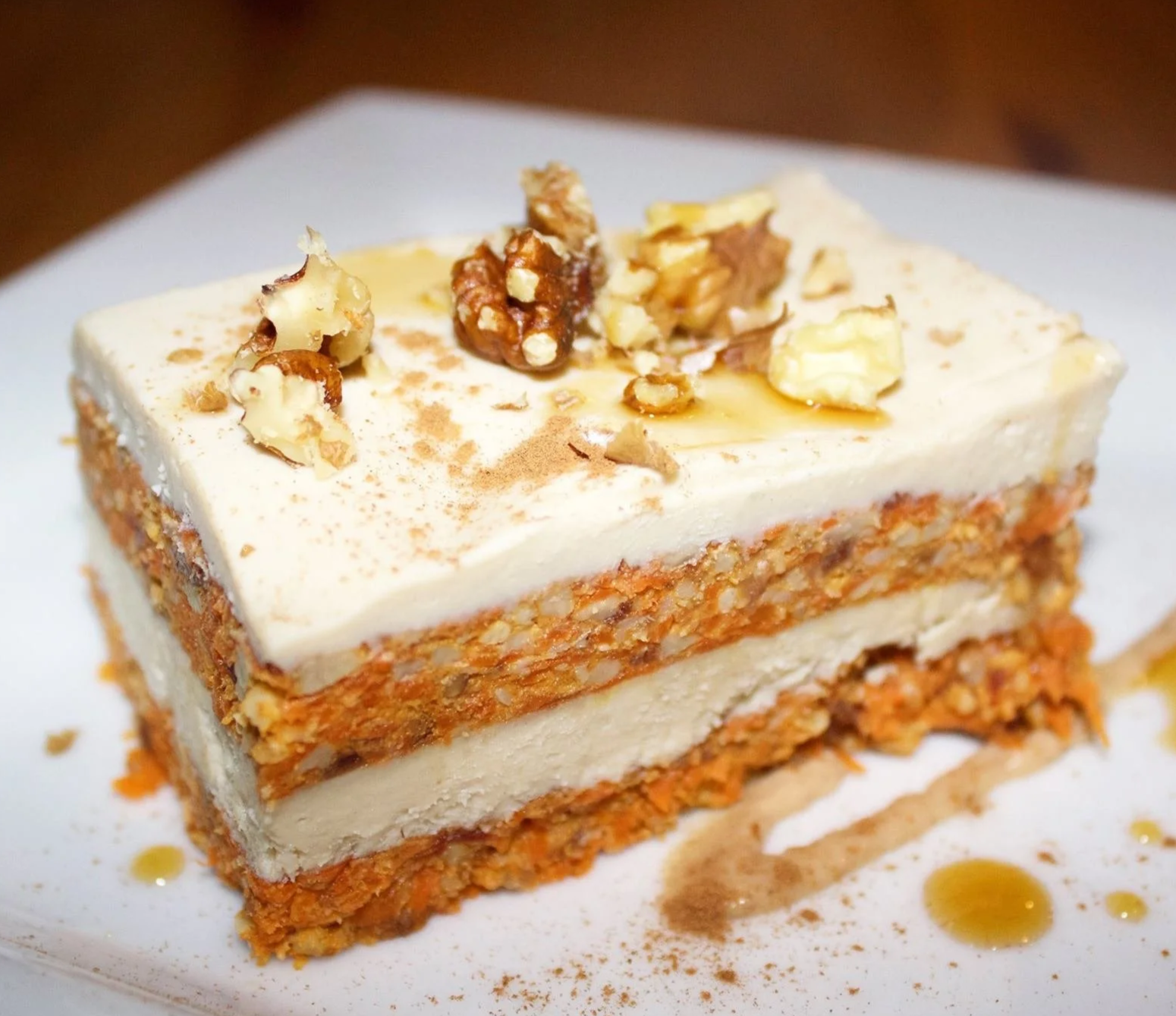
Coconut Flour Carrot Cake with Toasted Coconut
A nut-free variation — coconut flour base, raw honey, finished with toasted coconut
Season: Autumn · early Winter · Cuisine: American · Farm-to-Table · Grain-free, nut-free · Yield: Two 8-inch layers, serves 10–12 · Active: 30 min · Total: 1 hr 30 min · Best eaten: afternoon
This is the nut-free counterpart to the almond flour cake above — a coconut flour base with raw honey, toasted coconut topping, and the same choice of cashew or mascarpone frosting. The coconut flour gives a slightly lighter, more delicate crumb, and the toasted coconut on top adds textural contrast. Use this version when nuts are a constraint, or simply when the deeper coconut flavor is what you want.
Ingredients
Cake
2 cups shredded carrots
1 cup coconut flour
1 tsp ground ginger
¼ tsp freshly grated nutmeg
2 tsp ground Ceylon cinnamon
1 tsp baking soda
1 cup coconut oil, melted
1 cup raw honey
8 pasture-raised eggs (this is correct — coconut flour absorbs roughly 4–5x its weight in liquid, so the egg-to-flour ratio is dramatically higher than a wheat or almond flour cake)
4 tbsp full-fat coconut milk
Toasted Coconut Topping
2 cups unsweetened shredded coconut
1 tsp ground Ceylon cinnamon (more to taste)
Frosting
Use either Path A (cashew cream cheese) or Path B (mascarpone cream cheese) from the almond flour cake recipe above. Both pair beautifully with the coconut flour cake; the cashew is structurally the better match if you want a fully nut-free finish (use sunflower seed butter as a cashew alternative if nuts must be excluded entirely).
Method
Preheat the oven to 350°F. Line two 8-inch round cake pans with parchment rounds on the bottom; lightly grease the sides with melted coconut oil.
Mix the dry ingredients. In a large bowl, whisk together the coconut flour, ginger, nutmeg, cinnamon, and baking soda.
Mix the wet ingredients. In a separate bowl, whisk the eggs, then add the melted coconut oil (cooled slightly), raw honey, and coconut milk. Whisk until smooth and fully combined.
Combine. Add the wet ingredients to the dry, whisking until smooth. Fold in the grated carrots until evenly distributed. The batter will be thick — coconut flour absorbs liquid as it sits, so don't be tempted to thin it.
Bake. Divide between the two 8-inch pans. Smooth the tops. Bake 30–40 minutes until golden and a toothpick comes out clean. (One large cake adds ~10 minutes; cupcake format subtracts 5–10 minutes.)
Cool. Cool in the pans 15 minutes, then invert onto wire racks. Cool completely to room temperature before frosting.
Toast the coconut. While the cakes cool, mix the shredded coconut with the cinnamon. In a dry cast iron pan over medium-low heat, toast the coconut 5–10 minutes, stirring frequently, until evenly golden brown — watch carefully, coconut goes from perfect to burned in seconds. Tip onto a plate to stop the cooking.
Make the frosting. Prepare either Path A or Path B from the almond flour cake recipe above.
Assemble. Place one cake layer on a stand or plate. Cover with a generous layer of frosting, smoothing with an offset spatula. Top with the second cake layer. Coat the top and sides with the remaining frosting. Sprinkle the toasted cinnamon-coconut across the top and gently press a little onto the sides for a complete coconut coat.
Chill and serve. Refrigerate at least 1 hour before serving — overnight is better. Bring the cake out of the refrigerator about 20 minutes before serving for the tenderest crumb.
Storage: Refrigerated, covered, up to 5 days. Cake freezes well — wrap individual slices in parchment, then foil, and freeze up to 2 months.
Nourishment Notes
This nut-free variation leans on coconut as the structural fat — coconut flour, coconut oil, coconut milk, and toasted coconut topping. Coconut is rich in medium-chain triglycerides (MCTs) and lauric acid, which the body metabolizes differently than long-chain fats: more directly into ketones and energy, with less storage as adipose tissue. The high egg content delivers a substantial protein and fat-soluble vitamin load (A, D, E, K2, choline, B12) — pasture-raised eggs from a good farm are one of the most nutrient-dense single foods available, and eight of them in a cake make this a genuinely nourishing dessert rather than empty sweetness. Raw honey replaces the maple syrup of the almond flour version and brings its own gifts: trace enzymes, antibacterial polyphenols, propolis traces, and a slightly different glycemic curve. Like the almond flour cake, this is afternoon eating — the rich fat and concentrated sweetness metabolize most gracefully when the sun is up.
Sourcing:
Coconut flour: Big Tree Farms or Bob's Red Mill organic.
Unsweetened shredded coconut: Big Tree Farms (single-source Bali, fair-trade), Let's Do Organic, or Edward & Sons.
Raw honey: local apiarist is the genuine peak; for shipped, Really Raw Honey or Beekeeper's Naturals.
Whole spices (ginger, nutmeg): Burlap & Barrel or Diaspora Co. — single-origin, dramatically more flavorful than commodity. Grate fresh nutmeg from the whole nut for the brightest aromatic compounds.
All other shared ingredients (carrots, coconut oil, eggs, coconut milk, mascarpone, raw cream cheese, raw cashews, Just Thrive probiotic) follow the sourcing notes from the almond flour cake recipe above.