Risotto with Seasonal Vegetables
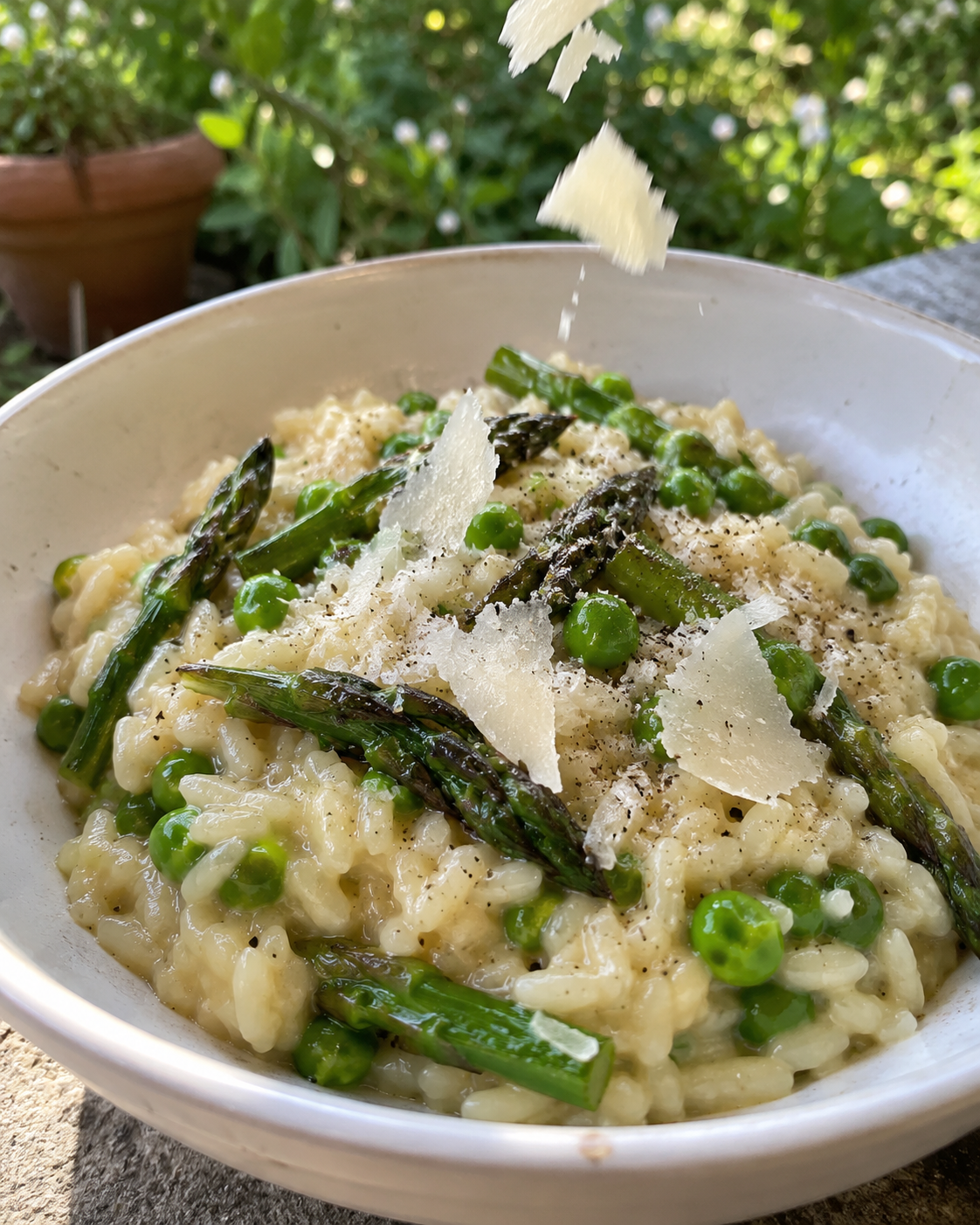
Creamy Italian risotto made the traditional way, with a silky butter-and-Parmigiano finish, topped with the vegetables of the season: asparagus and peas in spring, zucchini and corn in summer, butternut and mushrooms in fall, and roasted roots in winter.
Yield: Serves 4 · Active: 35 min · Total: 40 min · Year-round, with a vegetable topping for every season · Cuisine: Northern Italian · Best eaten: early evening
Risotto is a technique, not just a recipe. Once you learn it, you can make it all year long, changing the vegetables with the seasons. The secrets are simple: good rice, hot homemade broth added a ladle at a time, gentle stirring, and the mantecatura, beating in cold butter and Parmigiano at the very end for a glossy, creamy finish.
Keeping it grain-free? See my Cauliflower “Risotto” with Shrimp and Scallops or Herb-Roasted Chicken.
Ingredients
Risotto
6 cups homemade chicken bone broth
4 tbsp grass-fed butter, plus 2 tbsp cold butter to finish
1 tbsp extra virgin olive oil
1 medium yellow onion, finely chopped
1½ cups Carnaroli rice (or Vialone Nano or Arborio)
Pinch of Baja Gold sea salt
½ cup dry white wine (or ½ cup broth plus 1 tsp lemon juice, for alcohol-free)
1 cup finely grated Parmigiano-Reggiano, cold from the fridge, plus more to finish
Black pepper
Seasonal vegetables (about 3 cups; choose one season)
Spring: 1 bunch asparagus, cut into 2-inch pieces and roasted at 425°F with olive oil for 8–10 minutes; 1 cup peas or shelled fava beans, stirred into the risotto for the last 2 minutes; a few thinly sliced radishes and ramps or chives, to finish.
Summer: 2 zucchini, cut into half-moons and charred in a hot skillet; 1 cup cherry tomatoes, blistered in the same pan; kernels from 1 ear of corn, stirred in for the last 2 minutes; torn basil, to finish.
Fall: 3 cups cubed butternut squash, roasted at 425°F for 25 minutes; 8 oz mushrooms and 1 leek, sautéed in butter until golden; crispy fried sage leaves, to finish.
Winter: 3 cups diced carrots, turnips, and parsnips, roasted at 425°F for 25–30 minutes; a handful of cavolo nero (Tuscan kale), wilted in butter; sautéed mushrooms.
Method
Prep your vegetables. Roast or sauté your seasonal vegetables first, so they’re ready when the risotto is.
Heat the broth. Bring the broth to a boil in a saucepan, then lower the heat to keep it hot but not boiling.
Soften the onion. In a heavy, wide pot or deep skillet (at least 10 inches), melt 4 tbsp butter with the olive oil over medium heat. Add the onion, and cook about 8 minutes, stirring, until soft and translucent but not browned.
Toast the rice. Add the rice and a pinch of salt, and stir gently for 2–3 minutes, until the grains turn very pale gold and you hear a faint crackle.
Add the wine. Pour in the wine, raise the heat to medium-high, and stir until it’s almost completely absorbed. Then ladle in enough hot broth to just cover the rice.
Cook and stir. Set a timer for 16 minutes. Adjust the heat so the risotto bubbles gently, not furiously. Stir often (but not constantly), and add another ladle of broth each time the last one is nearly absorbed.
Taste. At 16 minutes, start tasting. The rice is ready when it’s creamy and tender, with just a little bite at the center, usually 16–20 minutes. The risotto should flow slowly when you tilt the pan; add a splash more broth if it’s too thick.
Rest. Take the pot off the heat, and let it rest 1–2 minutes.
Finish (the mantecatura). Add the 2 tbsp cold butter and the cold Parmigiano, and beat vigorously with a wooden spoon until glossy and creamy. Taste for salt (the broth and cheese add plenty), and add black pepper.
Serve. Spoon onto warm plates, top with your seasonal vegetables, and finish with more Parmigiano.
Storage
Best eaten right away; risotto thickens as it sits.
Leftovers: refrigerated up to 3 days. Turn them into arancini: roll cold risotto into balls (tuck a cube of mozzarella in the center, if you like), roll them in almond flour or grated Parmigiano, and pan-fry in ghee or tallow until golden.
A note on the wine: The alcohol mostly cooks off as the wine reduces, but not completely. Use the alcohol-free swap for children or anyone avoiding alcohol.
Nourishment Notes
Why timing matters — the starches in Italian rice soften on a fairly precise schedule. Too little time, and the center stays chalky; too much, and the grains break down into porridge. Most Italian rice needs 16–20 minutes, but tasting is the real test, which is why Italian grandmothers cook risotto by feel, not by clock.
Choosing the rice — Carnaroli is the variety many Italian chefs prefer. It’s higher in amylose than Arborio, so it releases starch more slowly, holds its shape better, and is harder to overcook. Vialone Nano, the traditional rice of the Veneto, falls between the two. Arborio is the easiest to find, and it works well too.
The mantecatura — beating cold butter and cold Parmigiano into the risotto off the heat. The cold fats emulsify with the starchy broth into a silky, glossy sauce; warm or melted butter would make it greasy instead. It’s the same idea behind a French beurre monté.
Homemade bone broth — gelatin, glycine, and minerals, which make the risotto richer and support the gut lining. Since the rice absorbs all of it, the quality of your broth makes the biggest difference to the flavor.
Rice — steady, satisfying carbohydrates, paired here with butter, cheese, broth, and vegetables, which help balance its effect on blood sugar.
Parmigiano-Reggiano — calcium, protein, and vitamin K2, and naturally low in lactose from its long aging.
Grass-fed butter — vitamins A, D, E, and K2, plus butyrate.
Seasonal vegetables — asparagus and peas bring folate and fiber in spring; zucchini, tomatoes, and corn bring vitamin C, lycopene, and lutein in summer; squash and mushrooms bring beta-carotene and B vitamins in fall; and root vegetables and kale bring fiber, vitamin K, and minerals in winter.
As a circadian food, risotto is best as an early dinner. Carbohydrates with protein and fat in the evening can support restful sleep.
For your cycle: Warm, comforting, and full of steady carbohydrates and minerals from the broth, risotto is especially soothing in the luteal phase, when your body asks for a little more fuel.
Sourcing
Rice — Carnaroli, Vialone Nano, or Arborio, imported from Italy, like Acquerello (aged Carnaroli) or Riso Gallo
Bone broth — homemade from pasture-raised chicken, or Bonafide Provisions or Kettle & Fire
Grass-fed butter — organic, cultured butter from 100% grass-fed cows
Parmigiano-Reggiano — DOP, aged 24 months or more (save the rinds for broth)
Dry white wine (optional) — organic and low-sulfite, like a Pinot Grigio or Soave
Onion and seasonal vegetables — organic, from a farmers’ market
Extra virgin olive oil — organic, single-estate, harvest-dated, in dark glass
Salt — Baja Gold sea salt
— Anna aka Food Marshall