Scallops with Green Curry, MIXED VEGETABLES, Wakame & CRISPY DULSE
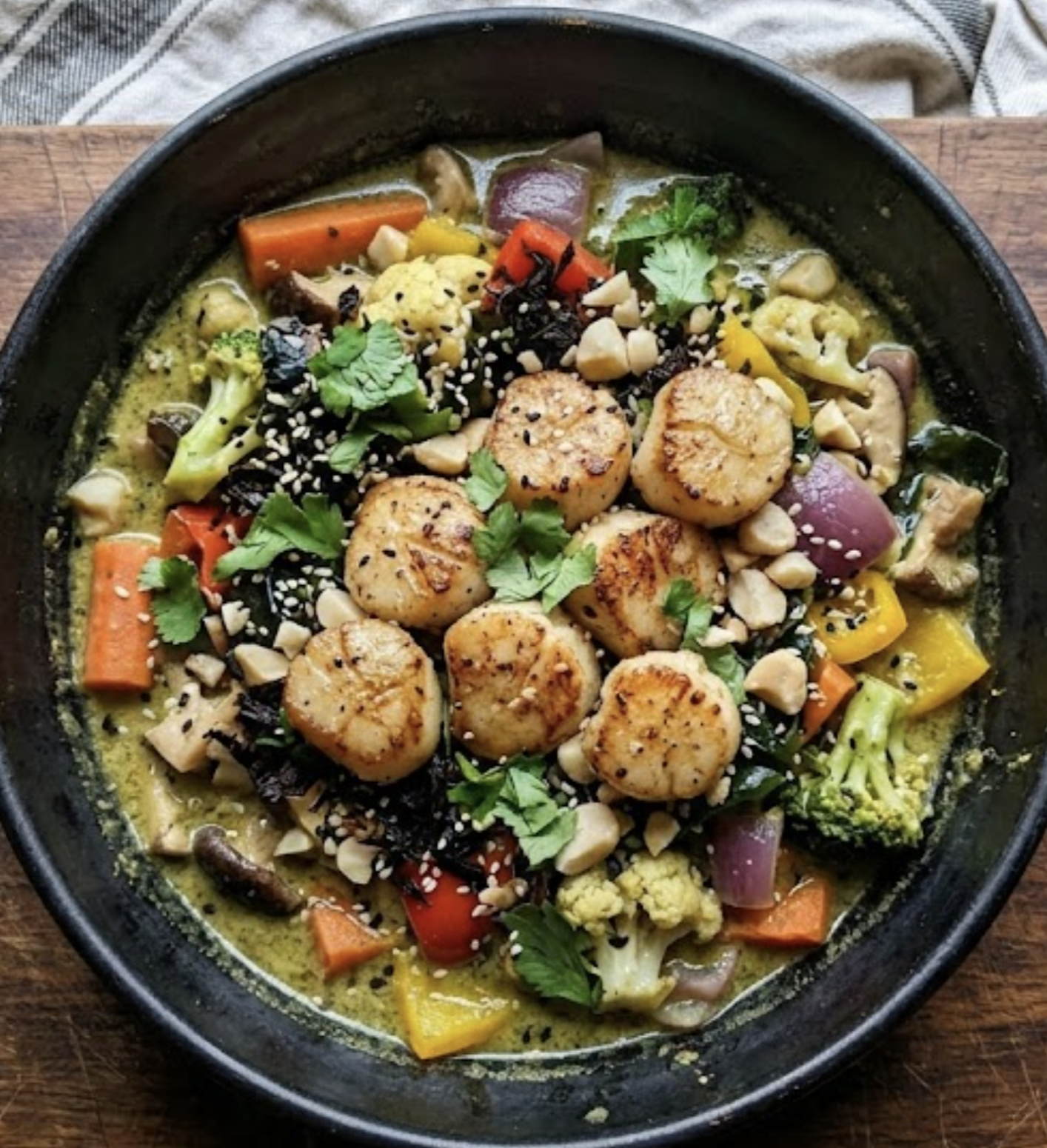
Pan-seared wild scallops on a bright green curry-coconut sauce, finished with rehydrated wakame, crispy dulse, and a colorful base of stir-fried Asian-inspired vegetables and grilled mushrooms.
Yield: 4 servings as appetizer, 2 as main · Active: 35 min · Total: 40 min
Year-round (peak scallop season October–April)
A note from the kitchen
Wakame is one of the most mineral-dense foods on earth, naturally rich in iodine, calcium, magnesium, and the kind of trace minerals that the body deeply recognizes as nourishment. Pair that with wild scallops (lean protein, the cleanest of seafoods), a colorful base of crisp-grilled vegetables and umami-rich mushrooms, and coconut-green curry (medium-chain fats, anti-inflammatory herbs), and you have a plate that's both appealing to the senses and deeply nourishing.
Ingredients
For the scallops
12–16 large wild sea scallops (about 1 lb — see Sourcing for sustainable wild options)
2 tbsp grass-fed butter
1 tbsp high-quality extra-virgin olive oil
Sea salt and freshly cracked black pepper
For the green curry-coconut sauce
1 cup full-fat coconut milk (single-ingredient, no gums or stabilizers)
2–3 tbsp green curry paste (see Sourcing)
1 tbsp fresh lime juice
1 tsp coconut aminos (or fish sauce for traditional)
1 tsp fresh ginger, finely grated (or more depending on your preference for ginger)
1 clove garlic, finely minced
Pinch of sea salt
For the wakame and crispy dulse
2 tbsp dried wakame seaweed (about 1 cup rehydrated)
1 cup warm filtered water (for rehydrating)
¼ cup dried dulse strips
1 tbsp virgin coconut oil (for crisping the dulse)
For the vegetables and mushrooms
1 cup carrots, cut into matchsticks or thin rounds
1 small red onion, thinly sliced into half-moons
1 red or yellow bell pepper, seeded and thinly sliced
1 cup small broccoli florets
1 cup small cauliflower florets
8 oz mixed mushrooms (shiitake, trumpet, oyster, or maitake), sliced or torn into bite-sized pieces
2 tbsp grass-fed ghee or virgin coconut oil (for stir-frying)
1 clove garlic, minced
Sea salt and freshly cracked black pepper
For finishing
Fresh cilantro leaves
Fresh Thai basil leaves (or regular basil)
1 small red chili, thinly sliced (Fresno or Thai chili)
Toasted sesame seeds (black or white)
Lime wedges
Flaky sea salt
A drizzle of high-quality extra-virgin olive oil
Optional crunch: slivered raw macadamias, slivered raw almonds, or toasted pumpkin seeds
Method
Rehydrate the wakame. Place the dried wakame in a small bowl and cover with warm filtered water. Let sit 5–10 minutes, until soft and expanded. Drain and gently squeeze out excess water. Set aside.
Crisp the dulse. In a small dry skillet over medium-low heat, melt the coconut oil. Add the dried dulse strips and toast 1–2 minutes, stirring frequently, until crisp and slightly darker. Don't walk away — dulse goes from perfectly crisp to burnt quickly. Transfer to a paper-towel-lined plate to drain. Set aside.
Make the green curry-coconut sauce. In a small saucepan over medium-low heat, whisk together the coconut milk, green curry paste, lime juice, coconut aminos, grated ginger, minced garlic, and a pinch of salt. Simmer gently 5–7 minutes, stirring occasionally, until slightly thickened and fragrant. Don't boil hard — keep it at a gentle simmer to preserve the bright herbal flavors. Taste and adjust lime, salt, or curry paste. Keep warm.
Stir-fry the vegetables. Heat 1 tbsp ghee or coconut oil in a large skillet or wok over medium-high heat. Add the carrots, onion, bell pepper, broccoli, and cauliflower. Stir-fry 4–5 minutes, until just crisp-tender. Add the minced garlic, season with sea salt and pepper, and stir-fry 1 minute more. Transfer to a warm bowl.
Grill the mushrooms. In the same skillet, add the remaining 1 tbsp ghee or coconut oil. Add the mushrooms in a single layer and let them sear undisturbed for 2–3 minutes per side, until deeply golden and crispy at the edges. Season with a pinch of sea salt. Transfer to the vegetable bowl.
Prep the scallops. Pat the scallops completely dry with paper towels — dry scallops are the key to a good sear. Remove the small side muscle if still attached. Season both sides generously with salt and a small amount of pepper.
Sear the scallops. Heat a large cast-iron or stainless steel skillet over medium-high heat until very hot. Add the butter and olive oil. Once the butter foams, add the scallops in a single layer, leaving space between each one (work in batches if needed — overcrowding will steam them rather than sear). Sear undisturbed for 2 minutes per side, until deeply golden on both sides and just opaque in the center. Don't overcook — scallops should be just-set, not rubbery.
Plate the dish. Warm 4 small plates (for appetizer service) or 2 large plates (for main course). Spoon a generous pool of the warm green curry-coconut sauce onto the center of each plate. Arrange a small bed of the stir-fried vegetables and grilled mushrooms slightly to one side. Place the seared scallops on top of the sauce or against the vegetables. Drape the rehydrated wakame artfully around the scallops.
Finish. Scatter fresh cilantro, Thai basil, sliced red chili, and crumbled crispy dulse across the plate. Sprinkle with toasted sesame seeds and optional slivered nuts or pumpkin seeds. Drizzle with a small amount of high-quality olive oil. Add a pinch of flaky sea salt. Serve with lime wedges on the side.
Serve immediately while the scallops are warm and the sauce is still glossy.
Variations
Spicier version: Add a thinly sliced jalapeño or extra Thai chili to the green curry sauce while simmering. Garnish with extra chili slices.
DIY curry paste: Make your own quick green curry paste — blend 1 cup fresh cilantro, ½ cup fresh basil, 2 green chilies, 1 stalk lemongrass (white part), 1-inch piece ginger, 3 cloves garlic, zest of 1 lime, 1 tbsp coconut aminos, and 2 tbsp olive oil until smooth. Most commercial green curry pastes have minimal added sugar, but this avoids any.
Make it a complete meal: Serve over a base of cauliflower rice (riced cauliflower sautéed in coconut oil with a pinch of salt) or roasted spaghetti squash strands.
With shrimp or wild prawns: Substitute the scallops with 1 lb peeled wild shrimp or langostines, seared the same way (about 1 minute per side).
With wild halibut or cod: Substitute with 4 small wild halibut or cod fillets, pan-seared in butter for 3–4 minutes per side. The fish absorbs the green curry sauce beautifully.
Mushroom-only version (vegetarian): Skip the scallops and double the mushrooms (16 oz mixed wild mushrooms). The umami-rich mushrooms become the centerpiece, with the curry-coconut sauce and wakame anchoring the dish.
With seaweed variety: Mix the wakame with kombu strips, arame, or hijiki for a more complex marine flavor profile.
Sourcing
Wild sea scallops. Look for U.S. or Canadian wild-caught Atlantic sea scallops — these are sustainable and have a clean, sweet flavor. Avoid "wet" scallops (treated with sodium tripolyphosphate — they release water when cooked and won't sear). Look for "dry" or "dry-packed" scallops only. They should smell of clean ocean and feel firm and pearlescent.
Wakame seaweed. Eden Foods (organic wakame, Japanese-sourced), Maine Coast Sea Vegetables (sustainably harvested Atlantic wakame), or Japanese/Korean grocery markets. Look for "wakame" specifically — not "seaweed mix." Dried wakame keeps in a sealed jar for 1 year.
Dried dulse. Maine Coast Sea Vegetables (Atlantic-harvested), Pacific Harvest (Pacific-harvested). Dulse is one of the most mineral-rich seaweeds and crisps beautifully when toasted. Should be deep red-purple in color and smell of fresh ocean.
Green curry paste. Avoid brands with added sugar, MSG, or stabilizers. Or make your own (see Variations). Recommended brands: Mekhala or Maesri.
Full-fat coconut milk. Single-ingredient canned coconut milk — just coconut and water, no gums (guar gum, xanthan gum), no preservatives, no stabilizers. Native Forest Organic Simple (BPA-free cans) is the cleanest option.
Coconut aminos. Coconut Secret raw coconut aminos. Soy-free, lower-sodium alternative to soy sauce.
Wild mushrooms. Look for fresh shiitake, oyster, maitake (hen of the woods), or king trumpet mushrooms from a farmers' market, Asian grocer, or specialty produce section. Avoid bruised or slimy mushrooms.
Fresh organic vegetables. Carrots, bell peppers, broccoli, cauliflower, and red onion from a farmers' market or organic produce section.
Fresh herbs. Cilantro, Thai basil (or regular basil), fresh ginger — local farmers' market or your own garden for the freshest flavor. Thai basil has a more anise-like flavor and is genuinely different from sweet Italian basil; if you can find it, use it.
Fresh chili. Fresno or Thai chili from a farmers' market or Asian grocer. Adjust quantity to your heat tolerance.
High-quality extra-virgin olive oil. Single-estate (one farm, one variety, one harvest), harvest-dated within the last 12 months, in a dark glass bottle. Should smell fresh, green, slightly peppery — never musty or rancid.
Grass-fed butter. Vital Farms, Organic Valley Pasture Butter, Beurre d'Isigny, or local artisan brands.
Sea salt. Baja Gold mineral sea salt for cooking, fleur de sel for finishing.
Storage
Scallops: Best the day made — the seared scallops are at their peak immediately after cooking. Don't try to reheat seared scallops; they overcook quickly.
Green curry-coconut sauce: Refrigerated up to 3 days in a sealed glass jar. Delicious over roasted vegetables, eggs, or wild fish.
Rehydrated wakame: Refrigerated up to 2 days, sealed.
Crispy dulse: Best the day made — it loses its crispness within a few hours. Make fresh each time.
Stir-fried vegetables and mushrooms: Refrigerated up to 3 days. Reheat gently in a skillet to restore crispness.
Why This Dish
Wild scallops — clean lean protein and trace minerals. Wild sea scallops deliver about 20 grams of complete protein per 3.5-oz serving, plus selenium, B12, phosphorus, and magnesium. Like all small filter-feeding marine animals, scallops sit near the bottom of the marine food chain — much lower in mercury, PCBs, and microplastic contamination than larger predatory fish.
Wakame and dulse — the mineral anchor. Wakame is one of the most iodine-dense foods on earth (essential for thyroid function), plus calcium, magnesium, iron, and the polysaccharide fucoidan (with documented anti-inflammatory and immune-supporting properties). Dulse adds protein (about 25% by dry weight), B12, potassium, and a distinctly umami-savory flavor.
Coconut milk and coconut oil — medium-chain fats. Coconut delivers medium-chain triglycerides (MCTs), which the body metabolizes differently than long-chain fats — they're more readily used for energy. Coconut also delivers lauric acid, which has documented antimicrobial properties.
Green curry herbs — anti-inflammatory plant medicine. The herbs and aromatics in green curry — fresh cilantro, basil, lemongrass, ginger, garlic — each carry documented anti-inflammatory and digestive-supporting compounds. Ginger and lemongrass in particular have been used traditionally across Southeast Asian medicine for centuries.
Wild mushrooms — beta-glucans and umami. Shiitake, oyster, and maitake mushrooms deliver beta-glucans (immune-supporting polysaccharides), B vitamins, ergothioneine (a unique antioxidant), and concentrated umami flavor. Wild and pasture-grown mushrooms also synthesize vitamin D when exposed to sunlight.
Bell peppers, broccoli, and cauliflower — vitamin C and sulforaphane. The colorful vegetable base delivers vitamin C (red bell peppers contain more per gram than oranges), beta-carotene, and the sulfur compounds in cruciferous vegetables (sulforaphane, indole-3-carbinol) with documented detoxification-supporting and anti-inflammatory effects.
Bright fresh herbs and coconut milk can transform the simplest seafood into something genuinely memorable.
— Anna aka Food Marshall