Wildflower VANILLA SPONGE cake with seasonal variations
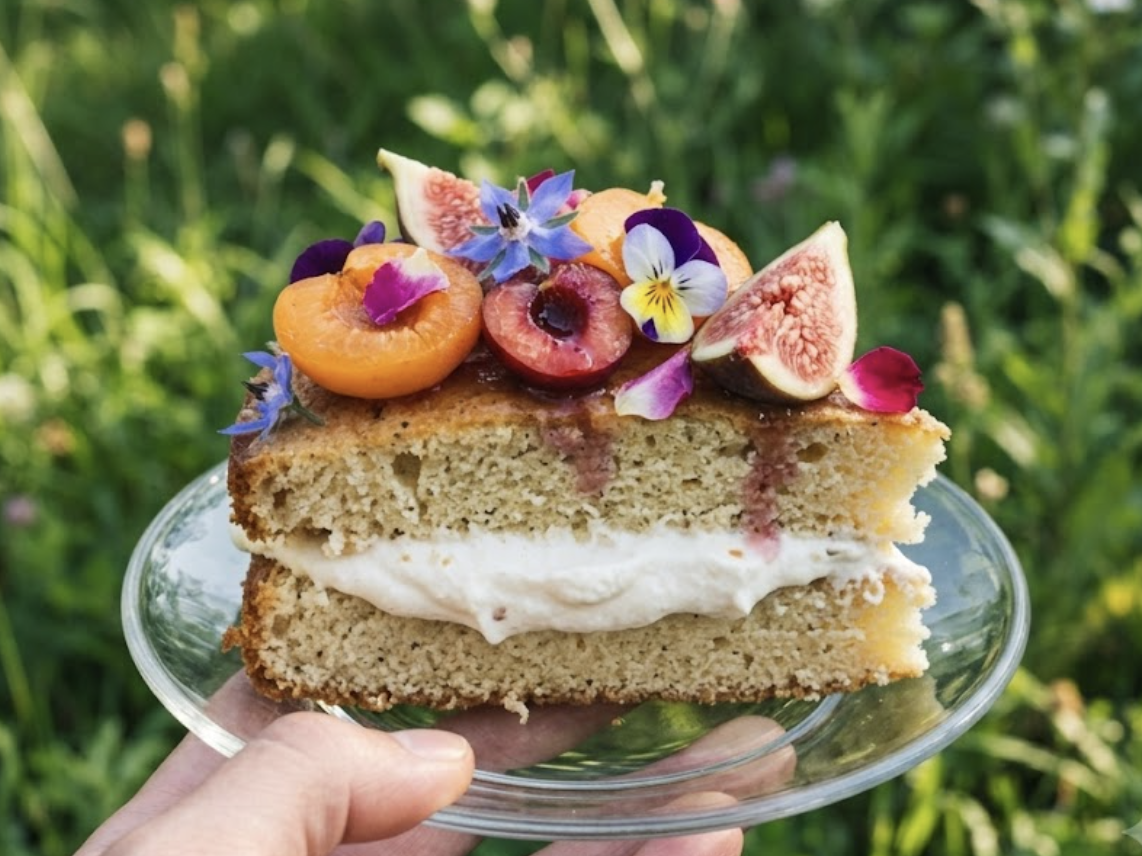
A grain-free almond-and-coconut vanilla sponge soaked in fruit, layered with raw cream, and crowned in edible flowers and leaves — built to travel, meant to be eaten outdoors. One master template, dressed by the season and whatever is blooming in the garden.
Yield: One 8-inch (20 cm) two-layer cake · 10–12 slices · Active: 30 min · Total: ~2 hr 30 min (with cooling) · Year-round (base recipe; specific variations dressed by season)
A note from the kitchen
This recipe is built as a master template — one sponge, one cream finish, four seasonal expressions. The featured version below is the high-summer Mango & Apricot variation, photographed against passionflowers and wild chamomile.
A note on the technique. This cake uses three structural layers of fruit, each doing different work:
A brushed fruit soak on the cooled sponge — a thin layer of fruit purée brushed across both cake layers like a glaze. This soaks into the crumb (grain-free sponges can run dry, and the soak keeps them tender) and infuses every bite with fruit flavor.
Fresh sliced fruit between the layers, nestled into the cream — this gives the cake its visual drama when sliced (you'll see whole fruit pieces peeking through the cream) and contributes fresh texture.
An optional jammy fruit-chia filling between layers — for those who want a more concentrated fruit-flavor punch in addition to (or instead of) the fresh fruit.
You can choose just the soak + fresh fruit (lighter, fresher) or all three (more abundant). Both work beautifully. After the featured recipe, you'll find the master sponge plus four ways to dress it through the turning year: stone fruit & fig, all berry, warming spice, and citrus & herb.The Featured Cake — Mango & Apricot
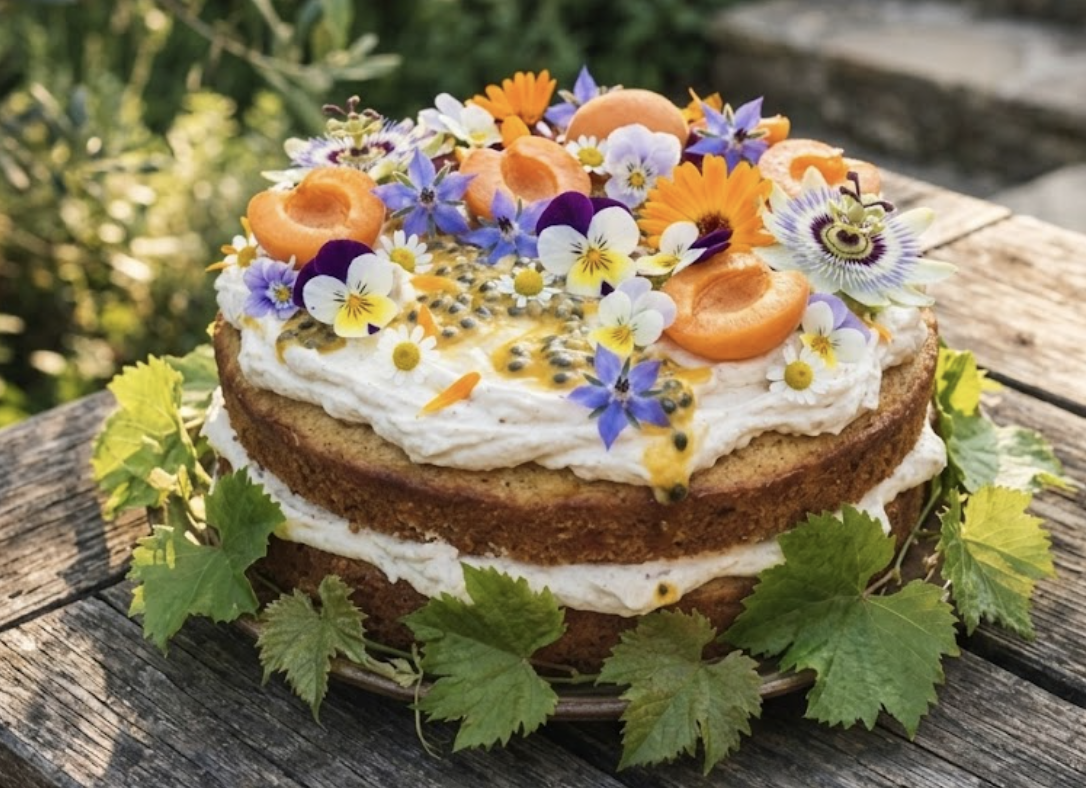
A high-summer birthday cake — vanilla sponge with tree-ripened mango soak, jammy apricot-chia filling, soft whipped raw cream, and a scatter of fresh apricot slices, passionflowers, and wild chamomile.
Ingredients
Vanilla sponge
1 cup blanched almond flour
½ cup coconut flour
6 pastured eggs, separated
1/3 cup raw honey (local, unheated)
1/3 cup grass-fed butter, melted and cooled (or extra-virgin olive oil)
Seeds of 1 vanilla bean + 1 tsp pure vanilla extract
Zest of 1 lemon
1 tsp baking soda
1 tbsp raw apple cider vinegar (with the mother)
Pinch of sea salt
Mango soak (brushes onto the cooled sponge)
1 ripe mango, puréed — (about 1 cup) tree-ripened, fragrant
Juice of ½ lime
Seeds of ½ vanilla bean
Fresh fruit layer (between the layers, with the cream)
4–5 ripe apricots, pitted and sliced into thin wedges
½ ripe mango, peeled and sliced thin (optional)
A few passion-fruit segments (pulp scooped out)
Optional apricot-chia jam filling (for extra fruit concentration)
4–5 ripe apricots, pitted and chopped (in addition to the sliced fresh ones above)
1 tbsp chia seeds
1 tsp raw honey (only if apricots are tart)
Squeeze of fresh lemon juice
Cream layer and finish
1 ¾ cup raw cream, cold (or mascarpone, or chilled coconut cream for dairy-free)
2 tbsp raw honey
Seeds of ½ vanilla bean
To dress (all edible, food-safe, foraged or organic)
Fresh apricot slices
A few passion-fruit segments (the pulp scooped out — beautiful jeweled garnish)
Edible flowers: passionflowers, wild chamomile, borage, calendula, violas
Young grapevine leaves, rinsed (decorative bed)
Always confirm every flower is edible and unsprayed before it touches the cake
Method
Prep. Heat oven to 350°F. Line two 8-inch round tins with parchment and lightly grease the sides.
Whip the whites. Beat the egg whites with a pinch of sea salt to soft-firm peaks. Set aside.
Build the batter. In a separate bowl, whisk the yolks with the raw honey, melted butter, vanilla seeds, vanilla extract, and lemon zest until pale and creamy. Stir in the almond flour and coconut flour until just combined.
Activate the leavening. In a small bowl, stir the baking soda into the apple cider vinegar (it will fizz immediately). Fold this through the batter quickly.
Fold in the whites. Gently fold the whipped egg whites into the batter in three additions, keeping the batter as airy as possible.
Bake. Divide the batter evenly between the two tins and smooth the tops. Bake 28–35 minutes, until golden on top and a skewer comes out clean. Let cool in the tins for 10 minutes, then transfer to a rack to cool completely. Grain-free sponges are fragile when warm — let them set fully.
Make the mango soak. Whisk the mango purée with the lime juice and vanilla seeds.
Brush the soak onto the cooled sponges. Once the cakes are completely cool, brush the mango soak generously over both layers (use a pastry brush or the back of a spoon). Let them drink it in for 10 minutes — the sponge will absorb most of the soak.
Slice the fresh fruit. While the soak absorbs, slice the fresh apricots into thin wedges. Cut the half mango into thin slices if using. Scoop out the passion-fruit pulp.
Make the optional apricot-chia jam filling (if using). Simmer the chopped apricots with the lemon juice (and honey, only if needed) for 8–10 minutes until jammy and broken down. Stir in the chia seeds and let thicken for 15 minutes. Cool fully.
Whip the cream. Whip the cold cream with the raw honey and vanilla seeds to soft, swirling peaks. Don't overwhip — you want softness, not stiffness.
Assemble the cake.
Place the bottom layer (already brushed with soak) on a serving plate.
Spread with a generous layer of cream — about half of the total whipped cream.
If using the apricot-chia jam: spoon a thin layer over the cream.
Fresh fruit layer: arrange sliced apricot wedges (and mango slices, if using) across the cream in a single layer, with a scatter of passion-fruit pulp.
Place the second sponge layer (already brushed with soak) on top.
Crown the top with the remaining cream, swirled rustically with the back of a spoon (don't smooth flat — texture is beautiful).
Dress. Tuck young grapevine leaves around the base of the cake. Scatter fresh apricot slices and passion-fruit pulp across the top. Lay the passionflowers, wild chamomile, borage, calendula, and violas across the cream the way wildflowers fall in a meadow — loose, abundant, asymmetrical. Don't overstyle.
Serve. Best eaten the day it's made, ideally midday to golden hour, outdoors.
The Master Template
The sponge and the cream stay the same in every version. Only the soak, the filling, the sliced fresh fruit, and the garnish change.
Vanilla sponge — the constant
Same ingredients and method as above.
Cream layer and finish — the constant
Same ingredients and method as above.
Method scaffold
The sponge bakes the same way every time. After cooling:
Brush with your chosen seasonal soak (rehydrates the sponge, infuses fruit flavor throughout)
Layer with whipped cream + sliced fresh fruit (the visible fruit drama when sliced)
Optionally add the jammy chia filling (more concentrated fruit flavor)
Dress with the season's edible flowers and fruit
Four Ways Through the Seasons
Each variation keeps the same sponge and cream. Only the soak (≈ 2/3 cup), sliced fresh fruit for between the layers, optional jammy filling (≈ 6–8 fruits + 1 tbsp chia), and garnish change.
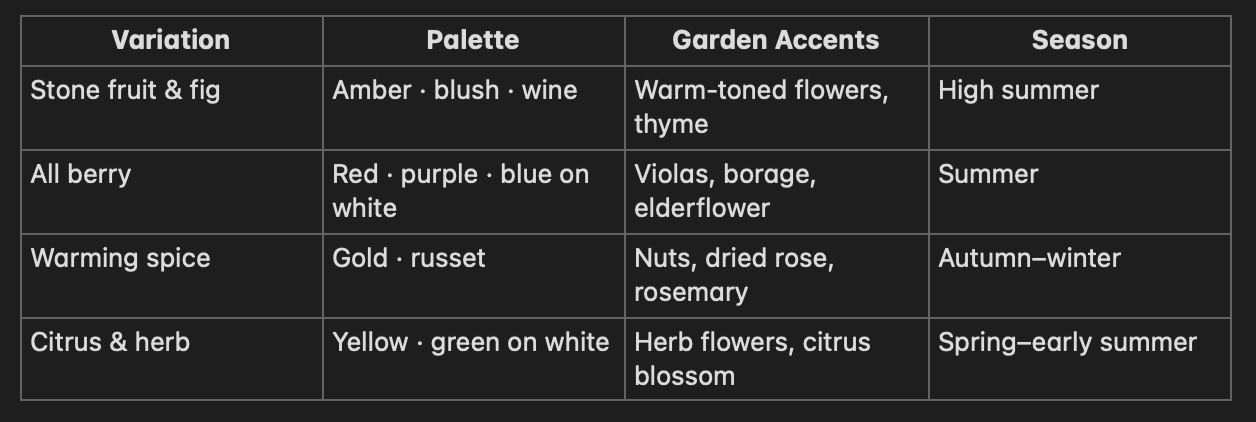
1. Stone Fruit & Fig — High Summer
Honeyed, jewel-toned, golden-hour abundant
Soak — peach & vanilla. Purée 1 very ripe peach or white nectarine (about 2/3 cup) with the juice of ½ lemon and the seeds of ½ vanilla bean. Brush over the cooled sponges.
Sliced fresh fruit layer. 3 ripe plums sliced into thin wedges + 2 fresh figs quartered.
Optional jammy filling — roasted plum & fig with thyme. Simmer 4 plums + 3 chopped figs with a squeeze of lemon, one thyme sprig, and a touch of honey (only if tart) for 8–10 minutes until jammy. Pull the thyme, stir in 1 tbsp chia, thicken for 15 minutes, cool.
Cream tweak. Fold 1 tsp orange-blossom water or extra vanilla into the cream.
From the garden. Fig halves cut-side up to show the ruby interior, sliced plums and apricot wedges fanned over the crown. Warm-toned flowers — calendula, nasturtium, marigold — with one or two borage blooms for a blue spark, tiny thyme sprigs, and young grapevine leaves at the base.
2. All Berry — Summer
Abundant, jewel-bright, an overflowing summer-berry meadow
Soak — raspberry. Purée and sieve a handful of raspberries (about 2/3 cup) with the juice of ½ lemon and the seeds of ½ vanilla bean.
Sliced fresh fruit layer. A loose handful of mixed whole berries — halved strawberries, whole raspberries, blackberries, blueberries.
Optional jammy filling — mixed berry chia. Simmer 1 cup mixed blackberries, raspberries, and blueberries with a squeeze of lemon (honey only if needed) for 6–8 minutes until they slump. Stir in 1 tbsp chia, thicken for 15 minutes, cool.
Cream tweak. Leave the cream snow-white for maximum contrast, or ripple a spoonful of berry purée through it for a marbled effect.
From the garden. A loose crown of whole berries — strawberries, raspberries, blackberries, blueberries, red currants on the stem if you can find them. Violas, borage, elderflower or tiny white blossoms, and strawberry flowers, with soft accents of lemon balm or mint leaves.
3. Warming Spice — Cooler Months
Ginger, cinnamon, cardamom — gently medicinal for the cold half of the year
Sponge tweak (optional). Whisk 1 tsp ground cinnamon, ½ tsp ground cardamom, and ½ tsp ground ginger into the dry mix for a chai-spiced crumb.
Soak — ginger-honey infusion. Warm 2/3 cup water with 1 tbsp grated fresh ginger, 3 lightly crushed cardamom pods, a cinnamon stick, and 1 tbsp raw honey. Steep 10 minutes, strain, add a splash of lemon. Brush warm.
Sliced fresh fruit layer. 1 ripe pear and 2 fresh figs, sliced thin.
Optional jammy filling — spiced pear & fig. Simmer 2 pears (or 1 pear + 1 apple) + 2 figs with fresh ginger, a pinch each of cinnamon and cardamom, and lemon for 10 minutes until soft. Stir in 1 tbsp chia, thicken, cool.
Cream tweak. Fold a pinch of cinnamon and ground cardamom (and a little extra honey) into the cream.
From the garden. Honey-glazed pear or fresh fig slices, toasted pecans or walnuts, a fine dusting of cinnamon. Warm calendula and marigold petals, a few dried rose petals, rosemary sprigs. Cinnamon sticks and star anise tucked in as decorative (not for eating).
Medicinal note. Ginger (digestive, anti-inflammatory), cinnamon (blood-sugar steadying), cardamom (carminative, warming) — a gently functional celebration cake for cooler seasons.
4. Citrus & Herb — Spring into Summer
Bright, resinous, sunlit — citrus and silvery-green herbs against white cream
Sponge tweak. Add extra lemon and orange zest to the batter (the base already has lemon).
Soak — orange-rosemary (or lemon-thyme). Warm the juice of 1 orange + 1 lemon (about 2/3 cup) with 1 tbsp honey and 1 rosemary sprig (or thyme) for 5 minutes to infuse. Strain, add a little zest. Brush over the layers.
Sliced fresh fruit layer. Segments from 1 orange and a few thin lemon wheels (rinds removed).
Optional jammy filling — honey-lemon curd. Whisk 3 egg yolks with ⅓ cup lemon juice, 2 tbsp honey, and the zest of 1 lemon over gentle heat until thick. Off heat, whisk in 3 tbsp grass-fed butter. Cool fully — silky, bright, no refined sugar. Dairy-free option: use an orange-thyme compote — simmer orange segments with thyme, lemon, and chia until jammy.
Cream tweak. Fold orange or lemon zest into the cream for a citrus-flecked finish.
From the garden. Thin fresh or dehydrated citrus wheels and orange segments. Rosemary and thyme sprigs (their pale-blue flowers are edible and lovely), citrus blossom if you have it, plus marigold, viola, and chamomile.
Sourcing
Blanched almond flour. Finely ground blanched almond flour (skins removed) — not almond meal. Bob's Red Mill Super-Fine Blanched Almond Flour, Anthony's Goods, King Arthur Baking, or Wellbee's. Single-ingredient: just almonds.
Coconut flour. Single-ingredient organic coconut flour. Bob's Red Mill or Anthony's Goods.
Pastured eggs. From a small farm or trusted farmers' market source. The yolks should be deep orange (a sign of pasture access and varied diet), never pale yellow. A pastured egg yolk delivers significantly more vitamin A, vitamin D, vitamin E, and omega-3s than a conventional egg.
Raw honey. Local, unfiltered, single-origin when possible. For this delicate sponge, a lighter honey (orange blossom, wildflower, acacia) works best — darker honeys will overpower the vanilla.
Grass-fed butter. From cows on pasture year-round. Vital Farms, Organic Valley Pasture Butter, Beurre d'Isigny, or local artisan brands.
Raw cream. From a small grass-fed dairy. Use realmilk.com to find a local raw dairy. If raw isn't accessible, look for minimally pasteurized (vat-pasteurized) grass-fed heavy cream. Never ultra-pasteurized.
Mascarpone (alternative). Look for traditional mascarpone made from grass-fed dairy if possible — Italian-imported brands are generally good quality.
Coconut cream (dairy-free alternative). Chill a can of full-fat coconut milk overnight, then scoop the solid cream from the top. Native Forest Simple (no gums) is the cleanest option.
Vanilla bean. Madagascar bourbon vanilla beans are the gold standard. Look for plump, oily, fragrant beans.
Raw apple cider vinegar. With the mother — Bragg's is the benchmark. The probiotic culture (the "mother") signals that the vinegar is alive and unpasteurized.
Fresh fruit (mango, apricots, peaches, figs, berries). Tree-ripened, in peak season, from a farmers' market or local farm. Fruit that doesn't smell fragrant when you hold it won't taste like much. Frozen organic fruit (thawed) works beautifully for the soak and jammy filling layers when fresh isn't accessible — but for the sliced fresh fruit between layers, use truly fresh fruit only.
Edible flowers. Always confirm every flower is edible and unsprayed before use. Safe edible flowers commonly used: violas, borage, calendula, nasturtium, chamomile, marigold, elderflower, rose petals (unsprayed, food-grade), pansy, lavender, citrus blossoms, herb flowers (thyme, rosemary, oregano). Source from a trusted organic farmer, your own garden, or specialty edible flower farms. Never use florist flowers — they're treated with pesticides and chemicals.
Sea salt. Baja Gold mineral sea salt for the sponge, fleur de sel for finishing.
Storage
Whole assembled cake: Best the day it's made. Keep covered in the refrigerator up to 2 days — the soaked sponge stays moist. Add fresh flowers just before serving, as they wilt quickly.
Sponges (unfilled, baked): Wrapped tightly, refrigerated up to 3 days. Freeze up to 1 month, well-wrapped. Thaw at room temperature, then brush with the soak when you're ready to assemble.
Optional jammy filling (made ahead): Refrigerate in a sealed glass jar up to 5 days. The chia gel keeps the fruit thick and the flavors deepen overnight.
Soak: Best made fresh the day of assembly — fresh fruit purées oxidize quickly.
Whipped cream: Best made just before assembly. If made earlier, refrigerate up to 4 hours in a covered container; re-whip briefly to refresh the peaks.
Why This Cake
A celebration cake doesn't have to leave the body wrung out. Every layer is doing meaningful nourishment work — not just delivering pleasure.
Almond and coconut flour — protein, fiber, and stable fats. These flours trade refined wheat starch for almond's vitamin E, magnesium, and protein, and coconut's fiber and medium-chain fats. The sponge holds together without gluten and lands gently on blood sugar — no spike-and-crash.
Pastured eggs — choline, lutein, and fat-soluble vitamins. Six eggs in one cake delivers a meaningful dose of choline (essential for brain and liver function), lutein and zeaxanthin (the carotenoids that support eye health), and vitamins A, D, E, and K2 in the yolks. The deeper the yolk color, the higher the carotenoid load.
Raw honey — enzymes, polyphenols, and pollen compounds. Local raw honey delivers glucose oxidase, polyphenols, pollen-bound compounds, and trace minerals that conventional refined sugar lacks entirely. A small amount (about ⅓ cup across an entire 12-slice cake) is a thoughtful sweetness load.
Grass-fed butter — CLA, butyrate precursors, and vitamin K2. Real butter from grass-fed cows delivers conjugated linoleic acid (CLA), short-chain fatty acid precursors that support gut health, beta-carotene, and vitamin K2 (essential for calcium metabolism and arterial health).
Raw cream — fat-soluble vitamins. Raw cream from grass-fed cows delivers vitamins A, D, K2, beta-carotene, and conjugated linoleic acid. The source quality of raw cream remains genuinely superior even when the cream is whipped and integrated into a layered cake.
Whole fruit — enzymes, vitamin C, and polyphenols. Three structural layers of fruit (the soak, the sliced fresh layer, and optionally the jammy filling) deliver the fruit's full nutrient profile — enzymes, vitamin C, potassium, carotenoids, and polyphenols. The fresh sliced fruit between layers is the rawest, most enzyme-rich form. Cooking briefly for the jammy filling preserves most heat-stable compounds. The chia in the jammy filling (if used) adds omega-3 ALA, soluble fiber, calcium, and magnesium.
Edible flowers and leaves — beauty and gentle medicine. Many of the flowers used in this cake have genuine traditional medicinal roles. Chamomile is gently calming. Borage is traditionally used for skin and gut support. Calendula has been used for centuries for skin and immune health. Lavender (in small amounts) is calming. Rose petals carry polyphenols.
Why this kind of cake. Conventional birthday cake delivers refined wheat flour, refined cane sugar, hydrogenated industrial fats, food coloring, and often emulsifiers and preservatives. The combination spikes blood sugar dramatically, crashes the eater 60–90 minutes later, and inflames the body. This cake inverts all of that. The sweetness is gentle and fiber-bound from the fruit and modestly honeyed from raw honey. The fats are real (eggs, butter, cream). The flour is whole-food (almond, coconut). The flowers are botanical medicine. The whole thing is a celebration that genuinely nourishes.
Best enjoyed in daylight, outdoors, when the body handles carbohydrate most gracefully and the sun is doing half the digesting.
— Anna aka Food Marshall