Seared Alpaca Medallions with Purple Potato Purée, Roasted Romanesco and Cauliflower, Pumpkin, Rainbow Carrots, and Chimichurri
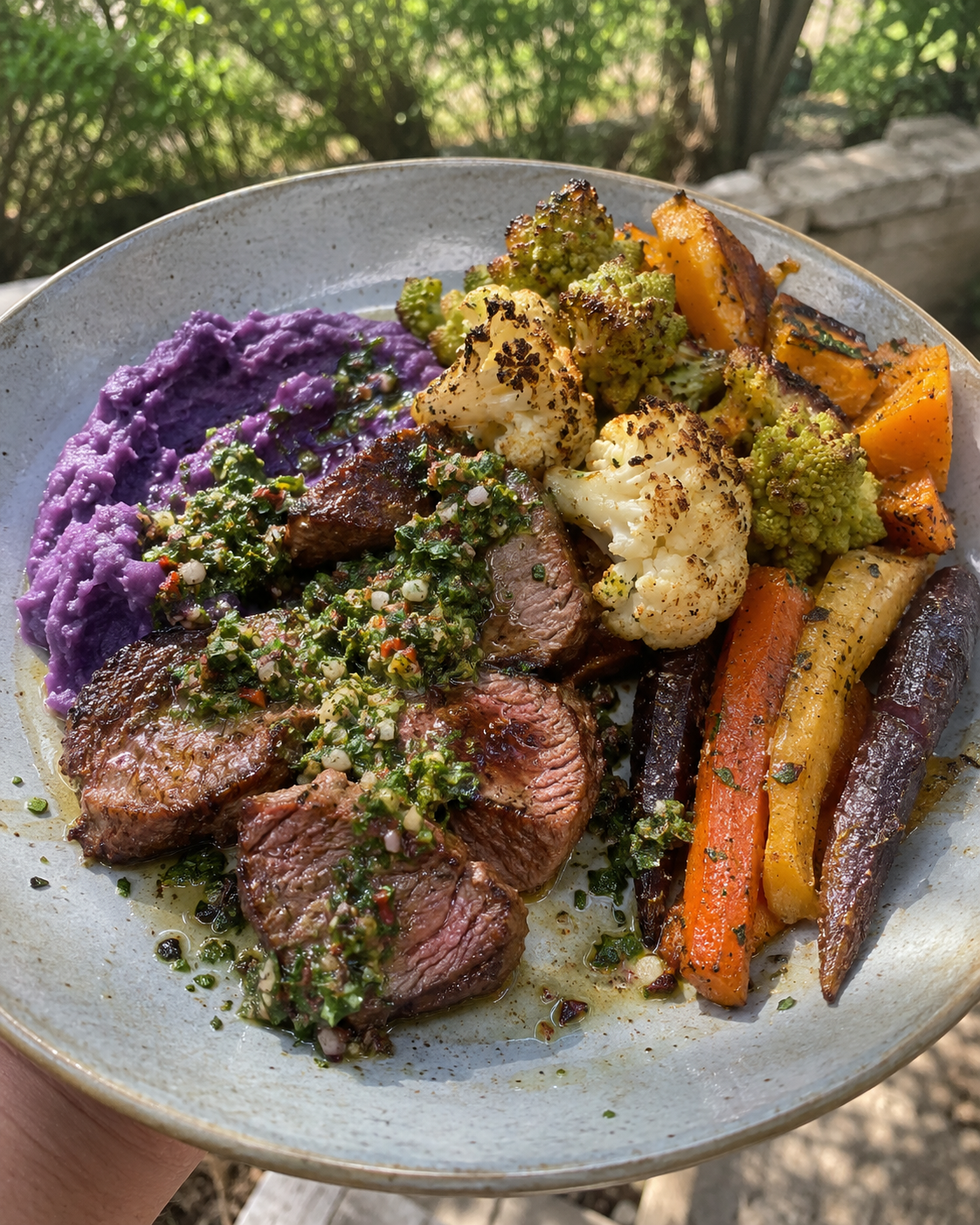
Tender alpaca medallions seared in butter with garlic and herbs, served with a vivid purple potato purée for dipping, roasted romanesco and cauliflower, caramelized pumpkin and rainbow carrots, garlicky greens, and a bright chimichurri made with. Gorgeous family-style on a big platter.
Yield: Serves 4 · Active: 45 min · Total: 1 hr 15 min · Best in North America in fall and early winter, when pumpkin, romanesco, and carrots are at their peak · Best eaten: early evening
MEET Alpaca
What it is: Alpacas are small members of the camel family, domesticated in the Andes of Peru and Bolivia thousands of years ago and prized mainly for their incredibly soft fleece. Their meat has long been a traditional Andean food and is still widely eaten in Peru. In the U.S., alpaca meat comes from small farms, often from herds raised primarily for fiber. Alpacas have soft, padded feet instead of hard hooves, and with no upper front teeth, they graze by nibbling grass rather than pulling it up by the roots, which makes them gentle on pastures. I sourced mine from a farm while I was in Oregon. It was my first time trying alpaca, and I loved it
What it tastes like: Mild, tender, and slightly sweet, somewhere between lean beef and veal, with a fine, delicate texture and no gamey flavor.
Why it's nourishing:
Exceptionally lean: Studies of alpaca meat in Peru have found it to be lower in fat than most other red meats.
Complete protein: It's rich in high-quality protein.
Iron, zinc, and B12: It's a good source of heme iron, zinc, and B12.
How to cook it:
Medallions and loin are best seared quickly to medium-rare (125–130°F).
Ground alpaca needs a little added fat, moisture, or broth, and should be cooked just to 160°F.
Tougher cuts like shoulder suit slow braises and stews.
Can't find alpaca? Grass-fed beef or bison tenderloin, elk loin, or lamb loin make beautiful stand-ins. Cook them the same way, seared hot and fast to medium-rare (125–130°F), so the lean meat stays tender and juicy.
Where to buy: Look for small U.S. ranches and farms that sell direct, at farmers' markets, or through specialty online meat purveyors, and ask how the animals were raised: on pasture, with no added hormones or antibiotics.
Your Game Plan
About 1 hr 15 min out: Heat the oven to 425°F. The pumpkin and carrots go in. Start the potatoes for the purée.
About 50 min out: The cauliflower and romanesco go in. Make the chimichurri.
About 25 min out: Rice the potatoes and make the purée; keep it warm. Take the alpaca out of the fridge.
About 15 min out: Sauté the greens.
About 10 min out: Sear the alpaca and let it rest.
Plate family-style.
Ingredients
Alpaca
1½ lb alpaca loin or tenderloin, cut into 4 medallions (1–1½ inches thick)
1 tsp Baja Gold sea salt
½ tsp freshly cracked black pepper
1 tbsp beef tallow or ghee
2 tbsp grass-fed butter
3 garlic cloves, lightly crushed
2 sprigs fresh rosemary and 3 sprigs fresh thyme
Purple potato purée
2 lb purple potatoes (like Purple Majesty or Peruvian purple), unpeeled
4 tbsp grass-fed butter
½–¾ cup warm whole milk or bone broth
¾ tsp Baja Gold sea salt
1 tsp fresh lemon juice (to keep the color vivid)
Roasted vegetables
1 small kabocha or sugar pie pumpkin, seeded and cut into wedges (no need to peel kabocha)
1 lb rainbow carrots, halved lengthwise if large
1 head romanesco, cut into florets
½ head cauliflower (white, purple, or orange), cut into florets
5 tbsp beef tallow or ghee, melted, divided
1½ tsp Baja Gold sea salt, divided
1 tsp ground cumin, for the pumpkin and carrots
Garlicky greens
1 large bunch Swiss chard or lacinato kale, stems removed, leaves torn
1 tbsp ghee
2 garlic cloves, sliced
Pinch of salt and a squeeze of lime
Huacatay chimichurri
1 cup fresh cilantro, finely chopped
½ cup fresh flat-leaf parsley, finely chopped
1 tbsp huacatay paste (or 2 tbsp fresh mint, finely chopped, plus a pinch of dried oregano)
2 garlic cloves, grated
½ jalapeño or 1 tsp ají amarillo paste (optional, for gentle heat)
2 tbsp red wine vinegar
Juice of ½ lime
½ cup extra virgin olive oil
½ tsp Baja Gold sea salt
Method
Roast the pumpkin and carrots. Heat the oven to 425°F. Toss them with 3 tbsp of the fat, the cumin, and 1 tsp salt, and roast on a parchment-lined pan 30–35 minutes, flipping once, until caramelized.
Cook the potatoes. Put the whole potatoes in a pot, cover with cold salted water, and bring to a gentle simmer. Cook until very tender, 20–25 minutes.
Roast the cauliflower and romanesco. Toss the florets with the remaining fat and salt and roast on a second pan 20–25 minutes, until golden at the edges and tender. Romanesco cooks a little faster than cauliflower, so check it early.
Make the chimichurri. Stir everything together. Keep it loose and bright.
Make the purple potato purée. Drain the potatoes, peel off the skins while they're hot (or leave them on, for a rustic purée), and press the flesh through a ricer. Fold in the butter, salt, and lemon juice, then warm milk a splash at a time until silky and spoonable. The lemon's acidity keeps the purple vivid; purple potato pigments can turn bluish-gray in alkaline conditions. Keep it warm.
Sauté the greens. Warm the ghee with the garlic over medium heat, then add the greens and salt and toss until just wilted. Finish with lime.
Sear the alpaca. Pat the medallions dry and season with the salt and pepper. Heat the tallow in a cast iron skillet over medium-high heat until shimmering. Sear the medallions 2–3 minutes per side, until deeply browned. Lower the heat, add the butter, garlic, rosemary, and thyme, and baste the medallions with the foaming butter for 1 minute. Pull them at 125–130°F for medium-rare (the USDA recommends 145°F for whole cuts). Alpaca is very lean, so it's most tender cooked medium-rare to medium; past that, it turns dry quickly. Rest 5 minutes.
Plate family-style. Spoon the purple potato purée into a wide bowl or swoosh it across a platter, and pile the roasted pumpkin, rainbow carrots, romanesco, cauliflower, and greens around it. Slice the alpaca and arrange it on top, then spoon the chimichurri over everything. Invite everyone to drag the romanesco and cauliflower florets through the purple purée.
Storage: Alpaca, up to 3 days refrigerated; purée and roasted vegetables, up to 4 days; chimichurri, up to 4 days.
About romanesco: Romanesco is an Italian heirloom cousin of broccoli and cauliflower, with lime-green florets that spiral in a natural fractal pattern, each spiral made of smaller spirals. It tastes like a nuttier, sweeter cauliflower, and it's at its best in fall.
Nourishment Notes
Alpaca — lean complete protein, heme iron, zinc, and B12.
Purple potatoes — anthocyanins (the same deep-purple pigments found in blueberries), potassium, vitamin C, and B6. Cooled leftovers also form resistant starch, which feeds your gut bacteria.
Romanesco and cauliflower — glucosinolates (the precursors to sulforaphane and DIM), vitamin C, vitamin K, and choline.
Pumpkin and rainbow carrots — beta-carotene, made far more absorbable by roasting in fat. Purple carrots add anthocyanins, and yellow ones add lutein.
Swiss chard and kale — magnesium, folate, vitamin K, and calcium.
Huacatay, cilantro, and parsley — aromatic compounds, chlorophyll, vitamin K, and apigenin.
Grass-fed butter, ghee, and tallow — fat-soluble vitamins A, D, E, and K2, plus CLA.
For your cycle: Alpaca's heme iron and B12 make this restorative during the menstrual phase. The brassicas' glucosinolates support estrogen metabolism through Phase 2 liver detoxification, and the potatoes, pumpkin, and carrots bring steady, satisfying carbohydrate for the luteal phase.
Sourcing
Alpaca loin or tenderloin — pasture-raised, from a small U.S. alpaca farm or a specialty meat purveyor
Purple potatoes — organic, from a farmers' market; Purple Majesty and Peruvian purple are two widely grown varieties
Romanesco, cauliflower, pumpkin, rainbow carrots, and greens — organic, from a farmers' market in fall
Huacatay paste and ají amarillo paste — from a Latin American grocer, made with just the herb or pepper, oil or water, salt, and vinegar, with no added preservatives or colorings (or substitute fresh mint and a jalapeño)
Fresh herbs, garlic, jalapeño, and limes — organic
Milk — raw whole milk from a farmer you know and trust, or organic grass-fed milk (Kalona SuperNatural)
Grass-fed butter, ghee, and tallow — organic, cultured butter from 100% grass-fed cows; Ancient Organics ghee; tallow rendered from grass-fed suet
Red wine vinegar — organic and naturally fermented
Spices (cumin and black peppercorns) — organic and non-irradiated
Extra virgin olive oil — organic, single-estate, harvest-dated, in dark glass
Salt — Baja Gold sea salt; Maldon or fleur de sel de Guérande for finishing
— Anna aka Food Marshall