Smoky Yak Chili with Pumpkin
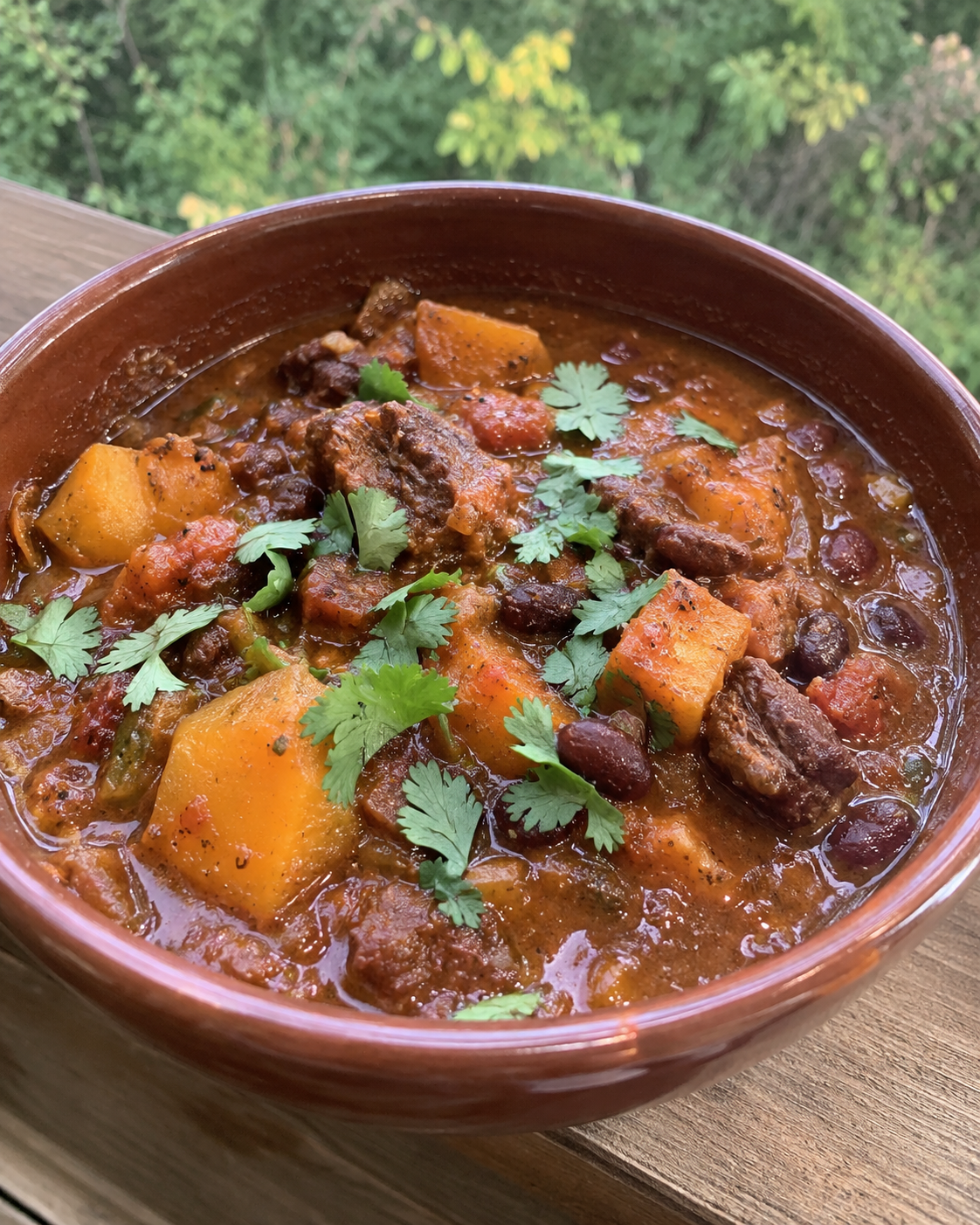
A hearty, bean-free chili of grass-fed ground yak, sweet roasted pumpkin, peppers, and tomatoes, simmered with ancho, chipotle, smoked paprika, cumin, and a touch of cacao for depth. Pile it high with cultured sour cream, avocado, pickled red onions, and toasted pumpkin seeds. It's a cozy, one-pot fall favorite that's perfect for game day, Halloween night, or the freezer.
Yield: Serves 6 · Active: 30 min · Total: 1 hr 30 min · Best in North America in fall and early winter, when pumpkins and peppers overlap · Best eaten: early evening
Why no beans? The classic Texas "bowl of red" has never included beans; it's all about the meat and the chiles. Leaving them out makes this chili grain-free and legume-free, with the pumpkin adding body and natural sweetness instead.
MEET YAK
What it is: Yaks are shaggy, long-haired cattle native to the high plateaus of the Himalayas and Tibet, where they've been raised by herders for thousands of years for meat, milk, fiber, and transport. Built for cold, thin mountain air, they're hardy, thrive on grass and forage, and need little in the way of feed or shelter. Today a growing number of small ranches raise them in the U.S., especially in Colorado and Montana.
What it tastes like: Like a sweeter, milder, cleaner-tasting beef. Despite its exotic reputation, yak isn't strongly gamey, and it's often milder than bison or elk. The meat is a deep ruby red and finely textured.
Why it's nourishing:
Lean protein: Yak is naturally very lean, with little marbling, and rich in complete protein.
Iron, zinc, and B12: It's an excellent source of highly absorbable heme iron, zinc for immunity and hormones, and B12 for energy and the nervous system.
Grass-fed fats: Because yaks are typically raised on grass and forage, their fat brings CLA and more omega-3s than grain-fed beef.
How to cook it:
Don't overcook it. Because yak is so lean, it dries out quickly. Sear steaks to medium-rare (about 125–130°F), and cook ground yak just to 160°F.
Add a little fat and moisture to ground yak: ghee, grated onion, an egg, or a splash of broth.
Braise tough cuts (like shoulder and shanks) low and slow until tender.
Can't find yak? Ground bison, elk, or grass-fed beef all make a wonderful chili. Bison and elk are just as lean; with beef, you may want to spoon off a little fat after browning.
Where to buy: Look for small U.S. ranches and farms that sell direct, at farmers' markets, or through specialty online meat purveyors, and ask how the animals were raised: on pasture, with no added hormones or antibiotics.
Ingredients
Chili
2 tbsp beef tallow or ghee
2 lb grass-fed ground yak
1½ tsp Baja Gold sea salt, divided
1 large onion, diced
1 red bell pepper, diced
1 poblano pepper, diced
4 garlic cloves, minced
2 tbsp tomato paste
2 tbsp ground ancho chile
1–2 tsp chipotle powder (to taste)
1 tbsp smoked paprika
1 tbsp ground cumin
1 tsp dried Mexican oregano
½ tsp ground Ceylon cinnamon
1 tbsp raw cacao powder
1 jar (24–28 oz) crushed tomatoes
2 cups beef or chicken bone broth
3 cups sugar pie pumpkin or kabocha, peeled and cut into ¾-inch cubes
Juice of 1 lime
Toppings (choose your favorites)
Cultured sour cream or raw kefir crema (kefir whisked with a little sour cream, lime, and salt)
Sliced avocado
Quick-pickled red onions (1 red onion, thinly sliced and tossed with the juice of 2 limes and ½ tsp salt for 30 minutes)
Toasted pumpkin seeds
Fresh cilantro
Shredded raw-milk cheddar
Fermented hot sauce
Lime wedges
Method
Brown the yak. Heat the tallow in a large Dutch oven over medium-high heat. Add the yak and 1 tsp salt and cook, breaking it up, until deeply browned, 8–10 minutes. Let it sit undisturbed for a minute or two at a time so it browns rather than steams. (Yak is lean, so there's no fat to drain off.)
Add the vegetables. Add the onion and peppers and cook 6–8 minutes until soft. Add the garlic for 1 minute.
Bloom the spices. Stir in the tomato paste, ancho, chipotle, smoked paprika, cumin, oregano, cinnamon, and cacao, and cook 1–2 minutes, until the paste darkens and the spices are fragrant. Toasting the spices in fat deepens their flavor.
Simmer. Add the crushed tomatoes, broth, and remaining salt, and bring to a gentle simmer. Cover partially and simmer 30 minutes, stirring occasionally.
Add the pumpkin. Stir in the pumpkin and simmer 20–30 minutes more, uncovered, until it's tender and the chili has thickened. Some cubes will melt into the sauce, which is exactly what you want.
Finish with lime juice, then taste and adjust the salt and chipotle.
Serve in warm bowls, piled with your favorite toppings.
Make ahead: Like most chilis, it's even better the next day, once the flavors have melded.
Storage: Refrigerated up to 4 days, or frozen up to 3 months.
Leftover transformations: Spoon leftover chili over a baked sweet potato, fold it into scrambled pastured eggs for a hearty breakfast, or serve it in lettuce cups with avocado and pickled onions.
Nourishment Notes
Grass-fed yak — complete protein, heme iron, zinc, B12, and CLA, with a deep, slightly sweet flavor.
Pumpkin — beta-carotene (made more absorbable by the chili's fats), potassium, and fiber.
Tomatoes — lycopene, which becomes more absorbable when cooked with fat.
Peppers and chiles — vitamin C (which helps your body absorb iron), beta-carotene, and capsaicin.
Cumin, oregano, and cinnamon — traditionally used to support digestion, and cinnamon helps moderate blood sugar.
Raw cacao — magnesium and flavanols, plus a rich, mole-like depth.
Bone broth — gelatin, glycine, and minerals.
Cultured sour cream or kefir crema — live cultures (add them cold, on top) and fat-soluble vitamins.
Pumpkin seeds — zinc, magnesium, and iron.
For your cycle: Yak's heme iron (the body absorbs about 15–35% of heme iron, compared with roughly 2–20% of the iron in plants), zinc, and B12, plus the peppers' vitamin C, make this especially restorative during the menstrual phase. The pumpkin's steady carbohydrate suits the luteal phase.
Sourcing
Ground yak — 100% grass-fed, from a small U.S. yak ranch (many are in Colorado and Montana) or a specialty meat purveyor
Pumpkin — organic sugar pie pumpkin or kabocha, from a farmers' market (large carving pumpkins are watery and bland)
Crushed tomatoes and tomato paste — organic, in glass, with no added sugar (Bionaturae and Jovial both make them)
Peppers, onion, garlic, cilantro, and limes — organic
Spices (ancho, chipotle, smoked paprika, cumin, Mexican oregano, and Ceylon cinnamon) — organic and non-irradiated
Raw cacao powder — organic, ideally tested for heavy metals
Bone broth — homemade, or Bonafide Provisions (organic, sold frozen)
Sour cream, kefir, and cheddar — raw or organic grass-fed, from a farmer you know and trust
Pumpkin seeds — organic and raw
Fermented hot sauce — homemade, or a naturally fermented hot sauce with no added sugar or preservatives
Beef tallow or ghee — tallow rendered from grass-fed suet, or grass-fed ghee
Baja Gold sea salt
— Anna aka Food Marshall