Seared Scallops with Warm Hazelnut-Goat Cheese and Autumn Vegetable-Pear Medley
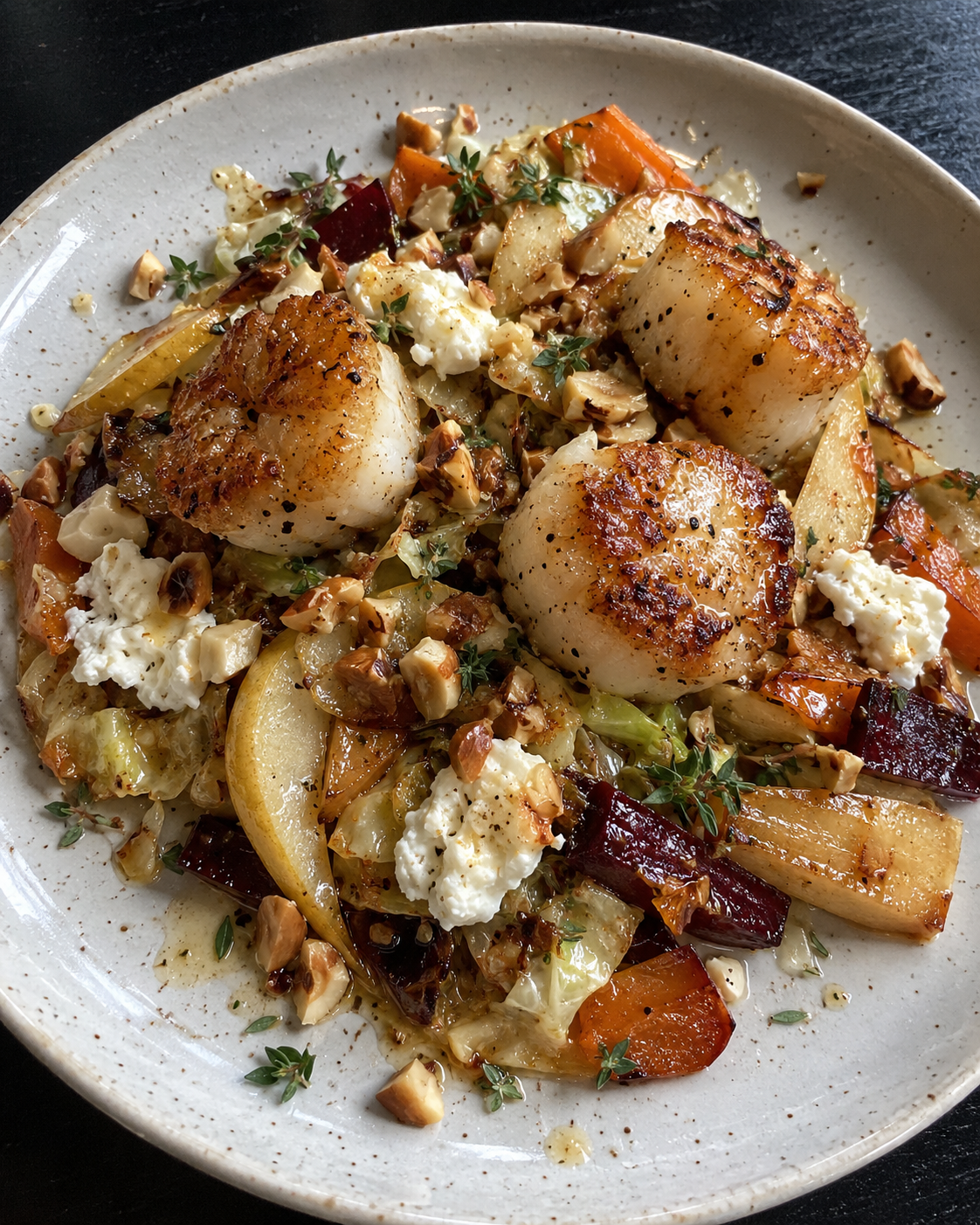
Golden-seared sea scallops over a warm autumn slaw of cabbage, carrot, golden beet, radish, and pear, all cut into fine matchsticks and quickly sautéed so they stay crisp-tender and bright. A spoonful of creamy goat cheese with toasted hazelnuts ties it all together.
Yield: Serves 2 · Active: 30 min · Total: 30 min · Best in North America in fall, when pears, beets, cabbage, and radishes are at their peak · Best eaten: early evening
Complete Menu
Seared Sea Scallops
Warm Autumn Vegetable-Pear Medley
Hazelnut-Goat Cheese
Your Game Plan
About 30 min out: Toast the hazelnuts and make the hazelnut-goat cheese. Cut the vegetables and pear into matchsticks, and shred the cabbage.
About 15 min out: Pat the scallops dry and season them.
About 10 min out: Sauté the vegetable-pear medley and keep it warm.
About 5 min out: Sear the scallops.
Plate right away.
Recipe 1 — Hazelnut-Goat Cheese
Ingredients
2 oz soft goat cheese, at room temperature
2 tbsp toasted hazelnuts, finely chopped
Optional: a tiny drizzle of raw honey
Freshly cracked black pepper
1–2 tsp warm water or thick yogurt, to loosen
Method
Toast the hazelnuts. Toast them in a dry skillet over medium heat 3–5 minutes, stirring, until fragrant and golden. If they have skins, rub them off in a towel while warm. Chop finely.
Mix. Stir together the goat cheese, hazelnuts, optional honey, and pepper, adding warm water or yogurt a little at a time until it's soft and spoonable.
Recipe 2 — Warm Autumn Vegetable-Pear Medley
Keeping everything in fine matchsticks makes this feel like a warm autumn slaw rather than a pile of roasted vegetables. Golden beet keeps the whole dish from turning pink.
Ingredients
1½ cups finely shredded red or Savoy cabbage
1 carrot, cut into thin matchsticks
1 small golden beet, peeled and cut into thin matchsticks
3–4 radishes, cut into thin matchsticks
½ firm pear, cored and cut into thin matchsticks
2 tbsp extra virgin olive oil
1 tsp fresh thyme leaves
1–2 tsp raw apple cider vinegar
½ tsp Baja Gold sea salt
Method
Sauté the cabbage and carrot. Heat the olive oil in a large skillet over medium heat. Add the cabbage and carrot and cook 3–4 minutes, tossing, until just tender.
Add the beet and radish and cook 1–2 minutes more, so they keep some bite.
Add the pear last, just 30–60 seconds, so it's warm and lightly caramelized but doesn't collapse.
Finish with the thyme, a splash of cider vinegar, and salt. Keep warm.
Recipe 3 — Seared Sea Scallops
Ingredients
8–10 large dry-packed sea scallops, side muscles removed
½ tsp Baja Gold sea salt
1 tbsp ghee (or a mix of ghee and olive oil)
Method
Dry them extremely well. Pat the scallops completely dry with paper towels; a dry surface is the secret to a golden crust. Season with salt just before cooking.
Heat the pan. Heat the ghee in a heavy skillet (cast iron or stainless) over medium-high heat until very hot but not smoking.
Sear. Lay the scallops in with space between them and don't move them. Sear 1½–2 minutes, until a deep golden crust forms, then flip and cook about 1 minute more, depending on size. They're ready when the center is still slightly translucent; carryover heat finishes the job.
Plating
Pile the warm vegetable-pear medley onto each plate, arrange the scallops on top, and add small spoonfuls of hazelnut-goat cheese around them. Finish with a few extra thyme leaves, a sprinkle of chopped hazelnuts, and a pinch of flaky salt.
Storage
Scallops: Best eaten right away; they don't reheat well
Vegetable-pear medley: Refrigerated up to 2 days. It's lovely cold as a slaw, too
Hazelnut-goat cheese: Refrigerated up to 5 days
Support for the Female Infradian Rhythm
This plate supports every phase of your cycle. Scallops bring B12, selenium, zinc, and magnesium. Cabbage and radishes deliver glucosinolates, which support estrogen metabolism through Phase 2 liver detoxification, and golden beets bring folate and nitrates that support healthy blood flow. Hazelnuts add vitamin E and magnesium, especially welcome in the luteal phase.
Nourishment Notes
Sea scallops — lean complete protein, B12, selenium, zinc, magnesium, and some omega-3s.
Cabbage — glucosinolates, vitamin C, and vitamin K. Red cabbage adds anthocyanins.
Golden beets — betaxanthins (the golden pigments), folate, nitrates, and potassium.
Radishes — vitamin C and glucosinolates.
Carrots — beta-carotene, which becomes more absorbable cooked with olive oil.
Pear — fiber, vitamin C, and copper, plus natural sweetness.
Goat cheese — calcium, K2, and protein, with mostly A2-type casein.
Hazelnuts — vitamin E, manganese, copper, and oleic acid.
Thyme and apple cider vinegar — thymol, plus acetic acid for blood-sugar balance.
Sourcing
Sea scallops — dry-packed (never "wet" or treated with STP), ivory to pale peach rather than bright white. Hand-harvested diver scallops from Maine (in season roughly December through April) are a special treat, and farmed scallops are an excellent, sustainable year-round choice (wild seafood can't be certified organic)
Goat cheese — a soft farmstead goat cheese from a local dairy, organic when you can find it, or a French raw-milk AOP chèvre such as Sainte-Maure de Touraine
Hazelnuts — organic Oregon hazelnuts, or Nocciola Piemonte IGP from Italy
Pear — organic, firm Bosc or Anjou, ideally from a Pacific Northwest orchard or your local farmers' market
Cabbage, carrots, golden beets, and radishes — organic, from a farmers' market
Raw apple cider vinegar — organic, with the mother (Bragg)
Raw honey (optional) — organic, local, and unfiltered
Yogurt (optional) — organic, plain, full-fat sheep's or goat's milk yogurt
Ghee — Ancient Organics, or homemade from organic grass-fed butter
Fresh thyme — organic
Extra virgin olive oil — organic, single-estate, harvest-dated within the past year, in dark glass
Salt — Baja Gold sea salt; Maldon or fleur de sel de Guérande for finishing
— Anna aka Food Marshall