Steak Tartare with Beet Cream, Raw Sauerkraut, and Parmesan-Arugula Salad
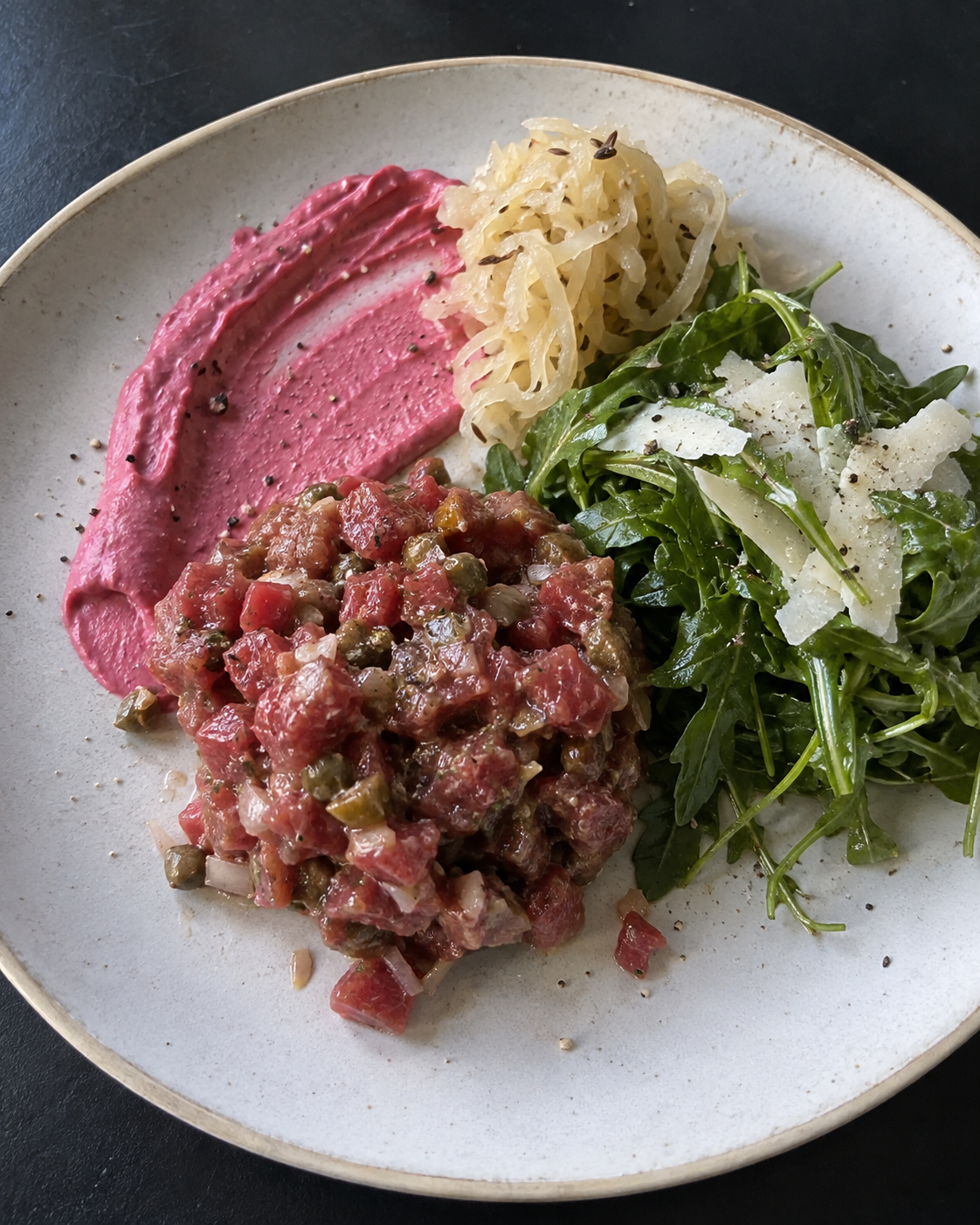
Grass-fed beef tenderloin tossed with shallot, capers, cornichons, and Dijon, set over a swoosh of brilliant pink beet cream and crowned with a golden egg yolk. Spoonfuls of tangy raw sauerkraut and a peppery Parmesan-arugula salad round out the plate.
Yield: Serves 2 · Active: 25 min · Total: 25 min (plus about 1 hour if roasting the beet) · Year-round; beets and arugula are at their best in North America in spring and fall · Best eaten: midday or early evening
Complete Menu
Hand-Cut Steak Tartare
Beet Cream
Raw Sauerkraut
Parmesan-Arugula Salad
Your Game Plan
Up to 3 days ahead: Roast the beet and make the beet cream.
About 30 min out: Chill your plates, mixing bowl, and knife in the fridge. Mince the shallot and chop the cornichons, capers, and parsley.
About 15 min out: Hand-cut the beef, then keep it cold.
Right before serving: Dress the arugula, mix the tartare, and plate.
Recipe 1 — Hand-Cut Steak Tartare
Ingredients
6–8 oz very fresh grass-fed beef tenderloin
1 small shallot, very finely minced
1 tbsp cornichons, finely chopped, plus extra for serving
1 tsp capers, rinsed and chopped
1 tsp Dijon mustard
1 tbsp fresh flat-leaf parsley, finely chopped
1 tsp extra virgin olive oil
¼ tsp Baja Gold sea salt, plus flaky salt for finishing
Freshly cracked black pepper
2 egg yolks from pasture-raised eggs (raw from a farmer you trust, or pasteurized)
Method
Chill everything. Put your cutting board, knife, mixing bowl, and plates in the fridge for 20–30 minutes. Raw beef should stay cold from start to finish.
Hand-cut the beef. Slice the tenderloin into thin slices, then into thin strips, then into tiny cubes, about ⅛ inch. Hand-cutting (rather than grinding) gives tartare its tender, silky texture. If the beef is hard to cut cleanly, pop it in the freezer for 15 minutes first.
Keep it cold. Transfer the beef to the chilled bowl and refrigerate until right before serving.
Mix at the last minute. Gently fold in the shallot, cornichons, capers, Dijon, parsley, olive oil, salt, and pepper. Taste and adjust. Mix it only right before serving, since the salt and acid start to change the beef's texture as it sits.
Recipe 2 — Beet Cream
Ingredients
1 small roasted beet, peeled (see below)
¼ cup thick sheep's or goat's milk yogurt
1 tsp Dijon mustard
1 tsp raw apple cider vinegar or sherry vinegar
Pinch of Baja Gold sea salt
Method
Roast the beet. Wrap the beet in parchment and roast at 400°F for 45–60 minutes, until a knife slides in easily. Let it cool, then rub off the skin with a towel.
Blend the beet, yogurt, Dijon, vinegar, and salt until brilliant pink and completely smooth. Taste and adjust.
Chill until serving.
Recipe 3 — Raw Sauerkraut
Use 2–4 tbsp of raw, unpasteurized sauerkraut, homemade or store-bought from the refrigerated section. For homemade, see my Ferment Foundations post. Its bright tang cuts through the richness of the beef, much like the classic cornichons.
Recipe 4 — Parmesan-Arugula Salad
Ingredients
2 large handfuls baby arugula
1 tbsp extra virgin olive oil
1 tsp fresh lemon juice
Pinch of Baja Gold sea salt
Freshly cracked black pepper
Parmigiano-Reggiano, shaved with a vegetable peeler
Method
Toss the arugula with the olive oil, lemon juice, salt, and pepper just before serving, then shave the Parmigiano over the top.
Plating
Swipe a generous spoonful of beet cream across each chilled plate. Shape the tartare into a mound or ring over the cream, press a small well into the top, and gently nestle in an egg yolk. Tuck a little sauerkraut and a few cornichons around the tartare, finish with flaky salt and cracked pepper, and set the Parmesan-arugula salad alongside.
Know Your Farmer
Steak tartare is only as good as the beef and eggs it's made from, so the relationship matters. Buy whole-muscle tenderloin from a butcher or rancher you trust, ideally cut fresh the day you serve it, from 100% grass-fed animals raised on pasture. Ask how the meat was handled and stored, and tell them you're serving it raw; a good butcher will help you choose the best piece. For the yolks, choose eggs from a small farm with healthy, pasture-raised hens.
Nourishment Notes
Grass-fed beef tenderloin — heme iron, B12, zinc, selenium, and complete protein. Raw beef also keeps its natural creatine and heat-sensitive B vitamins, some of which are lost in cooking.
Pasture-raised egg yolk — choline, fat-soluble vitamins A, D, E, and K2, and lecithin, all reflecting the hen's time in the sun and on pasture.
Beets — dietary nitrates that support healthy blood flow, plus betalains (the pigments behind their brilliant color), folate, and potassium.
Sheep's and goat's milk yogurt — live cultures (never heated here), calcium, and protein, with mostly A2-type casein that many people find easier to digest.
Raw sauerkraut — living probiotic microbes, vitamin C, and vitamin K, plus a bright tang that balances rich foods.
Arugula — eaten raw, it keeps its glucosinolates and the enzyme that turns them into isothiocyanates as you chew, along with vitamin K and folate.
Parmigiano-Reggiano — calcium, K2, and complete protein, made from raw milk by law.
Capers, cornichons, shallot, and parsley — quercetin from the capers, bright acidity from the cornichons, organosulfur compounds from the shallot, and vitamin K and apigenin from the parsley.
Dijon mustard — glucosinolates and a sharp kick.
Extra virgin olive oil and lemon — oleic acid, polyphenols, and vitamin C.
Support for the Female Infradian Rhythm
This plate is especially restorative during the menstrual and luteal phases. Grass-fed beef delivers heme iron (the body absorbs about 15–35% of heme iron, compared with roughly 2–20% of the iron in plants), plus B12 and zinc for menstrual replenishment. Beets support healthy blood flow, the egg yolk brings choline, and the raw sauerkraut and yogurt support a healthy gut, which also helps clear used hormones.
As a circadian food, tartare is best enjoyed at midday or early evening, in daylight, when your digestion is strongest.
Storage
Steak tartare: Serve right away; don't store leftovers.
Beet cream: Refrigerated up to 4 days.
Roasted beets: Refrigerated up to 5 days.
Arugula salad: Best dressed just before serving.
Sourcing
Beef tenderloin — 100% grass-fed and grass-finished whole-muscle tenderloin from a butcher or rancher you trust, cut fresh: a local regenerative ranch, Alderspring Ranch (certified organic), or White Oak Pastures
Eggs — organic and pasture-raised, from a local farm where the hens truly range on pasture, or Alexandre Family Farm (Regenerative Organic Certified). Use pasteurized eggs if you prefer
Sheep's or goat's milk yogurt — organic, plain, and full-fat, with live cultures; raw from a local dairy, or Bellwether Farms sheep's milk yogurt
Beets — organic, from a farmers' market
Raw sauerkraut — homemade, or raw and unpasteurized from the refrigerated section, made with just cabbage and sea salt
Dijon mustard — organic, with no preservatives or sugar; Delouis Fils and Maison Orphée both make organic Dijon from just mustard seeds, vinegar, water, and salt
Capers — organic, salt-packed if you can find them; rinse before using
Cornichons — organic, with no added sugar or dyes; naturally fermented if you can find them
Arugula, shallots, parsley, and lemons — organic
Parmigiano-Reggiano — DOP, aged 24+ months, made from raw milk by law
Vinegar — raw apple cider vinegar with the mother, or Vinagre de Jerez DOP sherry vinegar
Extra virgin olive oil — organic, single-estate, harvest-dated within the past year, in dark glass
Salt — Baja Gold sea salt; Maldon or fleur de sel de Guérande for finishing
— Anna aka Food Marshall