Tomato, Basil, and Goat Cheese Frittata & QUICHE — 2 recipes
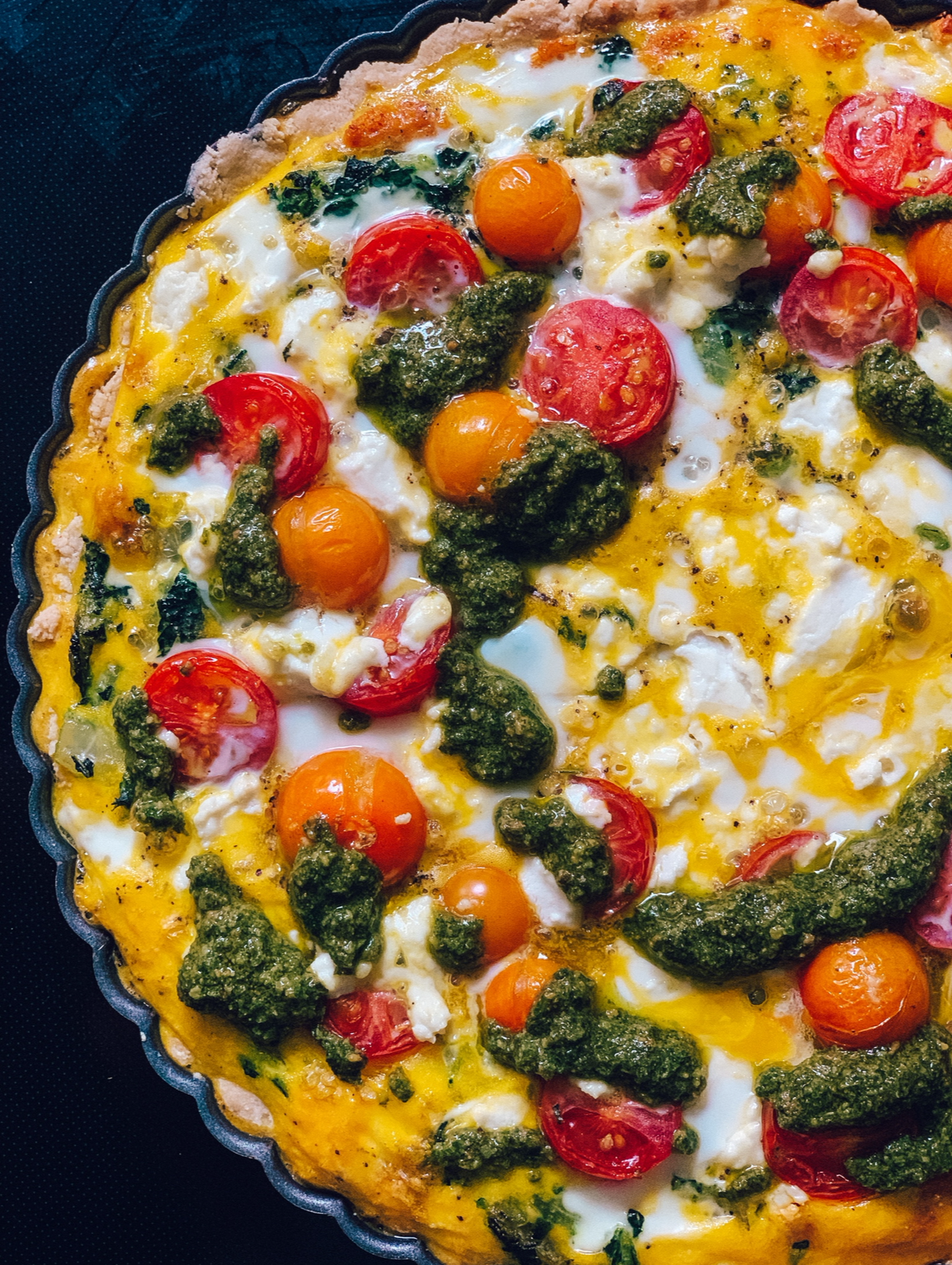
Tomato, Basil, and Goat Cheese Frittata
A summer brunch built on peak-season tomatoes, fresh basil, soft chèvre, and pasture-raised eggs — Italian-style, crustless, vegetable-forward
Serves 6 (or 8–10 as part of a brunch spread) · 15 min active · 1 hr total (incl. 10 min rest) · summer · morning to early afternoon
Ingredients
10 large pasture-raised eggs, room temperature
1 cup raw whole milk (or ½ cup raw milk + ½ cup raw heavy cream for a richer custard)
2 medium white or yellow onions, diced
2 tbsp raw grass-fed ghee (or raw butter, or extra virgin olive oil)
2 garlic cloves, minced
1 ½ cups cherry or grape tomatoes, halved (or 2 medium heirloom tomatoes, thickly sliced)
½ cup fresh basil leaves, torn by hand (plus more for garnish)
½ cup fresh chèvre, crumbled
1 tsp sea salt
½ tsp freshly ground black pepper
Optional
a few sprigs of fresh thyme, leaves stripped
2 tbsp grated Parmigiano-Reggiano, for the top
Method
Prep. Preheat the oven to 350°F (175°C). Grease a 9 × 13-inch baking dish or a 10–12-inch oven-safe cast-iron skillet with ghee or olive oil.
Sauté the onions. Melt 2 tbsp ghee in a skillet over medium heat. Add the diced onions with a pinch of salt. Cook 8–10 minutes, stirring occasionally, until translucent and lightly golden at the edges.
Add the garlic. Cook 1 minute more.
Remove from heat. Cool slightly. Hot onions will scramble the eggs if added directly — let them cool to warm, not hot.
Whisk the eggs. In a large bowl, whisk together the eggs, milk (or milk + cream), salt, pepper, and optional thyme until smooth and lightly foamy, about 1 minute. Homogenous, not aerated.
Layer the vegetables. Distribute the cooled onions across the bottom of the prepared dish. Scatter the halved tomatoes cut-side up across the onions.
Tear most of the basil over the top, reserving a small handful for garnish after baking.
Pour and finish. Pour the egg mixture evenly over the vegetables.
Scatter the crumbled goat cheese in irregular pale clumps across the surface — don't blend it in; the visible white pockets are the visual signature of a finished frittata.
Sprinkle with optional Parmigiano if using.
Bake in the center of the oven 30–35 minutes, until the center is just set with a slight jiggle when nudged.
For more color: Broil 1–2 minutes at the end. Watch closely — the surface goes from golden to burnt quickly.
Rest. Rest 10 minutes before slicing. Non-negotiable. The eggs finish setting during the rest, and cutting too early causes the filling to weep.
Garnish with the reserved fresh basil and slice into wedges. Serve warm, room temperature, or cold.
Storage: Refrigerator up to 3 days, tightly covered. The flavors deepen overnight. Reheat gently at 300°F for 10–15 minutes, or serve cold (surprisingly delicious in summer). For a picnic, slice into wedges and wrap each in parchment.
Nourishment Notes
This is the Italian frittata tradition rather than the French quiche tradition — eggs beaten with milk, combined with whatever vegetables and herbs are at the peak of the season, and baked until just set. Frittata di pomodori has been a fixture in southern Italian summer kitchens for centuries; the Roman agricultural writer Apicius describes frittata-like dishes as far back as the 4th century. The crustless format suits a summer dish: bright, egg-forward, vegetable-driven, with each ingredient allowed to be the star.
Pasture-raised eggs are the foundation. Genuinely pasture-raised eggs carry roughly twice the omega-3 fatty acids of conventional eggs, along with substantially more vitamin A, vitamin D, and a richer carotenoid profile — visible in the deep orange of the yolk. Ten eggs deliver roughly 60 grams of complete protein plus the full spectrum of fat-soluble vitamins. Raw grass-fed milk brings intact enzymes (lactase, lipase, phosphatase), butyrate for the gut lining, and the same fat-soluble vitamin profile in custard form. Goat chèvre carries a naturally A2-leaning beta-casein that many dairy-sensitive people tolerate more comfortably than cow milk, and goats' more varied forage produces a more distinct fatty acid profile. Raw ghee — clarified butter, fat without the milk solids — has been a core cooking fat in Indian and Mediterranean traditions for at least 5,000 years; it is exceptionally stable under heat and retains the fat-soluble vitamins of butter.
Peak-season tomatoes, vine-ripened in long daylight, carry meaningfully more lycopene, vitamin C, and total antioxidant load than their hothouse counterparts. Lycopene is one of the few nutrients whose bioavailability actually increases with gentle cooking and fat — the ghee, eggs, and cheese here all assist absorption. Summer-grown basil, under the same long photoperiod, develops higher concentrations of its aromatic terpenes (linalool, eugenol, estragole), which is why a torn leaf of real summer basil smells so much more intense than the hothouse version.
Eggs are ancestrally a breakfast food — the body uses their complete amino acid profile and fat-soluble vitamins most efficiently at the start of the day, when digestive fire and metabolic capacity peak alongside the rising sun. A slice of this frittata at morning or midday lands at the moment the body is best equipped to use it. Avoid as a late-evening meal — the richness settles best in daylight digestion.
Storage: Refrigerator up to 3 days, tightly covered.
Sourcing: Pasture-raised eggs from a local farm — small farms selling at farmers' markets are the gold standard, and eggs with deep-orange yolks plus unwashed shells signal genuinely pasture-raised hens; for shipped options, Alexandre Family Farm (regenerative California dairy with exceptional eggs) or Apricot Lane Farms direct (biodynamic Southern California) are the top-tier choices, with Vital Farms acceptable as a widely-available fallback. Raw milk and raw cream from a local raw-dairy producer or Amish farm where legally available — Amish creameries across Pennsylvania, Ohio, Indiana, and Wisconsin produce exceptional raw fresh dairy through cow-shares, roadside stands, and Amish-run grocery markets; the Weston A. Price Foundation's raw-milk finder (realmilk.com) helps locate one near you. Avoid ultra-pasteurized at all costs. Soft goat cheese from a local goat dairy at the farmers' market is the gold standard; for shipped options, Cypress Grove (humane Sonoma producer) or Laura Chenel (small-batch Sonoma chèvre) both ship and meet the structural standard. Heirloom or cherry tomatoes from a local farmers' market at peak — heirloom varieties (Cherokee Purple, Brandywine, Green Zebra, Sungold cherry) carry significantly more flavor and lycopene than commodity varieties. Fresh basil from a windowsill pot grown at home, or a farmers' market herb vendor; the difference between summer-grown garden basil and hothouse-shipped basil is substantial. Raw grass-fed ghee or butter from a local Amish creamery; for shipped options, Pure Indian Foods (genuinely traditional ghee) or Kerrygold Reserve (Irish grass-fed, widely available).
Tomato, Basil, and Goat Cheese Quiche with Caramelized Onion and Basil Pesto
A Provençal summer quiche layered over a grain-free almond crust — slow-caramelized onion base, fresh basil pesto, peak tomatoes, soft goat cheese, and a silky egg custard
Serves 6–8 · 50 min active · 1 hr 30 min total · summer · morning to early afternoon
Ingredients
Almond flour crust
1 ½ cups blanched almond flour
3 tbsp grass-fed butter, cold and cubed
1 large pasture-raised egg
½ tsp sea salt
Caramelized onion
1 large yellow onion, thinly sliced
2 tbsp grass-fed butter
½ tsp sea salt
Basil pesto (or use ⅓ cup quality store-bought)
1 cup fresh basil leaves, packed
¼ cup pine nuts (or walnuts), lightly toasted
2 garlic cloves
⅓ cup grated Parmigiano-Reggiano
⅓ cup cold-pressed extra virgin olive oil
¼ tsp sea salt
Quiche filling
8 large pasture-raised eggs
¾ cup full-fat coconut milk (or grass-fed cream)
1 ½ cups cherry tomatoes, halved
4 oz fresh chèvre, crumbled
2 tbsp fresh basil, torn
½ tsp Himalayan pink salt
freshly cracked black pepper
Method
Caramelize the onion (start first — takes time). Melt 2 tbsp butter in a skillet over medium-low heat. Add the sliced onion and salt.
Cook 25–35 minutes, stirring occasionally, until deeply golden, silky, and reduced significantly. Don't rush this — quick-cooking produces sharp onions, not sweet caramelized ones. Cool.
Make the pesto. Pulse the basil, pine nuts, garlic, and Parmigiano in a food processor until coarsely chopped.
With the motor running, drizzle in the olive oil until smooth. Season with salt. Set aside.
Make the crust. Preheat the oven to 350°F (175°C).
In a food processor, pulse the almond flour, salt, and cold cubed butter until pea-sized crumbs form.
Add the egg and pulse until a dough comes together.
Press the dough evenly into a 9-inch tart pan or pie dish, building up the sides slightly.
Pre-bake the crust 10 minutes. Cool slightly.
Assemble. Spread the cooled caramelized onion evenly over the pre-baked crust.
Drizzle with about half the pesto (reserve the rest for serving alongside).
Make the filling. In a large bowl, whisk together the eggs, coconut milk (or cream), salt, and pepper.
Arrange the halved tomatoes cut-side up over the onion-pesto layer.
Scatter the crumbled goat cheese among the tomatoes.
Pour the egg mixture evenly over the top.
Tear the additional fresh basil over the surface.
Bake 35–40 minutes, until the center is just set with a slight jiggle when nudged.
Rest. Cool 10 minutes before slicing — non-negotiable. The eggs finish setting during the rest.
Slice into wedges. Serve with the reserved pesto drizzled over each portion.
Variation: Simpler retreat-format quiche. For a faster version (ideal for breakfast catering at scale), skip the caramelized onion and pesto layers. Pre-bake the crust, then layer halved tomatoes, torn basil, crumbled goat cheese, and 2 minced garlic cloves directly on the crust. Pour the egg-and-coconut-milk mixture over and bake as above. Scales easily to a 9 × 13 dish or two 9-inch crusts for serving 12+.
Storage: Refrigerator up to 4 days, tightly covered. Reheats beautifully at 325°F for 10 minutes, or serve at room temperature. Quiche is genuinely better at room temperature — the flavors integrate more clearly than when piping hot.
Nourishment Notes
Quiche is a foundational French country dish — eggs, dairy, and seasonal vegetables baked into a single dish that scales easily for groups, holds beautifully overnight, and is genuinely better at room temperature. The grain-free almond crust replaces traditional wheat pastry, providing vitamin E, magnesium, and monounsaturated fats while eliminating gluten — and the result is a tender, buttery shell that holds together remarkably well. The combination — tomato, basil, goat cheese — is fundamentally a Provençal summer pairing, best made when heirloom tomatoes are at peak (July through early September in most US climates).
Pasture-raised eggs anchor the structure with complete protein and fat-soluble vitamins A, D, E, and K2, plus choline and lecithin (which acts as a natural emulsifier giving the quiche its silky structure). Fresh tomatoes deliver lycopene that becomes more bioavailable when cooked with fat, alongside vitamin C, beta-carotene, and a full carotenoid spectrum — and the substantial butter, eggs, and cream of a quiche provide exactly the fat that lycopene needs to be absorbed. Fresh basil contributes eugenol, methyl chavicol, and rosmarinic acid; soft goat cheese (particularly raw or grass-fed) brings calcium, vitamin K2, and live bacterial cultures. Goat cheese specifically is naturally lower in lactose and contains smaller fat globules and a different protein structure (more A2 beta-casein) than cow's milk cheese, making it digestible for many who cannot tolerate cow dairy. Grass-fed cream or coconut milk provides the substantial fat that ensures absorption of the fat-soluble vitamins.
The two flourishes that elevate this version above a basic egg-and-tomato quiche — caramelized onion and basil pesto — operate on different parts of the flavor spectrum. Caramelized onions require time but very little active work; the slow Maillard browning concentrates the onion's natural sugars and develops glutamic acid (the same umami compound found in aged cheeses and bone broth). Onions deliver quercetin and prebiotic fibers; long caramelization preserves these while developing deep flavor. Pesto is the foundational Ligurian sauce — basil, pine nuts, garlic, Parmigiano, olive oil — bringing eugenol, methyl chavicol, and rosmarinic acid from the basil; pinolenic acid from pine nuts; and oleocanthal from extra virgin olive oil. Together, the caramelized onion provides depth and sweetness, while the pesto provides brightness and herbal punch.
This is summer brunch eating at its best — a centerpiece dish that genuinely wows guests despite a fairly straightforward method. The retreat-format variation (without the onion and pesto layers) is the workhorse alternative for catering breakfast at scale, where speed matters more than depth. Both versions hold beautifully overnight, and both are genuinely better at room temperature than served piping hot — making them ideal for the slow rhythm of a summer brunch where guests serve themselves over the course of an hour.
Storage: Refrigerator up to 4 days, tightly covered. Reheats well at 325°F for 10 minutes. Quiche is genuinely better at room temperature.
Sourcing: Blanched almond flour: ideally a small-batch organic mill — Honeyville Farms or Anthony's Organic are the best widely-available options, both stone-ground from California almond growers. Pasture-raised eggs from a local farm at the farmers' market is the gold standard (deep-orange yolks and unwashed shells signal genuinely pasture-raised hens); for shipped options, Alexandre Family Farm or Apricot Lane Farms direct are the top-tier choices, with Vital Farms acceptable as a widely-available fallback. Heirloom or cherry tomatoes from a local farmers' market at peak — heirloom varieties (Cherokee Purple, Brandywine, Sungold cherry) carry significantly more flavor and lycopene than commodity varieties. Fresh basil from a windowsill pot grown at home, or a farmers' market herb vendor. Soft goat cheese from a local goat dairy at the farmers' market is the gold standard; for shipped options, Cypress Grove or Laura Chenel (both small-batch Sonoma producers). Grass-fed butter from a local Amish creamery is the best option; for shipped, Kerrygold Reserve (Irish grass-fed, widely available) or Vital Farms cultured butter. Coconut milk: Native Forest Organic Simple (guar-gum-free) or Aroy-D pure coconut milk in cartons (Thai, single-ingredient, no additives). Pine nuts: Mediterranean origin (Italian or Spanish) from a specialty importer like Gustiamo or Sahadi's — not Chinese pine nuts, which can cause "pine mouth" syndrome. Parmigiano-Reggiano DOP, 24+ months aged — look for the rind stamp; specialty Italian importers like Eataly, Buon'Italia, or local cheese counters ship Parmigiano with traceable origin. For event catering 24+: scale to 4 quiches or 2 large 9 × 13 dishes; bake on different oven racks and rotate at the halfway mark.