Bison Burgers with Mushrooms, Onions & Goat Cheddar
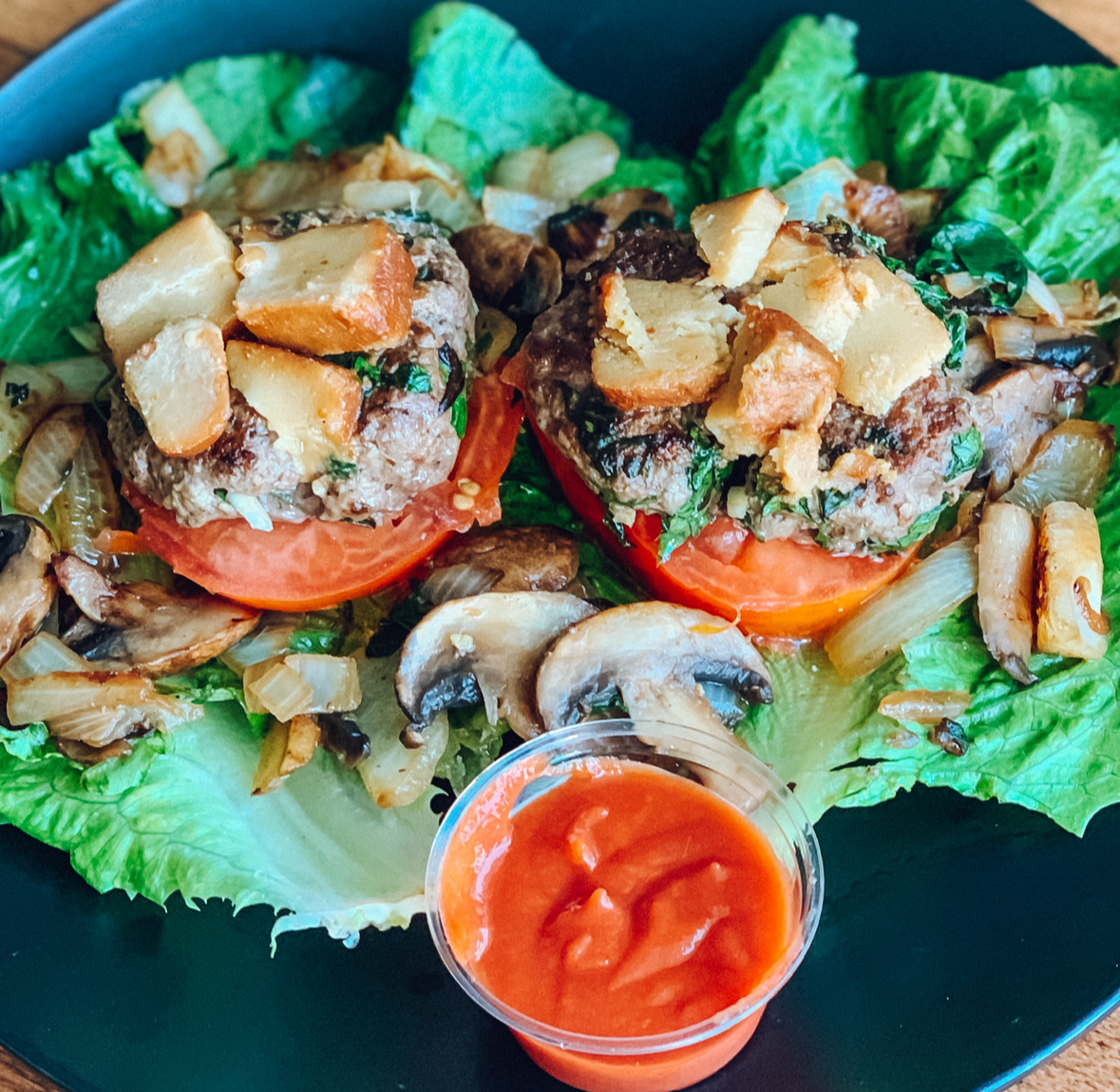
The grain-free American burger reconstructed on real ingredients — pasture-raised bison, sautéed shiitakes, raw goat cheddar, butter-lettuce wrap.
Season: Year-round · spring/summer at peak Cuisine: American Heritage Yield: Serves 3–4 Active: 25 min · Total: 35 min · Best eaten: midday or early evening
This is the burger reconstructed on the opposite end of the food system — pasture-raised bison instead of industrial ground beef, sautéed shiitake mushrooms instead of the standard tomato-onion-pickle, raw grass-fed goat cheddar instead of processed American cheese, butter lettuce as the wrap instead of refined-flour brioche. The result is a burger that's recognizably a burger but eats more like a substantial dinner — denser, more flavorful, and considerably more nourishing than the conventional version.
Bison is a leaner red meat than beef, with a slightly more favorable omega-3 to omega-6 ratio when grass-fed — and the historical context matters. Bison historically grazed across the North American prairies for thousands of years before colonization decimated the herds; today's pasture-raised bison from regenerative ranches (Force of Nature, or local farmers' market sources) restores some of that ecological tradition. The meat tastes meaningfully different from beef — cleaner, more mineral-forward, slightly more concentrated — and the leaner profile means a slight thumb-indent in the center of each patty (to prevent doming during cooking) makes a real difference.
The burger lands as a complete meal. Serve alongside roasted potatoes, a simple green salad, or simply a generous spread of fermented pickles and grainy mustard.
Ingredients
Burgers
1 lb grass-fed ground bison (or beef)
4 cloves garlic, minced
½ cup fresh parsley, finely chopped
1 tsp sea salt
½ tsp freshly cracked black pepper
Sautéed Mushrooms & Onions
1 cup shiitake mushrooms, sliced
1 yellow onion, sliced
1 tbsp grass-fed butter
Sea salt and black pepper
Toppings
1 head butter lettuce, leaves separated
1 large heirloom tomato, sliced
⅓ cup grass-fed goat cheddar (or other raw cheese), shredded
¼ cup fermented pickles, sliced
1 ripe avocado, sliced (optional)
Pickled onion or pickled cabbage, for garnish (optional)
Homemade avocado-oil mayo, fermented mustard, or no-sugar-added ketchup
Sub: grass-fed beef works as the original suggests. For dairy-free, skip the goat cheddar and add an extra slice of avocado plus a smear of homemade mayo. Cremini or oyster mushrooms work in place of shiitake.
Method
Preheat the oven to 375°F.
Burgers.In a large bowl, gently combine ground bison, garlic, parsley, salt, and pepper. Mix lightly with your hands — overmixing makes tough burgers. Form into 4 patties, slightly indenting the center of each with your thumb (this keeps them from doming during cooking).
Mushrooms & onions.Melt butter in a large skillet over medium heat. Add mushrooms and onions; sauté 3–5 minutes until golden brown. Season with salt and pepper. Remove from the pan and set aside.
Burgers.In the same skillet (oven-safe), sear the patties 2–3 minutes per side over medium-high heat.Transfer the skillet to the oven and bake 4–6 minutes more until cooked through.
Top each patty with shredded goat cheddar and return to the oven 2 minutes to melt.
Assemble.Place a butter lettuce leaf on each plate. Top with a tomato slice, the burger patty (with melted cheese), the sautéed mushrooms and onions, sliced pickles, avocado, and your chosen condiments.
Nourishment Notes
Bison is a leaner red meat than beef, with a slightly more favorable omega-3 to omega-6 ratio when grass-fed, alongside heme iron, zinc, B12, and B6 in their most bioavailable forms. Bison historically grazed across the North American prairies for thousands of years before colonization decimated the herds; pasture-raised bison from regenerative ranches (like Force of Nature) restores some of this ecological tradition. The leanness is genuinely meaningful: bison is roughly 25% lower in calories per gram than beef, with comparable protein content — making it useful for those wanting concentrated protein without the heavier saturated-fat load of beef.
Shiitake mushrooms bring beta-glucans (immune-supporting polysaccharides), B vitamins, and ergocalciferol (vitamin D2 from sun-exposed mushrooms). The umami compound guanylate in shiitakes — combined with the glutamate naturally present in aged cheese — produces a synergistic umami effect that makes a small amount of mushroom plus cheese register as more substantial than either alone. Goat cheddar — particularly raw and grass-fed — delivers calcium, vitamin K2, and the live bacterial cultures that pasteurization destroys; goat dairy is naturally lower in lactose and easier to digest than cow's dairy for many people. The protein structure of goat milk (more A2 beta-casein, smaller fat globules) makes it tolerable for many who react to cow dairy.
Butter lettuce as the bun replacement keeps the meal grain-free while adding folate, vitamin K, and prebiotic fibers. The lettuce wrap is genuinely structural — the soft, sturdy leaves of butter lettuce hold together better than romaine or iceberg and don't compete with the burger flavors. Fermented pickles contribute lactic acid bacteria and the digestive support of traditional ferments — look for genuinely fermented pickles (Bubbies or local farmers' market) rather than vinegar-cured commercial pickles, which lack the live cultures.
As a circadian and seasonal food, this is midday or early-evening eating — the protein-and-fat-anchored meal lands beautifully when ambient digestive fire is at peak.Year-round, with peak resonance in spring and summer when heirloom tomatoes are in season and outdoor grilling is available.
Sourcing: Ground pasture-raised bison from a local rancher at your farmers' market is the gold standard — many small-scale bison ranchers sell direct, and bison is one of the few meats where regenerative grazing produces genuinely superior flavor and nutritional density. For shipped options, Force of Nature (regenerative ranching, single-source small-ranch sourcing, USDA-organic ancestral blends widely respected in the wellness world), Wild Idea Buffalo Co. (South Dakota tallgrass-prairie regenerative bison, founded by Dan O'Brien, ships nationally), or Northstar Bison (Wisconsin family-owned, 100% grass-fed, ships direct) all meet the structural standard. Avoid commodity grocery-store bison — most is grain-finished in commercial feedlots, which defeats the nutritional advantage. Shiitake mushrooms: a local mushroom forager or farmers' market mycology vendor is the gold standard (look for log-grown rather than sawdust-grown for deeper flavor); for shipped options, Far West Fungi (small California growers, ship fresh nationally) or dried shiitake from a Japanese specialty importer like Mitoku or Eden Foods. Raw goat cheddar from a local goat dairy at the farmers' market is the gold standard; for shipped options, Cypress Grove (humane Sonoma producer) or Laura Chenel are top-tier; Mt. Mansfield Creamery in Vermont produces excellent small-batch raw goat cheddar that ships seasonally. Butter lettuce from a local farmers' market when in season — small farms with heirloom varieties (Buttercrunch, Tom Thumb, Marvel of Four Seasons) produce significantly more flavor than supermarket butter lettuce; consider growing your own (it's one of the easiest crops for a backyard or windowsill garden, ready in 4–6 weeks).
Storage: Cooked burgers keep 2 days refrigerated; reheat gently. The burger components scale linearly. For 8 guests, double; cook in two skillets simultaneously.