Raw Zucchini Lasagna with Pistachio Pesto, Sun-Dried Tomato Marinara, and Nut-Seed Cheese
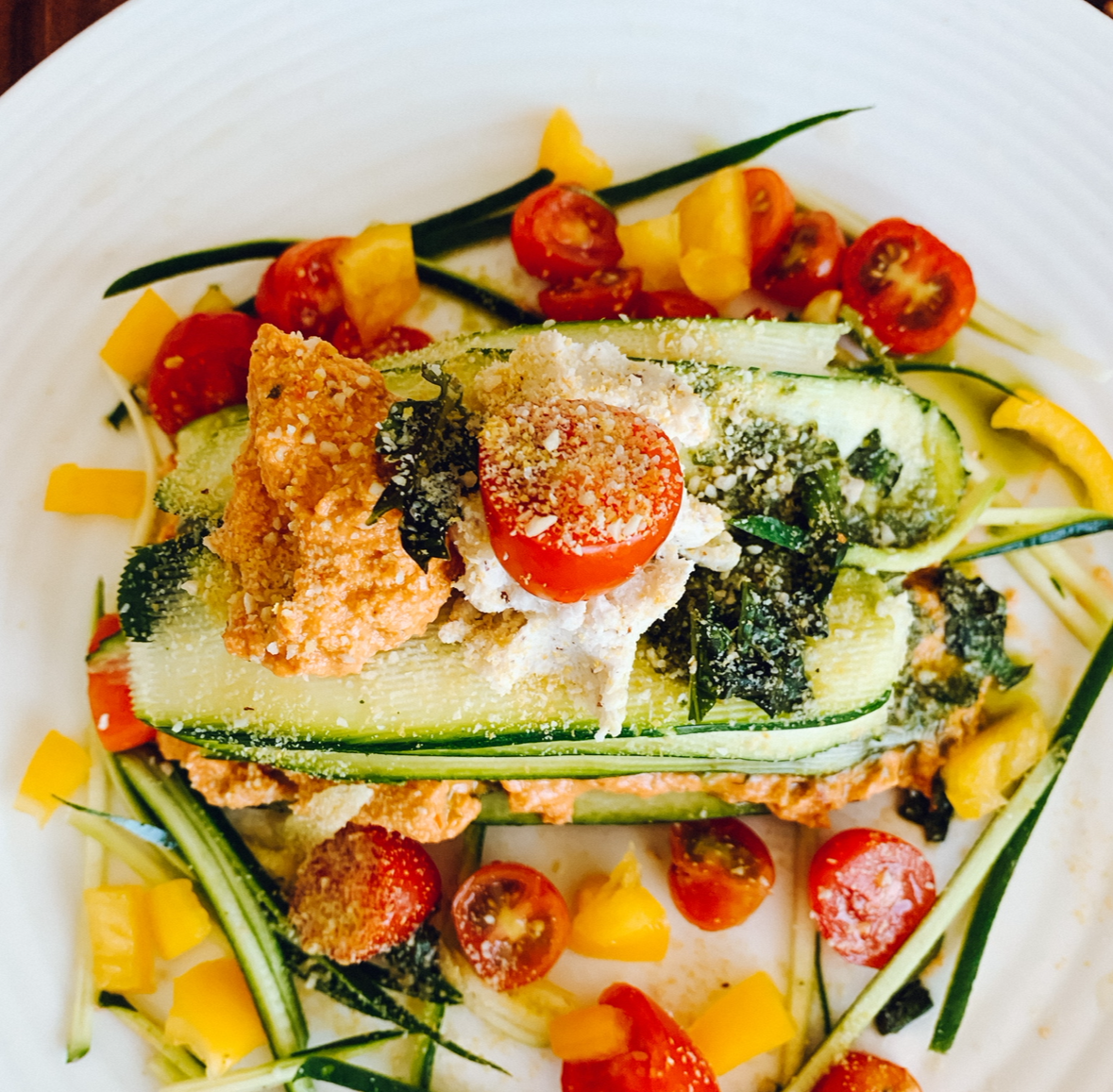
From my raw food days archive: a no-cook summer lasagna made with paper-thin zucchini ribbons instead of pasta, layered with a vibrant pistachio-spinach pesto, a rich sun-dried tomato marinara, and a creamy nut-seed cheese. It's a beautiful plant-based summer lunch on its own, and it also welcomes quality protein: serve it with baked wild fish or grass-fed meatballs, swap in grass-fed ricotta for the nut cheese, or add a layer of seasoned ground beef in place of the walnut "meat."
Yield: Serves 6–8 · Active: 45 min · Total: 1 hr 15 min (no cooking required) · Best in North America in summer, when zucchini and tomatoes are at their peak · Best eaten: midday or early evening
Ingredients
Zucchini layers
7–8 medium zucchini, sliced lengthwise on a mandoline into ⅛-inch ribbons
1 tsp Baja Gold sea salt, for drawing out moisture
1 large beefsteak or heirloom tomato, thinly sliced
½ cup fresh basil leaves, chopped
2 tbsp extra virgin olive oil
1–2 tbsp unfortified nutritional yeast
Freshly ground black pepper
Pistachio-spinach pesto
1 cup pistachios, soaked 8 hours and drained
1 cup baby spinach
1 cup fresh basil leaves
2 garlic cloves
Juice of 1 lemon
6 tbsp extra virgin olive oil
Pinch of Baja Gold sea salt and black pepper
Or classic basil pesto: Pulse 2 cups packed basil leaves, ½ cup pine nuts, 1 garlic clove, 1 tbsp lemon juice, 2 tsp nutritional yeast, and ½ tsp salt, then stream in 3–4 tbsp olive oil.
Sun-dried tomato marinara
1 cup unsulfured sun-dried tomatoes, soaked in water 30 minutes and drained
2 medium beefsteak tomatoes, chopped and seeded
1 red bell pepper, diced
1 garlic clove
Juice of 1 lemon
1 tsp dried oregano
4 tbsp extra virgin olive oil
Pinch of Baja Gold sea salt, black pepper, and red pepper flakes
Optional: 1 Medjool date, to balance the acidity
Nut-seed cheese
½ cup cashews, soaked 2 hours and drained
½ cup sprouted sunflower or pumpkin seeds
½ zucchini, chopped
2 tbsp unfortified nutritional yeast
Juice of 1 lemon
2 tbsp extra virgin olive oil
Pinch of Baja Gold sea salt and black pepper
Filtered water, to blend
Or simple cashew ricotta: Blend 1 cup soaked cashews, ¼ cup nutritional yeast, the juice of 1 lemon, 2 garlic cloves, ¼ cup fresh basil, and ½ tsp salt, adding water a little at a time, until thick and creamy.
Or grass-fed ricotta: Use 1½ cups whole-milk ricotta from grass-fed milk, stirred with lemon zest, basil, salt, and pepper.
Optional add-in layers, for a heartier lasagna
Walnut "meat": Pulse 1 cup walnuts (soaked 1 hour and drained), ½ cup soaked sun-dried tomatoes, 1 tbsp coconut aminos, 1 tsp lemon juice, and, optionally, 1 tbsp chickpea miso, until cohesive but still a little chunky. (Or use 1 lb browned, seasoned grass-fed ground beef.)
Wilted spinach: Massage 7 oz baby spinach with ¼ tsp salt until it wilts down, then squeeze out the liquid.
Method
Salt the zucchini. Lay the zucchini ribbons on towels, sprinkle them lightly with salt, and let them sit 15 minutes, then pat them very dry. Don't skip this: raw zucchini holds a lot of water, and salting draws it out, so the lasagna stays firm instead of watery.
Make the pesto. Pulse the pistachios, spinach, basil, garlic, lemon juice, salt, and pepper until combined but still a little chunky, then stream in the olive oil.
Make the marinara. Pulse all the marinara ingredients except the olive oil until combined, then stream in the oil until well blended. Taste and adjust the salt and acidity.
Make the cheese. Blend all the cheese ingredients in a high-speed blender until completely smooth, adding water as needed, until it's thick, like ricotta.
Make any add-in layers (walnut "meat" and wilted spinach), if using.
Assemble. In a deep 8x12 dish, overlap zucchini ribbons in a single layer. Spread with pesto, then add another layer of zucchini. Spread with marinara (and walnut "meat," if using), then add another layer of zucchini. Spread with the cheese (and wilted spinach, if using), then finish with a final layer of zucchini. Arrange the tomato slices on top.
Garnish. Drizzle with olive oil, and scatter with basil, a sprinkle of nutritional yeast, salt, and pepper.
Chill at least 30 minutes, so the flavors meld and the layers firm up. Take it out of the fridge 20–30 minutes before serving; the flavors shine at room temperature.
Slice into squares and serve.
Individual stacks: Instead of a dish, build each serving on a plate: 3 overlapping zucchini ribbons, dots of marinara, cheese, and pesto, and a tomato slice, repeated twice, then finished with basil and a drizzle of pesto.
Ways to Make It Your Own
Char the red pepper over a gas flame or under the broiler, then peel it before blending it into the marinara, for a smoky depth.
Add capers and olives: blend ¼ cup rinsed salt-packed capers and ¼ cup pitted Castelvetrano olives into the marinara, for a puttanesca-style sauce.
Use Sicilian sun-dried tomatoes, which have a deeper, more complex flavor than most.
Add pine nuts to the pistachio pesto: ¼ cup, for a pesto between the Sicilian pistachio and classic Genovese styles.
Scatter fresh herbs between the layers, like basil, parsley, and oregano, for aromatic bursts in every bite.
Top with heirloom tomatoes, like Cherokee Purple, Brandywine, and Green Zebra, for gorgeous color.
For the Adventurous: Cultured Macadamia Cheese
A tangy, cultured nut cheese, made like a fresh dairy cheese.
Blend 1 cup macadamia nuts (soaked 8 hours and drained), ½ cup filtered water, and ½ tsp probiotic powder until smooth.
Culture. Spoon it into a strainer lined with cheesecloth, set a light weight on top, and leave it at room temperature for 24–36 hours, until pleasantly tangy. A shorter culture tastes flat, while much longer can turn it too sour.
Season. Mix in ¼ tsp salt, 1 tsp nutritional yeast, ½ tsp lemon juice, 1 tsp onion powder, and ¼ tsp garlic powder. It keeps refrigerated up to 2 weeks.
Storage
The lasagna is best within a day; the zucchini softens as it sits. You can assemble it up to 24 hours ahead, but expect a softer texture. The pesto, marinara, and cheese keep separately in the fridge up to 4 days, and the cultured macadamia cheese up to 2 weeks.
Nourishment Notes
Paper-thin zucchini ribbons take the place of pasta, with a fraction of the carbohydrates and plenty of water, potassium, and vitamin C. The three sauces each play a role, just like a classic lasagna: the marinara brings sweet, tangy depth, the nut cheese brings creaminess, and the pesto brings a bright, herbal top note. Together, they make the dish taste complex, not one-note.
Sun-dried tomatoes are what make the raw marinara so rich without cooking. Drying concentrates their natural glutamates, the same savory compounds that make Parmigiano taste so deep. Pairing sun-dried and fresh tomatoes is a classic of Sicilian cooking.
Cultured nut cheeses follow the same principle as traditional dairy fermentation: the probiotic bacteria feed on the nuts' natural sugars and produce lactic acid, which gives the cheese its tangy, fresh-cheese flavor. The walnut "meat," with sun-dried tomato and coconut aminos, plays the role of a meat ragù, with savory depth and body.
Zucchini and tomatoes — vitamin C, potassium, and lycopene (made more absorbable by the olive oil).
Pistachios — vitamin B6, potassium, lutein, and monounsaturated fats.
Spinach and basil — folate, vitamin K, magnesium, and eugenol.
Cashews and seeds — magnesium, zinc, copper, and vitamin E.
Walnuts (if using) — ALA omega-3s and polyphenols.
Red bell pepper — vitamin C (more than a day's worth in a single pepper) and beta-carotene.
Nutritional yeast (unfortified) — protein, naturally occurring B vitamins, and a savory, cheesy flavor.
Extra virgin olive oil — oleic acid and polyphenols.
For your cycle: This light, fresh, mineral-rich lasagna is especially lovely in the follicular and ovulatory phases. For more iron and protein, especially during your period, serve it with baked wild fish or grass-fed meatballs.
Sourcing
Zucchini — organic, from a farmers' market or your garden in summer (heirloom varieties like Costata Romanesco and Cocozelle are especially flavorful)
Tomatoes, red bell peppers, basil, spinach, and garlic — organic, from a farmers' market or your garden
Sun-dried tomatoes — organic and unsulfured, ideally Sicilian
Pistachios — organic, Sicilian Bronte pistachios from Gustiamo, or California pistachios from Santa Barbara Pistachio Company or Fiddyment Farms
Pine nuts (for the classic pesto) — organic, Italian or Mediterranean (some imported pine nuts can cause a temporary bitter taste called "pine mouth")
Cashews, walnuts, and macadamias — organic (every cashew sold has been heat-treated, even "raw" ones)
Sprouted sunflower or pumpkin seeds — organic, like Go Raw
Grass-fed ricotta (option) — whole-milk ricotta from grass-fed milk, with no gums or stabilizers
Nutritional yeast — unfortified, like Sari Foods
Coconut aminos and chickpea miso — organic and soy-free, like Coconut Secret aminos and Miso Master chickpea miso
Probiotic powder (cultured cheese) — a dairy-free probiotic powder with no fillers
Extra virgin olive oil — organic, single-estate, harvest-dated, in dark glass, like those from Gustiamo or Olio2Go
Salt — Baja Gold sea salt
— Anna aka Food Marshall