Almond-Buckwheat, Raspberry-Rose Honey Cake
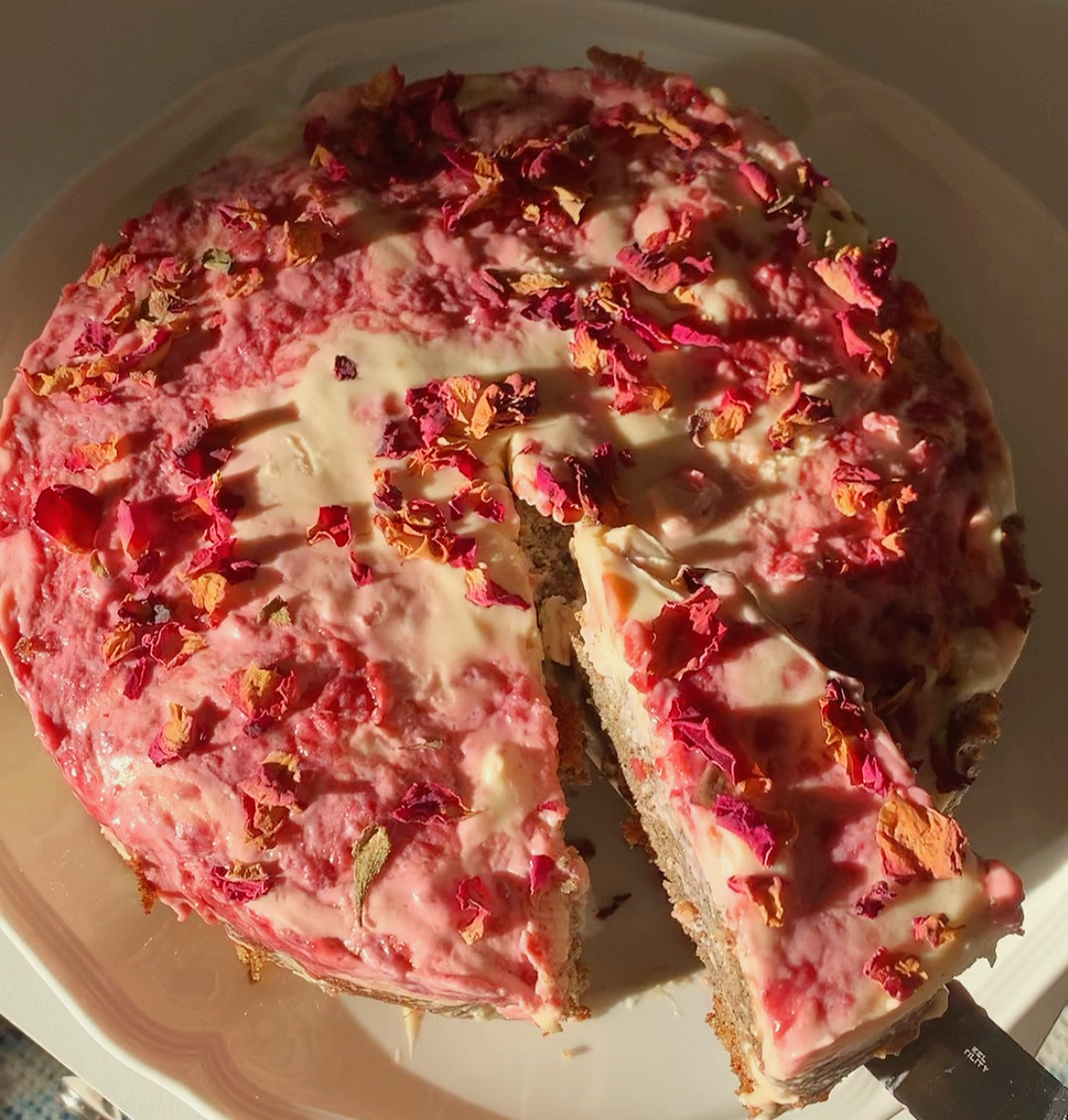
A tender almond-and-buckwheat cake with whole raspberries and rose-scented cream frosting
Serves 10 · 30 min active · 1 hr 30 min total · summer · early afternoon or tea-time
See the IG post of the recipe here
Ingredients
Cake
½ cup grass-fed butter, softened, plus more for greasing
1 cup ground almonds (almond flour)
3 large pasture-raised eggs
½ cup buckwheat flour (Buckwheat flour can vary in absorbency by brand. If your batter looks too wet, the cake might need 5 extra minutes; if it looks too dry, add 1 tbsp of cream or milk to loosen. Adjust on the second bake if needed)
2 tsp baking powder
2/3 cup raw honey (if you are more sensitive to sweets, drop to ½ cup honey + add 2 tbsp pure maple syrup for a slightly more caramel-balanced sweetness)
1 tsp vanilla extract
1 tbsp rose water (distilled rose water from a Middle Eastern source — see sourcing notes)
¾ cup fresh raspberries (plus more for decorating the top)
Cream icing
¾ cup + 2 tbsp grass-fed heavy cream
2 tbsp mascarpone or labneh (makes for a fuller, denser, more luxurious cream that holds its shape better at room temperature)
1 tbsp raw honey
1 tsp rose water
1 tsp vanilla extract
To finish
fresh or dried rose petals (food-grade)
dehydrated raspberries
fresh raspberries
Method
1. Preheat oven to 350°F. Line a 9-inch round cake tin with parchment paper and lightly grease the sides with butter.
2. Whisk the dry ingredients. In a medium bowl, whisk together the almond flour, buckwheat flour, and baking powder. Set aside.
3. Cream the butter and honey. In the bowl of an electric mixer, cream the softened butter and honey on medium-high speed for 2–3 minutes, until pale, light, and fluffy. The honey will incorporate fully into the butter and the mixture should look like soft, glossy whipped cream.
4. Add the eggs. Beat in the eggs one at a time, mixing well after each addition. The batter may look slightly curdled at this stage — that's normal and will smooth out when the dry ingredients go in.
5. Add the flavoring. Beat in the vanilla and rose water until just combined.
6. Add the dry ingredients. Gradually fold the dry ingredient mixture into the wet, mixing on low speed (or by hand with a spatula) until just combined. Do not overmix — overmixing develops the eggs and produces a tough, dense cake.
7. Add the raspberries. Pour the batter into the prepared tin and smooth the top. Dot the fresh raspberries across the surface, pressing down lightly with a spoon so they sink slightly into the batter — but not all the way through.
8. Bake 40–45 minutes, until golden, springy to the touch, and a skewer inserted in the center comes out clean (a few moist crumbs are fine; wet batter means more time).
9. Cool in the tin 10 minutes, then turn out onto a cooling rack. Cool completely (about 1 hour) before icing.
10. Make the cream icing. In a chilled bowl, whip the cold heavy cream with an electric beater on medium-high until ribbon consistency — just past soft peaks but not stiff. The cream should hold its shape but still flow off a spoon in a slow ribbon.
11. Add flavoring. Gently fold in the yogurt, honey, rose water, and vanilla using a spatula — do not overwhip, or the cream will turn grainy and start to break.
12. Assemble. Once the cake is completely cool, spread a generous layer of cream icing across the top in soft, swooping movements. Don't try to make it perfectly smooth — a slightly rustic finish reads more elegant than over-styled.
13. Decorate with fresh raspberries, dehydrated raspberries (crushed or whole), and a scattering of fresh or dried food-grade rose petals.
Nourishment Notes
Buckwheat is one of the more interesting "alternative grains" in modern gluten-free baking — botanically, it's not a grain at all but the seed of a plant related to rhubarb and sorrel. The flour has a distinctive earthy, slightly nutty flavor that pairs especially well with sweet ingredients like honey and berries. Buckwheat has been a staple grain in Russia, Poland, Ukraine, and Northern Italy for at least 1,000 years, where it's used for blini, kasha, pierogi fillings, and the Italian pizzoccheri pasta of Lombardy's Valtellina valley.
Rose water is the aromatic distillate of rose petals — typically Rosa damascena or Rosa centifolia — and it's been used in Persian, Levantine, North African, and Indian cookery for at least 1,200 years. The flavor profile is unmistakable but easy to overuse: too much rose water reads soapy or perfumed; the right amount adds a delicate floral top note that complements honey, berries, almonds, and pistachios. The 1 tbsp in this cake is the right window — enough to register on the palate but not enough to dominate.
The almond-and-buckwheat flour combination is a structural choice that produces a cake with substantial body and texture. Almond flour alone produces a dense, crumbly cake; buckwheat flour alone is tannic and slightly bitter. Together — with butter, eggs, and honey — they create a cake with the moistness and tender crumb of a French quatre-quarts (classic French pound cake) but with a more complex grain flavor and a gluten-free profile. This is the same architectural principle behind many Eastern European tortes, including the famous Hungarian Esterhazy almond cake.
Storage: Un-iced cake keeps at room temperature 2 days well-wrapped, or refrigerated 4 days. Iced cake keeps refrigerated 3 days, though the cream cap softens slightly each day. The cake actually improves in flavor on day 2 as the buckwheat-honey-rose flavors integrate. Freezes well un-iced, tightly wrapped, up to 1 month — thaw at room temperature 4 hours before icing. The icing alone is best made and used within 24 hours.
Recipe Adapted from The Caker
Pairs well with: A pot of chamomile, jasmine green, or rose-petal tea — the floral notes echo and amplify the rose water in the cake. For a more substantial pairing, hibiscus tea (hot or iced) provides tartness that balances the cake's sweetness beautifully. For adults, a small pour of Moscato d'Asti, an off-dry Riesling, or a chilled rosé. For non-alcoholic, a glass of cold sparkling water with a few crushed raspberries and a fresh mint sprig. For the gathering: a platter of additional fresh raspberries, blueberries, and blackberries; a small bowl of additional whipped cream for guests who want extra; a tiered cake stand for an afternoon tea presentation.
Sourcing
Almond flour: King Arthur super-fine almond flour, Anthony's Goods (organic, blanched), or Bob's Red Mill super-fine. Look for blanched, finely ground for the smoothest cake texture.
Buckwheat flour: Anthony's Goods organic buckwheat flour, Bob's Red Mill organic, or a regional source if you live near a buckwheat-growing region (Eastern European, Russian, or Northern Italian sources are typically freshest). Look for stone-ground for the most aromatic flour.
Grass-fed butter: Vital Farms, Organic Valley Pasture Butter, or Kalona Organic in spring and summer when grass content is highest. Imported European butters (Beurre d'Isigny from France, Lurpak Pastor) are also exceptional for baking.
Pasture-raised eggs: Local farm or Vital Farms Pasture-Raised. The deeply orange yolks are the indicator of real foraging.
Heavy cream: Look for raw or minimally pasteurized cream from grass-fed cows. Alexandre Family Farm (regenerative, A2/A2 Jersey), Organic Pastures, or Snowville Creamery for shipped options. Avoid ultra-pasteurized cream — it's structurally damaged and often won't whip properly.
Greek yogurt or mascarpone: For yogurt, look for Maple Hill Creamery or Stonyfield grass-fed Greek. For mascarpone (recommended swap), Vermont Creamery, BelGioioso, or imported Italian Galbani.
Raw honey: Local apiarist whenever possible — local honey carries pollen profiles unique to your region. Really Raw Honey, Bee Raw, or Savannah Bee Company for shipped raw honey.
Vanilla: Heilala Vanilla for whole beans, Singing Dog Vanilla for organic extract, or Nielsen-Massey for premium pure vanilla.
Rose water: Cortas (Lebanese, the gold standard), Mymouné (Lebanese, artisanal), or Sadaf (Persian-style). Avoid grocery store generic rose water — often diluted, sometimes synthetically flavored. Look for "distilled rose water" with rose petals listed as the only ingredient besides water.
Raspberries: Local farmers' market during peak season (June–August in temperate climates). Heritage varieties (Heritage, Caroline, Tulameen) carry significantly more flavor than commercial varieties. Avoid winter raspberries from South American greenhouses.
Dried raspberries: Just Tomatoes, Etc. dried raspberries, or Trader Joe's freeze-dried raspberries (one of the few generic brands worth recommending — clean ingredient list).
Food-grade rose petals: Marx Foods edible flowers, or harvested from your own garden if you grow unsprayed roses (Rosa damascena, Rosa centifolia, or Rosa rugosa are best). Avoid grocery-store decorative roses, which are typically heavily sprayed.
Baking powder: Bob's Red Mill aluminum-free baking powder, or Rumford aluminum-free. Aluminum-containing baking powders leave a metallic aftertaste.