Layered Hazelnut Brownies with Blueberry, Caramel & Vanilla Cream
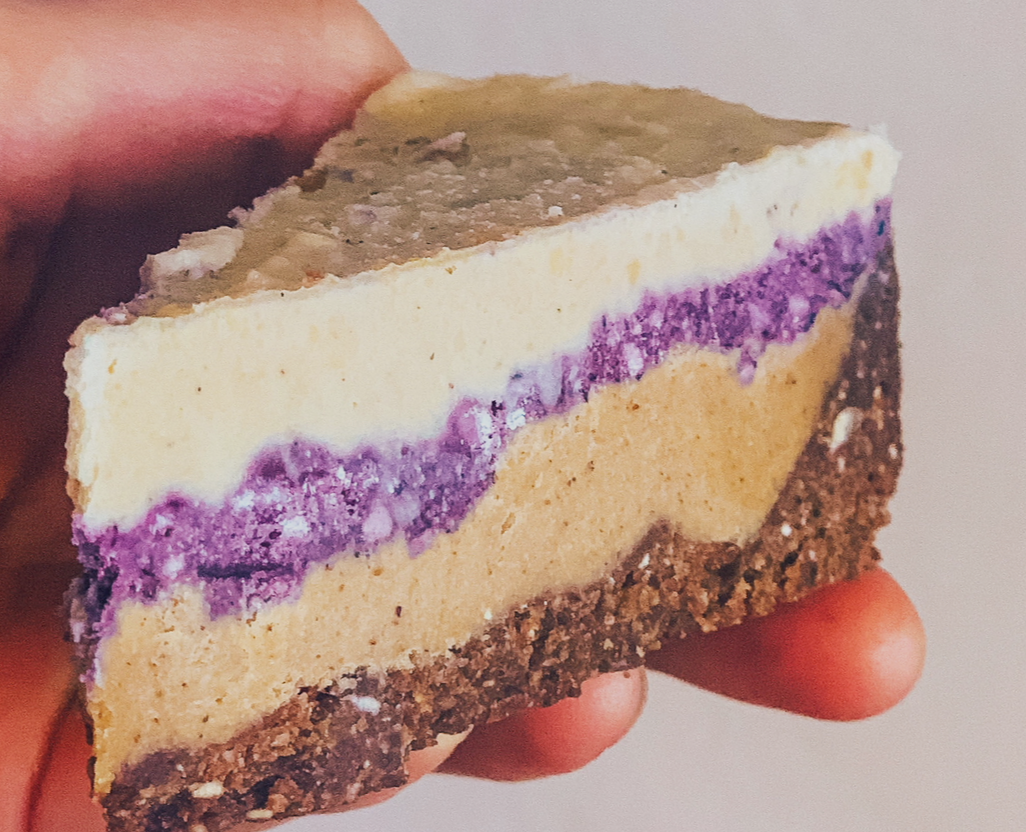
A four-layer raw dessert built for late summer — chocolate hazelnut brownie base, jewel-bright blueberry layer, vanilla-almond caramel ribbon, and a cloud-light cashew vanilla cream on top. Slices into bars or wedges; serves as cake too. No baking, no refined sugar.
Season: Late summer through early autumn (peak blueberry window)
Cuisine: Raw · Plant-based · Refined-sugar-free · Grain-optional
Yield: One 8-inch square pan (serves 12–16 as bars) or one 9-inch round springform (serves 10–12 as a layered cake)Active: 45 min Total: 6 hours, including setting time
Best eaten: Late morning or early afternoon, slightly chilled
Four distinct layers, each with its own personality: a chewy chocolate-hazelnut brownie base that tastes like a refined Nutella; a jewel-bright blueberry layer that reads like fresh fruit, not jam; a vanilla-almond caramel ribbon that catches you by surprise in the middle; and a thick layer of cashew vanilla cream on top, light and almost mousse-like, sitting on the bars or cake like a final cloud. Every bite carries all four layers. Every slice looks like a cross-section of summer.
The blueberries get their own dedicated layer, blended with coconut butter and lemon, set firm into the slab between the brownie and the caramel. It tastes like summer compressed into a quarter-inch.
The caramel is built from cashews, almond butter, and maple syrup — closer to a thick frosting than a sauce, and infused with lemon to keep it bright rather than cloying. Optional lucuma or mesquite powder (both raw, both Indigenous-rooted) deepens the caramel notes for those who want full complexity.
The vanilla cream on top is the cloud — whipped cashew cream with vanilla bean and a touch of lemon, light enough that the whole dessert feels celebratory rather than heavy.
This serves as bars at a casual gathering, or sliced as a layered cake at a more elegant table. Either way, it's the dessert that becomes the conversation.
Ingredients
For the brownie base:
1 cup raw hazelnuts
1 cup raw almonds
½ cup raw walnuts (or sub additional hazelnuts)
1 cup Medjool dates, pitted
½ cup raw cacao powder
2 tbsp coconut oil or melted cacao butter
Pinch sea salt
1–3 tbsp filtered water (only if needed to bind)
For the blueberry layer:
1 cup fresh or frozen blueberries (thawed if frozen)
⅓ cup melted coconut butter
2–3 tbsp pure maple syrup (to taste)
2 tbsp fresh lemon juice
Pinch sea salt
For the vanilla-almond caramel layer:
2 cups raw cashews, soaked 4–8 hours and rinsed
½ cup raw almond butter
¼ cup pure maple syrup
¼ cup full-fat coconut milk (or coconut cream)
3 tbsp coconut oil, melted
2 tbsp fresh lemon juice
Pinch sea salt
Optional: 1 tbsp lucuma powder + 1 tsp mesquite powder for deeper caramel notes
For the vanilla cream topping:
2 cups raw cashews, soaked 4–8 hours and rinsed
½ cup full-fat coconut milk or coconut cream
2–3 tbsp pure maple syrup (or coconut sugar, dissolved into the coconut milk first)
2 tbsp fresh lemon juice (+ optional zest of ½ lemon)
1 tsp vanilla bean powder (or seeds from 1 vanilla bean)
¼ cup coconut oil, melted (only if needed for firmer set)
Pinch sea salt
To finish:
A handful of fresh blueberries
Crushed raw hazelnuts or hazelnut crumbs
A few cacao nibs or shavings
Optional: a sprinkle of dried lavender, fresh edible flowers, or a dusting of cacao powder
Optional: flaky sea salt
Method
1. Soak the cashews.
Place 4 cups raw cashews total (2 cups for the caramel + 2 cups for the vanilla cream) in a bowl, cover with filtered water, and soak 4–8 hours (or overnight in the refrigerator). Drain and rinse before using. You can soak them all together and divide later.
2. Make the brownie base.
Line an 8-inch square pan or 9-inch round springform pan with parchment paper, leaving overhang on two sides for easy lifting (square pan) or just lining the base (round pan).
In a food processor, pulse the hazelnuts, almonds, and walnuts until you have a coarse crumb texture — keep some larger pieces for textural interest. Add the dates, cacao powder, coconut oil, and salt. Process until the mixture sticks together when pressed between your fingers — add 1 tbsp water at a time only if needed to bring it together. The mixture should be slightly tacky and dark.
Press the brownie mixture firmly and evenly into the base of the pan, compacting with the back of a spatula. Place in the freezer while you make the next layer.
3. Make the blueberry layer.
In a high-speed blender or food processor, blend the blueberries, melted coconut butter, maple syrup, lemon juice, and salt until completely smooth and a vibrant deep purple. Taste and adjust — add 1 more tbsp maple syrup if too tart for your preference.
Pour evenly over the chilled brownie base and smooth into a thin, even layer. Tap the pan gently against the counter to release any air pockets. Return to the freezer for 30 minutes to set.
4. Make the vanilla-almond caramel.
In a high-speed blender, combine 1½ cups soaked cashews, almond butter, maple syrup, coconut milk, lemon juice, salt, and (if using) the lucuma and mesquite powders. Blend on high until completely smooth and creamy — at least 2–3 minutes, scraping down the sides as needed. The texture should be silky and pale-amber, like a thick cashew caramel.
Add the melted coconut oil and blend another 30 seconds until fully incorporated.
Pour over the set blueberry layer and smooth into an even layer. Tap the pan to release air pockets. Return to the freezer for 1–2 hours to set firmly.
5. Make the vanilla cream.
In a high-speed blender, combine 1½ cups soaked cashews, coconut milk, maple syrup, lemon juice, vanilla bean powder, and salt. Blend on high until silky smooth — 2–3 minutes, scraping down the sides as needed.
Test the consistency: if the cream feels firm enough to set into a stable layer, you may not need additional coconut oil. If you want a firmer, more sliceable top layer, add the ¼ cup melted coconut oil and blend another 30 seconds. The texture should be that of softly whipped cream — light enough to pour but holding its shape.
6. Top and freeze.
Pour the vanilla cream over the chilled caramel layer and smooth into a clean top. Cover loosely with parchment and freeze overnight (at least 6 hours, ideally 8) until completely set.
7. Slice and serve.
While still frozen, lift the bars out of the pan using the parchment overhang (square pan) or release the springform sides (round pan). Place on a cutting board.
Let sit at room temperature 5–10 minutes before slicing — this softens the surface just enough for clean cuts. Cut into 12–16 even bars (square pan) or 10–12 wedges (round pan) using a sharp knife dipped in hot water and wiped between cuts.
8. Decorate and finish.
Top each bar or wedge with fresh blueberries, crushed hazelnuts, a few cacao nibs, and an optional dusting of dried lavender or scattering of edible flowers. A pinch of flaky sea salt brings the chocolate and caramel notes alive.
Allow slices to thaw 10–15 minutes at room temperature before eating — the layers are at their best when slightly soft but still cool.
Variation — The Elevated Version
For a more avant-garde, dinner-party version, swap the simple structure above for these layered alternatives:
Blueberry coulis throughout: Instead of a single blueberry layer, blend 2 cups fresh blueberries with 3 tbsp maple syrup, 2 tbsp lemon juice, and a pinch of salt to make a vibrant coulis. Use 1 cup as a thin layer between the brownie and the caramel; reserve the remaining 1 cup for finishing — drizzled over each plated slice for visual drama and brightness.
Blueberry caramel layer: Replace the vanilla-almond caramel with a blueberry caramel — blend ¼ cup coconut oil, ¼ cup cacao butter, ¼ cup coconut sugar (or monk fruit), ¼ cup cashew butter, ⅓ cup blueberry coulis, and ¼ cup warm water until silky and pourable. The result is a deep purple-rose caramel that reads as berry-forward rather than vanilla-forward.
Earl Grey vanilla cheesecake top: Replace the simple vanilla cream with an Earl Grey-infused cashew cheesecake — 1½ cups soaked cashews blended with ¼ cup maple syrup, ¼ cup melted cacao butter, ⅓ cup melted coconut oil, a pinch of salt, 3–6 drops of vanilla medicine flower extract (or seeds from 1 vanilla bean), and the contents of 1 Earl Grey tea bag steeped briefly in warm coconut milk and strained. The bergamot in the Earl Grey echoes the lemon in the layers and creates a perfumed, elegant finish.
This elevated variation reads as a dinner-party showpiece — slightly more complex, more avant-garde, more "I'm impressing someone." The simpler base recipe reads more "Sunday afternoon with the people you love." Both are real; choose by occasion.
Nourishment Notes
The brownie base alone delivers an impressive nutritional foundation: hazelnuts contribute vitamin E, manganese, copper, and the highest plant-based folate concentration of any common nut; almonds add additional vitamin E and magnesium; and walnuts contribute alpha-linolenic acid (the plant form of omega-3). Together they provide a substantial dose of essential minerals, and the fat structure that anchors the natural sugars in the dates.
Raw cacao is the heart of the brownie layer. Unlike processed cocoa, raw cacao retains its full complement of flavanols (epicatechin and catechin), theobromine (a gentle, sustained stimulant without caffeine's spike), and an unusually high mineral profile — magnesium, iron, copper, and zinc. Raw cacao has roughly 40 times the antioxidant content of blueberries — and combining the two in this dessert produces a quietly remarkable polyphenol load.
Blueberries themselves are one of the most concentrated antioxidant fruits available. They carry anthocyanins (the deep purple-blue pigment), proanthocyanidins, and polyphenols that have documented effects on cognitive function, vascular health, and cellular repair. Wild blueberries are even more concentrated than commercial varieties — if you can source them, they're meaningfully more nutrient-dense. Peak-season local blueberries (July–August in temperate climates) deliver dramatically more polyphenol load than supermarket berries flown from South American greenhouses in December.
The cashews and coconut throughout the layers deliver substantial mineral content and the medium-chain triglycerides (MCTs) the body uses efficiently for energy. Almond butter in the caramel adds vitamin E and additional magnesium. Lemon brightens every layer and contributes vitamin C — meaningfully supporting collagen synthesis and the absorption of the iron and other minerals from the nuts and cacao.
The fat structure of this dessert prevents the spike-and-crash pattern of conventional sweets. The combination of cashews, coconut oil, almond butter, hazelnuts, and walnuts delivers substantial fat alongside the natural sugars from dates, maple syrup, and blueberries; the result is a glycemic curve that stays gentle and a satiety profile that means a small bar genuinely satisfies. Compared to a conventional brownie (built on white flour, refined sugar, hydrogenated oils, and eggs), this version delivers a fraction of the sugar load, zero refined ingredients, and a dramatically richer nutrient profile.
Lucuma and mesquite powders (in the optional caramel addition) are the unsung heroes of raw dessert work. Lucuma, from a South American fruit traditionally called "the gold of the Incas," adds a maple-caramel sweetness with a low glycemic load and meaningful contributions of beta-carotene, iron, niacin, and zinc. Mesquite powder, ground from the seed pods of the desert mesquite tree, brings a deep caramel-toffee complexity along with calcium, potassium, magnesium, and iron. Together they elevate raw desserts from "sweetened with dates" to "deeply complex caramel notes" without any refined sugar.
The peak blueberry window is short — make this when blueberries are at their seasonal best. Bring it to a summer birthday, a late-summer brunch, an early-autumn gathering, or any occasion that wants a celebratory, layered dessert.
Sourcing
Blueberries: Local farmers' market or pick-your-own farm during peak season (July–August in temperate climates). Wild blueberries (smaller, more intensely flavored, higher in polyphenols) are available at farmers' markets in Maine, Eastern Canada, and Northern Europe. Trader Joe's frozen wild blueberries are an excellent shipped alternative. Avoid commercial blueberries from South American greenhouses in winter — they have a fraction of the polyphenol density of peak-season berries.
Raw hazelnuts: Freddy Guys Hazelnuts (Oregon, regenerative), Holmquist Hazelnuts (Washington, multi-generational family farm), or imported Bronte Tonda Gentile delle Langhe from Gustiamo (Piedmontese — small, intensely flavored, considered the best hazelnut in the world). Raw only — never roasted or salted for this recipe.
Raw almonds and walnuts: One Degree Organic Foods sprouted almonds and walnuts (genuinely exceptional), Anthony's Goods organic raw, or local sources. Soaked and rinsed before using is ideal — improves digestibility and flavor.
Raw cashews: Big Tree Farms organic, Anthony's Goods raw organic, or Terrasoul Superfoods. Look for whole, unbroken cashews. Raw only.
Rolled oats: One Degree Organic Foods sprouted rolled oats (best digestibility), Bob's Red Mill organic gluten-free rolled oats, or Anthony's Goods organic gluten-free.
Medjool dates: Joolies (organic California), Natural Delights, or local farmers' market sources.
Raw cacao powder: Navitas Organics raw cacao powder, Sunfood Superfoods, or Terrasoul Superfoods organic. Raw and unprocessed for the highest flavanol content.
Raw cacao butter: Navitas Organics raw cacao butter, Sunfood Superfoods raw cacao butter, or Terrasoul Superfoods organic. Look for raw, cold-pressed.
Coconut butter: Artisana raw organic coconut butter, Nutiva organic coconut manna, or Once Again organic coconut butter. Coconut butter is different from coconut oil — it's whole pureed coconut meat, with both the fat and the fiber. Don't substitute coconut oil for coconut butter; the texture and flavor are different.
Coconut milk / coconut cream: Native Forest Organic Simple is the gold standard — full-fat, in BPA-free cans, no gums or thickeners. Aroy-D is an excellent alternative in cartons. Avoid lite coconut milk and brands with guar gum or carrageenan.
Coconut oil: Nutiva organic virgin, Dr. Bronner's fair-trade organic, or Garden of Life raw extra-virgin. Cold-pressed, unrefined.
Coconut sugar: Big Tree Farms, Madhava, or Wholesome organic.
Almond butter: Big Spoon Roasters organic almond butter (single-ingredient, sprouted — exceptional), Once Again organic, or homemade. Avoid commercial almond butter with added sugar or palm oil.
Cashew butter: Artisana raw cashew butter, or homemade by blending raw cashews until smooth.
Maple syrup: Grade A dark or amber from a Northeastern producer — Crown Maple, Coombs Family Farms, or local farmers' market sources.
Vanilla bean powder: Heilala Vanilla bean powder, or homemade by grinding dried vanilla beans in a spice grinder. Vanilla extract works as a substitute (1 tsp = 1 tsp), but vanilla bean powder gives a more concentrated, more visual presence.
Vanilla beans: Heilala Vanilla, or Beanilla for sourcing single-origin Madagascar or Tahitian beans.
Lucuma powder: Navitas Organics lucuma powder, Sunfood Superfoods, or Terrasoul Superfoods. Look for raw, unprocessed Peruvian lucuma.
Mesquite powder: Sunfood Superfoods organic mesquite powder, Terrasoul Superfoods, or sourced from regenerative Sonoran or Southwestern producers.
Cacao nibs: Navitas Organics raw cacao nibs, Sunfood Superfoods, or Terrasoul Superfoods.
Lemons: Local citrus from a regenerative farm during peak season. Avoid waxed conventional lemons. Friend's Ranches in Ojai for exceptional Meyer lemons.
Earl Grey tea (for the elevated variation): Harney & Sons Earl Grey Supreme (with bergamot oil), Mariage Frères French Earl Grey (with cornflower petals), or local artisan tea source. Look for loose-leaf tea over bags for the highest quality.
Edible flowers and dried lavender (optional finishing): Marx Foods, local farmers' market, or your own unsprayed garden. Dried culinary lavender — Cascadia Farms, Sonoma Lavender, or Mountain Rose Herbs.
Storage
Frozen up to 1 month, wrapped tightly in parchment and stored in a freezer-safe container. Refrigerated for up to 5 days once thawed (though texture is best straight from the freezer with a 10-minute thaw before serving). Individual bars or slices freeze well — wrap each in parchment and store in a freezer bag for grab-and-thaw single servings.
Each layer also keeps separately for up to 1 week refrigerated and is excellent on its own:
The brownie base alone is a great snack
The blueberry layer is delicious over yogurt or oatmeal
The caramel makes an excellent dip for fresh apples or pears
The vanilla cream is a perfect topping for berries or fruit
Pairs Well With
For the table: A pot of fresh-brewed loose-leaf tea — Earl Grey, jasmine green, lavender chamomile, or a fruit-forward herbal blend. A glass of cold-brewed coffee for adults at brunch. Sparkling water with a few crushed blueberries and a fresh mint sprig for a non-alcoholic beverage. For adults, a small pour of late-harvest Riesling, an off-dry Moscato d'Asti, or a chilled rosé. Port wine with the chocolate notes is a classical pairing.
For the gathering: A platter of additional fresh berries — blueberries, raspberries, blackberries, strawberries — alongside the bars or cake for an abundant summer dessert table. A small bowl of additional vanilla cream or whipped coconut cream for guests who want extra. Fresh edible flowers (pansy, violet, calendula, lavender) scattered on the platter for visual abundance.
For the meal context: This is the dessert to follow a light summer meal — a Mediterranean grilled fish, a Greek salad, summer crudités. For brunch: alongside a frittata, fresh fruit, and herbal tea. For an autumn-leaning version: pair with a butternut squash soup, a roasted root vegetable salad, or a grilled chicken with herbs. The bars are excellent picnic food and travel well.
Why These Brownies
The conventional brownie is built on white flour, refined sugar, hydrogenated oils or butter, eggs, and synthetic chocolate sauce — a combination that delivers maximum sugar load and minimum nutritional value. Blueberry layered desserts in conventional bakeries are typically built on artificial blue coloring and high-fructose corn syrup glaze.
This is what brownies look like when you remove the industrial shortcuts. Soaked nuts and dates instead of refined flour and refined sugar. Real raw cacao instead of processed chocolate. Real blueberries — peak-season, ideally wild — instead of artificial color and syrup. Cashews, coconut, almond butter, and maple syrup instead of industrial dairy and refined sweeteners. Vanilla bean instead of artificial vanillin. Real layers, real flavors, real food.
The four-layer structure is what makes this dessert genuinely special. Most raw desserts collapse into one or two flavor profiles — chocolate, or fruit, or caramel, or cream — and stop there. This dessert layers all four into a single bite, giving the palate a complete experience: bitter chocolate, bright fruit, deep caramel, light cream. Each layer has its own texture, its own temperature, its own vibration.
Make this for a summer birthday, an early-autumn gathering, a Sunday afternoon when blueberries are still on the bush. Slice into bars for casual eating; slice into wedges for a more elegant presentation. Either way, this is the dessert that becomes the conversation — and the dessert your friends ask you to make again the following year.
The warm-and-bright season asks the body for layered nourishment, complexity, and color. A four-layer raw dessert built from real food is one of the body's most generous answers.