Savory Beetroot Tart with Whipped Goat Cheese, Rosemary & Thyme
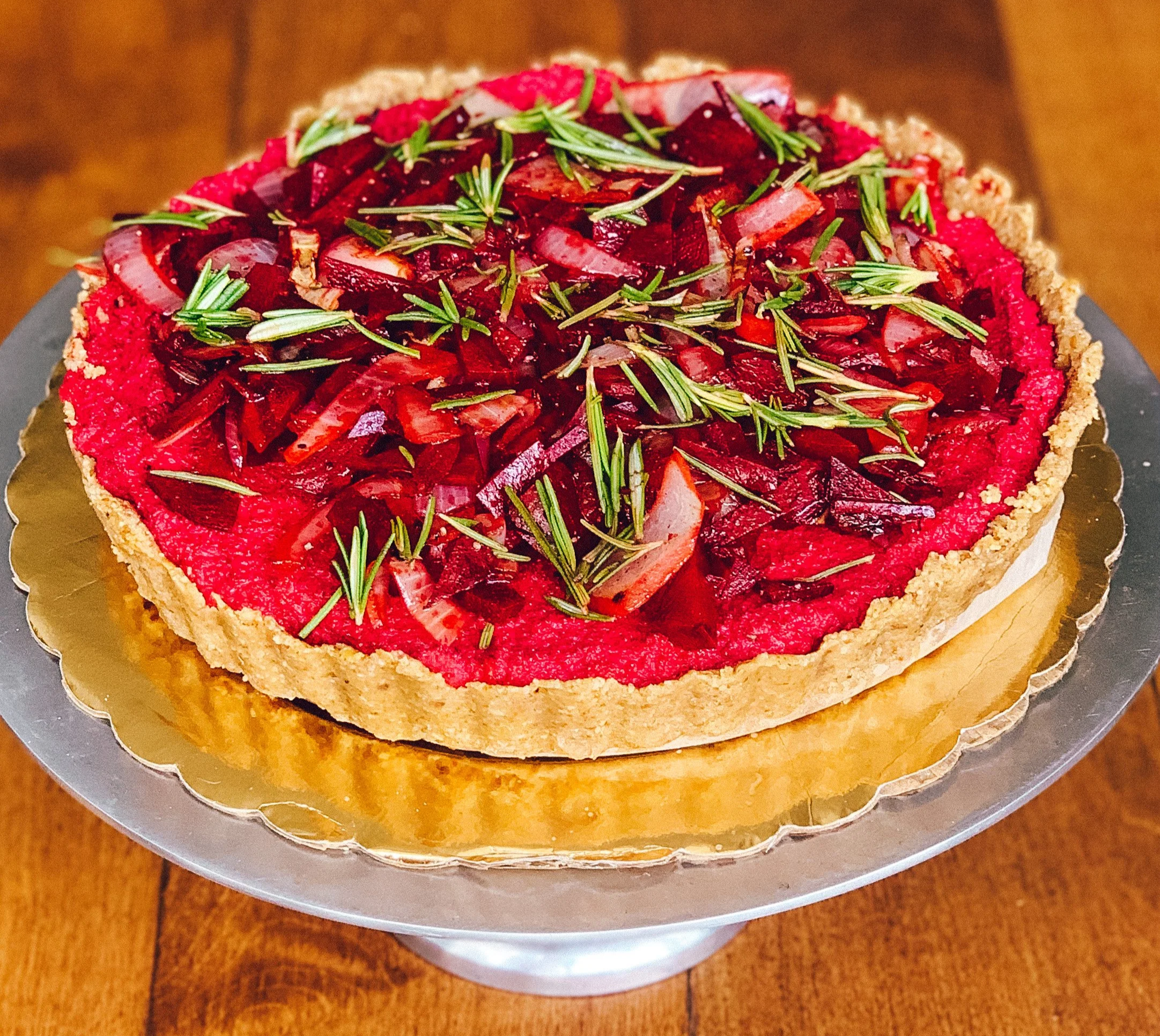
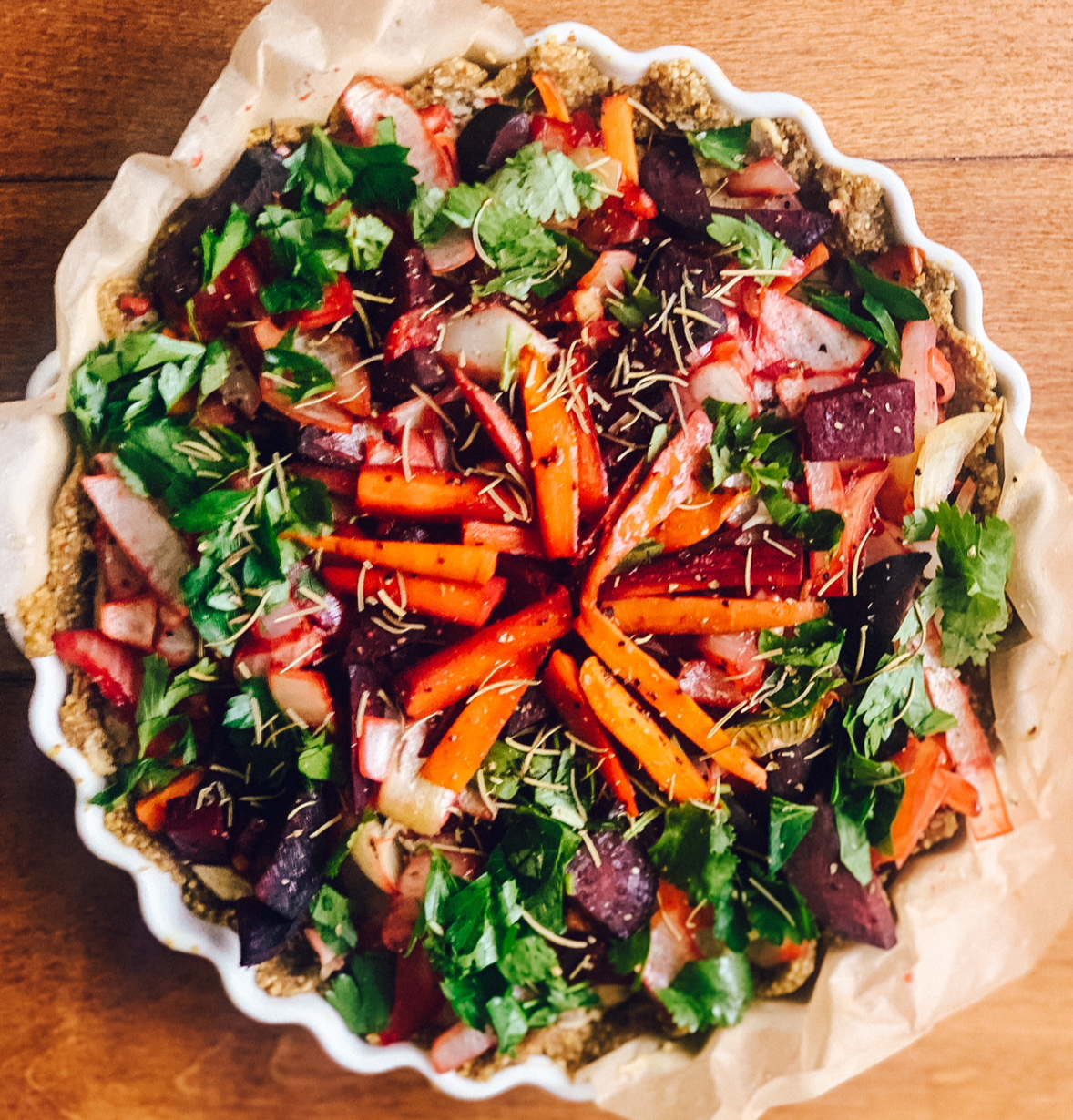
A nut-and-seed herbed crust, whipped goat cheese filling (four variations), roasted and raw beets, caramelized onions, and a pop of fresh herbs — served on a bed of massaged kale with carrot ribbons. The autumn savory dish that turns a tart into a complete meal.
Season: Late summer through early winter (peak beet window)
Cuisine: Savory · Whole-food · Grain-free · Refined-sugar-free · Mediterranean-leaning
Yield: One 8-inch round tart (serves 6–8 as a meal, 10–12 as an appetizer) OR four 4-inch individual tartlets
Active: 50 min · Total: 2 hours, including setting time
Best eaten: Lunch or early dinner, slightly cool but not cold
A note from the kitchen
Beets are deep ruby and gold, grown sweet from the slow earth they grew in, and dense with minerals and earthy aromatics. When the autumn beets come in — and they're at their peak from late summer through the first frosts — they ask for a real dish to live in.
This tart is that dish. A nut-and-seed crust seasoned with herbs — the kind of savory raw crust that works beautifully as a foundation for any number of fillings. A whipped goat cheese filling that's bright, tangy, and luxurious in a way that no plant-based cream can quite match. Roasted beets layered with raw fanned beets for a two-textured crown. Caramelized onions tossed in balsamic for the umami depth. Fresh rosemary and thyme threading through every layer.
And the whole thing served over a bed of massaged kale with carrot ribbons — turning what would otherwise be just a tart into a complete autumn lunch or early dinner. This is the dish for a Sunday lunch with people you love, a candlelit dinner-party first course, or a midweek meal when the beets are calling and you want to honor them properly.
— Anna aka Food Marshall
Ingredients
For the crust:
1.5 cup raw almonds
1 cup raw walnuts
½ cup raw pumpkin seeds or sunflower seeds
1 pasture raised egg
2 tbsp nutritional yeast
1 tbsp apple cider vinegar
1 tbsp tamari or coconut aminos (for soy-free)
1–2 tbsp extra-virgin olive oil
1 tsp fresh rosemary, finely chopped (or ½ tsp dried)
1 tsp fresh thyme leaves (or ½ tsp dried)
Pinch sea salt
For the whipped goat cheese filling — four variations:
Variation 1 — Pure whipped goat cheese (the classic):
8 oz soft goat cheese (chèvre), at room temperature
¼ cup goat milk yogurt or thick Greek yogurt (for the lift)
2 tbsp extra-virgin olive oil
1 tbsp fresh lemon juice
Zest of 1 organic lemon
1 tsp fresh thyme leaves
1 tsp finely chopped fresh chives
½ tsp finely chopped fresh rosemary
1 garlic clove, finely grated (optional)
Sea salt and freshly cracked black pepper to taste
Variation 2 — Goat cheese + ricotta blend (richer, more body — Tartine-inspired):
1 cup whole-milk ricotta
½ cup soft goat cheese, at room temperature
2 tbsp extra-virgin olive oil
1 tbsp fresh lemon juice
Zest of 1 organic lemon
2 tbsp finely chopped fresh chives
2 tbsp finely chopped fresh basil
2 tsp apple cider vinegar
Sea salt and freshly cracked black pepper to taste
Variation 3 — Whipped goat cheese with grated raw beet (pink-tinted, savory):
8 oz soft goat cheese, at room temperature
¼ cup goat milk yogurt or thick Greek yogurt
½ cup raw beet, finely grated (squeeze out excess juice)
2 tbsp extra-virgin olive oil
1 tbsp fresh lemon juice
Zest of 1 organic lemon
1 tsp fresh thyme leaves
½ tsp finely chopped fresh rosemary
Sea salt and freshly cracked black pepper to taste
Variation 4 — Two-layer: white goat cheese base + pink beet layer (most dramatic):
For the white base: half the recipe of Variation 1 above (4 oz goat cheese, 2 tbsp yogurt, 1 tbsp olive oil, ½ tbsp lemon, herbs to taste)
For the pink layer: half the recipe of Variation 3 above (4 oz goat cheese, 2 tbsp yogurt, ¼ cup grated raw beet, 1 tbsp olive oil, ½ tbsp lemon, herbs to taste)
For the beet topping:
2 medium red beets (for roasting)
2 medium golden or Chioggia beets (for roasting)
1 small red beet (for raw fanned slices on top)
2 tbsp extra-virgin olive oil
Sea salt and freshly cracked black pepper
2 tbsp aged balsamic vinegar
1 tsp raw honey or coconut nectar (optional, for glossier finish)
For the caramelized onions:
1 large red onion, thinly sliced
2 tbsp extra-virgin olive oil or grass-fed butter
2 tbsp aged balsamic vinegar
1 tsp raw honey (optional)
Sea salt to taste
For the massaged kale and carrot ribbon bed:
1 large bunch lacinato (Tuscan) kale, stems removed and leaves torn
2 tbsp extra-virgin olive oil
1 tbsp fresh lemon juice
¼ tsp sea salt
2 medium carrots, ribboned with a vegetable peeler
To finish:
Fresh rosemary sprigs
Fresh thyme sprigs
2 tbsp toasted hazelnuts or pumpkin seeds, roughly chopped
A drizzle of fig balsamic or aged balsamic glaze
Optional: edible flowers (nasturtium, calendula, chive blossoms) for spring/summer presentation
Optional: additional crumbled goat cheese for finishing
Flaky sea salt
Method
1. Roast the beets.
Preheat the oven to 400°F. Wash the 4 beets (2 red + 2 golden) but leave whole and unpeeled. Wrap each beet individually in parchment paper, then loosely in foil (or use a covered ceramic dish with a splash of water). Roast 45–60 minutes, until a knife slides easily into the largest beet.
Cool slightly, then slip off the skins under cool running water (the skins should rub off easily). Slice into ¼-inch rounds and toss gently in 1 tbsp olive oil, the balsamic vinegar, optional honey, salt, and pepper. Set aside.
Tip: Roasted beets keep refrigerated up to 5 days, so this step can be done a day or two ahead.
2. Caramelize the onions.
While the beets roast, heat 2 tbsp olive oil or butter in a wide skillet over medium-low heat. Add the thinly sliced red onion with a pinch of salt. Cook slowly, stirring every few minutes, 25–35 minutes, until the onions are deeply golden, soft, and jammy.
In the last 2 minutes, add the balsamic vinegar and optional honey. Stir until the vinegar reduces and coats the onions in a glossy glaze. Remove from heat and set aside.
Patience: Real caramelized onions take time. Don't rush this step — under-caramelized onions are pale and harsh; properly caramelized onions are deep mahogany and sweet. Time on low heat is the secret.
3. Make the crust.
Line an 8-inch round tart pan with a removable bottom (or four 4-inch individual tartlet pans) with parchment paper on the base. Lightly grease the sides with olive oil.
In a food processor, pulse the almonds and walnuts until you have a coarse crumb texture — you can keep some larger pieces for textural contrast. Add the sunflower seeds, nutritional yeast, herbs, and salt. Pulse a few more times to incorporate.
Add the apple cider vinegar, tamari/coconut aminos, and olive oil. Pulse until the mixture sticks together when pressed between your fingers — add 1–2 tsp water if needed.
Press the crust evenly into the bottom of the tart pan(s), working it slightly up the sides. Compact firmly with the back of a spatula or the bottom of a flat glass.
Choose your finish:
Raw method: Place the crust in the freezer for 30 minutes to firm up.
Lightly baked method (recommended for sturdier structure): Bake at 325°F for 12–15 minutes, until the edges are golden and the crust is fragrant. Cool completely.
4. Make the goat cheese filling (choose your variation).
For Variations 1, 2, or 3: In a medium bowl, combine all filling ingredients for your chosen variation. Whip with a hand mixer or whisk vigorously by hand for 1–2 minutes until light, fluffy, and creamy. Taste and adjust seasoning — more lemon, more salt, more herbs as needed.
For Variation 4 (two-layer): Make the white goat cheese filling and the pink beet filling separately in two bowls.
5. Assemble the tart.
Place the chilled or cooled crust on a serving plate.
For Variations 1, 2, or 3: Spread or dollop the whipped goat cheese filling evenly into the tart shell, smoothing into a clean layer with an offset spatula. Leave a slight border of crust visible at the edge for visual contrast.
For Variation 4: Spread the white goat cheese filling first, then dollop the pink beet filling on top and gently swirl with a spoon or knife for a marbled effect. Or layer the white as the base and the pink as a thinner top layer for a clean two-tone presentation.
6. Top the tart.
Arrange the roasted beet slices in concentric circles or a fanned rose pattern across the top of the goat cheese, alternating red and golden beets for color contrast. Don't worry about perfection — rustic beauty is the goal.
Spoon the caramelized onions in small clusters around the beet pattern, tucking them between beet slices for textural and flavor contrast.
For the raw beet flourish: thinly slice the small red beet (a mandoline works best) and arrange a few translucent raw slices on top of the roasted beets like petals — they add visual brightness and a fresh-earthy contrast.
7. Make the massaged kale bed.
In a large bowl, combine the torn kale leaves, olive oil, lemon juice, and salt. Massage with your hands for 1–2 minutes — the kale will visibly soften, darken, and reduce in volume by about half. This is the structural step that makes raw kale tender enough to be the base of a dish.
Toss with the carrot ribbons until evenly distributed.
8. Plate and finish.
For the full-meal presentation: Spread the massaged kale and carrot ribbons across a large serving platter or individual plates. Place the tart (or individual tartlets) at the center.
Garnish the tart with fresh rosemary and thyme sprigs, the toasted hazelnuts or pumpkin seeds, an additional drizzle of fig balsamic or balsamic glaze, an optional sprinkle of crumbled goat cheese, and a finishing pinch of flaky sea salt.
If using edible flowers (nasturtium, calendula, chive blossoms), scatter them across the tart and the kale bed for visual abundance.
9. Serve.
The tart is best served at slightly cool room temperature — about 15–20 minutes out of the refrigerator. Slice with a sharp knife and serve each portion on top of the kale bed, with extra kale on the side for a complete meal.
Variation: Beetroot Mille-Feuille
For an elegant alternative presentation that turns this into a stunning canapé or dinner-party starter, build the goat cheese and beets as a layered mille-feuille rather than a tart:
Method:
Roast 6 small to medium beets (3 red, 3 golden) until tender. Peel and cool. Slice into ¼-inch horizontal rounds.
Make Variation 2 (goat cheese + ricotta blend) — the body of this filling holds up beautifully to layering.
Use a 2¾-inch ring mold to cut perfect circles from each beet slice. Discard or save the trim for snacking.
Inside the ring mold, layer: one beet round → a layer of cheese mixture → another beet round (alternating red and golden) → cheese → beet → cheese → beet. Use 4 beet slices total per mille-feuille.
Refrigerate 2 hours to firm. Carefully release from the ring mold.
Optionally trim with a sharp knife to a clean square or rectangle shape.
Serve on small plates with microgreens, a few hazelnuts, fresh basil leaves, and a drizzle of olive oil and balsamic.
This version is more refined, more individual-plated — perfect for a dinner-party first course or a special occasion appetizer. Makes 4–6 mille-feuilles depending on beet size.
Nourishment Notes
Why I chose goat cheese for the filling
Goat cheese, when sourced well, is genuinely irreplaceable. Real fresh chèvre from grass-fed goats — small farm, minimally processed, with a clean tangy flavor and creamy mouthfeel — delivers something cashew cream cannot fully replicate: the complete fat-soluble vitamin profile (A, D, E, and K2) of full-fat dairy, the casein and whey proteins that pasture-raised animals concentrate, and the unique mouth-feel of real cultured cheese. K2 in particular — found exclusively in fermented foods and pasture-raised animal fats — directs calcium where it belongs in bone and tooth structure rather than soft tissue, and is one of the most under-appreciated nutrients in modern Western diets.
Goat dairy is also significantly easier to digest than cow dairy for many people. Goat milk has smaller fat globules, lower casein content (predominantly A2-type rather than the more inflammatory A1-type concentrated in conventional cow dairy), and a different lactose profile that many people who can't tolerate cow's milk find they handle without issue.
The savory raw crust — a quiet brand signature
The nut-and-seed crust is the distinguishing structural move of this dish. Most savory tarts use shortcrust (refined wheat flour + butter), puff pastry (refined wheat flour + lots of butter), or a graham-style crust (refined sugar + refined flour). All work, none are particularly nourishing.
The almond-walnut-sunflower/pepita crust delivers omega-3 fats (from walnuts), substantial mineral density (magnesium, manganese, copper, zinc), and a distinctive savory umami from the tamari, nutritional yeast, and herbs. Nutritional yeast contributes B-vitamin density (particularly B12 in fortified versions) and the cheese-like flavor that elevates raw nut crusts from "healthy substitute" to "actually delicious."
Lightly baked at 325°F for 12 minutes, the crust holds its shape better and develops a slightly toasty depth — but the raw version (set firm in the freezer) is equally delicious and preserves the full nutrient profile of the raw nuts and seeds.
Beets as the seasonal star
Beets are one of the most nourishing vegetables of the colder months. Their deep red and golden pigments contain compounds linked to reduced inflammation and healthy circulation. They’re also naturally rich in nitrates, which the body converts into nitric oxide — helping support blood flow, energy, and exercise performance.
They provide folate, potassium, magnesium, and other important minerals, while their natural sweetness deepens beautifully when roasted. This recipe uses both roasted and raw beets: roasted for richness and caramelized flavor, raw for freshness and crunch.
Using both red and golden beets also brings a wider range of colorful plant compounds and a more balanced flavor.
The caramelized onion is doing serious flavor work
Slowly caramelized onions are one of the great overlooked foundations of real cooking. Time and low heat transform the sharp bite of raw onion into deep sweetness and savory amber richness, creating the same kind of browned complexity found in roasted meat, toasted bread, and long-simmered stews. There is no true shortcut to their flavor. The patience is the ingredient.
The balsamic vinegar at the end of cooking provides additional acidity and depth — it cuts through the sweetness and adds the characteristic tang that pairs beautifully with goat cheese.
Massaged kale as the structural base
Massaged kale is one of the most underrated techniques in modern raw and whole-food cooking. The simple act of working olive oil, lemon juice, and salt into the kale leaves with your hands for 1–2 minutes physically breaks down the cellulose structure of the tough lacinato leaves — producing a kale that's tender, flavorful, and almost silky in texture. Without massaging, raw kale is fibrous and harsh; massaged kale is genuinely delicious raw.
This dish uses massaged kale as the base for the entire tart — turning a stand-alone tart into a complete, balanced meal. The kale provides chlorophyll, vitamin K, vitamin C, calcium, iron, and the bitter glucosinolates that support liver detoxification. The carrot ribbons add beta-carotene, color contrast, and a subtle sweetness that balances the bitter kale.
As a circadian and seasonal food
As a seasonal, circadian-style meal, this tart fits naturally into late summer through early winter — when beets are at their sweetest, richest, and most nutrient-dense. Make it in early autumn as the first harvest arrives, through the colder months when frost and storage deepen the beet’s natural sweetness.
Its ingredients create the kind of balanced meal the body tends to respond well to: slow-burning fats from nuts and goat cheese, steady protein from dairy and seeds, fiber-rich carbohydrates from beets and onions, and the mineral and antioxidant density of dark leafy greens. The result is sustained, grounded energy — not the spike-and-crash feeling that often follows refined, sugar-heavy meals.
Sourcing
Beets: Local farm or farmers' market during peak harvest (August–November). Heritage varieties (Chioggia, Bull's Blood, Detroit Dark Red, Burpee's Golden) carry significantly more flavor than commercial. CSA boxes typically deliver beets through the autumn. Avoid commercial beets that have been in cold storage for months — they lose their sweetness and become more fibrous.
Goat cheese: Look for fresh chèvre from grass-fed goats, ideally raw or minimally pasteurized. Vermont Creamery is widely available and exceptional. Cypress Grove (California) makes some of the best fresh chèvre in the US. Beecher's Handmade Cheese for additional varieties. For raw goat cheese, look for local farmers' market sources or specialty cheese shops carrying Pug's Leap (California, raw) or Capriole Farmstead (Indiana). For imported, French Bûcheron or Spanish goat cheese from a quality cheesemonger.
Goat milk yogurt: Redwood Hill Farm goat milk yogurt (California, plain), or local farmers' market sources.
Ricotta (for Variation 2): Whole-milk ricotta from a local creamery or Calabro (Connecticut, traditional Italian-style). Avoid commercial ricotta with stabilizers, gums, or skim milk.
Raw almonds, walnuts, and seeds: One Degree Organic Foods sprouted almonds and walnuts (genuinely exceptional), Anthony's Goods organic raw, or local sources. For sunflower and pumpkin seeds, Go Raw sprouted, or Anthony's Goods organic.
Flax seeds: Bob's Red Mill organic golden or brown flax seeds, or local source. Grind fresh just before using for maximum nutrient retention.
Nutritional yeast: Bragg's nutritional yeast or Anthony's Goods. Look for non-fortified for the cleanest flavor profile, or fortified for the B12 boost.
Tamari or coconut aminos: San-J organic tamari (gluten-free), or Coconut Secret coconut aminos for soy-free.
Apple cider vinegar: Bragg's organic with the mother — non-pasteurized, contains the beneficial bacteria.
Extra-virgin olive oil: First cold-pressed from a single estate. Frantoia (Sicilian), Castelvetrano, McEvoy Ranch (California), or Brightland for shipped options. Look for harvest date on the bottle (within the last 12 months) and dark glass packaging.
Balsamic vinegar: Aged balsamic from Modena, Italy. La Vecchia Dispensa, Massimo Bottura, or Olivella's. Avoid grocery store balsamic — typically caramel-colored vinegar with no aging. For fig balsamic, O Olive Oil & Vinegar (California), or specialty cheesemonger.
Onions: Look for storage onions from your local farmers' market in autumn — they have significantly more depth than spring onions or supermarket onions. Red Wing, Walla Walla, or local heirloom varieties.
Lacinato (Tuscan) kale: Local farm or farmers' market. The deep blue-green leaves with bumpy texture indicate proper variety. Conventional curly kale works as a substitute but is slightly more fibrous when massaged.
Carrots: Local farm, ideally heritage rainbow varieties (purple, white, yellow, deep orange) for visual abundance. Daucus carota varieties from a regenerative farm.
Fresh herbs (rosemary, thyme, basil, chives): Garden-grown if possible — fresh herbs are dramatically more flavorful than refrigerated grocery store herbs. Local farmers' market alternative.
Edible flowers: Marx Foods for shipped, or your own unsprayed garden. Common safe edible flowers: nasturtium, calendula, chive blossom, borage, pansy.
Hazelnuts: Freddy Guys Hazelnuts (Oregon, regenerative), Holmquist Hazelnuts (Washington), or imported Bronte Tonda Gentile delle Langhe from Gustiamo (Piedmontese — considered the best hazelnut in the world).
Sea salt: Selina Naturally Celtic Sea Salt (mineral-rich) or Maldon flake for finishing.
Raw honey: Local apiarist whenever possible. Really Raw Honey, Bee Raw, or Savannah Bee Company for shipped raw honey.
Storage
The fully assembled tart is best eaten the day it's made — the goat cheese filling is at its peak texture and the beets are at their visual best. Refrigerated leftovers keep up to 2 days, though the kale base should be added fresh to each plate.
The components store separately:
The crust keeps refrigerated up to 5 days, or frozen up to 1 month
The roasted beets keep refrigerated up to 5 days
The caramelized onions keep refrigerated up to 1 week
The whipped goat cheese filling keeps refrigerated 3 days
This is a recipe that benefits from prepping components in advance. Roast the beets and caramelize the onions on Sunday for a Tuesday lunch.
Why This Tart
Most modern savory tarts rely on refined flour pastry, heavy industrial dairy, and out-of-season ingredients — beautiful in appearance, but often overly rich and unsatisfying in the long run. This version rebuilds the tart from the ground up with more nourishing ingredients and deeper flavor.
Instead of refined pastry, the crust is made from nuts, seeds, herbs, and umami-rich ingredients. Fresh goat cheese replaces overly processed dairy, while roasted seasonal beets, slow-caramelized onions, and tender kale bring sweetness, depth, and balance. Every layer is designed to feel both grounding and vibrant.
The different filling variations allow the tart to shift with the occasion: simple and elegant for a light lunch, richer and creamier for a dinner gathering, or visually dramatic with whipped beet-colored goat cheese for a centerpiece dish.
This is a tart built for autumn — when beets are sweetest, kale softens after the first frost, and fresh herbs still linger before winter. It’s the kind of meal that feels celebratory while still deeply nourishing: rich in minerals, fiber, healthy fats, and steady energy.
— Anna aka Food Marshall