Spaghetti Squash, Eight Ways: Weeknight to Dinner Party
Eight ways to honor one of autumn’s most underrated vegetables: from a 15-minute Parmesan shrimp weeknight dinner to a dinner-party showpiece with sage-parsley pesto and homemade ricotta. With a foundational roasting tutorial, protein options for every recipe, and the sourcing that turns spaghetti squash from a pasta substitute into a celebratory ingredient of its own.
Yield: Serves 2–6 (varies by recipe) · Active: 15 min–1 hr · Total: 45 min–2 hours · Best in North America from September through winter, during squash season · Best eaten: midday or early evening
A note from the kitchen
Spaghetti squash is one of the most underestimated vegetables in the modern American kitchen. The conventional wellness world has reduced it to "the low-carb pasta substitute" — a dietary compromise rather than a celebration. But this is a vegetable that deserves better. The Italian-American Sunday-table tradition has known for generations that spaghetti squash, treated well, is its own thing entirely: golden-yellow strands with a delicate sweetness, a satisfying al dente texture, and an extraordinary capacity to carry sauce, herbs, fat, and protein without the heaviness of wheat pasta.
This collection is a love letter to spaghetti squash. Eight recipes that range from a 15-minute Parmesan-shrimp weeknight bowl to a dinner-party showpiece with homemade ricotta and sage-parsley pesto. A pesto-and-mushroom dish for autumn weeknights. An Italian-style sausage-and-vegetable stew that warms the whole kitchen. A raw dairy Alfredo for the cold months when something creamy is what the body wants. A wild salmon plate with avocado vinaigrette and Dijon Brussels sprouts. A super-green, vegetable-packed spaghetti squash with collards, Brussels sprouts, and carrot-top pesto.
Each recipe accommodates protein add-ons — grilled chicken, wild fish, lamb meatballs, sardines — so the framework scales from a quick lunch to a complete dinner depending on what's in the fridge and what's on the table. The collection is designed to live with you for the autumn and winter months, when spaghetti squash is at its peak harvest and asks for a real place at the dinner table.
Quick navigation
The Foundational Roasted Spaghetti Squash: three methods, the technique everything else builds on
Parmesan Shrimp Spaghetti Squash with Herb Pesto: a 15-minute weeknight dinner
Spaghetti Squash with Pistachio Pesto, Mushrooms, and Caramelized Onions: an autumn weeknight
Spaghetti Squash Alfredo with Roasted Cauliflower: creamy comfort
Italian-Style Spaghetti Squash with Sausage and Vegetables: a hearty Sunday lunch
Super Green Spaghetti Squash with Collards, Brussels Sprouts, and Carrot-Top Pesto: vegetable-forward abundance
Wild Salmon with Spaghetti Squash, Dijon Brussels Sprouts, and Avocado Vinaigrette: an elegant dinner plate
Sage-Parsley Pesto Spaghetti Squash with Roasted Cauliflower, Broccoli, and Homemade Ricotta: a dinner-party showpiece
1. The Foundational Roasted Spaghetti Squash
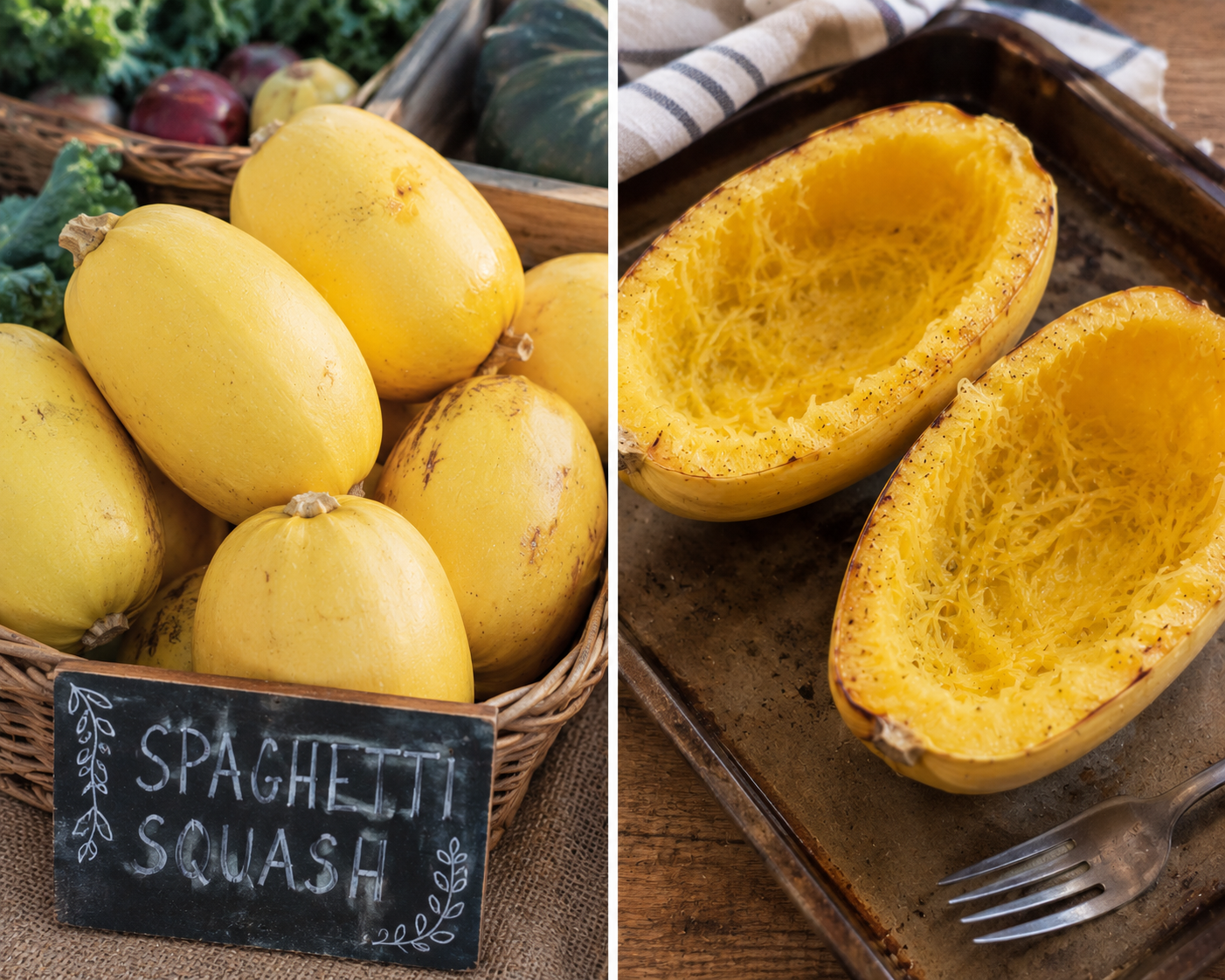
Three ways to roast spaghetti squash, depending on your time and how you’ll use it. This is the foundation for every recipe in the collection.
Yield: One medium spaghetti squash (about 4–5 cups cooked strands) · Active: 5 min · Total: 30–45 min · Year-round (peak September–November)
Method 1: Cut-side down (the standard, most reliable). Heat the oven to 400°F. Halve the squash lengthwise, and scoop out the seeds and stringy pulp with a metal spoon (save the seeds; see below). Drizzle the cut sides generously with olive oil, and season with salt and pepper. If you like, lay 6–8 thyme sprigs on the sheet pan, and set the squash halves cut-side down on top. Roast 25–35 minutes for a medium squash, until the skin gives slightly when pressed and a knife slides easily into the flesh. Don’t over-roast; the strands should be al dente, not mushy. Let it cool slightly, then scrape the flesh into long strands with a fork.
Method 2: Cut-side up (more caramelization, slightly drier strands). Roast the same way, but cut-side up. The cut surface caramelizes beautifully, for a deeper flavor, though the strands will be a little drier. It’s best for saucy recipes, like the Alfredo, the Italian-style sausage, and the pesto dishes.
Method 3: Cubed (fastest, for weeknights). Trim both ends of the squash, peel it with a sturdy vegetable peeler or paring knife, and cut it into 1-inch cubes. Toss with olive oil, salt, and pepper, and roast at 425°F for 20–25 minutes, until tender. You’ll get roasted cubes rather than strands, which are lovely in bowls.
Don’t toss the seeds. Rinse them, pat them dry, toss them with olive oil and salt, and roast them at 350°F for 10–12 minutes, until golden and crisp. They make a crunchy, mineral-rich topping for any recipe below.
Storage: Roasted squash keeps refrigerated up to 5 days in a glass container. The strands reheat gently, or are lovely cold in a bowl. It freezes up to 1 month, though the texture softens a little, which is fine for saucy dishes, but not for recipes where al dente strands are the star.
A note on the seeds
Don't discard the seeds. Rinse them in a colander, pat dry, toss with olive oil and salt, and roast on a small baking sheet at 350°F for 10–12 minutes until golden and crisp. They make an excellent topping for any of the recipes below — adds crunch, minerals, and zero waste.
2. Parmesan Shrimp Spaghetti Squash with Herb Pesto
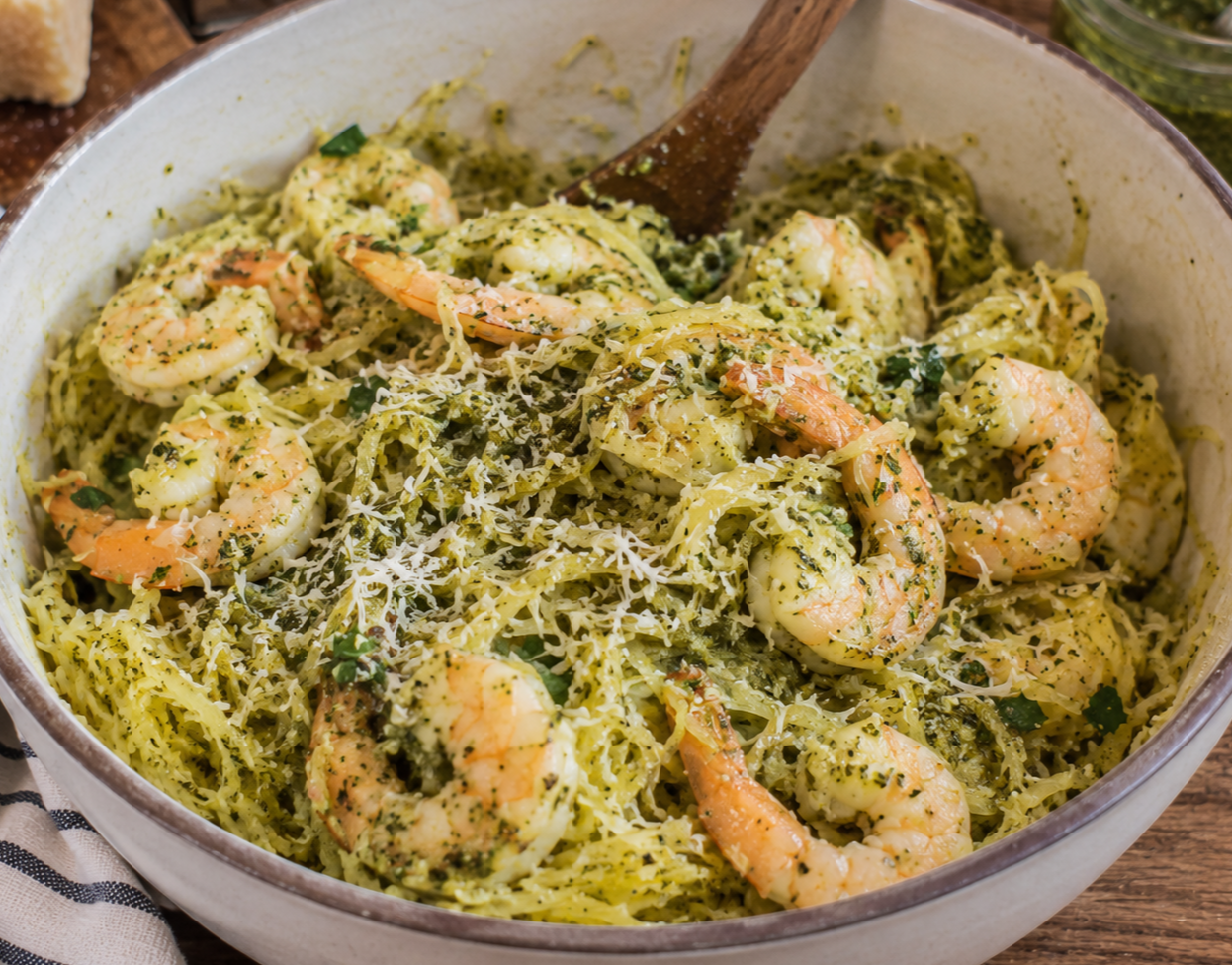
Roasted spaghetti squash tossed with garlic-butter shrimp, freshly grated Parmigiano-Reggiano, and a dollop of herb pesto. A 15-minute weeknight dinner that tastes like a restaurant plate.
Yield: Serves 2 · Active: 15 min · Total: 45 min, including roasting the squash · Year-round · Best eaten: early evening
Spaghetti squash
1 small to medium spaghetti squash (about 3 cups cooked strands)
2 tbsp extra virgin olive oil
Baja Gold sea salt and freshly cracked black pepper
Shrimp
1 lb wild shrimp (Gulf, Pacific, or Argentine red), peeled and deveined
2 tbsp grass-fed butter
1 tbsp extra virgin olive oil
3 garlic cloves, finely minced
1 tsp smoked or sweet paprika
½ tsp Baja Gold sea salt
Optional: a pinch of red pepper flakes
Juice of ½ lemon
To finish
½ cup freshly grated Parmigiano-Reggiano
2–3 tbsp herb pesto (basil, parsley, or mixed; homemade or store-bought)
Optional: 2 tbsp toasted pine nuts or pumpkin seeds
Fresh basil, torn, and flaky sea salt
Roast the squash cut-side down (Method 1) at 400°F for 25–35 minutes. Prep everything else while it roasts.
Cook the shrimp. Heat the butter and olive oil in a large skillet over medium-high heat. When the butter foams, add the garlic for 30 seconds, then the shrimp in a single layer. Cook 1–2 minutes per side, just until pink and opaque. Sprinkle with the paprika, salt, and red pepper flakes, squeeze the lemon over the top, and toss. Take it off the heat.
Combine. Scrape the squash into strands, right into the skillet with the shrimp, and toss gently. Add the Parmigiano, and toss again until it melts in.
Serve. Divide it between two warm plates, and top each with a generous spoonful of pesto, pine nuts (if using), torn basil, and flaky salt. Serve right away.
Storage: Best the day it’s made. Leftovers keep refrigerated up to 2 days.
3. Spaghetti Squash with Pistachio Pesto, Mushrooms & Caramelized Onions
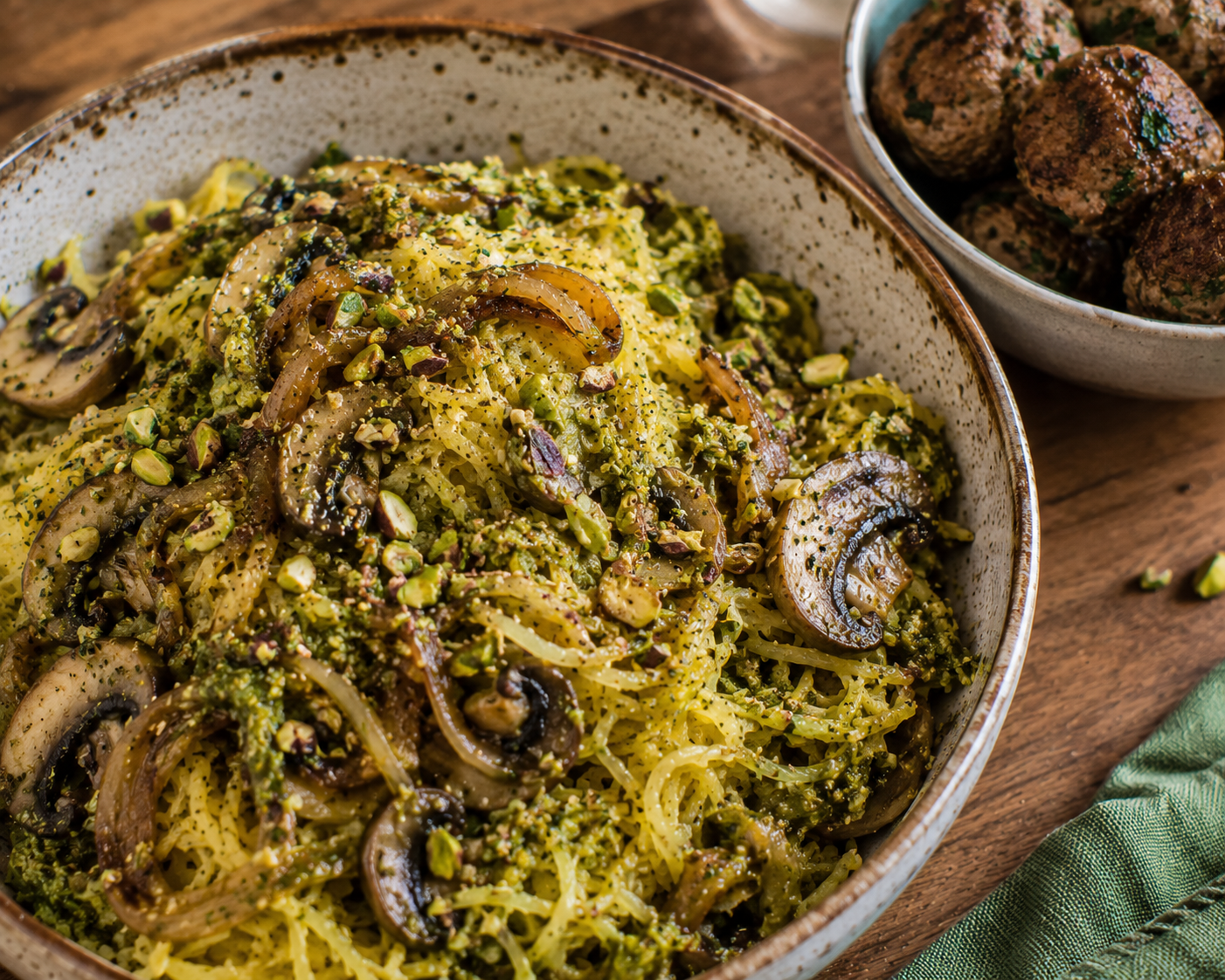
A deeply autumnal dish: sautéed mushrooms and slowly caramelized onions tossed with spaghetti squash and a vibrant pistachio-basil pesto. Vegetarian as written, with protein options below.
Yield: Serves 4 · Active: 30 min · Total: 1 hr 15 min, including roasting the squash · Best in fall and early winter · Best eaten: early evening
Spaghetti squash
1 medium spaghetti squash (4–5 cups cooked strands)
2 tbsp extra virgin olive oil
Baja Gold sea salt and freshly cracked black pepper
Caramelized onions
1 large yellow or red onion, thinly sliced
2 tbsp grass-fed butter or extra virgin olive oil
½ tsp Baja Gold sea salt
1 tbsp aged balsamic vinegar
Mushrooms
1 lb mixed mushrooms (cremini, shiitake, oyster, and maitake), sliced
2 tbsp grass-fed butter
1 tbsp extra virgin olive oil
2 garlic cloves, minced
2 sprigs fresh thyme, leaves stripped
½ tsp Baja Gold sea salt
Pistachio pesto
1 cup fresh basil leaves, packed
¼ cup fresh flat-leaf parsley
⅓ cup shelled pistachios
2 garlic cloves
Zest and juice of 1 lemon
1 tsp Dijon mustard
Optional: ¼ cup freshly grated Parmigiano-Reggiano
⅓ cup extra virgin olive oil
Baja Gold sea salt, to taste
To finish: chopped pistachios, a drizzle of your best olive oil, fresh basil, and flaky sea salt
Protein options:
Grilled chicken: 2 pasture-raised chicken breasts, butterflied and grilled with lemon, thyme, garlic, and olive oil, until they reach 165°F, then sliced over the top
Pan-seared wild salmon: 2 fillets, seared skin-side down for 4 minutes, then flipped for 2 more. Its richness is beautiful with the earthy mushrooms.
Trout: 2 whole trout or fillets, pan-seared simply with butter, salt, and thyme
Lamb meatballs: 1 lb pasture-raised ground lamb mixed with 1 grated garlic clove, 1 tbsp chopped rosemary, lemon zest, salt, and pepper, rolled into 1-inch balls, and pan-seared or roasted at 400°F for 12–15 minutes, until they reach 160°F
Sardines or anchovies: a tin of wild sardines or anchovies packed in olive oil, drained and torn over the top, for a Mediterranean salty-savory finish
Roast the squash cut-side down (Method 1) at 400°F for 25–35 minutes.
Caramelize the onions. Meanwhile, cook the onion in the butter with a pinch of salt in a wide skillet over medium-low heat for 25–30 minutes, stirring every few minutes, until deep golden, soft, and jammy. Add the balsamic for the last 1–2 minutes, stirring until glossy.
Sauté the mushrooms. Heat the butter and olive oil in a separate skillet over medium-high heat. When the butter foams, add the mushrooms in a single layer (in batches, if needed, so they brown instead of steaming). Cook 4–5 minutes per side, until deep golden and crisp at the edges, then add the garlic, thyme, and salt, and stir 1 minute more.
Make the pesto. Pulse the basil, parsley, pistachios, garlic, lemon zest and juice, Dijon, and Parmigiano (if using) in a food processor until coarsely chopped, then stream in the olive oil until it’s as chunky or smooth as you like. Season with salt.
Combine. Scrape the squash into strands, and toss it in a large bowl with the onions, mushrooms, and 3–4 tbsp of the pesto. Taste, and add more pesto, salt, or lemon.
Serve on warm plates, topped with chopped pistachios, olive oil, basil, and flaky salt, with your protein on top, if using.
Storage: Best the day it’s made. Leftovers keep refrigerated up to 3 days, and the pesto up to 1 week.
4. Spaghetti Squash Alfredo with Roasted Cauliflower
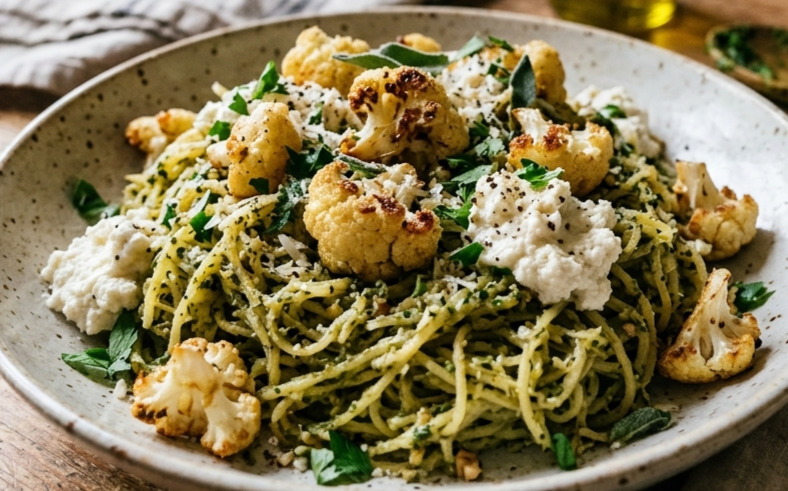
A creamy raw-cream Alfredo with roasted cauliflower, comforting in a way grain-free dishes rarely are. Vegetarian as written, with protein options below.
Yield: Serves 4 · Active: 25 min · Total: 1 hour, including roasting the squash · Best in fall and winter · Best eaten: early evening
Squash and cauliflower
1 medium spaghetti squash
1 head cauliflower, cut into florets
2 tbsp extra virgin olive oil, divided
1 tsp mild chili powder (ancho-style)
Baja Gold sea salt and freshly cracked black pepper
Alfredo sauce
1 cup raw grass-fed heavy cream (or raw whole milk, for a lighter sauce)
4 tbsp grass-fed butter
2 garlic cloves, finely minced
¾ cup freshly grated Parmigiano-Reggiano
Optional: ¼ cup freshly grated Pecorino Romano, for sharpness
1 tsp Baja Gold sea salt and ½ tsp freshly cracked black pepper
Optional: a pinch of freshly grated nutmeg (traditional) and red pepper flakes
Optional: 1 tbsp fresh lemon juice
¼ cup fresh basil and parsley, finely chopped
Parsley-cashew crumble (optional, but recommended)
½ cup cashews
¼ cup fresh flat-leaf parsley
1 garlic clove
2 tbsp unfortified nutritional yeast
Pinch of Baja Gold sea salt
To finish: extra Parmigiano (or nutritional yeast), fresh herbs, red pepper flakes, and, optionally, a poached or fried pasture-raised egg per plate
Protein options:
Pan-seared wild salmon: 2–4 fillets, seasoned simply and seared skin-side down for 4 minutes, then flipped for 2 more
Grilled chicken: pasture-raised breasts, butterflied and grilled with lemon, garlic, and olive oil, until they reach 165°F, then sliced over the top
Wild cod or halibut, gently poached or pan-seared. Mild fish is beautiful with the creamy sauce.
Pasture-raised Italian sausage: 12 oz, sliced into rounds and browned
Lamb meatballs: 1 lb ground lamb with rosemary, garlic, and lemon zest, pan-seared until they reach 160°F
A poached or fried egg: the runny yolk turns this into something extraordinary
Roast the squash. Heat the oven to 400°F. Halve the squash, drizzle the cut sides with 1 tbsp olive oil, salt, and pepper, and roast cut-side up (Method 2) for 30–45 minutes, until tender enough to scrape into strands.
Roast the cauliflower. On a separate pan, toss the cauliflower with the remaining olive oil, chili powder, salt, and pepper, and roast 25–30 minutes, until lightly charred and golden.
Make the Alfredo. Meanwhile, melt the butter in a wide saucepan over low heat. Add the garlic, and cook just 30–45 seconds, until fragrant but not browned. Pour in the cream, and warm it gently for 2–3 minutes, without letting it boil. Keeping the heat low keeps the sauce silky (and preserves more of the raw cream’s delicate qualities).
Add the cheese. Take the pan off the heat, and whisk in the Parmigiano (and Pecorino, if using) a little at a time, letting each addition melt before adding more. Whisk in the salt, pepper, nutmeg, and red pepper flakes, until silky and glossy, then stir in the herbs and lemon juice (if using). Taste: it should be rich, nutty, and slightly sharp. Add more salt or lemon if it tastes flat.
Make the crumble (optional). Pulse the cashews, parsley, garlic, nutritional yeast, and salt to a coarse, sandy texture.
Combine. Scrape the squash into strands, and toss them with the Alfredo in a warm bowl.
Serve in warm, shallow bowls, topped with roasted cauliflower, the crumble, extra Parmigiano, herbs, red pepper flakes, and an egg, if you like.
Storage: Best the day it’s made. Leftovers keep refrigerated up to 3 days. The Alfredo keeps separately up to 5 days, and it’s wonderful over roasted vegetables and baked potatoes.
5. Italian-Style Spaghetti Squash with Sausage & Vegetables
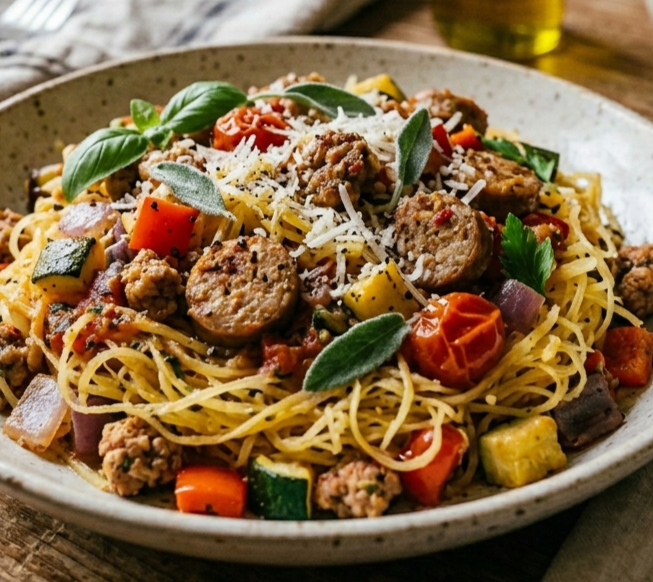
A rich, hearty tomato sauce full of colorful vegetables, tossed with roasted spaghetti squash and pasture-raised Italian sausage. It makes the whole kitchen smell like an Italian grandmother’s house.
Adapted from the Price-Pottenger Foundation
Yield: Serves 6 · Active: 45 min · Total: 1 hr 30 min · Best in fall and winter · Best eaten: midday or early evening
1 medium spaghetti squash
12 oz pasture-raised Italian sausage (about 3 large sausages: sweet, hot, or fennel)
1 tbsp grass-fed ghee
1 yellow onion, thinly sliced into half-moons
2 garlic cloves, finely minced
2 cups cherry tomatoes (an heirloom mix, if you can find them)
1 bell pepper (red, yellow, or orange), thinly sliced
1 medium fennel bulb, thinly sliced
2 large zucchini, cut into matchsticks
Baja Gold sea salt and red pepper flakes, to taste
Extra virgin olive oil, for drizzling
A small bunch of fresh basil, thinly sliced
Roast the squash. Heat the oven to 350°F. Halve the squash and scoop out the seeds, then set it cut-side down in a baking dish with about 1 inch of water. Roast 30–45 minutes, until the skin is soft to the touch, then let it cool.
Cook the onion. Melt the ghee in a large cast iron skillet over medium heat, and cook the onion and garlic about 5 minutes, until the onion softens.
Add the tomatoes. Cover and cook 5–7 minutes, until they soften, then gently smash them with a wooden spoon to release their juices.
Add the pepper and fennel. Cover and cook 5 minutes more, until they start to soften.
Add the sausage. Slice the sausages into 1-inch rounds, add them to the skillet, cover, and cook 5–7 minutes, stirring occasionally, until cooked through.
Add the zucchini, salt, and red pepper flakes. Cover and cook 2–3 minutes more, until the zucchini is just tender.
Combine. Scrape the squash into strands, add them to the skillet, and toss everything together for a few minutes, until heated through.
Serve on warm plates, drizzled generously with olive oil and sprinkled with basil.
Storage: Refrigerated up to 4 days; it’s even better reheated, as the flavors deepen overnight. It freezes up to 2 months.6. Super Green Spaghetti Squash with Collards, Brussels Sprouts & Carrot-Top Pesto
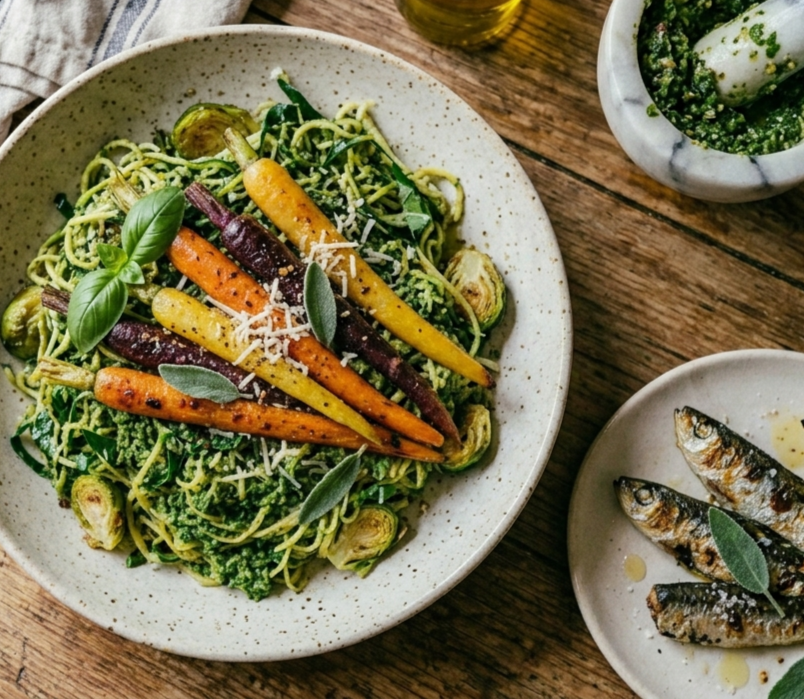
A deep green, nutrient-dense plate of sautéed greens, Brussels sprouts, and roasted spaghetti squash, with a zero-waste carrot-top pesto. Vegetarian as written, with protein options below.
Yield: Serves 4 · Active: 30 min · Total: 1 hr 15 min, including roasting the squash · Best in fall and winter · Best eaten: midday or early evening
Spaghetti squash
1 medium spaghetti squash
2 tbsp extra virgin olive oil
Baja Gold sea salt and freshly cracked black pepper
Greens
2 tbsp grass-fed butter or extra virgin olive oil
1 shallot, finely diced
3 garlic cloves, minced
1 lb Brussels sprouts, halved (or quartered, if large)
1 large bunch collard greens, stems removed and leaves chopped
Optional: 2 cups baby spinach
Baja Gold sea salt, black pepper, and a squeeze of lemon
Carrot-top pesto
2 cups fresh carrot tops, washed well
¼ cup fresh flat-leaf parsley
⅓ cup pepitas (pumpkin seeds)
1 shallot
2 garlic cloves
Zest of 1 orange and 1 lemon
2 tbsp aged balsamic vinegar
⅓ cup extra virgin olive oil
Baja Gold sea salt and black pepper
To finish: roasted rainbow carrots (the ones whose tops became pesto, tossed with olive oil and salt and roasted at 400°F for 25 minutes), freshly grated Parmigiano-Reggiano (optional), toasted pepitas, and a drizzle of olive oil
Protein options:
Grilled chicken: pasture-raised breasts, grilled with lemon, thyme, and olive oil, until they reach 165°F
Pan-seared wild salmon: 2–4 fillets, seared simply with salt and pepper
Wild cod or halibut, gently poached in a little broth or butter
Trout, whole or fillets, pan-seared with thyme and lemon
Lamb meatballs: 1 lb ground lamb with rosemary, garlic, and lemon zest, cooked to 160°F. Lamb’s deep flavor is beautiful with the brassicas.
Sardines or anchovies, torn over the top
A soft-boiled or poached pasture-raised egg, 1 per plate
Roast the squash cut-side down (Method 1) at 400°F for 25–35 minutes, and roast the carrots on a separate pan alongside it, for 25–30 minutes.
Make the pesto. Pulse the carrot tops, parsley, pepitas, shallot, garlic, orange and lemon zest, balsamic, salt, and pepper in a food processor until coarsely chopped, then stream in the olive oil. Taste and adjust.
Sear the Brussels sprouts. Heat the butter in a large skillet over medium-high heat, cook the shallot 2 minutes, then add the garlic for 30 seconds. Add the sprouts cut-side down, and leave them 3–4 minutes, until deep golden, then flip and cook 2 minutes more.
Add the collards. Stir them in, cover, and cook 4–5 minutes, until bright green and tender. Add the spinach (if using) for the last minute, then season with salt, pepper, and lemon.
Combine. Scrape the squash into strands, add them to the skillet, and toss with a drizzle of olive oil.
Serve on warm plates, topped with the roasted carrots, a generous spoonful of pesto, Parmigiano, toasted pepitas, and a drizzle of olive oil, with your protein on top, if using.
Storage: Best the day it’s made. Leftovers keep refrigerated up to 3 days, and the pesto up to 1 week.
7. Wild Salmon with Spaghetti Squash, Dijon Brussels Sprouts & Avocado Vinaigrette
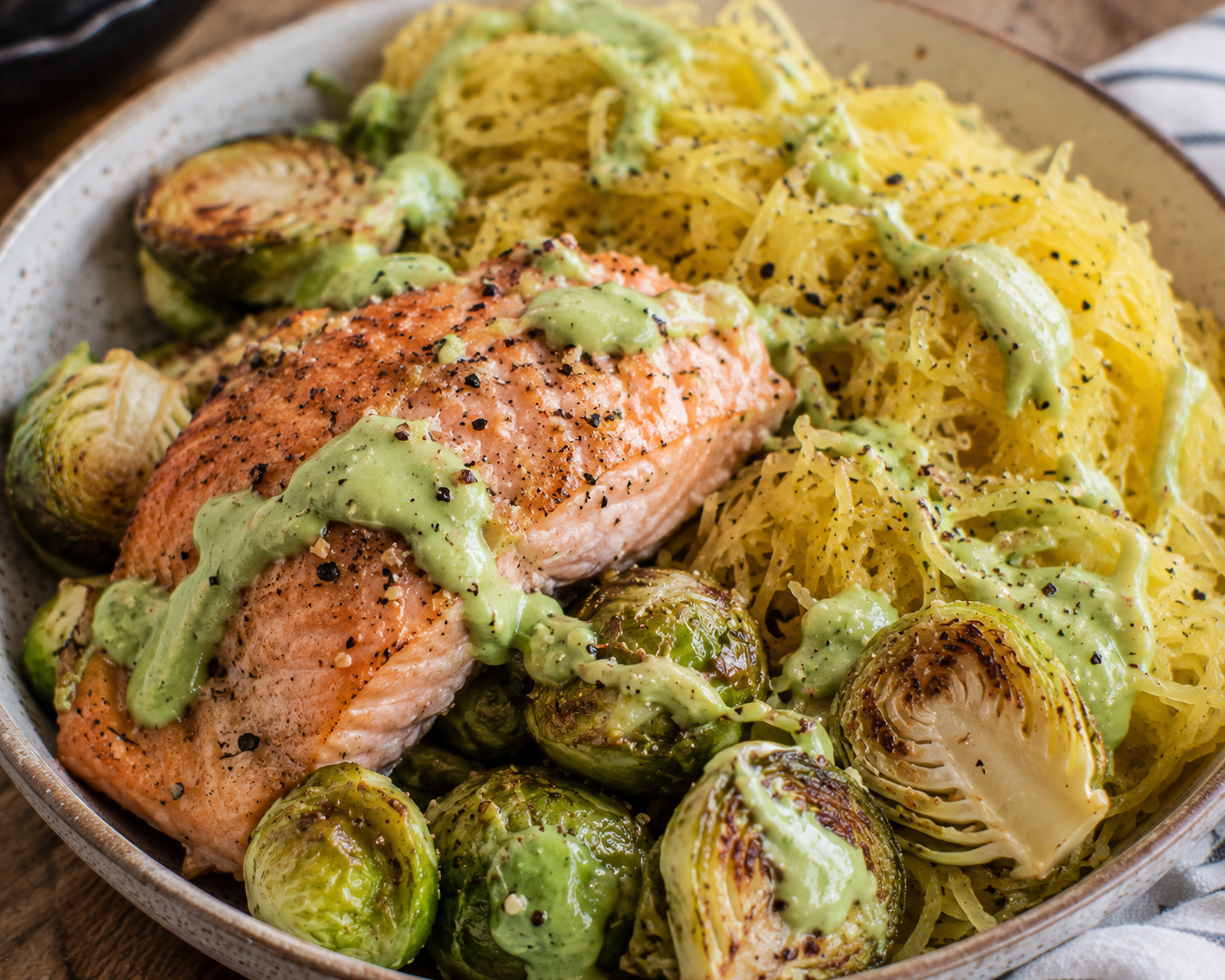
An elegant, complete dinner plate: pan-seared wild salmon, roasted spaghetti squash, Brussels sprouts with Dijon and toasted pumpkin seeds, sautéed kale, and a creamy avocado vinaigrette over everything.
Yield: Serves 2 · Active: 35 min · Total: 1 hour · Year-round (especially fall through spring) · Best eaten: early evening
Spaghetti squash
1 small spaghetti squash
2 tbsp extra virgin olive oil
Baja Gold sea salt and freshly cracked black pepper
Dijon Brussels sprouts
1 lb Brussels sprouts, halved
2 tbsp grass-fed butter or extra virgin olive oil
1 tbsp Dijon mustard
1 tsp aged balsamic vinegar
¼ cup pumpkin seeds
Baja Gold sea salt and black pepper
Sautéed kale (optional, but recommended)
1 large bunch lacinato kale, stems removed and leaves chopped
1 tbsp extra virgin olive oil
1 garlic clove, minced
A squeeze of lemon and a pinch of salt
Salmon
2 wild Alaskan salmon fillets (5–6 oz each)
1 tbsp grass-fed butter
1 tbsp extra virgin olive oil
Baja Gold sea salt and black pepper
Avocado vinaigrette
½–1 ripe avocado
Optional: 1 small shallot, minced, and 1 garlic clove, grated
1 tbsp red or white wine vinegar
1 tbsp Dijon mustard
¼ cup extra virgin olive oil
¼ tsp Baja Gold sea salt and black pepper
Filtered water, as needed
To finish: fresh dill or parsley, lemon wedges, and flaky sea salt
Roast the squash cut-side down (Method 1) at 400°F for 25–35 minutes. Drizzle it with a little more olive oil, salt, and pepper after roasting.
Sear the Brussels sprouts. Heat the butter in a large skillet over medium-high heat, and cook the sprouts cut-side down 4–5 minutes, without moving them, until deep brown, then flip and cook 3–4 minutes more. Whisk the Dijon and balsamic, pour it over the sprouts, and toss with the pumpkin seeds, salt, and pepper.
Sauté the kale. Warm the olive oil in a separate skillet over medium heat, add the garlic for 30 seconds, then the kale, and cook 3–4 minutes, until wilted but still bright green. Finish with lemon and salt.
Make the vinaigrette. Blend everything until completely smooth and creamy, adding 1–2 tbsp water to thin it to a drizzle.
Sear the salmon. Pat it dry, and season it with salt and pepper. Heat the butter and olive oil in a clean skillet over medium-high heat, and when it foams, lay the salmon in skin-side down. Cook 4 minutes without moving it, until the skin is crisp, then flip and cook 2 minutes more for medium-rare, or 3–4 for medium. Rest 1 minute.
Plate. Scrape the squash into strands, and mound them in the center of each warm plate. Arrange the Brussels sprouts, kale, and salmon around them, and drizzle the avocado vinaigrette over everything. Finish with dill or parsley, lemon wedges, and flaky salt.
Storage: Best the day it’s made. The salmon and vegetables keep refrigerated up to 2 days, and the vinaigrette is best within 1 day.
8. Sage-Parsley Pesto Spaghetti Squash with Roasted Cauliflower, Broccoli & HOMEMADE Ricotta
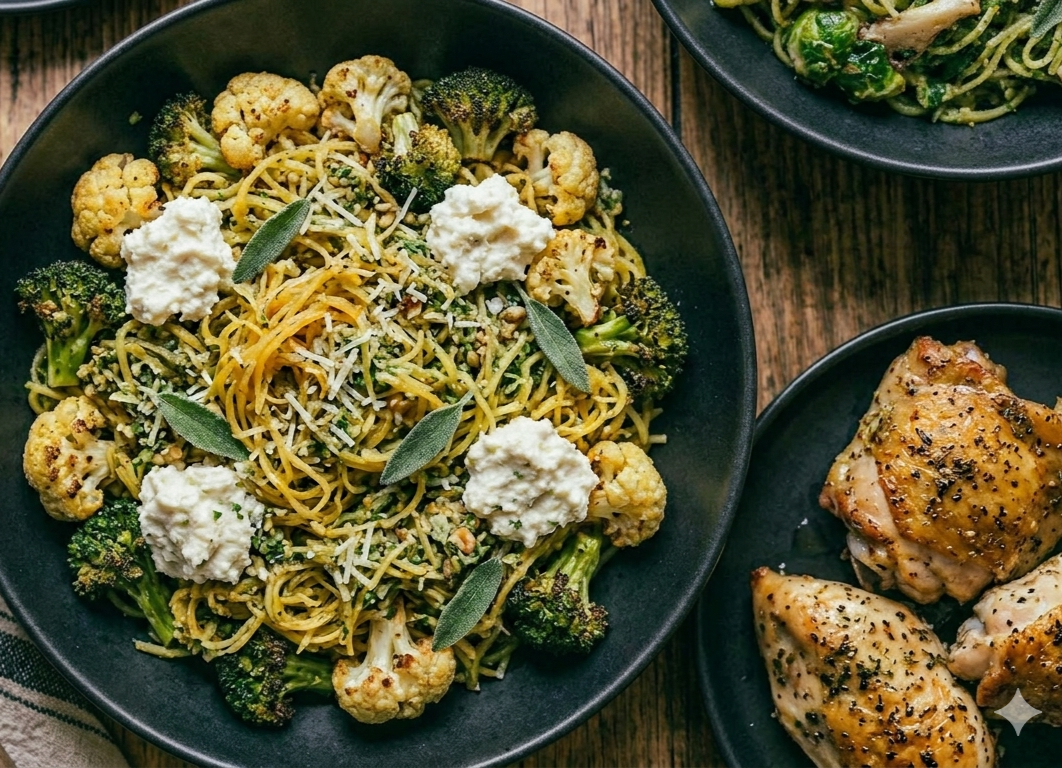
The dinner-party showpiece: roasted spaghetti squash topped with roasted cauliflower and broccoli, homemade ricotta, and a vibrant sage-parsley pesto, with an optional butternut squash purée underneath. Vegetarian as written, with protein options below.
Yield: Serves 4 · Active: 1 hour · Total: 2 hours, including all the components · Best in fall and early winter · Best eaten: early evening
Spaghetti squash
1 medium to large spaghetti squash
12–18 sprigs fresh thyme
Extra virgin olive oil and Baja Gold sea salt
Roasted cauliflower and broccoli
1 head cauliflower, cut into florets
1 head broccoli, cut into florets
2 tbsp extra virgin olive oil
Optional: 1 tsp ground turmeric, for color
Baja Gold sea salt and black pepper
Butternut squash purée (optional, for an elevated plate)
2 lb butternut squash, peeled and cubed
2 garlic cloves, peeled
3 tbsp extra virgin olive oil
1 tbsp each fresh rosemary and thyme, chopped
1½ tsp Baja Gold sea salt and a pinch of black pepper
1–2 tbsp grass-fed butter
Optional: ½ cup bone broth
Sage-parsley pesto
1 cup flat-leaf parsley, packed
¼ cup fresh sage leaves, packed
⅔ cup pepitas (pumpkin seeds)
1 clove black garlic, crushed (or regular garlic; black garlic adds a deep, savory sweetness)
Baja Gold sea salt, to taste
⅓ cup extra virgin olive oil
Ricotta: homemade (see below), or a good whole-milk ricotta
To finish: toasted pepitas, crispy fried sage leaves, a drizzle of your best olive oil, and flaky sea salt
Protein options:
Roasted bone-in chicken thighs: 4 pasture-raised thighs, seasoned with rosemary, salt, and pepper, and roasted at 400°F for 35–40 minutes, until they reach 175°F
Pan-seared wild salmon: 4 fillets, seasoned simply and seared
Lamb meatballs: 1 lb ground lamb with rosemary, garlic, and lemon zest, cooked to 160°F
Pasture-raised duck breast: 2 breasts, scored and seared skin-side down until crisp. Duck’s richness is extraordinary with sage.
Make the butternut purée (optional). Heat the oven to 375°F. Toss the butternut squash and garlic with the olive oil, rosemary, thyme, salt, and pepper, and roast 30–35 minutes, until tender. Blend it with the butter (and broth, if using) until completely smooth. Keep it warm.
Roast the spaghetti squash. Raise the oven to 400°F. Halve the squash and scoop out the seeds. Scatter the thyme sprigs on a sheet pan, set the squash halves cut-side down on top, and drizzle the skins with olive oil and salt. Roast 25–35 minutes, until tender, then let it cool slightly and scrape it into strands.
Roast the cauliflower and broccoli. Toss them with the olive oil, turmeric (if using), salt, and pepper, and roast on separate pans at 400°F for 25–30 minutes, until charred at the edges. (Broccoli cooks faster than cauliflower, so pull it first, or broil the cauliflower briefly at the end for crisp, golden edges.)
Make the pesto. Pulse the parsley, sage, pepitas, black garlic, and salt in a food processor into a thick paste, then stream in the olive oil, adding 1–2 tbsp water if it’s too thick.
Fry the sage (optional). Heat 2 tbsp olive oil in a small skillet over medium heat, and fry 6–8 sage leaves for 30–45 seconds, until crisp. Drain them on a towel.
Assemble. Spread a generous spoonful of butternut purée (if using) across each warm plate, and top it with a mound of spaghetti squash. Arrange the roasted cauliflower and broccoli around it, add 2–3 dollops of ricotta, and drizzle generously with the sage-parsley pesto.
Finish with crispy sage, toasted pepitas, olive oil, and flaky salt, with your protein on top, if using.
Storage: Store the components separately: the spaghetti squash up to 5 days, the roasted vegetables up to 3 days, the butternut purée up to 4 days, the pesto up to 1 week, and the ricotta up to 5–7 days. Reheat and assemble fresh.
Homemade Ricotta: Three Ways
Homemade ricotta is one of the most rewarding kitchen projects: 30 minutes of active time, a few simple ingredients, and a result that’s better than anything you can buy. Here are three ways to make it.
Method 1: Quick Whole-Milk Ricotta (start here)
Makes about 3–4 cups
1 gallon whole milk (raw or gently pasteurized, but not ultra-pasteurized; cow’s, goat’s, or sheep’s milk)
Optional: ½ cup raw heavy cream, for extra richness
⅓ cup fresh lemon juice (about 2 lemons) or raw apple cider vinegar
1 tsp non-iodized sea salt
Equipment: a large stainless steel pot (not aluminum), a thermometer, a fine-mesh colander, butter muslin or 2–3 layers of cheesecloth, a large bowl to catch the whey, and a slotted spoon.
Heat the milk. Heat the milk, cream (if using), and salt over medium heat, stirring occasionally so it doesn’t scorch, to 185–200°F, when you’ll see wisps of steam and small bubbles at the edges, about 10–15 minutes. Don’t let it boil, which makes the ricotta grainy.
Add the acid. Take the pot off the heat, and gently stir in the lemon juice or vinegar for just 5–10 seconds. Cover, and let it sit undisturbed for 10–20 minutes, as white curds rise to the top and the pale yellow-green whey settles below. If no curds form, add 1–2 tbsp more acid, and wait 5 minutes.
Strain. Line a colander with muslin or cheesecloth, set it over a large bowl, and gently ladle in the curds with a slotted spoon (pouring breaks them up).
Drain to your liking: 10–20 minutes for a soft, spreadable ricotta (best for this recipe and for toast), 30–60 minutes for a firmer ricotta (for stuffing or lasagna), or overnight in the fridge for a dense, sliceable cheese. If it’s too dry, stir in a little whey or cream.
Store it in a sealed glass container in the fridge up to 7 days, or freeze it up to 2 months (it turns slightly grainy, so use frozen ricotta in cooked dishes).
Method 2: Traditional Whey Ricotta (the classic Italian method)
This is how Italian cheesemakers have made ricotta for centuries. Ricotta means “recooked,” because it’s made by recooking the whey left over from making other cheeses. If you make cheese or can get fresh whey from a local cheesemaker, it’s the most traditional, zero-waste way.
Important: This only works with whey from rennet-set cheeses, like mozzarella, cheddar, or Gouda. Whey from acid-set cheeses (paneer, ricotta, or cottage-style cheeses) has already given up most of its protein.
Makes about 1 cup from 1 gallon of whey
1 gallon fresh whey from rennet cheesemaking, used within 24 hours (older whey becomes too acidic)
2 tbsp white vinegar or raw apple cider vinegar
Sea salt, to taste
Optional, but divine: 2–4 tbsp raw cream, stirred in at the end
Heat the whey in a large stainless steel pot over medium heat to 195°F, stirring gently so it doesn’t scorch (a double boiler helps).
Add the vinegar. Just before it boils, take it off the heat, and add the vinegar. Tiny white curds (the whey proteins) will rise almost immediately.
Rest 5–10 minutes, so the curds come together.
Drain. Gently ladle the curds into a cheesecloth-lined colander, and drain 1 hour for a soft cheese, or 5–7 hours for a firmer one.
Finish. Stir in salt to taste, and the cream, if using, for a smoother, richer ricotta.
Store it refrigerated up to 7–10 days.
Method 3: Almond Ricotta (plant-based)
2 cups almonds, soaked overnight and peeled (the skins slip off easily after soaking)
1 quart filtered water
¾ tsp citric acid
Zest of 1 lemon
½ tsp Baja Gold sea salt
Blend the almonds and water in a high-speed blender for 1–2 minutes, until smooth, then strain through a nut milk bag into a pot (save the pulp for another use). Heat the almond milk to about 194°F, then whisk in the citric acid, lemon zest, and salt. Take it off the heat, and let it stand 15 minutes, until curds form. Pour it into a cheesecloth-lined strainer, cover, and drain in the fridge 2–3 hours. It keeps refrigerated up to 5 days.
Choosing your milk
Cow’s milk ricotta is the most familiar: mild, sweet, creamy, and balanced.
Goat’s milk ricotta is slightly tangier, with a subtle goaty note that fades as it drains. It’s lovely with the sage-parsley pesto, and many people who don’t tolerate cow’s milk find goat’s milk easier to digest, thanks to its smaller fat globules, mostly A2-type casein, and slightly lower lactose.
Sheep’s milk ricotta is the most traditional Italian version, and sheep’s milk is one of the richest milks there is (6–8% fat), for the most luxurious ricotta. It’s rare in the U.S., but worth seeking out for a dinner party.
Use whatever good milk you can find. Raw or gently pasteurized milk works, but ultra-pasteurized milk won’t form proper curds, since its proteins have been changed by the high heat. And since ricotta is heated to 185°F or more, ricotta made from raw milk is no longer raw, though it keeps the beautiful flavor of good milk.
A note on salt: Use non-iodized sea salt or cheese salt, since iodized salt can give fresh cheese an off flavor.
Don’t toss the whey. The pale yellow-green liquid left over is full of whey protein, calcium, magnesium, potassium, and B vitamins. Since it’s been heated, it has no live cultures, so don’t use it to start ferments like sauerkraut (use the unheated whey from yogurt or kefir for that). But it’s wonderful:
In place of water in baking (sourdough, pancakes, and muffins), for tang and tenderness
In smoothies, soups, and stocks
Chilled, as a refreshing drink on a hot day
For your garden (tomatoes, peppers, and squash love its minerals and slight acidity)
For chickens, pigs, and dogs
Refrigerated, the whey keeps 1 week, or freeze it in ice cube trays up to 3 months.
Why it’s worth the 30 minutes: Most people have never made ricotta, because they don’t realize how easy it is. Homemade ricotta has a delicate sweetness and a clean, fresh dairy flavor no store-bought version can match, it gives you useful whey as a bonus, and it connects you to an old Italian tradition of turning leftovers into nourishment. Make it on a Sunday afternoon, and use it all week: Monday on toast with raw honey and figs, Tuesday in this spaghetti squash, Wednesday in lasagna, Thursday whipped with herbs as a dip, and Friday in ricotta pancakes for the kids.
Nourishment Notes
Spaghetti squash
Spaghetti squash belongs to Cucurbita pepo, the same species as zucchini, pumpkin, and acorn squash, and its unusual fibrous flesh separates into pasta-like strands when cooked. A cooked cup has about 40 calories, 10 g of carbohydrates, and 2 g of fiber, along with vitamin C, manganese, potassium, and some beta-carotene. Compared with wheat pasta, it’s far lighter, with fewer carbohydrates and more vitamins, and it carries sauce, fat, and protein beautifully.
Spaghetti squash peaks from September through November, and it stores beautifully: kept whole in a cool, dark place, it lasts 1–2 months or more. That makes it one of the best winter pantry vegetables. Buy several at the harvest, and roast them through the cold months.
The pesto family
This collection features four pestos and a crumble: classic herb pesto (Recipe 2), pistachio-basil pesto (Recipe 3), a parsley-cashew crumble (Recipe 4), carrot-top pesto (Recipe 6), and sage-parsley pesto (Recipe 8). Pesto is one of the most useful sauces there is: a handful of fresh herbs, good fat, nuts or seeds, and a little salt and acid make a sauce that lifts any vegetable or protein. The word comes from the Italian pestare, “to pound,” from the original mortar and pestle. Classic pesto alla genovese (basil, pine nuts, garlic, Parmigiano-Reggiano, olive oil, and salt) was first written down in Liguria in the 1800s, though Romans made a similar herb-and-cheese paste called moretum. A food processor makes it a 3-minute project, but a pestle-pounded pesto is worth trying at least once.
Carrot-top pesto is one of the most underrated zero-waste preparations there is. Carrot tops are usually thrown away, but they’re rich in vitamins A, C, and K, and calcium, and turning them into pesto uses the whole carrot, from root to leaf.
The protein options
The choice of protein is modular: pick based on what’s in the freezer, what’s in season, and what feels right. Wild Alaskan salmon is at its peak in summer, when Alaska’s sockeye and king salmon runs arrive, and freezes beautifully for the rest of the year. Pasture-raised chicken is good year-round. Lamb is traditionally a spring meat, though pasture-raised lamb is available all year. Wild cod and halibut from Alaska and the West Coast are sustainable choices. And sardines and anchovies are shelf-stable, sustainable, and one of the most underused proteins in the American kitchen: a good tin turns any of these dishes into a complete Mediterranean meal in 30 seconds.
Together, these are complete meals. The fat from the olive oil, butter, and ghee balances the squash’s carbohydrates. The protein from the eggs, fish, or meat brings satiety and amino acids. And the vegetables bring fiber and minerals. These aren’t “diet food” or substitute meals, but real, nourishing dinners.
For your cycle: The squash’s steady carbohydrates and the vegetables’ minerals make these grounding in the luteal phase, and the salmon and sardines bring omega-3s, which help ease menstrual cramps. The brassica dishes (Recipes 4, 6, 7, and 8) also support estrogen metabolism.
Sourcing
Spaghetti squash — organic, from a farmers’ market during the harvest (September–November); choose medium squash with intact stems and unblemished skin, which store longest
Wild salmon, cod, and halibut — wild Alaskan sockeye, king, or coho salmon, and wild Pacific cod and halibut, from Vital Choice, SeaBear, Sizzlefish, or a trusted fishmonger (avoid farmed Atlantic salmon)
Trout — wild, or responsibly farmed rainbow trout, from a trusted fishmonger
Shrimp — wild-caught Gulf, Pacific, or Argentine red shrimp, with no added sodium tripolyphosphate
Sardines and anchovies — packed in olive oil, in glass or BPA-free tins, like Wild Planet, Fishwife, Bela Olhão, or Ortiz
Chicken, duck, and eggs — pasture-raised, from a local farm or White Oak Pastures (eggs from a local farm or Alexandre Family Farm)
Lamb — pasture-raised and grass-finished, from US Wellness Meats, Force of Nature, or a local farm
Italian sausage — pasture-raised, with no added sugar, from a local butcher
Grass-fed butter and ghee — organic, cultured butter from 100% grass-fed cows; grass-fed ghee, like Pure Indian Foods
Raw cream and milk (for the Alfredo and ricotta) — raw milk from a farmer you know and trust (find one at realmilk.com), or gently pasteurized, cream-line, grass-fed milk, like Snowville Creamery (Ohio); in California, Organic Pastures Dairy sells raw milk in-state, and Alexandre Family Farm offers pasteurized A2/A2 milk
Ricotta (if not making it) — whole-milk ricotta with no gums or stabilizers, like Calabro, or Bellwether Farms sheep’s milk ricotta
Parmigiano-Reggiano and Pecorino Romano — Parmigiano-Reggiano DOP from Italy, aged 24+ months, with “Parmigiano Reggiano” stamped into the rind (grated cheese in plastic tubs usually isn’t the real thing); Pecorino Romano DOP
Nuts and seeds — organic cashews, almonds, pistachios, pepitas, and pine nuts, from Terrasoul or Go Raw (sprouted pepitas); Italian or Mediterranean pine nuts
Nutritional yeast — unfortified, like Sari Foods
Citric acid (for the almond ricotta) — organic, like NOW Foods
Cheesemaking supplies — butter muslin, cheesecloth, and non-iodized cheese salt from New England Cheesemaking Supply Company or Cultures for Health
Extra virgin olive oil — organic, single-estate, harvest-dated within the last 12 months, in dark glass, like McEvoy Ranch or Brightland
Aged balsamic vinegar — from Modena, made from just grape must, like La Vecchia Dispensa or Villa Manodori
Dijon mustard — organic, with no preservatives or sugar; Delouis Fils or Maison Orphée
Vegetables and herbs — organic and seasonal, from a farmers’ market or CSA (Brussels sprouts on the stalk, if you can find them, and fresh herbs from your windowsill)
Mushrooms — fresh shiitake, oyster, maitake, and lion’s mane, from a local grower, a farmers’ market, or Smallhold
Cherry tomatoes — organic heirloom varieties (like Sun Gold and Black Cherry), at their peak from July through September
Salt — Baja Gold sea salt; Maldon for finishing
Storage Across the Collection
Roasted spaghetti squash: refrigerated up to 5 days, or frozen up to 1 month
Parmesan Shrimp: best the day it’s made; up to 2 days
Pistachio Pesto with Mushrooms and Onions: up to 3 days
Alfredo: up to 3 days; the sauce alone up to 5 days
Italian-Style with Sausage: up to 4 days, or frozen up to 2 months
Super Green: up to 3 days
Wild Salmon Plate: best the day it’s made; components up to 2 days, and the vinaigrette within 1 day
Sage-Parsley Pesto with Ricotta: store the components separately (see the recipe)
Pestos: refrigerated up to 1 week in glass, under a thin layer of olive oil, or frozen up to 3 months in ice cube trays
Pairs Well With
At the table: sparkling water with lemon and fresh basil, or a small glass of fresh-pressed apple cider.
For a gathering: Spaghetti squash dishes are lovely for autumn dinner parties, since they’re hearty without being heavy. Serve them with a simple green salad (arugula, lemon, olive oil, and shaved Parmigiano) and a simple, nourishing dessert (see my dessert collection).
As a meal or a side: These work as complete meals with a protein, or as hearty sides alongside a roast chicken, grass-fed steak, or whole roasted fish. The Italian-style sausage (Recipe 5) is perfect for Sunday lunch, the salmon plate (Recipe 7) for a weeknight, and the sage-parsley showpiece (Recipe 8) for a dinner party.
Why This Collection
Italian-American cooking has, in recent decades, become heavier and more processed than it once was: refined pasta, cream sauces with stabilizers, factory-farmed meat, and the loss of the seasonal vegetable abundance that defined real Italian home cooking for centuries.
This collection is the same comfort, made well: spaghetti squash in place of refined pasta, wild fish and pasture-raised meats, good dairy, real Parmigiano-Reggiano and olive oil, fresh herbs, and vegetables at their peak.
It’s how an Italian grandmother really cooked: with what was in season and in the garden, with patience and good ingredients. Make these through the autumn and winter, when spaghetti squash is at its peak. Make them for Sunday lunches with the people you love, for quiet weeknight dinners after a long day, and for dinner parties when you want something real and beautiful at the center of the table.
— Anna aka Food Marshall