Apple Cinnamon Galette
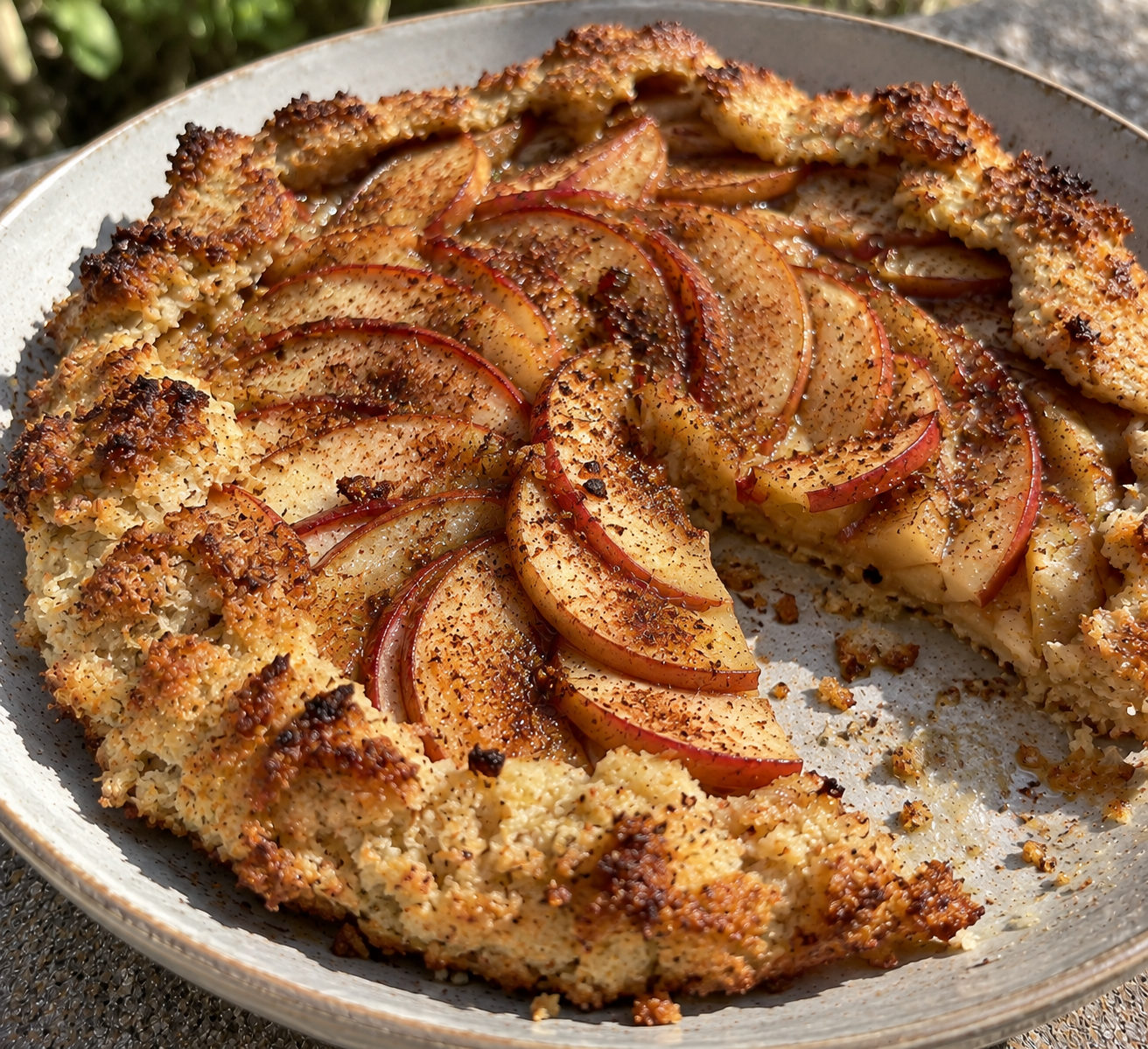
A free-form autumn galette of thinly sliced apples with honey and cinnamon, baked in a tender coconut-cottage cheese pastry.
Yield: Serves 8 · Active: 1 hour · Total: 2 hours · Best in North America in fall, during apple season · Best eaten: early afternoon
Ingredients
Pastry dough
¾ cup coconut flour
6 tbsp blanched almond flour
½ tsp baking soda
½ cup dry-curd cottage cheese (or farmer's cheese, or Greek yogurt strained for 24 hours)
⅓ cup coconut oil, melted
⅓ cup raw honey
2 pasture-raised eggs
1 tsp pure vanilla extract
Apple filling
4 firm baking apples (Honeycrisp, Pink Lady, Braeburn, Pink Pearl, or Spartan), cored and thinly sliced (about ⅛ inch), peeled or unpeeled
3 tbsp raw honey
1 tsp pure vanilla extract
½ tsp ground Ceylon cinnamon
¼ tsp freshly grated nutmeg
Pinch of Baja Gold sea salt
Egg wash
1 pasture-raised egg yolk, beaten with 1 tsp water
Optional finishing
Coconut sugar, for sprinkling
Extra ground cinnamon
1 tbsp grass-fed butter, melted
Method
Make the dough. Pulse the coconut flour, almond flour, and baking soda in a food processor. Add the cottage cheese and blend, then add the coconut oil, honey, eggs, and vanilla and blend until a cohesive dough forms.
Chill. Turn the dough onto a sheet of parchment, wrap it, and freeze at least 1 hour, until firm.
Prepare the apples. Core and thinly slice the apples, about ⅛ inch thick (peeling is optional; the skins add pretty color). Toss them with the honey, vanilla, cinnamon, nutmeg, and salt, and set aside while the dough chills.
Roll out the dough. Heat the oven to 350°F. Place the chilled dough between two large sheets of parchment on a baking tray, and roll it into a rough oval, about ⅛ inch thick. It should look rustic, so don't worry about perfection.
Form a rim. Gently lift the edges of the dough all the way around, about 1–1½ inches, to create a rim. Cold dough is easiest to work with.
Arrange the apples. Starting at the outer edge, lay the apple slices in a circle around the dough, slightly overlapping. Continue inward in smaller circles until the dough is covered.
Fold. Fold the edges of the dough inward over the apples, pleating them naturally to form a rustic crust.
Finish. Brush the crust with the egg wash. Sprinkle the apples and crust with coconut sugar and extra cinnamon, if you like, and drizzle with melted butter.
Bake 25–30 minutes, until the crust is golden brown and the apples are tender.
Cool completely before slicing or moving it, since the pastry is delicate. Serve warm or at room temperature.
Pairs well with Vanilla Ice Cream or grass-fed yogurt.
Storage: Refrigerated up to 4 days, or frozen up to 2 months. Reheat at 300°F for 10 minutes to recrisp.
A note on honey: Baked honey is no longer raw, so any good local honey works. Honey shouldn't be given to babies under 12 months.
Nourishment Notes
The galette is one of the great rustic pastries of Europe, a free-form, single-crust pie known in France as the galette and in Italy as the crostata. Its great advantage is forgiveness: the edges are simply folded over the fruit rather than pressed into a pan, so the pastry can wrinkle or sag without affecting the result. That's why it has always been the everyday home cook's pastry.
The dry-curd cottage cheese is the unusual ingredient that sets this pastry apart from a typical butter-and-flour crust. It adds moisture and protein that almond and coconut flour can't provide on their own, for a tender, slightly chewy crust that holds together without gluten. Fresh-cheese pastry doughs have a long history in Central European baking, like Germany's quark-oil dough, made with fresh cheese and oil instead of butter. Greek yogurt strained through cheesecloth for 24 hours works the same way if you can't find dry-curd cottage cheese.
Arranging the apple slices in concentric circles is a small detail that turns a simple fruit tart into something celebration-worthy, a technique seen in classic apple tarts across Europe. Firm apples like Honeycrisp, Pink Lady, and Braeburn hold their shape best when baked. Pink Pearl apples, with their rose-colored flesh, make an especially striking galette, and Spartans, a Canadian variety developed in the 1930s, are sweet and aromatic, though they soften more as they bake.
Apples — fiber (including pectin), quercetin, and vitamin C, with the most polyphenols in the skin.
Cottage cheese — protein, calcium, and B12.
Pasture-raised eggs — choline, lutein, and vitamins A, D, E, and K2.
Coconut and almond flour — fiber, vitamin E, and magnesium.
Ceylon cinnamon — polyphenols that help moderate blood sugar.
Sourcing
Apples — organic (apples are heavily sprayed when grown conventionally), from a local orchard or farmers' market in fall
Coconut and almond flour — organic and finely ground (keep the almond flour in the fridge)
Dry-curd cottage cheese or farmer's cheese — organic, from grass-fed milk, from a local dairy or cheesemonger (or strain organic whole-milk Greek yogurt)
Eggs — organic and pasture-raised, ideally from a local farm
Coconut oil — organic, virgin, and unrefined
Honey — organic, local, and raw
Coconut sugar (optional) — organic
Grass-fed butter (optional) — organic, cultured butter from 100% grass-fed cows
Vanilla — organic pure vanilla extract
Ceylon cinnamon and nutmeg — organic and non-irradiated; grate whole nutmeg fresh
Baking soda — aluminum-free
Baja Gold sea salt
— Anna aka Food Marshall