Slow-Braised Grass-Fed Brisket with Bone Broth, Dried Fruit & Roasted Garlic
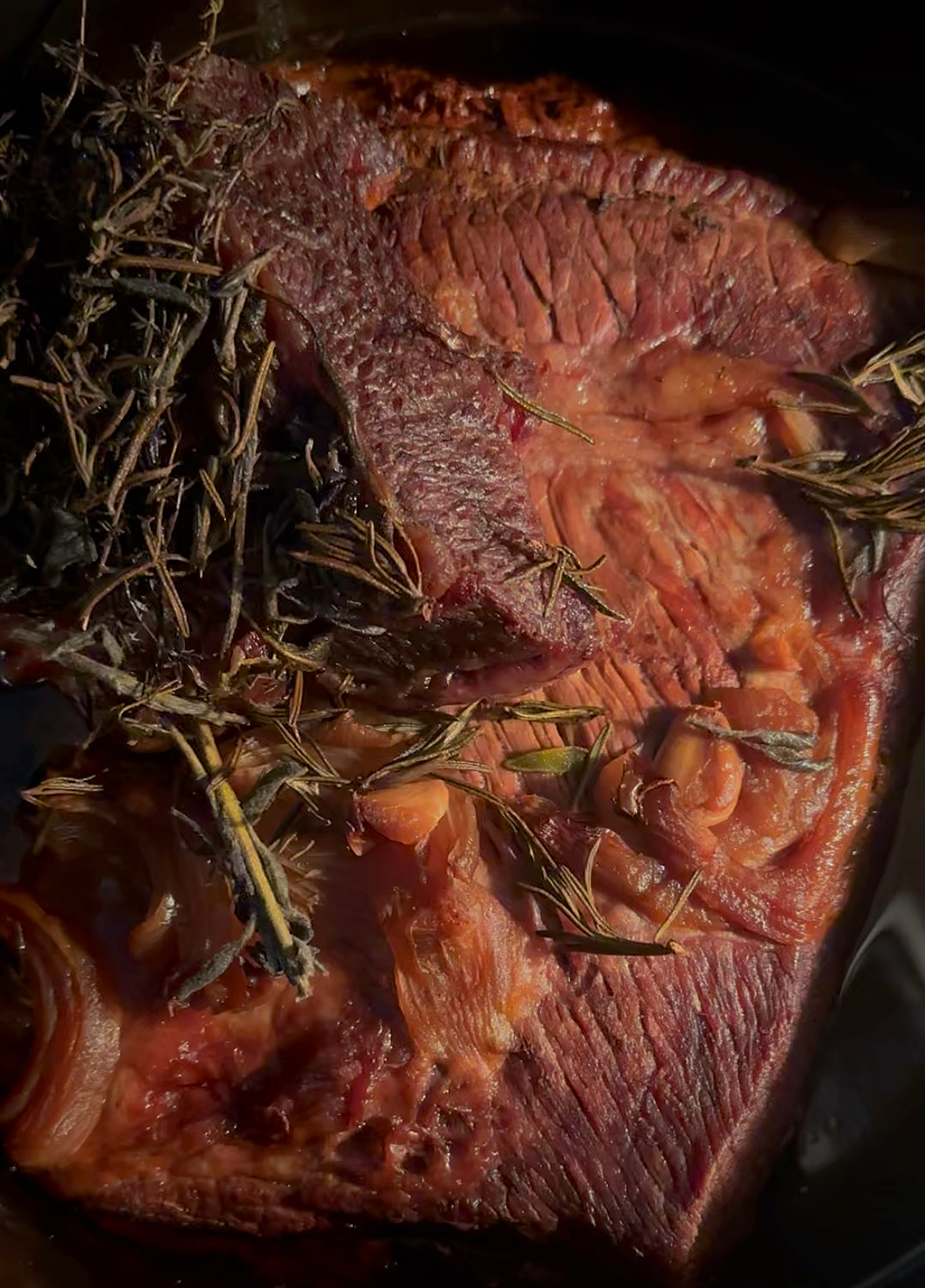
A holiday-table centerpiece, slow-braised in bone broth until fork-tender. Better the day after — and rooted in a tradition that spans Jewish, Sephardic, and Eastern European tables for centuries.
Season: Autumn · Winter
Cuisine: American-Jewish · Sephardic · Eastern European heritage
Yield: Serves 6–8 (best made a day ahead)
Active: 30 min Total: 4–8 hr (longer = more tender)
Best eaten: Sunday gathering or holiday dinner, 5–7 p.m.
Ingredients
For the brisket:
1 whole grass-fed beef brisket, ~5 lbs (point cut for richer fat marbling, flat cut for cleaner slicing — or a whole "packer cut" for both)
Sea salt and freshly cracked black pepper
3 tbsp grass-fed butter, ghee, or tallow
For the braising base:
2 cups yellow onions, finely diced
3 tbsp tomato paste, or 1 large tomato, seeded and chopped
1 tsp garlic, minced (save the rest of the head for the variation)
3 cups homemade beef bone broth (see notes on sourcing)
For the Sephardic / North African variation (optional):
1 lb sweet potatoes, cubed
2 carrots, chopped
½ cup unsulphured dried apricots
½ cup unsweetened pitted prunes
1 head garlic, halved horizontally
Spice rub options (choose one — or none):
Sephardic / North African rub:
2 tsp ground cumin
2 tsp smoked paprika
½ tsp ground coriander
½ tsp ground cinnamon
¼ tsp ground cardamom
¼ tsp freshly grated nutmeg
¼ tsp cayenne (or to taste)
1 tsp sea salt
½ tsp freshly cracked black pepper
Jamaican-inspired rub:
2 tsp ground allspice (the heart of jerk seasoning)
2 tsp smoked paprika
1 tsp ground ginger
1 tsp ground cinnamon
½ tsp freshly grated nutmeg
½ tsp ground cloves
¼ tsp cayenne (or up to 1 tsp for traditional heat)
1 tsp sea salt
½ tsp freshly cracked black pepper
Optional: 2 tsp finely chopped fresh thyme, 1 finely chopped scotch bonnet pepper (for the bold)
Or the simplest version: generous sea salt and freshly cracked black pepper, nothing more. Let the meat and braise speak.
Method
1. Salt the brisket the night before (recommended). Pat the brisket dry. Salt generously on all sides and refrigerate uncovered overnight. This is dry-brining — it pulls moisture into the meat fibers and produces dramatically better texture and seasoning. If pressed for time, salt at least 1 hour before cooking.
2. Apply the spice rub. 30 minutes before cooking, remove the brisket from the refrigerator. Mix the chosen spice rub and massage it into all surfaces of the meat. Let rest at room temperature while the oven preheats — bringing the meat closer to room temperature ensures more even cooking.
3. Preheat the oven to 300°F. Lower than the standard 325°F, but worth it. A slower braise produces silkier collagen breakdown and a more tender final result.
4. Sear the brisket. Heat butter, ghee, or tallow in a heavy Dutch oven (a Le Creuset or similar enameled cast-iron is ideal) over medium-high heat until shimmering. Sear the brisket 5–7 minutes per side until deeply, darkly browned — this is where the savory crust comes from. Don't rush. Transfer the brisket to a plate.
5. Build the braising base. In the same pot, sauté the onions 8–10 minutes until deeply golden, scraping up the browned bits from the bottom of the pot. Stir in the tomato paste and minced garlic. Cook 2–3 minutes until the tomato paste darkens slightly — this builds the umami foundation of the braise.
6. Begin the braise. Return the brisket to the pot, fat side up. Pour in the bone broth — the liquid should come about halfway up the side of the brisket, no higher. Too much liquid and you boil the meat instead of braising it; too little and it dries out.
7. Cover and transfer to the oven. Cook for 4–6 hours, basting every 45–60 minutes with the cooking liquid. Turn the brisket once halfway through. The longer the braise, the more fork-tender and melt-in-your-mouth the result — 6 hours is the sweet spot for a 5-lb brisket.
8. Add the fruit and vegetables (if using the variation). During the final 60–90 minutes, nestle the cubed sweet potatoes, chopped carrots, dried apricots, dried prunes, and the halved head of garlic around the brisket. Spoon some of the cooking liquid over them. The vegetables should be tender by the time the brisket is done; if they need more time, remove the brisket to rest and continue cooking the vegetables until soft.
9. Test for doneness. A fork should slide into the brisket with almost no resistance. If there's still pull, return to the oven for 30 more minutes. Don't rush this step.
10. Optional final broil for the charred crust. If you want a darker, more caramelized exterior, transfer the brisket to a roasting pan and broil 3–5 minutes on the top rack until the surface is deeply browned and the edges are crisping. Watch closely — it goes from perfect to burned in 60 seconds.
11. Rest the meat. Transfer the brisket to a cutting board and tent loosely with foil. Rest 20 minutes minimum — this is non-negotiable for proper slicing. Meanwhile, reduce the cooking liquid on high heat 8–10 minutes until slightly thickened, or skim the fat and serve as is.
12. Slice and serve. Always slice against the grain, in ¼-inch slices. Brisket has two distinct grain directions in the point and flat cuts — adjust your knife angle as you go. Return slices to the reduced sauce briefly to glaze, or serve the sauce alongside. Plate with the fruit and vegetables.
Getting the Charred Outside, Tender Inside
A few principles separate a good brisket from a great one:
Use a Le Creuset or other heavy enameled cast-iron Dutch oven. The thick walls hold low, even heat across the entire 4–6 hour braise — exactly what collagen needs to break down into gelatin. Thin pots create hot spots and uneven cooking.
Don't drown the meat. The liquid should reach roughly halfway up the brisket — no more. The meat above the liquid roasts and develops a darker crust; the meat below braises and becomes tender. Both are happening simultaneously, and that's the magic of a Dutch oven braise.
Baste every 45–60 minutes. A quick spoon of the cooking liquid over the exposed top surface keeps it moist while still allowing browning. Don't skip this — it's the difference between a good braise and a great one.
Finish with a broil if you want the charred edges. The slow braise produces tender meat and silky sauce, but not the deeply caramelized crust some traditions prize. A 3–5 minute broil at the end gives you both.
Make it the day before. This is genuinely better on day two. The flavors deepen, the fat solidifies on top of the cooking liquid for easy skimming, and the meat slices more cleanly when cold and re-warmed. If you're hosting, cook on Saturday for Sunday dinner.
Nourishment Notes
Brisket is a deeply traditional cut across many cultures — Jewish, Texan barbecue, Eastern European, Korean, Vietnamese — because long, slow cooking transforms a tough working muscle into one of the most flavorful and gelatin-rich preparations possible. Grass-fed beef brisket delivers heme iron, zinc, B12, B6, creatine, and complete protein in the most bioavailable forms, while the long braise extracts collagen and gelatin from the connective tissue. When consumed, gelatin breaks down into glycine, proline, and hydroxyproline — the connective-tissue amino acids that build the cellular structure of skin, joints, and gut lining. The modern diet of muscle meat alone runs chronically low in these compounds; a properly braised brisket restores the missing half.
Bone broth as the cooking liquid is structurally important. Quality bone broth — slow-simmered for 12+ hours from grass-fed bones — contains additional collagen, glycine, glutamine, and minerals that infuse into the brisket across the long braise. Using bone broth instead of water or commercial stock produces a dish that is structurally more nourishing and substantially deeper in flavor. The same principle anchors traditional Eastern European cholent, French pot-au-feu, and Korean seolleongtang.
The Sephardic dried fruit variation has roots in North African and Persian Jewish cooking, where the savory richness of the meat is paired with the concentrated sweetness of dried apricots and prunes — the same logic that drives Persian fesenjan and Moroccan tagines. Dried apricots add beta-carotene and potassium; prunes contribute polyphenols that traditional medicine has long associated with digestive support. Whole roasted garlic offers allicin's antimicrobial effects, mellowed by the long cook into a sweet, spreadable paste — and sweet potatoes contribute beta-carotene, fiber, and a gentle carbohydrate counterweight to the dense protein.
As a seasonal food, brisket belongs to the cold months, when the body's pull toward saturated fat and dense protein reaches its annual peak — and a long braise like this answers that ask completely. Holiday eating traditions across many cultures have understood this intuitively: the long-cooked, gelatin-rich, family-table dish is the right food for autumn and winter celebrations. Eaten earlier in the evening rather than late, the heavy protein and gelatinous fat stabilize blood sugar through the night without disrupting the body's cooling and melatonin curve.
Sourcing
Brisket: Look for 100% grass-fed, grass-finished brisket from a regenerative farm. White Oak Pastures (Georgia), Force of Nature, Alderspring Ranch, Belcampo, or U.S. Wellness Meats ship nationwide. Locally, ask your farmers' market butcher — many will order a whole brisket on request, and it's often less expensive than ground beef per pound. Avoid grain-finished or "grass-fed/grain-finished" hybrids.
Bone broth: Homemade is ideal — see the bone broth method in our slow-cooked beef stew recipe. If buying, look for Bonafide Provisions, Kettle & Fire, or Brodo in glass jars or pouches. Skip shelf-stable boxed broths, which are typically diluted and lack the gelling collagen content.
Bones for homemade broth: Same farms as the brisket sources, or your local Amish farm/butcher. Soup bones are typically a fraction of the cost of muscle meat.
Tomato paste: Bionaturae (Italian, in glass), Mutti (Italian, in tube — easier for small amounts), or Jovial. Avoid canned pastes lined with BPA or containing citric acid as a preservative.
Spices: Look for fresh, single-origin sources where possible. Burlap & Barrel (smoked paprika from Hungary, true cinnamon from Vietnam, Tellicherry pepper from Kerala), Diaspora Co. (cardamom, cumin, allspice from regenerative South Asian farms), or Spicewalla (allspice, smoked paprika, ginger). Skip mass-market grocery spice brands — they sit on shelves for months and lose their volatile oils, the compounds that carry flavor and bioactivity.
Dried fruit: Made in Nature or Sun Tropics for unsulphured apricots and prunes; local farmers' market sources when in season; Bella Viva Orchards for stone-fruit-region California dried fruit shipped fresh. Avoid commercial dried fruit, which is typically treated with sulfur dioxide, sugar-coated, or both.
Sweet potatoes and carrots: Local farmers' market or CSA pickup. Heritage varieties (Garnet, Beauregard, Japanese white sweet potato) carry more flavor and nutrient density than commercial. Look for orange-fleshed varieties for the highest beta-carotene content.
Garlic: Fresh whole heads from a farmers' market or local source — California-grown or your region's seasonal harvest. Avoid pre-peeled or jarred minced garlic (the flavor is fundamentally different and degrades quickly).
Cooking fat: Look for grass-fed butter (Kerrygold, Vital Farms, Organic Valley Pasture Butter), pasture-raised tallow (Fatworks, EPIC Provisions), or homemade ghee from grass-fed butter. Pure Indian Foods or Ancient Organics for shipped ghee.
Storage
Refrigerate up to 4 days — and the dish improves dramatically overnight. Reheat gently in the cooking liquid at 300°F or on the stovetop over low heat, covered. Freezes beautifully up to 3 months: slice the brisket fully cooled, layer in glass containers, and cover completely with cooking liquid before freezing. The liquid protects the meat from freezer burn and rehydrates it during thawing.
Why This Brisket
This is the dish that anchors the Sunday gathering, the holiday table, the family meal that takes hours to make and minutes to disappear. The hours of slow cooking are the point — they're the practice of slowing down, of preparing food the way our great-grandmothers did, of trusting that the kitchen labor of one cold afternoon will feed everyone you love and a few you didn't expect.
The cold-and-dark season asks the body for warmth, fat, depth, and time. A long-braised brisket is one of the body's most ancient answers — and one of the most generous things a kitchen can do.
Pairs Well With
Roasted vegetables (the classics):
Roasted Brussels sprouts — halved, tossed with grass-fed butter or tallow, sea salt, and a splash of raw apple cider vinegar; roasted at 425°F until the outer leaves are deeply caramelized and crisping. The slight bitterness cuts through the brisket's richness.
Roasted root vegetables — a mix of carrots, parsnips, rutabaga, turnips, and beets, tossed in tallow with rosemary and thyme, roasted at 400°F until the edges char. Heritage and seasonal varieties carry more flavor and nutrient density than supermarket standards.
Roasted winter squash — delicata (skin-on), kabocha, or honeynut squash, halved or sliced and roasted with butter, sea salt, and fresh sage. The natural sweetness echoes the dried fruit in the brisket.
Roasted cauliflower — broken into florets, tossed in ghee with cumin and smoked paprika, roasted until deeply browned. Pairs especially well with the Sephardic spice rub variation.
Creamy purées (for the holiday table):
Cauliflower purée — steamed cauliflower blended with grass-fed butter, raw cream, sea salt, and a clove of roasted garlic. A lighter, more digestible alternative to mashed potatoes that lets the brisket be the star.
Mashed sweet potatoes or yams — boiled or roasted sweet potatoes mashed with butter, a splash of bone broth, sea salt, and a grating of fresh nutmeg. The natural sweetness mirrors the dried fruit variation beautifully.
Celeriac purée — boiled celery root mashed with butter, cream, and sea salt. Subtle, elegant, and unexpectedly luxurious.
Mashed parsnips with brown butter — boiled parsnips mashed with browned butter and sea salt. Earthy, slightly sweet, and structurally a perfect partner to the brisket.
Bright, raw, and fermented elements (for balance):
Sauerkraut or fermented red cabbage — a generous spoonful alongside the meat. The acidity, probiotics, and crunch cut through the richness. Particularly traditional with Eastern European preparations.
Lacto-fermented cucumbers or kimchi — same principle: the brightness and live cultures balance the heaviness of the slow-cooked meat.
Watercress, arugula, or bitter greens salad — dressed simply with extra-virgin olive oil, lemon juice, sea salt, and a shaving of raw Parmigiano. The peppery, bitter notes are exactly what the palate wants alongside dense braised meat.
Pickled red onions — quick-pickled in raw apple cider vinegar with a pinch of salt and a teaspoon of raw honey. Elegant, easy, beautiful on the plate.
Grain or starch options (if grain is in your practice):
Sprouted sourdough — a thick slice for sopping up the rich braising sauce. Genuinely sprouted, traditionally fermented from a local baker.
Wild rice pilaf — wild rice cooked in bone broth with sautéed onions, mushrooms, and toasted pecans. A traditional Eastern European pairing.
Mashed potatoes with butter and bone broth — the classic. Use Yukon Gold or heritage varieties; mash with abundant butter and a splash of warm bone broth instead of milk.