Strawberries and Cream Cupcakes
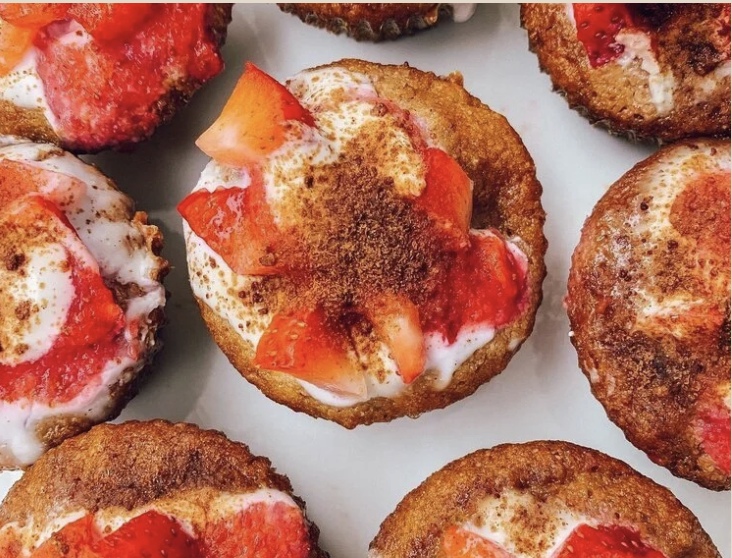
Almond-Coconut Flour Strawberry Cupcakes with Raw Cream Frosting
The grain-free, refined-sugar-free summer cupcake — almond-coconut-flour base, real cream frosting, fresh strawberry sauce, fresh berries on top.
Season: Late spring through early summer (peak strawberry window)
Cuisine: American · Grain-free
Yield: 12 cupcakes
Active: 25 min · Total: 1 hr
Best eaten: Early afternoon
There is a specific ten-day window each year when local strawberries are genuinely at their peak — usually late May through early June in temperate climates, slightly earlier in Florida or Southern California. Within that window, a strawberry tastes like nothing the rest of the year ever produces: deeply red all the way through (no white inside), fragrant from across the room, sweet without being cloying (excessively sweet), with the faint floral acidity that defines a real ripe berry. Outside that window, supermarket strawberries are a different food entirely — pale-fleshed, hollow, often picked weeks before peak ripeness and ripened in transit, with about a third of the polyphenol density of a peak-season berry.
This cupcake is built for that window. The base is a grain-free almond-coconut-flour cake — light enough to hold the cream frosting, substantial enough to anchor the berries. The frosting is real: grass-fed butter and raw cream (or cream cheese), whipped with a touch of raw honey and vanilla — not a sugar-and-shortening icing. The strawberry sauce is just berries reduced with lemon — no thickeners, no refined sugar, just the natural pectin of the fruit producing a glossy, vibrant red glaze. Topped with fresh sliced berries, a sprinkle of Ceylon cinnamon, and an optional dusting of coconut sugar.
Made well, this is the cupcake that makes a child's birthday or a spring brunch feel celebratory without delivering a sugar crash.
Ingredients
For the cupcakes:
2 cups raw almond flour
2 tbsp coconut flour
¼ tsp sea salt
½ tsp baking soda
3 pasture-raised eggs
⅓ cup raw, A2 whole milk (or full-fat coconut milk for dairy-free)
3 tbsp grass-fed butter or coconut oil, melted
½ cup pure maple syrup
1 tsp pure vanilla extract
optional: dash of ceylon cinnamon
For the strawberry sauce:
1 pint local, peak-season strawberries, hulled and sliced
Juice of ½ organic lemon
1 tbsp raw honey (optional — peak-season berries usually don't need it)
For the cream frosting:
1 stick (½ cup) grass-fed butter, softened
½ cup raw, grass-fed cream (or coconut cream for dairy-free, or raw cream cheese for tang)
1–2 tbsp raw honey
½ tsp pure vanilla extract
Pinch sea salt
To finish:
Fresh sliced strawberries
A light sprinkle of Ceylon cinnamon
Optional: a light dusting of coconut sugar
A note on dairy: A2 milk (or sheep's or goat's milk) is preferred for those sensitive to conventional cow dairy. Coconut milk works well in the batter and makes the cupcakes dairy-free; pair with coconut cream in the frosting for a fully dairy-free version.
Method
1. Preheat and prepare. Preheat the oven to 350°F. Line a 12-cup muffin tin with parchment cups, or grease well with butter or coconut oil.
2. Mix the dry ingredients. In a large bowl, whisk together the almond flour, coconut flour, sea salt, and baking soda.
3. Mix the wet ingredients. In a separate bowl, whisk the eggs, milk, melted butter, maple syrup, and vanilla until smooth.
4. Combine. Pour the wet ingredients into the dry and stir until just incorporated — don't overmix. Spoon evenly into the muffin tin, filling each cup about ¾ full.
5. Bake. 22–25 minutes, until a toothpick inserted in the center comes out clean and the tops are lightly golden. Cool completely on a wire rack before frosting — about 30 minutes. Warm cupcakes will melt the frosting.
6. Make the strawberry sauce. Combine sliced strawberries and lemon juice in a small saucepan over low heat. Cook gently 8–10 minutes, mashing slightly with a fork, until syrupy and the natural pectin thickens the liquid into a glaze. Add honey only if more sweetness is desired. Cool to room temperature before using.
7. Whip the frosting. In a stand mixer or with a hand mixer, whip the softened butter alone for 1–2 minutes until pale and fluffy. Add the cream (or cream cheese) and whip another 2–3 minutes until light and structurally stable. Beat in the honey, vanilla, and salt.
8. Assemble. Once cupcakes are completely cool, smear frosting on top using a small offset spatula or pipe with a star tip for a more formal presentation. Spoon the strawberry sauce over the frosting, allowing it to drip down the sides slightly. Finish with fresh strawberry slices, a sprinkle of Ceylon cinnamon, and an optional dusting of coconut sugar.
Variation: Strawberry Shortcake-Style Cupcakes
For a deconstructed shortcake feel — a Sweet Laurel-inspired filled version where the strawberry sauce and cream live inside the cupcake instead of on top:
Method changes:
Bake the cupcakes as directed and cool completely.
For the strawberry sauce, skip cooking. Blend 1 cup of fresh strawberries with 2 tbsp raw honey and the juice of 1 lemon in a food processor until smooth — this preserves the fresh-berry top notes that cooking would dull.
Slice the top off each cooled cupcake. Spoon a generous tablespoon of fresh strawberry sauce onto the cut surface, top with a dollop of whipped raw cream (or whipped coconut cream), and add a few quartered fresh strawberries.
Replace the top of the cupcake gently. Serve immediately or refrigerate up to 4 hours before serving.
This variation is the right move for a more elegant presentation — beautiful when split open at the table, with the cream and berry visible inside.
Nourishment Notes
This is a whole-food rebuild of a classic dessert, and the upgrade across every ingredient is meaningful. Almond flour replaces wheat flour with a much lower glycemic load and a substantial contribution of vitamin E (specifically alpha-tocopherol), magnesium, and monounsaturated fats. Coconut flour — used in small amount here — contributes additional fiber and structural lift. Pasture-raised eggs add choline (essential for liver function and acetylcholine synthesis), preformed retinol (vitamin A in its directly bioavailable form), and the carotenoids lutein and zeaxanthin that concentrate in retinal photoreceptors. Raw, A2 dairy — when accessible — preserves the lipase enzymes, butyric acid, and full fat-soluble vitamin profile that pasteurization and homogenization compromise. Pure maple syrup and raw honey replace refined sugar with sweeteners that retain trace minerals (manganese, zinc, calcium in maple; antimicrobial enzymes and pollen polyphenols in raw honey).
Strawberries themselves are a quietly potent fruit. They carry anthocyanins (the deep red pigment), ellagic acid (a polyphenol with documented anti-inflammatory and anti-mutagenic effects), and one of the highest vitamin C concentrations of any common berry — meaningfully supporting collagen synthesis and iron absorption from any iron-rich foods consumed alongside. Strawberries also contain trace amounts of salicylic acid, the same compound that's the active ingredient in aspirin in synthetic form, contributing to their mild anti-inflammatory profile. Peak-season local strawberries vs. supermarket strawberries is not a marginal distinction: a peak-season berry has roughly three times the vitamin C content, five times the polyphenol load, and dramatically higher concentrations of the volatile aromatic compounds that produce the characteristic strawberry smell and flavor. This is why this cupcake is genuinely seasonal — the same recipe made with off-season berries reads as "fine dessert"; made with peak berries, it reads as "the best cupcake of the year."
The fat in the frosting and cake matrix slows the glycemic response of the natural sugars considerably. Compared to a conventional vanilla cupcake with buttercream, this version delivers a fraction of the sugar load and a fraction of the seed-oil exposure — commercial buttercream is typically built on hydrogenated soybean oil and refined cane sugar; this frosting is built on grass-fed butter, raw cream, and raw honey. The K2 in grass-fed butter directs calcium where it belongs; the butyrate feeds gut lining; the fat-soluble vitamins ride into circulation alongside the natural sugars. A small cupcake genuinely satisfies — the substantial protein from the eggs and almond flour, plus the dense fat from the butter and cream, anchors the natural sweetness and prevents the spike-and-crash pattern that defines a conventional cupcake.
As a circadian and seasonal food, this is early-afternoon eating at its best. The body's insulin response is most graceful in the early afternoon, and the anthocyanin-rich strawberries pair beautifully with peak solar exposure — both peaking in the same hours, the body's circadian rhythm aligning with the dessert's polyphenol load. Late spring through early summer is the right window. Make this for a child's spring birthday, a Mother's Day brunch, a graduation, or any late-spring gathering that asks for a celebration cupcake without the conventional sugar load.
Sourcing
Strawberries: Local farmers' market or PYO (pick-your-own) farm during peak season — the only way to get true peak-quality berries. Driscoll's Sweetest Batch is the most acceptable supermarket option when farmers' market access isn't available. Avoid commercial strawberries from Florida or California in winter — they're picked weeks before peak ripeness and have a fraction of the polyphenol load. Heritage varieties (Mara des Bois, Tristar, Seascape, Albion) carry significantly more flavor than commercial Camarosa.
Almond flour: King Arthur super-fine almond flour, Anthony's Goods (organic, blanched), or Bob's Red Mill (super-fine). Look for blanched, finely ground for the smoothest cake texture — coarse-ground almond meal works but produces a denser, more rustic crumb. Avoid almond flour with rancid almonds — smell before using; it should smell sweet and faintly almond-like, never bitter or stale.
Coconut flour: Bob's Red Mill organic, Nutiva organic, or Anthony's Goods. Look for fresh, finely ground.
Eggs: Pasture-raised from a local farm or Vital Farms Pasture-Raised if shopping conventionally. The yolks should be deeply orange, almost red — the color signals carotenoid density from real foraging.
Raw A2 dairy: Alexandre Family Farm (regenerative, A2/A2 Jersey cows), Organic Pastures (California, raw), or Raw Farm USA for shipped raw dairy. Locally, raw milk co-ops or herd shares where legal. For raw cream cheese, Organic Pastures or local raw dairy where available; otherwise, full-fat conventional cream cheese from grass-fed cow milk (Vermont Creamery, Kalona SuperNatural).
Grass-fed butter: Vital Farms, Organic Valley Pasture Butter, or Kalona Organic in spring/summer when grass content is highest.
Maple syrup: Grade A dark or amber from a small Northeastern producer — Crown Maple, Sap! Maple, Coombs Family Farms, or local farmers' market sources. Avoid "pancake syrup" (corn syrup) and brands with artificial caramel coloring.
Raw honey: Local apiarist whenever possible — local honey carries pollen profiles unique to your region. Really Raw Honey, Bee Raw, or Savannah Bee Company for shipped raw honey. Avoid grocery-store honey that lists multiple country origins (often ultra-filtered and adulterated).
Vanilla extract: Heilala Vanilla, Singing Dog Vanilla, or Nielsen-Massey for true Madagascar or Tahitian vanilla bean extracts. Skip imitation vanilla, which is typically synthesized from petroleum byproducts.
Ceylon cinnamon: Burlap & Barrel Royal Cinnamon, Frontier Co-op Ceylon, or Diaspora Co. Pragati turmeric chain (also offers cinnamon). The "true" cinnamon — softer, sweeter, lower in coumarin than the more common cassia variety.
Coconut sugar (optional finish): Big Tree Farms, Madhava, or Wholesome organic coconut sugar.
Storage
Frosted cupcakes keep refrigerated up to 3 days. The strawberry sauce on top will continue to release juice slowly into the frosting over time — this is fine but means the cupcakes are most beautiful within 24 hours of assembly. Unfrosted cupcakes freeze well up to 1 month — frost just before serving. Strawberry sauce keeps 5 days refrigerated and is excellent on its own over yogurt, ice cream, or pancakes the next morning. The cream frosting holds 4 days refrigerated; let it come to room temperature 20 minutes before re-whipping for best texture.
Pairs Well With
A pot of fresh-brewed loose-leaf tea — peppermint, chamomile, or a green sencha — for afternoon tea presentation. A glass of raw, A2 whole milk for children. A small pour of homemade kombucha (strawberry or lemon-ginger) for adults who want something effervescent. A platter of additional fresh whole berries — a mix of strawberries, raspberries, and blackberries — alongside the cupcakes for a more abundant spring dessert table.
For a brunch context: pair with a frittata or shakshuka, a crisp green salad with edible flowers, and a pitcher of fresh-pressed orange juice cut with sparkling water.
Why This Cupcake
The conventional cupcake is one of the most engineered foods in the modern American diet — refined wheat flour, hydrogenated industrial fats, refined cane sugar, artificial colors, synthetic vanillin, and shelf-stable shortening icings that bear no relationship to actual cream. A child eats one and crashes within an hour. A small celebration becomes an afternoon of regulation problems.
This cupcake is the revamped, healthier version. Almond and coconut flour. Pastured eggs and raw A2 dairy. Maple syrup and raw honey instead of refined sugar. Real cream and cultured butter instead of shortening. Fresh peak-season strawberries reduced with lemon — no thickeners, no preservatives, no engineering. A child eats one and is satisfied without the crash. A celebration stays a celebration without the regulation cost.
This is what dessert can be when you actually want to nourish the people you're celebrating with. The seasons were never optional. The peak strawberry window is short — make this when the berries are at their peak, and you will have made the best cupcake of the year.