Beef Tenderloin Roulade with Wild Mushrooms, Olives & Greens
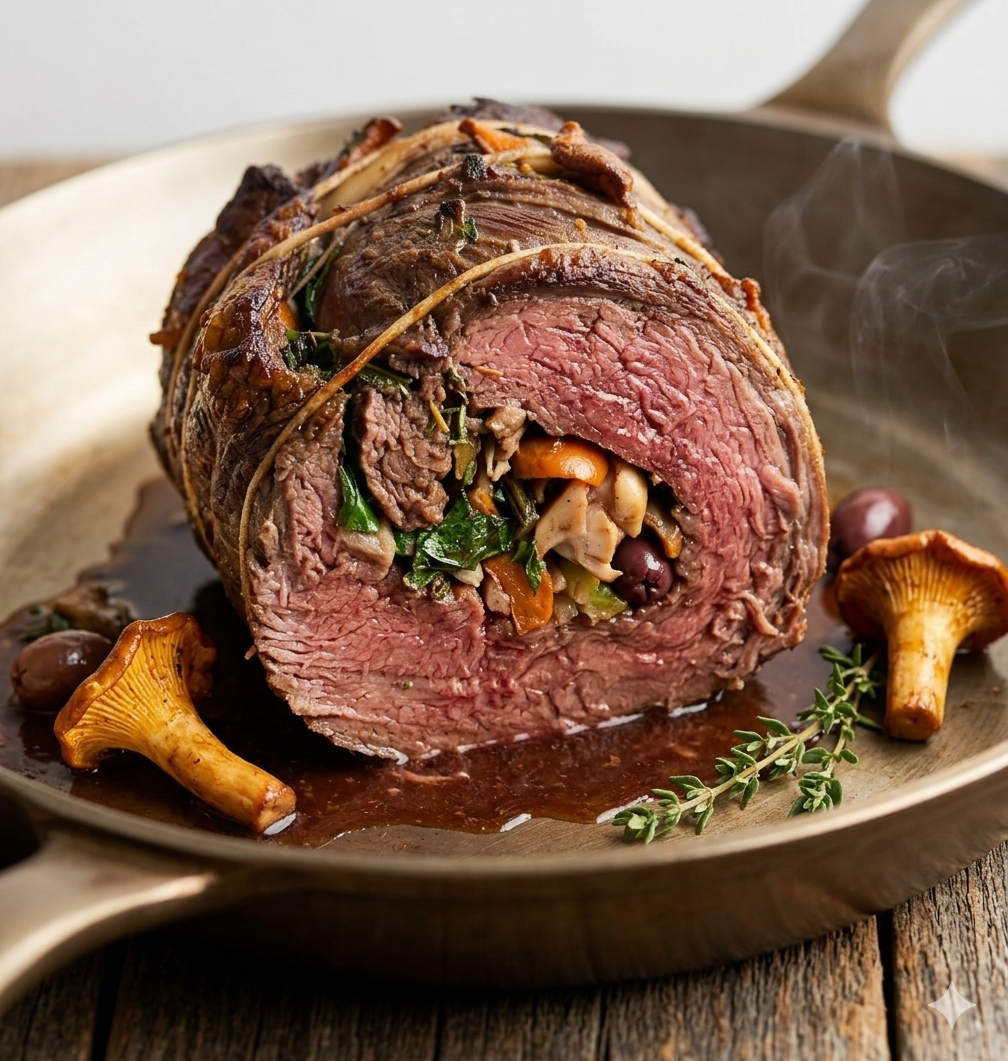
Pasture-raised tenderloin rolled around a Mediterranean filling.
Season: Year-round (especially autumn–winter holidays)
Cuisine: Mediterranean · American Farmhouse
Yield: Serves 5
Active: 30 min · Total: 1 hr 15 min
Best eaten: late afternoon or early evening
Ingredients
Beef
2 lb pasture-raised beef tenderloin
Sea salt and freshly ground black pepper (be liberal)
Butcher's twine
Filling
2-inch stick of raw, grass-fed butter (about 4 tbsp), for the sauté
1 shallot, finely diced
2–3 cloves garlic, minced
1 cup wild mushrooms (chanterelle, oyster, maitake, or mixed), sliced
½ red bell pepper, diced (or jarred roasted red peppers, drained and chopped)
1 cup spinach, chopped
½ cup kalamata olives, pitted and chopped
1 sprig fresh rosemary, leaves only, finely chopped
3 sprigs fresh thyme, leaves only
A handful of arugula
Optional: ¾ cup raw gorgonzola or goat cheese, crumbled
Finishing
¼ cup raw apple cider vinegar (or red wine)
Additional sea salt for finishing
To Serve — fresh herb green pesto · a bed of arugula · raw Dutch camembert · Dijon mustard
Method
Preheat the oven to 425°F.
Sauté the filling. Heat the butter in a large cast-iron skillet over medium heat. Add the shallot and garlic; cook 2 minutes until fragrant. Add the mushrooms and cook 5–6 minutes until they release their water and brown lightly. Add the bell pepper and cook 2 more minutes. Stir in the spinach, olives, rosemary, and thyme; cook just until the spinach wilts. Season with salt. Remove from heat and let cool slightly. Stir in the gorgonzola or goat cheese if using.
Butterfly and pound. Place the tenderloin on a clean cutting board. Butterfly it open lengthwise, cutting nearly through but not all the way, so it opens like a book. Cover with parchment or plastic wrap and pound gently with a meat mallet or heavy pan to flatten to a roughly even thickness — aim for about ¾-inch thick. Season liberally with sea salt on both sides.
Stuff and roll. Spread the cooled filling evenly across the surface of the meat, leaving a 1-inch border on the long sides. Add a handful of fresh arugula across the top. Roll up tightly from one long edge, ensuring the veggies don't escape (some will — tuck excess filling back into the roll as you go).
Tie. Wrap butcher's twine around the roll at 1-inch intervals, keeping the roll tight and the shape uniform.
Roast. Place the roulade seam-side-down on a parchment-lined sheet pan. Roast 30 minutes at 425°F.
Glaze and finish. Remove from the oven and drizzle the apple cider vinegar (or red wine) over the top; sprinkle with additional sea salt. Return to the oven for 10 more minutes.
Broil 5 minutes before serving for a deeply caramelized finish.
Rest 10 minutes tented loosely with foil before slicing.
Plate. Slice into 1-inch pinwheels, revealing the green-and-mahogany filling. Arrange over a bed of fresh arugula. Serve with herb green pesto, raw camembert alongside, and small dishes of Dijon mustard. Remove the twine before serving.
Nourishment Notes
Pasture-raised, grass-finished beef tenderloin is the leanest and most tender cut on the cow — the long muscle that runs along the underside of the spine, doing minimal work and therefore developing minimal connective tissue. Grass-finished beef carries meaningfully more omega-3 fatty acids, conjugated linoleic acid (CLA), beta-carotene, and vitamin E than grain-finished beef; its iron, zinc, B12, and creatine content is exceptional regardless of finishing method. The tenderloin specifically is the showpiece cut — what you serve when the occasion warrants the most expensive cut on the animal. Look for "grass-finished" rather than "grass-fed" on the label; the second usually means grass-raised but grain-finished in the final weeks, which changes the fat composition meaningfully. Wild mushrooms (chanterelle, oyster, maitake) are the editorial element of the filling — wild fungi carry vitamin D (a rare plant source, formed when mushrooms are exposed to UV light), beta-glucans (immune-supporting polysaccharides studied for their effect on macrophage activity), ergothioneine (a unique antioxidant amino acid), and the umami compounds that deepen the meat's own savoriness. Cultivated cremini and portobello work if wild aren't available, but the flavor and the bioactive compound profile are meaningfully different.
Kalamata olives bring oleic acid (the dominant monounsaturated fat that defines Mediterranean cooking), polyphenols (hydroxytyrosol, oleuropein) studied for cardiovascular and anti-inflammatory effects, and the salt-cured fermentation that traditional Mediterranean kitchens relied on for both preservation and flavor. Real kalamata olives are brine-cured rather than lye-cured — read the label; lye-cured olives lack the polyphenol depth. Spinach and arugula together provide a substantial chlorophyll load alongside vitamin K1, folate, magnesium, and the nitrates that traditional Mediterranean diets depend on for cardiovascular support. Raw, grass-fed butter — the cooking fat for the sauté — contributes butyrate (the short-chain fatty acid that feeds gut-lining cells) and the fat-soluble vitamins A, D, E, K2-MK4. Fresh rosemary and thyme together bring carnosic acid, rosmarinic acid, and thymol — Mediterranean polyphenols that protect the meat's fragile fatty acids during cooking and support the body's own oxidative defense systems.
As a circadian and seasonal food, this is celebration dinner, ideally timed for late afternoon or early evening rather than late at night. A rich, protein-dense roast metabolizes more cleanly during peak daylight hours, when digestive capacity is highest. Year-round in the strict sense, but particularly suited to autumn and winter holiday gatherings — the Mediterranean filling's wild mushrooms, dark olives, and warming herbs match what cold-weather tables traditionally offered, and the celebration nature of a stuffed tenderloin earns its place at a holiday meal. The herb pesto and raw camembert accompaniments lighten the plate; serve with substantial greens to balance.
Storage: leftovers keep 3 days refrigerated. Cold sliced roulade over salad with the herb pesto is a genuinely beautiful next-day lunch — better than reheating, which can dry the lean meat. For a gathering of 10, double the recipe and prepare two roulades; tenderloin is best cooked in batches under 3 lbs each for even doneness.