Visiting the World's Best Anchovies & Ways to Cook and Eat Them
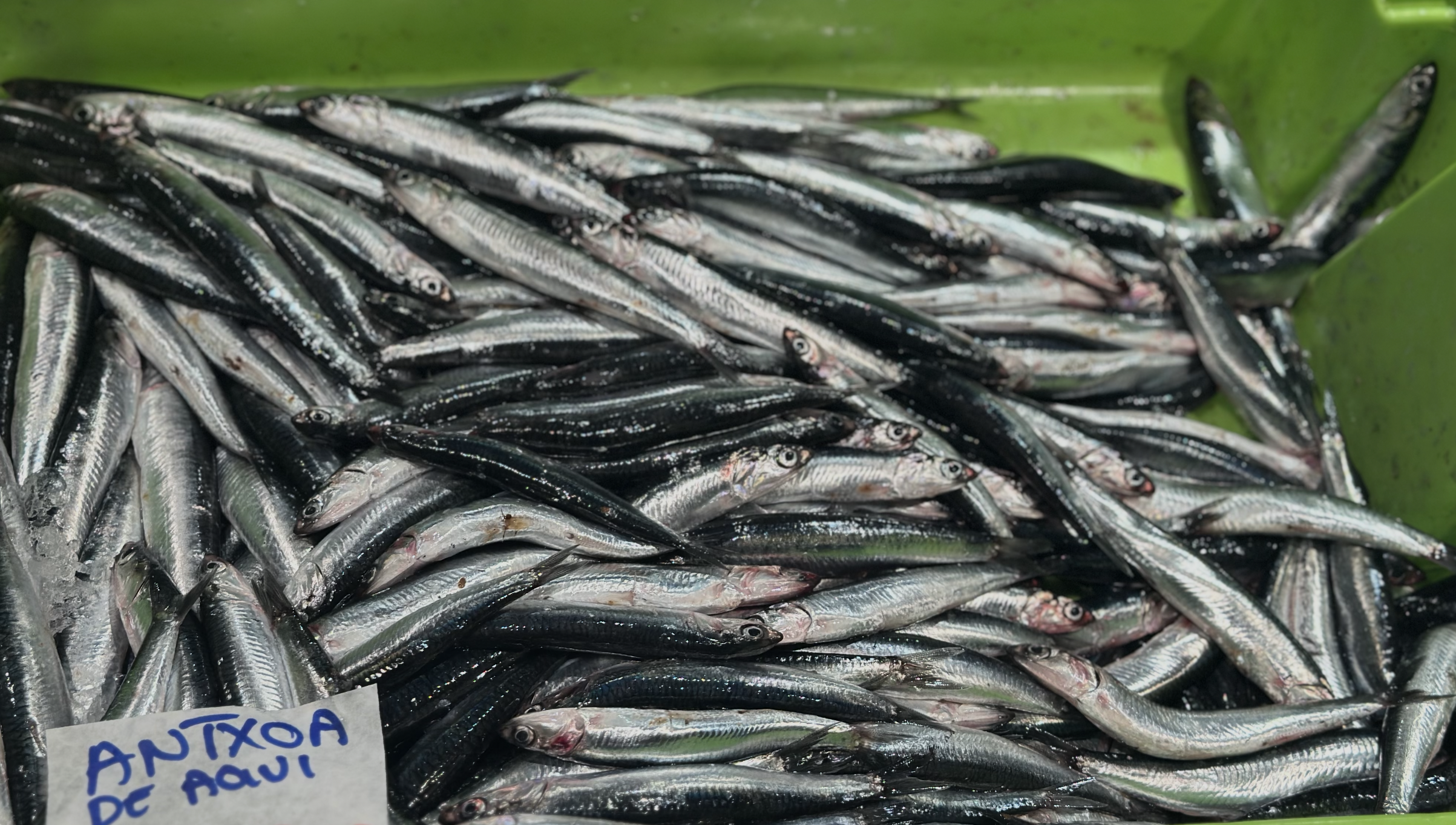
Santoña, Spain — the small Cantabrian fishing village where the world's most respected anchovies are hand-filleted by women who have been doing this work for generations. Plus traditional and creative ways to eat them, with full sourcing guidance for the home cook.
Properly sourced, anchovies are dramatically more nutrient-dense than almost any other animal protein — high in marine omega-3 fatty acids, bioavailable calcium from the small bones, vitamin D, B12, selenium, iodine, and the kind of trace minerals that the body deeply recognizes as ocean-source nourishment.
This isn't the salty, sliver-thin pizza-topping anchovy that gave anchovies a bad American reputation. Real Cantabrian anchovies are buttery, deeply mineral, almost meltingly soft, with a clean ocean flavor that's structurally distinct from anything you've had from a generic supermarket can.
Visiting Santoña — Where the World's Best Anchovies Are Made
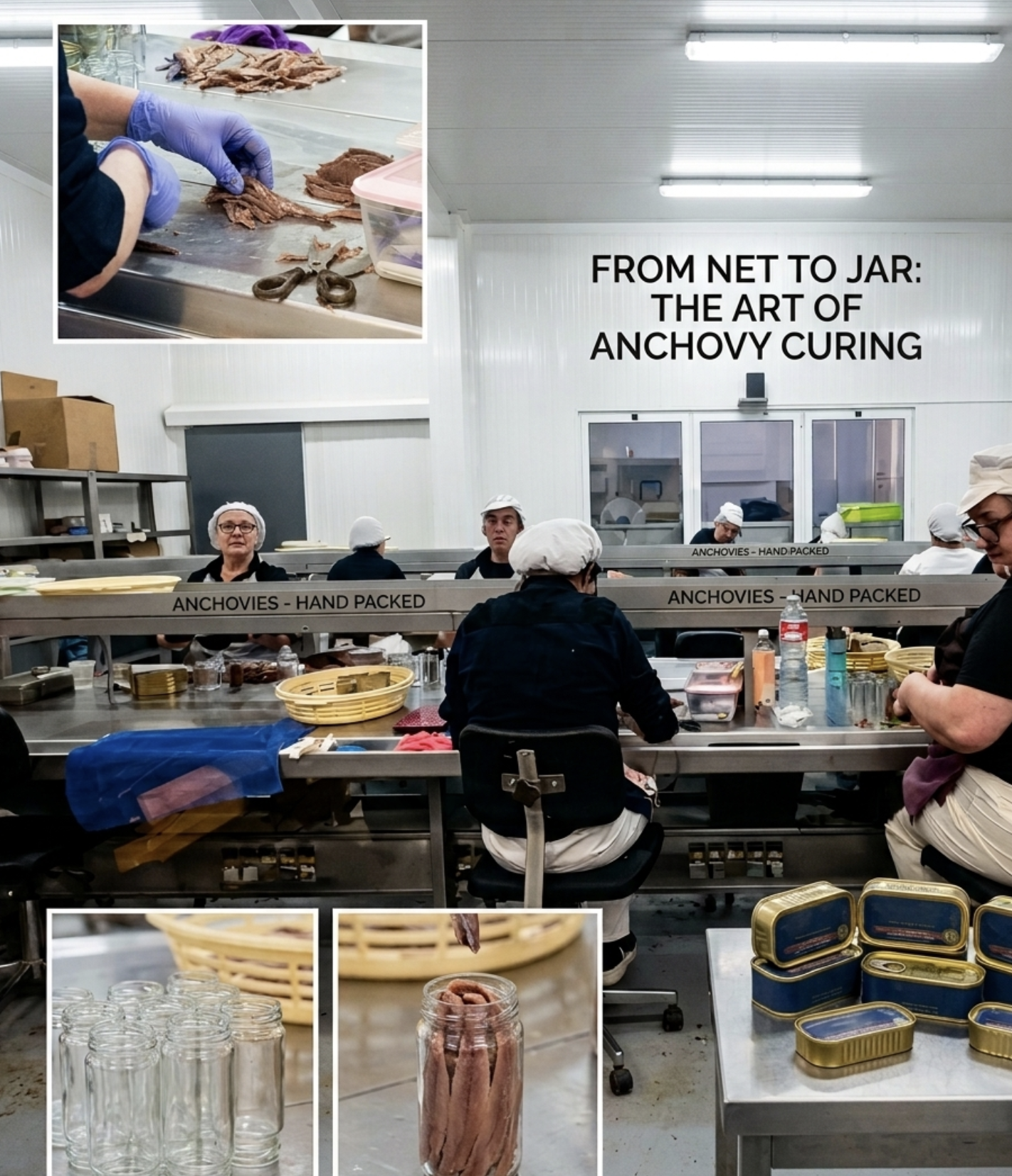
Santoña is a small fishing village on the Cantabrian coast of northern Spain, tucked into a natural harbor between Bilbao and Santander. The town's economic and cultural identity is anchored in one thing: the spring anchovy harvest. As you walk through the town it smells of anchovies!
Every April and May, when the bocartes (Engraulis encrasicolus) migrate through the Cantabrian Sea, the entire town shifts into harvest mode. Boats come in heavy with fish. The processing plants — small family-run fábricas alongside larger producers — work around the clock to clean, salt-cure, and pack the year's supply.
Cantabria is the region that anchors the central Spanish north coast — sitting between the Basque Country to the east and Asturias to the west. More rustic and dairy-oriented than the Basque coast, the region balances four distinct food traditions: the anchovy culture of the Atlantic coast (Santoña, Laredo, Castro Urdiales), mountain cattle and pastoralism in the inland valleys, creamy cow cheeses from the lush dairy land, and cave-aged blue cheeses like Picón Bejes-Tresviso. The anchovy tradition serves as the structural anchor that ties the region to the sea.
I went to the exact place where the harvest happens and visited the fábrica where the work actually gets done.
What you see when you walk in is a long room filled with women at stainless steel tables, each one with a small knife and a pile of salt-cured anchovies in front of her. They work fast — a fillet every few seconds. One woman peels away the skin with her thumbnails. Another removes the central spine bone and separates each fillet. A third lays them carefully into trays. A fourth aligns them in tins or glass jars. The technique hasn't been replicated by a machine — hecho a mano — made by hand.
Not all quality control is the same, and not all producers are honest. Some companies labeled “Cantabrian anchovies” don't use top-tier fish. Some use smaller, lower-grade catches and market them at premium prices. Some companies are more trustworthy and transparent about their sourcing; others are not. And there is a quieter, more troubling industry practice that almost no American consumer knows about: Some producers lace their olive oil with seed oils and still call them “anchoas en aceite de oliva.” Soybean oil, sunflower oil, and other industrial seed oils are sometimes mixed into the packing oil — sometimes the entire packing medium is industrial seed oil with a small amount of olive oil added to justify the label. This is part of why anchovy quality varies so dramatically from brand to brand even within “premium” categories. A good way to know if you truly are consuming EVOO is if it is left in the fridge, it will solidify.
The Nutritional Truth About Anchovies
Anchovies are structurally one of the most nutrient-dense foods on Earth — and one of the most criminally underused proteins in modern American eating. Here is what's actually in a single 3.5-oz serving:
Marine omega-3 fatty acids (DHA and EPA). Anchovies deliver approximately 1.5–2 grams of long-chain marine omega-3 per 3.5-oz serving — among the highest concentrations of any food. DHA is the primary structural fat of the human brain and retina; EPA carries documented anti-inflammatory effects. Eating anchovies twice a week delivers more usable DHA/EPA than nearly any other dietary strategy, including salmon and most omega-3 supplements. The omega-3 in whole-fish anchovies is structurally bioavailable, embedded in the food matrix rather than extracted and oxidized in capsule form.
Vitamin D. Anchovies are one of the few non-fortified foods that delivers meaningful vitamin D — approximately 65 IU per oz. The vitamin D in oily fish is structurally synergistic with the marine omega-3s and the fat-soluble vitamins A and K2 that occur in the same fish. Vitamin D supports bone health, immune function, mood regulation, and the expression of over 200 genes throughout the body.
Vitamin B12. Anchovies deliver about 9 micrograms of B12 per 3.5-oz serving — over 350% of the recommended daily intake. B12 is critical for nervous system function, red blood cell production, methylation, and DNA synthesis. Plant-based diets struggle to deliver bioavailable B12; small oily fish deliver it abundantly.
Bioavailable calcium (from the small bones). This is what makes anchovies structurally a uniquely complete food. When you eat the entire small fish — including the soft, tiny bones that have softened during cure — you consume approximately 230 mg of bioavailable calcium per 3.5-oz serving. Unlike isolated calcium supplements, the calcium in anchovy bones comes embedded in the protein matrix and accompanied by phosphorus, vitamin D, magnesium, and vitamin K2 — the structural cofactors that the body actually needs to deposit calcium into bone tissue rather than soft tissue.
Selenium. Anchovies are one of the densest food sources of selenium — about 36 micrograms per 3.5-oz serving (over 65% of the recommended daily intake). Selenium is one of the minerals most commonly deficient in modern diets, particularly in inland populations far from ocean ecosystems. Selenium supports thyroid function, immune defense, and the body's primary antioxidant systems (glutathione peroxidase).
Iodine. As with all ocean fish, anchovies deliver bioavailable iodine — critical for thyroid function and chronically under-consumed in non-coastal populations who don't eat sea vegetables.
CoQ10, taurine, complete protein. Like other oily small fish, anchovies deliver these specific compounds that support cardiovascular health, mitochondrial function, and cellular energy production. A 3.5-oz serving contains about 28 grams of complete protein with all essential amino acids.
The structural advantage of small fish. Anchovies sit at the very base of the marine food chain, eating plankton and microalgae. They live only 2–3 years, consume simple food, and accumulate almost none of the mercury, PCBs, dioxins, and microplastic contamination that plague larger predatory fish (tuna, swordfish, shark, larger salmon). Eating anchovies twice a week delivers the nutritional benefits of fish consumption without the contamination burden. This is why traditional coastal cultures across the Mediterranean, Spain, Portugal, southern France, and Italy have always centered small oily fish — not just out of economic necessity, but because the small-fish approach is genuinely the cleanest, most nutrient-dense way to eat from the sea.
Anchovies as one of the most economical real foods. Here is one of the great structural ironies of modern eating: one of the most nutrient-dense foods on Earth is also genuinely affordable. A 1.75-oz jar of high-quality Cantabrian anchovies costs roughly the same as a single grass-fed steak — but delivers omega-3, B12, calcium, vitamin D, and selenium in concentrations that match or exceed almost any other food category. The industrial food culture has trained American consumers to pay premium prices for less-nutrient-dense fish, while the small oily fish that deliver the most complete nourishment remain comparatively accessible. Eating anchovies regularly is one of the most economical ways to deliver the nutritional density of a premium ancestral diet — and it's one of the most accessible "superfood" strategies that exists.
Recipes with anchovies
Anchovies Wrapped with Idiazábal Cheese and Apricot Compote
A classic Basque pintxo — preserved anchovies wrapped around aged Idiazábal smoked cheese, served with a sweet-savory apricot or apple compote. A deliciously balanced salty-sweet-smoky combination.
Yield: 12 pintxos · Active: 15 min · Total: 30 min
Ingredients
For the pintxos:
12 high-quality preserved anchovies (Cantabrian)
3 oz Idiazábal cheese (smoked Basque sheep cheese), sliced into 12 small wedges (if Idiazábal is unavailable, substitute with aged Manchego, aged Mahón, smoked Gouda, or any aged smoked sheep cheese)
12 toothpicks or small skewers
Fresh chives or parsley sprigs for garnish
For the apricot compote (summer — July–August):
1 cup fresh apricots, halved and pitted
2 tbsp raw honey
1 tbsp fresh lemon juice
¼ tsp Ceylon cinnamon (optional)
Pinch of sea salt
For the apple compote (autumn/winter alternative):
2 medium tart apples (Granny Smith, Pink Lady, or heritage variety), peeled and diced
2 tbsp raw honey
1 tbsp fresh lemon juice
¼ tsp Ceylon cinnamon
Pinch of sea salt
Method
Make the compote. Combine all the compote ingredients in a small saucepan over medium-low heat. Cook 10–15 minutes, stirring occasionally, until the fruit has softened and the mixture has thickened to a jammy consistency. Cool completely.
Prepare the pintxos. Wrap each anchovy fillet around a wedge of Idiazábal cheese. Secure with a toothpick or small skewer.
Plate. Spoon a small dollop of compote on each pintxo or arrange the compote alongside in a small ramekin for dipping. Garnish with fresh chives or parsley.
Serve immediately at room temperature.
Variations
With fig compote (August–October): Substitute fresh halved figs cooked with honey and lemon.
With cherry compote (May–July): Substitute pitted cherries with honey, lemon, and a pinch of cinnamon.
With piquillo pepper: Add a small piece of jarred piquillo pepper to each skewer for color and acidity.
With aged Manchego instead of Idiazábal: A less smoky, more savory cheese profile.
Beet, Roncal & Anchovy with Raw Honey
Yield: 12 pintxos · Active: 15 min · Total: 1 hour (with beet roast time)
Ingredients
2 medium beets (red or golden), roasted whole until tender
3 oz aged Roncal cheese (or aged Manchego, or another firm aged sheep's milk cheese), thinly sliced
12 high-quality Cantabrian anchovy fillets
2 tbsp raw honey (preferably local, dark, unfiltered)
Flaky sea salt
Freshly cracked black pepper
Fresh thyme leaves for garnish
Method
Roast the beets. Preheat oven to 400°F. Wrap each beet individually in parchment, then foil. Roast 45–60 minutes until easily pierced with a knife. Cool. Slip off the skins with your hands (they will come off easily). Slice into thin rounds, about ¼ inch thick.
Assemble. On each beet slice, lay a thin slice of Roncal cheese, then drape a single anchovy fillet across the top.
Finish. Add a tiny dot of raw honey (just a few drops per pintxo — the honey is an accent, not a coating). Finish with flaky sea salt, cracked black pepper, and a few thyme leaves.
Serve immediately on a wooden board or platter.
Variations
With Aged Goat and Roasted Pepper: Substitute the beet with a strip of roasted red pepper, the Roncal with an aged goat cheese.
On almond crackers: Use a grain-free almond cracker as the base instead of beet slices for a more substantial pintxo.
Bagna Cauda (Warm Anchovy-Garlic Dip)
Yield: 6 servings · Active: 15 min · Total: 25 min · Autumn–winter (peak vegetable season)
Ingredients
12 high-quality oil-cured Cantabrian anchovy fillets
6 cloves garlic, peeled
½ cup grass-fed butter
½ cup high-quality extra-virgin olive oil
Optional: 1 tbsp aged sherry vinegar (for brightness)
Freshly cracked black pepper
For dipping:
Raw vegetables: thin sliced fennel, radishes, endive leaves, cucumber rounds, bell pepper strips, raw carrot batons
Blanched vegetables: broccolini, asparagus spears, cauliflower florets, Brussels sprout halves
Optional: hard-boiled pasture-raised eggs, halved
Method
Confit the anchovies and garlic. In a small saucepan, combine the anchovies, garlic, butter, and olive oil over the lowest heat possible. Cook 15 minutes, stirring occasionally — the anchovies will dissolve completely into the oil and the garlic will soften to a paste-like texture. The mixture should never simmer or bubble actively — just shimmer slightly.
Mash and finish. Use a fork or small whisk to mash everything together into a smooth, dipping consistency. Add the optional sherry vinegar and a few cracks of black pepper.
Transfer to a small warm bowl (a small fondue pot works beautifully if you have one — it keeps the bagna cauda warm at the table).
Serve. Surround the warm dip with the raw and blanched vegetables on a large platter. Dip and eat with hands or small forks.
Anchovy, Tomato & Avocado Salad
A summer composed salad — heirloom tomato wedges, ripe avocado, sliced red onion, draped Cantabrian anchovy fillets, finished with EVOO and sherry vinegar.
Yield: 4 servings · Active: 10 min · Total: 10 min · Late summer
Ingredients
2 large heirloom tomatoes, cut into wedges
2 ripe avocados, sliced
½ small red onion, very thinly sliced
8–12 Cantabrian anchovy fillets
¼ cup high-quality extra-virgin olive oil
1 tbsp aged sherry vinegar
½ tsp Dijon mustard (optional, for emulsion)
Sea salt and freshly cracked black pepper
Fresh basil leaves or torn parsley
Optional: a small handful of Marcona almonds or pine nuts
Method
Arrange the tomato wedges and avocado slices on a large platter or shallow bowl. Scatter the thinly sliced red onion across.
Drape the anchovy fillets over the salad.
Whisk together the olive oil, sherry vinegar, optional Dijon, sea salt, and pepper. Drizzle over the salad.
Scatter torn basil or parsley over the top. Finish with the optional almonds or pine nuts.
Serve immediately, at room temperature.
Frisée with Anchovies, Beet & Soft-Boiled Egg
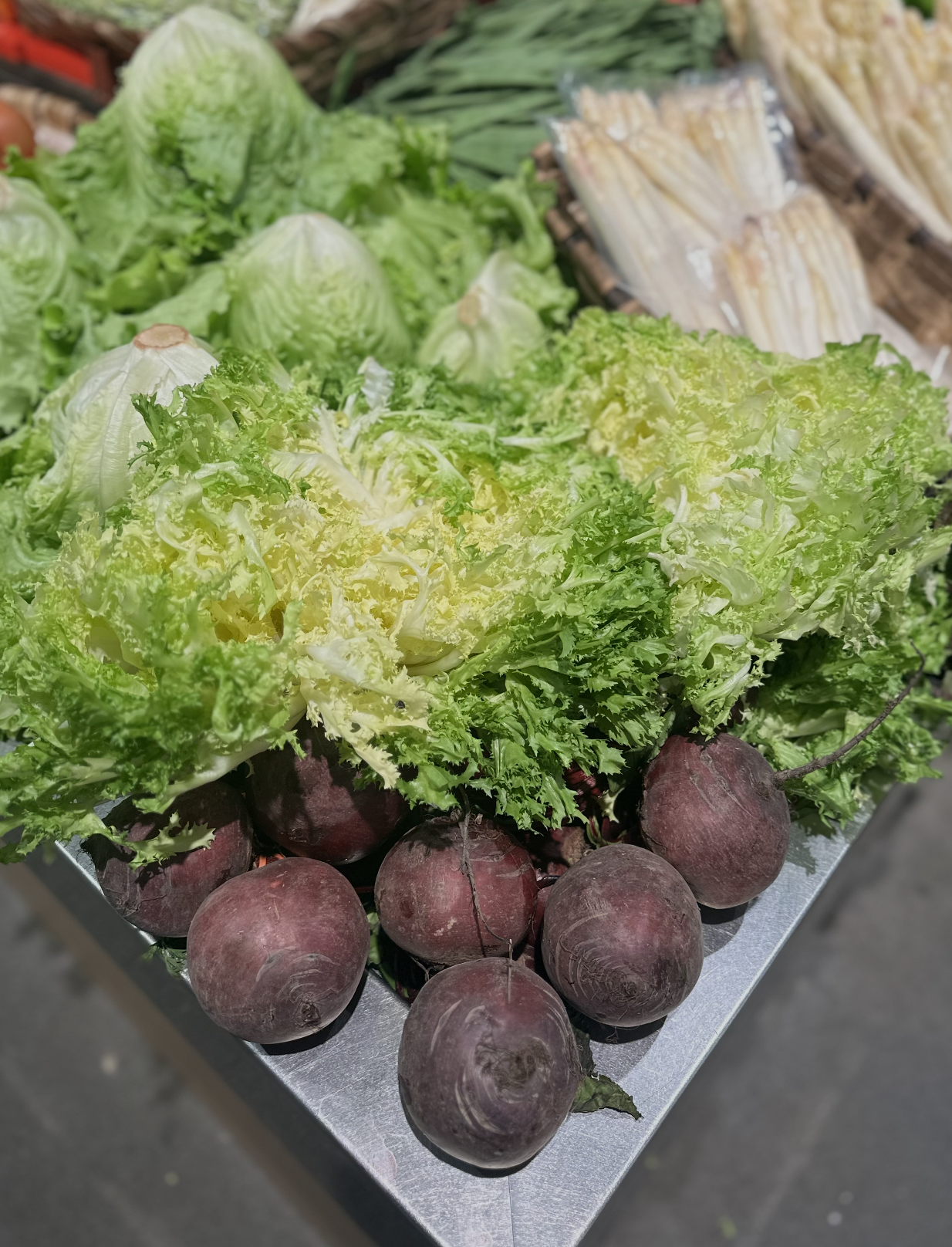
Bitter frisée, roasted beet wedges, draped Cantabrian anchovy fillets, a jammy 6-minute egg, capers, and a sharp mustard-anchovy vinaigrette.
Yield: 4 servings
Active: 20 min · Total: 1 hour (with beet roast)
Ingredients
For the salad:
1 large head frisée (curly endive), torn
2 medium beets, cut into wedges and roasted
4 large carrots, sliced into match sticks and roasted
4–6 radishes, cut into wedges and roasted
8 Cantabrian anchovy fillets
4 large pasture-raised eggs
2 tbsp capers, rinsed
¼ cup fresh flat-leaf parsley, roughly chopped
For the vinaigrette:
4 Cantabrian anchovy fillets
2 tsp Dijon mustard
2 tbsp aged sherry vinegar
⅓ cup high-quality extra-virgin olive oil
1 clove garlic, finely minced
Freshly cracked black pepper
Method
Roast the veggies. Preheat the oven to 400°F. Toss the beet wedges, carrots, and radish wedges with 2 tbsp olive oil, a pinch of sea salt, and a few cracks of pepper on a sheet pan. Roast 30–40 minutes, flipping once, until tender and lightly caramelized at the edges. Let cool slightly.
Soft-boil the eggs. Bring a saucepan of water to a boil. Lower the eggs in carefully. Cook exactly 6 minutes for a jammy yolk. Transfer to ice water for 1 minute. Peel and halve.
Make the vinaigrette. In a small bowl or jar, mash the anchovies with a fork. Whisk in the Dijon, sherry vinegar, garlic, and pepper. Slowly whisk in the olive oil until emulsified.
Assemble. Toss the frisée with about ⅔ of the vinaigrette. Divide among 4 plates.
Top each plate with the beet wedges, draped anchovy fillets, halved eggs (yolks facing up), capers, and parsley.
Drizzle the remaining vinaigrette over the eggs and beets. Serve immediately.
Anchovy Butter
A pantry condiment that transforms simple grilled meats, vegetables, and eggs — softened grass-fed butter mashed with anchovies, lemon zest, and garlic. Keeps in the refrigerator for 2 weeks; freezes beautifully.
Yield: ½ cup · Active: 10 min · Total: 10 min
Ingredients
½ cup grass-fed butter, softened to room temperature
4–6 high-quality oil-cured Cantabrian anchovy fillets
1 tsp finely grated lemon zest
1 small clove garlic, very finely minced
Freshly cracked black pepper
Optional: 1 tbsp finely chopped fresh parsley
Method
In a small bowl, mash the anchovies with a fork into a rough paste.
Add the softened butter, lemon zest, garlic, pepper, and optional parsley. Mash and mix until fully combined into a uniform compound butter.
Scrape the butter onto a sheet of parchment paper. Roll into a small log. Refrigerate to firm up (about 1 hour).
To use: slice rounds from the log and place on grilled steaks, roasted vegetables, soft-cooked eggs, baked sweet potato, or grain-free crackers as the butter melts.
Storage: Refrigerator up to 2 weeks. Freezer up to 3 months (slice from frozen).
Caesar Dressing with Real Anchovies
The proper way to make Caesar dressing — built on a foundation of high-quality anchovies, raw egg yolk, lemon, garlic, and aged Parmesan. The version that turns Caesar from a sad supermarket dressing into one of the great salad sauces.
Yield: about 1 cup (8 servings) · Active: 10 min · Total: 10 min
Ingredients
6 high-quality oil-cured Cantabrian anchovy fillets
2 cloves garlic, finely minced
2 large pasture-raised egg yolks (raw — see safety notes below)
2 tbsp fresh lemon juice
1 tsp Dijon mustard
1 tsp Worcestershire sauce (optional — choose one with clean ingredients, no high-fructose corn syrup)
½ cup high-quality extra-virgin olive oil
¼ cup finely grated aged Parmigiano-Reggiano or aged Pecorino Romano
Freshly cracked black pepper
Optional: ½ tsp coconut aminos for additional depth
Method
In a medium bowl or food processor, mash the anchovies and garlic together into a paste.
Add the egg yolks, lemon juice, Dijon, and optional Worcestershire. Whisk (or pulse) until smooth.
Slowly drizzle in the olive oil while whisking continuously (or pulsing) until the dressing emulsifies and thickens.
Stir in the grated cheese and pepper. Taste and adjust salt (the anchovies and cheese provide most of the salt — usually no additional salt is needed).
A note on raw egg yolk safety: Use only fresh pasture-raised eggs from a trusted source. The risk of salmonella from properly sourced pasture eggs is extremely low. Refrigerate the dressing immediately and use within 3 days.
To use: Toss with romaine, little gem lettuce, kale, or any sturdy green. Top with shaved Parmigiano-Reggiano, a few additional anchovy fillets, and a soft-boiled egg for a complete salad. For a grain-free version, skip croutons or substitute roasted chickpeas or toasted pumpkin seeds.
Salsa Verde with Anchovies
The traditional bright green herb sauce that lifts every protein it touches — fresh parsley, capers, anchovies, garlic, lemon, and olive oil. Use it over grilled meats, fish, eggs, roasted vegetables.
Yield: about 1 cup · Active: 10 min · Total: 10 min ·Ingredients
1 cup fresh flat-leaf parsley, finely chopped
4 high-quality Cantabrian anchovy fillets, finely chopped
2 tbsp capers, rinsed and chopped
2 cloves garlic, finely minced
⅔ cup high-quality extra-virgin olive oil
2 tbsp fresh lemon juice
1 tsp finely grated lemon zest
Freshly cracked black pepper
Optional: 1 tbsp finely chopped fresh chives or basil
Method
In a medium bowl, combine all the ingredients except the olive oil. Stir to combine.
Slowly drizzle in the olive oil while stirring, until the sauce comes together — it should be loose, vibrant green, and spoonable.
Taste. The anchovies and capers provide most of the salt; adjust with lemon and pepper as needed.
Use over grilled lamb chops, pan-seared sardines or whole fish, soft-cooked eggs, roasted potatoes, or as a finishing sauce for any simply-prepared protein.
Storage: Refrigerator up to 1 week, covered.
Additional Creative Recipes for the Adventurous Home Cook
The five recipes that follow are new — modern pairings that honor ancestral nutritional principles in entirely new combinations. They are designed for the home cook who wants to push beyond traditional preparations into pairings most people haven't seen before. Each one is genuinely accessible — no specialty chef equipment required — but each one delivers a flavor and nutritional combination that almost no one is exploring.
Anchovy & Avocado Toast on Sweet Potato Rounds
Roasted sweet potato rounds as a grain-free "toast" base, topped with smashed avocado, draped Cantabrian anchovy fillets, lemon zest, microgreens, and a drizzle of really good olive oil. The grain-free brunch dish for the home cook who's bored of egg toast.
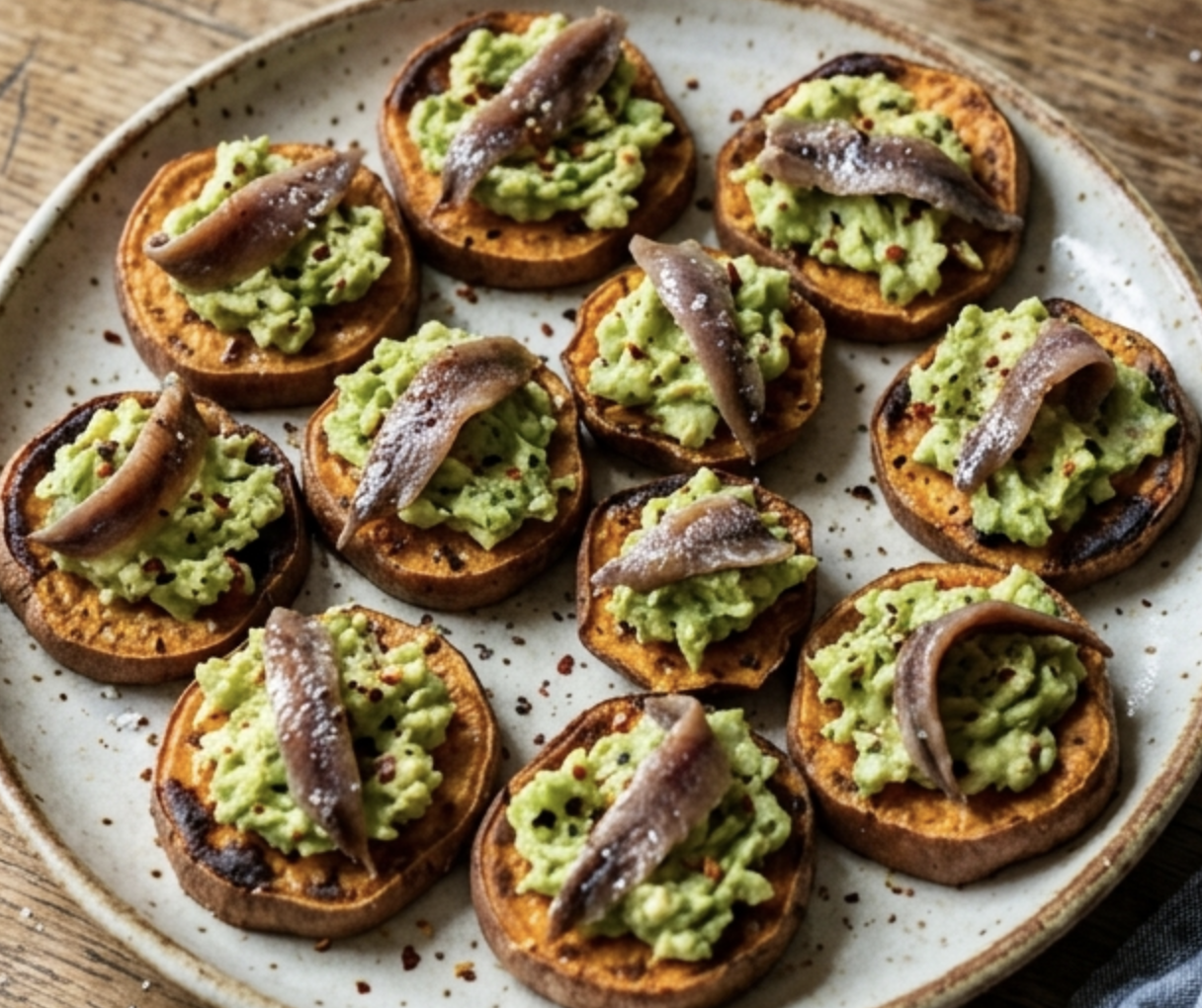
Yield: 4 servings · Active: 15 min · Total: 35 min (with sweet potato roast)
A note on this dish
Sweet potato as the "toast" base is gaining traction in grain-free cooking circles but rarely combined with anchovies. The roasted-sweet-potato-meets-anchovy-meets-avocado combination is genuinely under-explored — and structurally, it's one of the most nutrient-dense single plates you can put together for breakfast or brunch. Beta-carotene from sweet potato + healthy MUFA fats from avocado + marine omega-3 from anchovy = optimal fat-soluble vitamin A absorption. The roasted sweet potato also delivers magnesium, potassium, fiber, and slow-burning carbohydrates that make this dish satisfying without being heavy.
Ingredients
2 medium sweet potatoes (Japanese sweet potato or garnet yam both work beautifully), unpeeled
2 tbsp high-quality extra-virgin olive oil
½ tsp sea salt
2 large ripe avocados
1 tbsp fresh lemon juice
Pinch of sea salt
8–12 high-quality Cantabrian anchovy fillets
Finely grated zest of 1 lemon
Freshly cracked black pepper
A small handful of fresh microgreens (radish, sunflower, or pea shoots all work)
High-quality extra-virgin olive oil for finishing
Optional: flaky sea salt and red pepper flakes
Method
Roast the sweet potato rounds. Preheat the oven to 425°F. Slice the sweet potatoes into ½-inch rounds. Toss the rounds with the olive oil and sea salt on a sheet pan. Roast 20–25 minutes, flipping once halfway through, until tender in the center and lightly caramelized at the edges.
Make the smashed avocado. While the sweet potato roasts: scoop the avocado flesh into a small bowl. Add the lemon juice and a pinch of sea salt. Mash with a fork until mostly smooth but with some texture remaining.
Assemble. Spread a generous layer of smashed avocado on each sweet potato round. Drape 1–2 anchovy fillets across each.
Finish. Scatter the lemon zest over the top. Crack black pepper over each. Add a small pinch of microgreens to each round. Drizzle with a thin thread of additional olive oil. Finish with optional flaky sea salt and a pinch of red pepper flakes.
Serve immediately. Eat with your hands or a small fork.
Variations
With soft-boiled egg: Add a halved 6-minute jammy egg to each round for a more substantial brunch plate.
With fresh tomato: Add a thin slice of heirloom tomato between the avocado and anchovy in peak summer.
With raw goat cheese: Crumble a small amount of soft raw goat cheese over the avocado before the anchovy.
Slow-Roasted Tomato & Anchovy Confit with Garlic and Thyme
A jar of high-quality oil-cured anchovies poured over a bed of cherry tomatoes with whole garlic cloves, fresh thyme, and a generous bath of EVOO — slow-roasted for 90 minutes at low heat until the tomatoes burst and the anchovies melt into the oil. The most rewarding hands-off anchovy preparation imaginable, producing a pantry condiment you'll use for weeks.
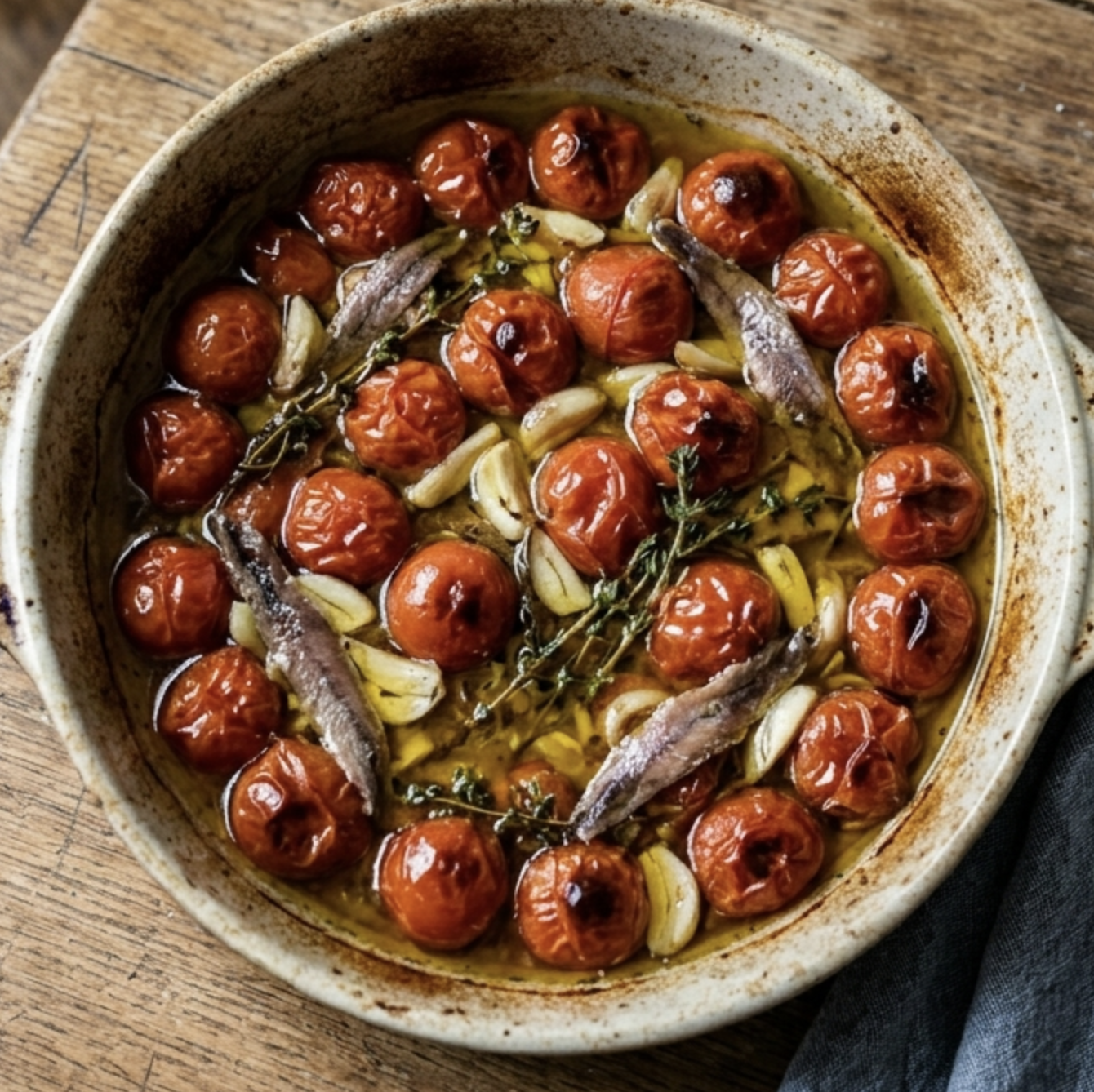
Yield: about 2 cups confit · Active: 10 min · Total: 100 min
A note on this dish
Most anchovy preparations are quick. This one is the opposite — a slow-cooked condiment that produces something close to a luxurious umami compote, with infused oil that becomes a finishing oil for weeks of meals. Almost no one is making this at home, and it's one of the most foolproof anchovy preparations possible: throw everything in a baking dish, set the oven, walk away for 90 minutes. The slow-roast extracts lycopene from tomatoes (more bioavailable than raw), confits the garlic to a buttery softness, and renders the anchovies into a melting umami foundation.
Use the confit over zucchini noodles, soft-scrambled eggs, roasted vegetables, grain-free crackers, or as a topping for grilled meats. The infused oil is precious — drizzle it over salads, fish, vegetables, or anything that benefits from deep umami olive oil.
Ingredients
2 pints cherry tomatoes (mixed colors when available), left whole
1 whole head garlic, cloves peeled and left whole
12 high-quality oil-cured Cantabrian anchovy fillets
6 sprigs fresh thyme
2 sprigs fresh rosemary (optional)
1 cup high-quality extra-virgin olive oil (enough to nearly cover everything)
1 tsp whole black peppercorns
2 bay leaves
1 strip lemon peel (no white pith)
Sea salt to taste
Optional: 1 small dried red chile
Method
Preheat the oven to 300°F. This is intentionally low — high heat will brown the anchovies and damage the omega-3 oils. The goal is a gentle confit.
Build the confit. In a baking dish (a small Dutch oven or heavy ceramic dish works beautifully), combine the cherry tomatoes, whole garlic cloves, anchovies, thyme, optional rosemary, peppercorns, bay leaves, lemon peel, and optional chile.
Pour the olive oil over until everything is nearly submerged (about 1 cup; add more if needed). The tomatoes can poke out slightly — they will burst and release their juices during cooking.
Sprinkle with a small pinch of sea salt (the anchovies provide most of the salt — go light).
Roast for 90 minutes, checking once at the 45-minute mark. The tomatoes should burst and collapse; the garlic should be tender and golden; the anchovies should have melted into the oil.
Cool slightly. Use warm over zucchini noodles, soft eggs, or roasted vegetables. Or cool completely and transfer to a glass jar.
Storage: Keeps in the refrigerator, fully submerged in its own oil, for up to 2 weeks. Bring to room temperature before serving (the oil solidifies when cold).
Serving ideas
Over zucchini noodles or spaghetti squash with shaved Parmigiano-Reggiano
Spooned over a 6-minute jammy egg with grain-free toast
Tossed with roasted broccoli, cauliflower, or Brussels sprouts
As a topping for grilled chicken thighs, lamb chops, or whole roasted fish
On grain-free crackers as an appetizer
Stirred into a vegetable soup just before serving for instant depth
Crispy Brussels Sprouts with Anchovy Brown Butter and Hazelnuts
Crispy charred Brussels sprouts tossed in a melted anchovy-brown-butter dressing with garlic, lemon zest, and toasted hazelnuts. The autumn vegetable dish that turns Brussels sprouts skeptics into believers.
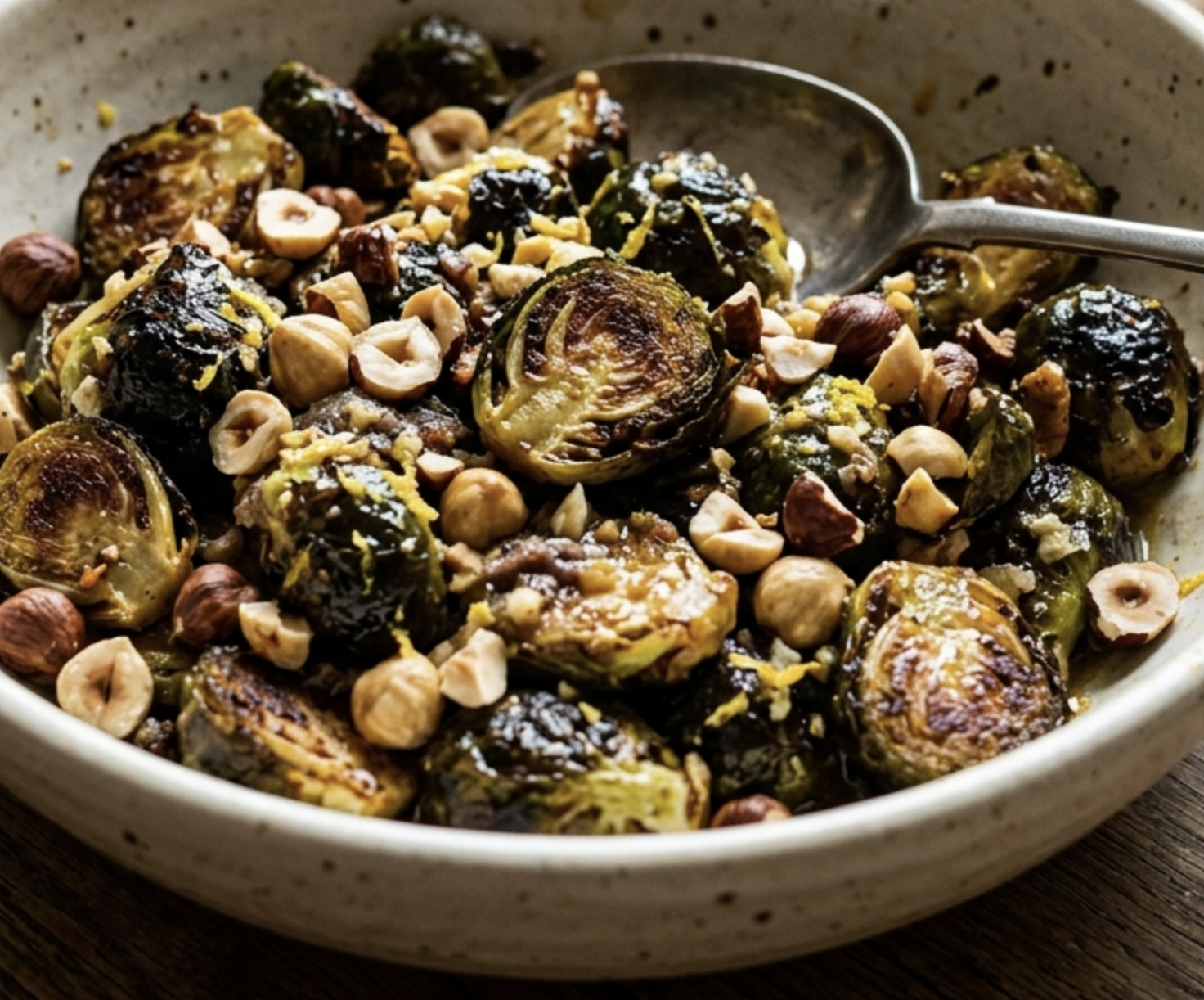
Yield: 4 servings · Active: 15 min · Total: 35 min · October–February
A note on this dish
Anchovy with Brussels sprouts is occasionally seen but rarely as the central flavor anchor. Most home cooks roast Brussels sprouts with bacon or balsamic — this version is more sophisticated and far more nutrient-dense. The cruciferous compounds (sulforaphane precursors) in Brussels sprouts pair with the fat-soluble vitamins A, D, and K2 in the grass-fed butter for optimal absorption. Anchovies add omega-3 and B12. Hazelnuts add vitamin E and magnesium. The browned milk solids in the butter deliver concentrated Maillard compounds that traditional cultures have always loved.
Ingredients
1.5 lb Brussels sprouts, trimmed and halved
3 tbsp high-quality extra-virgin olive oil
½ tsp sea salt
Freshly cracked black pepper
4 tbsp grass-fed butter
4 high-quality oil-cured Cantabrian anchovy fillets, finely chopped
2 cloves garlic, finely minced
1 tsp finely grated lemon zest
1 tbsp fresh lemon juice
⅓ cup raw hazelnuts, roughly chopped and lightly toasted in a dry pan
Flaky sea salt for finishing
Optional herb garnish: 2 tbsp finely chopped fresh parsley
Optional protein add-in: Ibérico ham and/or pancetta and/or pork belly, pan-seared into cubes
Optional fruit pairing: pomegranate arils, sliced green apple or pear
Cheese pairing: fresh ricotta, or shaved parmesan or manchego
Method
Roast the Brussels sprouts. Preheat the oven to 425°F. Toss the halved Brussels sprouts with the olive oil, sea salt, and a few cracks of pepper on a sheet pan. Spread cut-side down in a single layer. Roast 20–25 minutes without flipping until deeply caramelized on the cut side and crispy at the edges.
Make the anchovy brown butter. While the sprouts roast: in a small saucepan, melt the grass-fed butter over medium heat. Continue cooking, swirling occasionally, until the butter turns a deep golden brown and smells nutty — about 4–5 minutes. The milk solids should be lightly toasted at the bottom, not burnt.
Add the anchovies and garlic. Remove the pan from heat. Add the chopped anchovies, garlic, and lemon zest. Whisk until the anchovies melt and dissolve into the butter (the heat from the pan is enough — no need to return to the burner). Add the lemon juice and a few cracks of pepper.
Toss and finish. Transfer the hot roasted Brussels sprouts to a serving platter. Pour the anchovy brown butter over them and toss gently to coat. Scatter the toasted hazelnuts across the top. Finish with flaky sea salt and optional fresh parsley.
Serve immediately. The dish is best while the brown butter is still warm.
Variations
With pecans instead of hazelnuts: A slightly sweeter, softer crunch.
With pomegranate seeds: Add ¼ cup pomegranate seeds in autumn for color and a pop of acidity.
With aged Pecorino: Shave aged Pecorino Romano over the top before serving.
Watermelon, Anchovy & Feta with Mint and Black Pepper
Cubed cold watermelon, draped with salt-cured anchovy fillets, crumbled raw sheep's milk feta, torn fresh mint, freshly cracked black pepper, and a drizzle of really good olive oil.
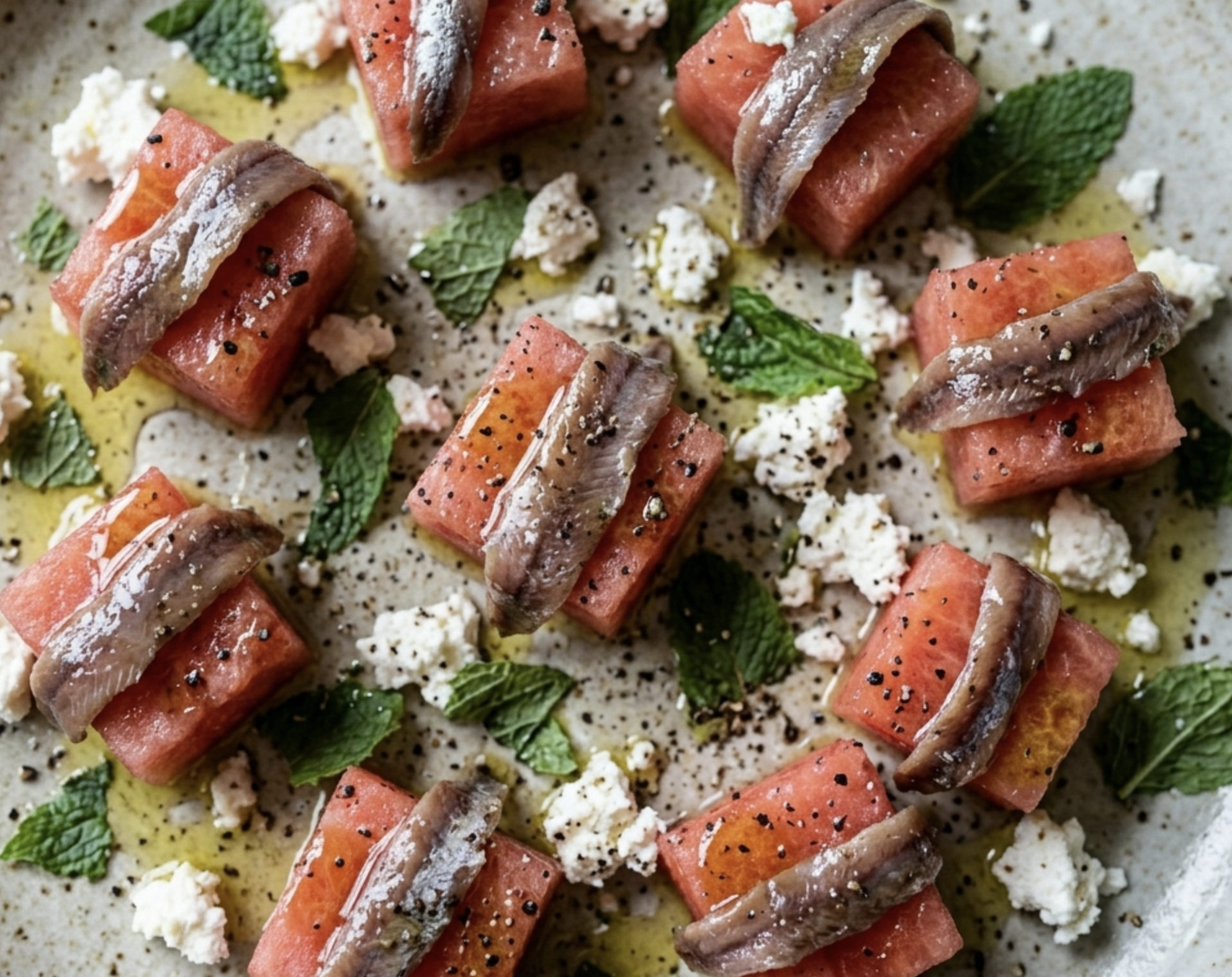
Yield: 4 servings · Active: 10 min · Total: 10 min · July–August (peak watermelon)
A note on this dish
Watermelon + anchovy is one of those pairings that sounds insane until you taste it. The salinity of the anchovy concentrates the watermelon's natural sweetness; the feta bridges the textures with creamy salt-richness; the mint cuts through everything with cool herbal brightness. Sicilian and Greek coastal fishermen have eaten this combination for centuries, and it remains one of the most refreshing structural Mediterranean salads in peak summer.
Structurally, this is a hydration-and-electrolyte plate: watermelon delivers lycopene, citrulline (cardiovascular support), and natural electrolytes. Raw sheep feta delivers fat-soluble vitamins and easier-digesting dairy fat than cow's milk cheese. Anchovy delivers omega-3, B12, and bioavailable calcium. Mint adds polyphenols and aids digestion.
Ingredients
4 cups cubed cold watermelon (about ½ a small watermelon, seedless or seeded)
4 oz raw sheep's milk feta (or grass-fed pasteurized feta), crumbled
8–12 high-quality salt-cured Cantabrian anchovy fillets
1 small handful fresh mint leaves, torn
1 tsp fresh lime or lemon juice
2 tbsp high-quality extra-virgin olive oil
Freshly cracked black pepper
Flaky sea salt
Optional: a few thin slices of red onion or shallot
Optional: a pinch of Aleppo pepper or red pepper flakes
Method
Arrange. Spread the cubed cold watermelon on a large flat platter or shallow bowl. Don't pile it — keep it in one layer so every cube gets toppings.
Add the feta. Crumble the feta evenly across the watermelon.
Drape the anchovies. Lay the anchovy fillets across the watermelon and feta in a relaxed pattern.
Scatter mint. Tear the mint leaves over the top.
Dress and finish. Squeeze the lime/lemon juice over everything. Drizzle the olive oil. Crack generous amounts of black pepper over the top. Finish with flaky sea salt, optional thinly sliced red onion, and optional Aleppo pepper.
Serve immediately. This is at its best when the watermelon is straight-from-the-fridge cold.
Variations
With ripe peach or nectarine: Add or substitute for the watermelon when peaches peak in August.
With cherry tomatoes: Add halved sweet cherry tomatoes alongside the watermelon for a more salad-like presentation.
With cucumber: Add cubed cucumber for extra crunch and hydration.
Grain-Free Caramelized Onion & Anchovy Tartlets
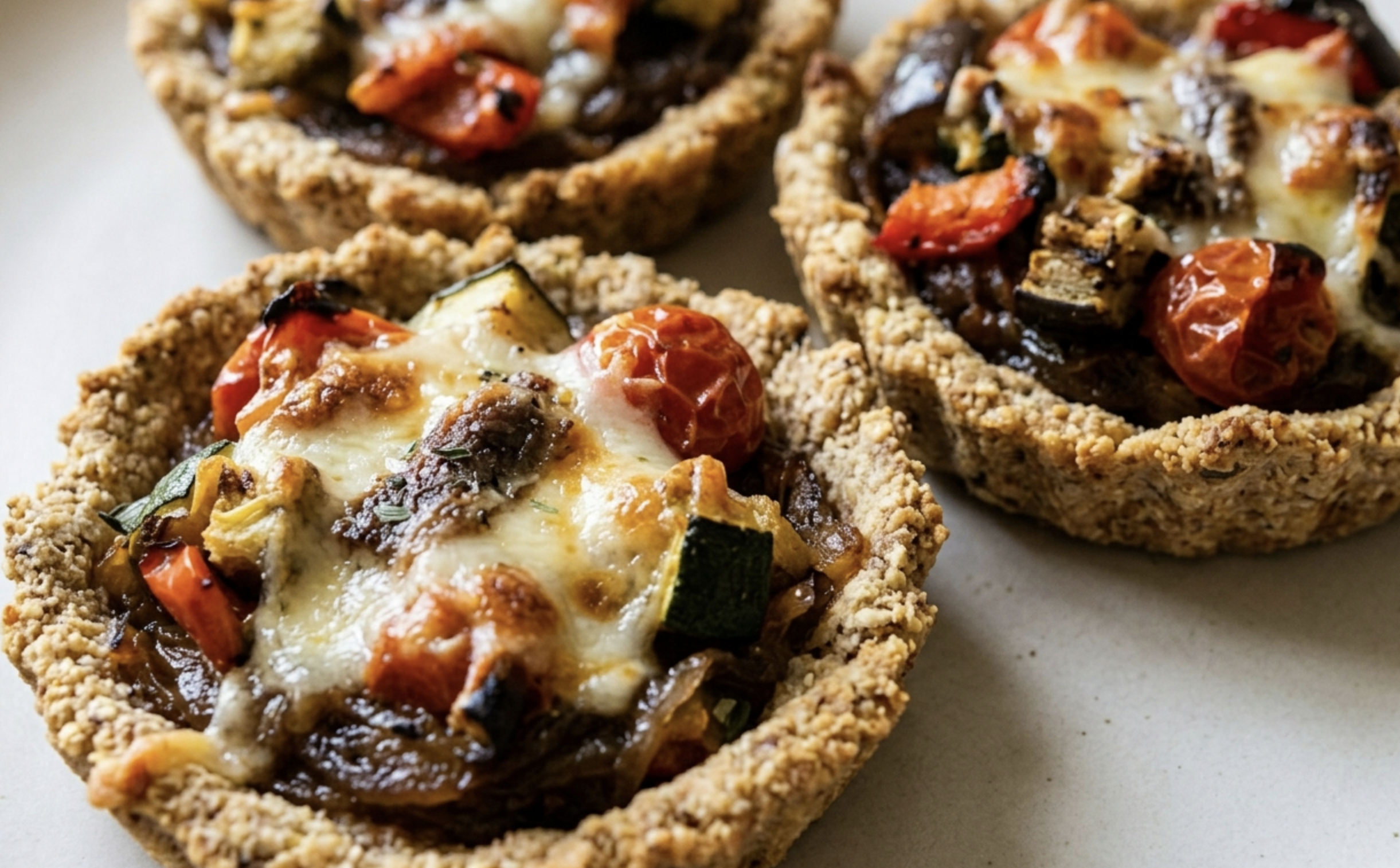
The classic Provençal pissaladière — a Niçoise flatbread of deeply caramelized onions, anchovies, olives, and herbs — reimagined grain-free in individual tartlets with a cassava and almond flour crust. Beautiful for entertaining, brunches, or a Mediterranean appetizer board.
Yield: 8 small tartlets · Active: 30 min · Total: 1 hour 30 min (with onion caramelization)
A note on this dish
Pissaladière is a Niçoise classic — a flatbread of slow-caramelized onions, anchovies, and black olives that has been made in the Provence region for centuries. The traditional version uses bread dough. This grain-free reinvention uses a simple cassava-and-almond-flour crust that takes 10 minutes to make and produces a structurally similar experience — crispy, flaky, golden. The caramelized onions take 40 minutes but are entirely hands-off; the assembly is 5 minutes; the bake is 15. Total: a beautiful Mediterranean appetizer for the home cook.
Ingredients
For the caramelized onions:
4 large yellow onions, very thinly sliced
3 tbsp grass-fed butter (or high-quality EVOO)
½ tsp sea salt
2 sprigs fresh thyme
1 bay leaf
For the cassava crust:
¾ cup cassava flour
¾ cup almond flour
½ tsp sea salt
⅓ cup high-quality extra-virgin olive oil
¼ cup cold filtered water (plus more as needed)
1 large pasture-raised egg
For assembly:
16 high-quality oil-cured Cantabrian anchovy fillets
½ cup pitted Niçoise or Kalamata olives
1 tsp fresh thyme leaves
1 tsp finely grated lemon zest
Freshly cracked black pepper
Optional: a few drops of raw honey for finishing
(see Variations below for additional vegetable and cheese toppings)
Method
Caramelize the onions. In a wide heavy skillet, melt the butter over low heat. Add the sliced onions, salt, thyme sprigs, and bay leaf. Cook over low heat, stirring occasionally, for 40 minutes until the onions are deeply caramelized, dark gold, and almost jammy. Remove thyme stems and bay leaf. Set aside to cool slightly.
Make the crust. While the onions caramelize: combine the cassava flour, almond flour, and sea salt in a medium bowl. Add the olive oil, water, and egg. Mix with a fork until a soft dough forms. Add more water 1 tsp at a time if the dough is too dry. The dough should be pliable but not sticky. Divide into 8 equal portions.
Shape the tartlets. Preheat the oven to 400°F. Line a sheet pan with parchment paper. Press each portion of dough into a small flat round (about 3 inches across, ¼ inch thick) directly on the parchment. Use your fingers to create a slight rim around the edge of each.
Pre-bake the crusts. Bake the empty crusts for 8 minutes to set them.
Assemble. Remove the crusts from the oven. Spread a generous layer of caramelized onions across each crust. Lay 2 anchovy fillets across the top of each in an X pattern. Scatter olives, fresh thyme leaves, and lemon zest. Crack black pepper over the top.
Final bake. Return to the oven and bake another 12–15 minutes until the crust is golden and the anchovies are warm.
Finish. Optional: add a drop or two of raw honey to each tartlet just before serving for a salt-sweet accent.
Serve warm or at room temperature.
Variations
With Mediterranean vegetables. Add thin slices of slow-roasted tomatoes, strips of roasted red pepper, or thin grilled zucchini slices on top of the caramelized onions before adding the anchovies. Finish with grated aged Manchego or Pecorino for a summer Mediterranean medley.
With caramelized onion + roasted red pepper: Add a strip of roasted piquillo pepper to each tartlet alongside the anchovies.
With aged sheep cheese: Sprinkle a small amount of grated aged Manchego or Pecorino Romano on top of the onions before adding the anchovies.
As a single large tart: Roll the dough into one large rectangle for a shareable family-style version. Bake the same way but with a longer pre-bake (12 min) and final bake (18 min).
What to Serve With Anchovies
Anchovies have a structural place in many different meal architectures. Here are the categories that pair most beautifully:
Bright vegetables to cut the brine
Jicama and cucumber rounds. The grain-free vehicle of choice — clean, crisp, neutral. Lets the anchovy be the flavor star.
Heirloom tomatoes. In peak season, sliced ripe tomatoes are the single best pairing for salt-cured anchovies. The natural sweetness and acidity of the tomato is a structural counterpoint to the salt.
Roasted piquillo peppers. The Spanish jarred sweet peppers — blistered, peeled, dressed with olive oil. The smoky sweetness is one of the great traditional pairings.
Padrón peppers. Blistered in olive oil with flaky salt. The Basque pintxos classic.
Roasted beets. Earthy, sweet, naturally rich. Pairs beautifully with both salt-cured and oil-cured anchovies.
Dairy that bridges the salt
Raw sheep's milk cheeses. Aged Manchego, Idiazábal, Roncal, Pecorino. These are the classic pairings — sheep dairy is gentler on most digestive systems than cow dairy and has the right fat density to balance anchovy salinity.
Aged cow cheeses. Aged Parmigiano-Reggiano, Cabrales (Spanish blue), Picón Bejes-Tresviso (Cantabrian blue). For more aggressive flavor combinations.
Grass-fed butter. European-style butter on grain-free seed bread, with a draped anchovy fillet. One of the great food combinations in any cuisine.
Aged goat cheese. Crumbled over salads with anchovies, or on a small pintxo with roasted pepper.
Fruit and sweet accents
Ripe figs. August–October peak. Sliced and served alongside anchovies and aged cheese — sweet-salt-funk perfection.
Fresh peaches and nectarines. Late summer pairings, particularly with salt-cured anchovies.
Strawberries. Late spring and early summer. The Ligurian tradition of sliced strawberries with anchovies on crostini is genuinely structural.
Raw honey. A few drops on a beet-and-anchovy pintxo, or on the Idiazábal cheese pintxo. Salt-sweet balance.
Eggs
Soft-boiled (jammy) eggs. The 6-minute egg is the universal pairing — runny yolk emulsifies with anchovies into a natural sauce.
Hard-boiled eggs halved. For tapas boards and composed salads (Lyonnaise-style).
Raw pasture-raised yolk. For Caesar dressing or as the binding element in homemade aioli.
Grain-free vehicles
Jicama rounds. Sliced thin on a mandoline.
Cucumber rounds. For lighter, more refreshing presentation.
Endive leaves. Used as scoops for salads or dips.
Grain-free seed bread. Almond, sunflower, chia-based breads.
Almond crackers. Simple homemade or store-bought grain-free crackers.
Roasted sweet potato rounds. As demonstrated in the creative recipes.
Sourcing — Where to Find Real Anchovies
The right producer makes the difference between an anchovy that converts you forever and one that confirms every negative association you had. Here is what to look for and what to avoid.
What to look for:
Glass jars, not cans. Cans transmit metal flavor and degrade omega-3 oils over time. Glass jars preserve flavor and visual freshness.
Hand-filleted. The label should say "hand-filleted" or the equivalent in Spanish ("artesanal"). Machine-processed anchovies are structurally inferior.
Single-origin extra-virgin olive oil as the packing medium. The ingredient list should read: anchovies, extra-virgin olive oil, sea salt. Nothing else.
Wild-caught, hand-harvested. Look for "pesca artesanal" or specific port of origin (Santoña, Laredo, Castro Urdiales).
Recent packaging date. Anchovies improve with some aging but degrade after a few years; check production dates.
What to avoid:
Vegetable oil, sunflower oil, soybean oil as packing medium. This is the most common red flag — some producers add seed oils to "olive oil" to lower costs.
Cans rather than glass jars. Almost always lower-grade fish or older stock.
No specific port of origin listed. Suggests the producer is hiding generic sourcing.
Industrial processing language on the label. Real producers brag about hand-filleting; mass-market producers obscure their methods.
Salt level that's overwhelming. Premium anchovies are well-salted but not punishingly so. If the brine tastes industrial, the fish is industrial.
The Santoña producers I trust:
Don Bocarte — The gourmet tier. Buttery, clean EVOO, true gourmet quality. The benchmark for premium Cantabrian anchovies.
Ortiz — Classic traditional Spanish benchmark, widely available in U.S. specialty food stores, including Whole Foods. Reliable quality across decades.
Codesa — Premium Cantabrian producer with multi-generation family heritage.
Nardín — Family-run, smaller-scale, very high-quality.
Fishwife Cantabrian Anchovies in Spanish EVOO — A modern accessible premium brand. Buttery texture, excellent sourcing, easier to find than the deeper Spanish luxury brands. Available at Whole Foods and on Amazon.
Companion ingredients:
Aged sherry vinegar. Made from sherry wine, aged in oak barrels minimum 6 months. Look for "aged" or "reserva" on the label — minimum 2 years for the deeper, more concentrated flavor. Spanish Jerez-region producers (including those carrying DOP designation) are the traditional gold standard. Substitutes: aged red wine vinegar (Italian or French) or a small-batch apple cider vinegar.
High-quality extra-virgin olive oil. Single-estate (one farm, one variety, one harvest), harvest-dated within the last 12 months. In a dark glass bottle. Should smell fresh, green, slightly peppery — never musty or rancid. Spanish single-origin olive oils (Picual, Hojiblanca, Arbequina) are the traditional companion to coastal Spanish anchovy cookery.
Cantabrian piquillo peppers. Jarred whole roasted peppers from Navarra, Spain. Look for producers like Matiz Gallego, Navarrico. The Lodosa region peppers are the traditional gold standard.
Marcona almonds. Pre-fried in olive oil and salted — a structural Spanish snack. Available from Spanish specialty importers.
Idiazábal cheese. Smoked Basque sheep cheese. Look for the DOP designation (which guarantees regional authenticity, breed, and process) or any quality artisan producer making smoked sheep cheese in the Basque tradition. Raw versions when available.
Roncal cheese. Aged Pyrenean sheep cheese. The DOP version is the traditional gold standard, but artisan-aged sheep cheeses from any small producer work beautifully.
Quince paste (membrillo). The traditional Spanish dried fruit paste, sliced thin. Available at Spanish importers or Whole Foods specialty cheese counters.
Raw honey. Local, unfiltered, single-origin when possible. Look for honey that's still slightly crystallized.
Jicama. For grain-free bread alternative. Local Latin American grocery or supermarket produce section. Look for firm, unblemished jicama with intact skin.
Sea salt. Baja Gold mineral sea salt (third-party tested at 29.5–31.5% sodium, harvested from the Sea of Cortez, solar-dried) or any equivalent unrefined mineral-rich sea salt for cooking. Fleur de sel for finishing.
Cassava flour. For the grain-free pissaladière crust. Look for Otto's Naturals or a quality single-ingredient cassava flour. Available at most natural-food stores and online.
Almond flour. For the grain-free pissaladière crust and other baking applications. Look for finely ground blanched almond flour (skins removed) — not almond meal, which is coarser and includes the skins. Look for a single-ingredient label: just almonds. Avoid almond flours with added preservatives, anti-caking agents, or starches. Stored in the refrigerator or freezer once opened to prevent rancidity from the natural oils. Available at most natural-food stores, larger conventional grocery stores, and online.
Storage
Oil-cured anchovies: Once opened, refrigerate the jar and use within 1–2 weeks. Submerged in their own olive oil, they keep well.
Vinegar-marinated anchovies (boquerones en vinagre): Refrigerator 4–5 days after marinating. The flavor improves on day 2 as the marinade fully integrates.
Salt-cured anchovies: Refrigerator up to 1 month, sealed in their original brine or covered in fresh olive oil.
Anchovy butter: Refrigerator up to 2 weeks. Freezer up to 3 months (slice from frozen).
Slow-roasted tomato and anchovy confit: Refrigerator up to 2 weeks, fully submerged in its own oil. Bring to room temperature before serving.
Caesar dressing with raw egg yolk: Refrigerator 3 days maximum. Discard if unsure.
Salsa verde with anchovies: Refrigerator up to 1 week.
Composed pintxo boards: Best assembled and eaten immediately. Individual components keep separately for 2–3 days.
Seasonal context
Anchovies are season-independent — they're a preserved food, available year-round. The fresh white anchovies for vinegar-marinating are seasonal (spring–summer in the Cantabrian Sea). The peak quality preserved anchovies come from the spring harvest (April–May).
- Anna (aka Food Marshall)