Coastal Sushi Rolls with Wild Fish, Colorful Vegetables, and Tropical Fruit
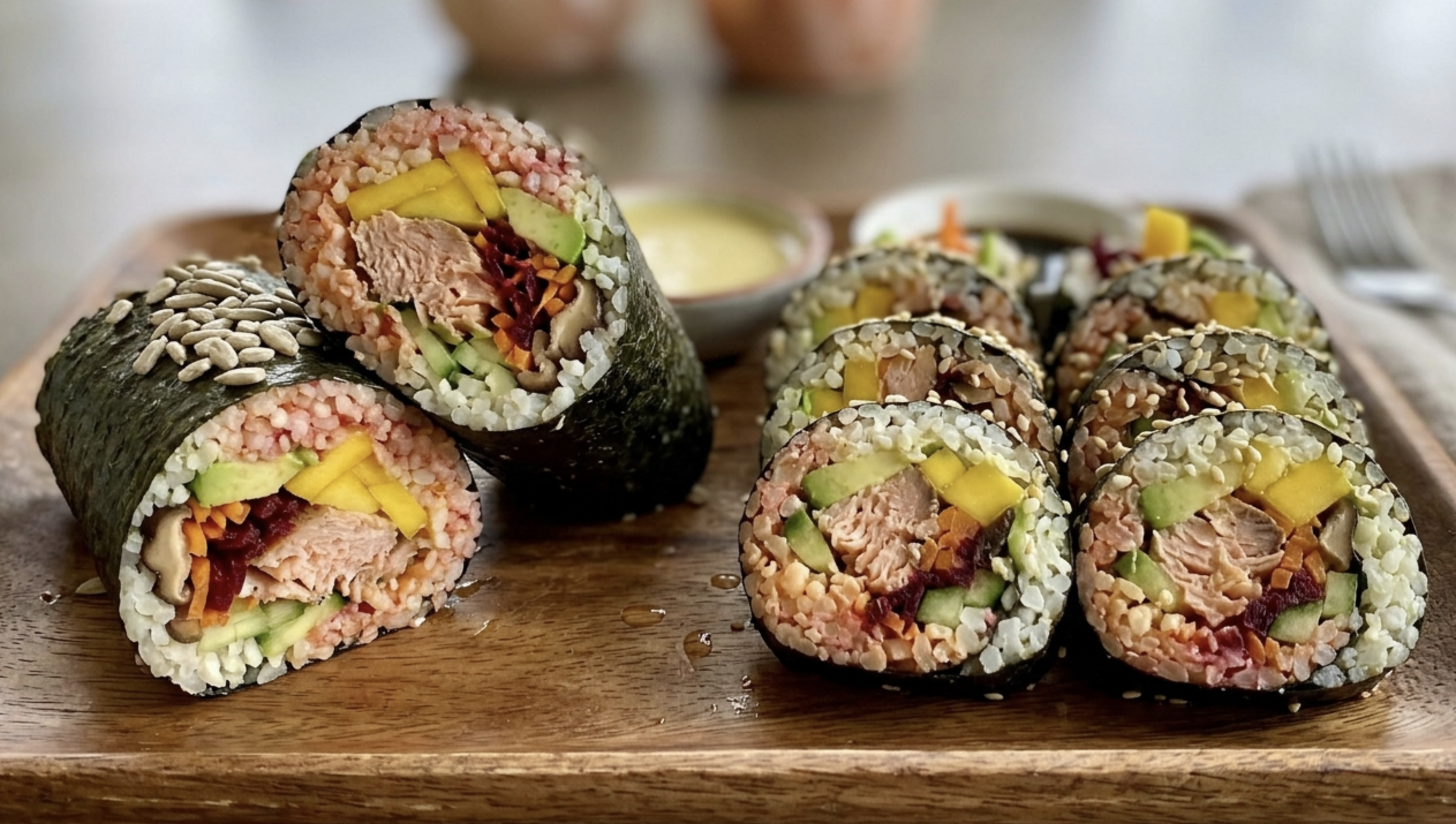
Hand-rolled sushi reimagined. Built on cauliflower rice or a shredded beet-and-carrot base, with wild fish, tropical fruit, marinated mushrooms, and two homemade dipping sauces. Soy-free, seed-oil-free, and one of the most colorful, abundant plates you can make at home.
Yield: About 4 large rolls (6-8 pieces per roll)
Active: 45 min · Total: 1 hr 15 min
A note from the kitchen
Sushi rolls are one of the great structural canvases of home cooking. This grain-free version replaces traditional sushi rice with cauliflower rice (or a vibrant shredded beet-and-carrot base) and swaps soy sauce for coconut or liquid aminos. The fillings are flexible — wild sardines, wild shrimp, smoked trout, or smoked salmon all work beautifully, paired with marinated mushrooms, ripe mango or pineapple, avocado, and bright julienne vegetables. Two homemade sauces accompany the rolls: a bright tahini-turmeric sauce and a fresh cilantro cream. Both bring meaningful anti-inflammatory and probiotic compounds to the plate.
A note on sourcing wild fish for sushi
This recipe uses cooked, smoked, or tinned wild fish — no raw fish required. For a raw version, source sashimi-grade fish from a fishmonger who handles it specifically, and follow the freezing protocol (below 0°F / -18°C for 7 days) for parasite safety before slicing.
Ingredients
For the cauliflower rice base (default)
1 large head cauliflower (about 2 lb), riced in a food processor or grated
2 tbsp high-quality extra-virgin olive oil
1 tbsp raw apple cider vinegar or coconut aminos
1 tsp raw honey (optional)
½ tsp sea salt
2-3 tsp powdered beetroot (for coloring half the rice — optional)
1 tbsp sweet smoked paprika (for coloring half the rice — optional)
For the shredded beet-and-carrot base (alternative OR ADDITIONAL)
2 medium raw beets, peeled and finely shredded
2 medium carrots, finely shredded
1 tbsp raw apple cider vinegar or coconut aminos
1 tsp raw honey (optional)
½ tsp sea salt
1 tbsp high-quality extra-virgin olive oil
For the wrappers
4 sheets nori seaweed (untoasted, sustainably harvested)
For the protein — pick one or mix
2 tins high-quality tinned sardines in extra-virgin olive oil, drained, OR
6-8 oz wild-caught smoked trout, flaked, OR
6-8 oz wild-caught smoked salmon, sliced thin, OR
6-8 oz cooked wild fish (poached cod, leftover wild salmon, or hand-shredded grilled fish), OR
6-8 oz cooked, peeled, deveined wild-caught shrimp
For the marinated mushrooms
8 oz shiitake mushrooms, thinly sliced (or cremini)
2 tbsp coconut aminos
1 tbsp high-quality extra-virgin olive oil
1 small clove garlic, finely minced
1 tsp finely grated fresh ginger
1 tsp raw apple cider vinegar
pinch sea salt
For the vegetables and fruit
1 small cucumber, julienned (seeds removed)
1 small zucchini, julienned (raw or lightly blanched)
1/2 cup per roll of thinly sliced ripe mango or pineapple (depending on seasonal availability and preference)
2 carrots, thinly sliced (optional)
1 ripe avocado, thinly sliced
1 small red bell pepper, julienned (optional, for color and crunch)
A handful of microgreens or pea shoots (optional)
For the exterior COATING
Sunflower seeds or sesame seeds (for coating the outside-rolled style)
For the tahini-turmeric sauce
¼ cup tahini (single-ingredient, runny consistency)
1 tbsp fresh lemon juice
½ tsp ground turmeric
1 small clove garlic, very finely minced
1 tsp raw honey
2–3 tbsp filtered water (to thin)
Pinch sea salt and pepper
For the cilantro cream sauce
½ cup whole-milk raw kefir (or whole-milk pasture-fed yogurt)
1 small ripe avocado
½ cup fresh cilantro leaves
1-2 tbsp fresh lime juice
1 small clove garlic
½ tsp sea salt
Optional: small piece fresh jalapeño for heat
For dipping and finishing
Coconut aminos or liquid aminos (for dipping — soy-sauce replacement)
Optional garnishes: Brazil nuts, macadamia nuts, or crushed pistachios, shredded coconut, sliced jalapeño, additional mango or avocado, flaky sea salt
Method
Prepare the cauliflower rice base. Pulse the cauliflower in a food processor until it resembles fine rice grains. Heat the olive oil in a wide skillet over medium heat. Add the riced cauliflower and sauté 4–5 minutes until just tender but not mushy. Remove from heat and let cool 10 minutes.
In a small bowl, whisk together the raw apple cider vinegar or coconut aminos, raw honey (if using), and sea salt until the honey dissolves. Fold gently into the cooled cauliflower rice. For the dramatic two-color presentation, divide the seasoned rice into two bowls — fold powdered beetroot into one and smoked paprika into the other.
And/or prepare the shredded beet-and-carrot base. Combine the shredded beets and carrots in a bowl. In a separate small bowl, whisk the raw apple cider vinegar or coconut aminos, raw honey (if using), sea salt, and olive oil together until the honey dissolves. Pour over the beets and carrots and toss gently. Let sit 15 minutes to soften slightly. The natural color of the beets is dramatic on its own.
Marinate the mushrooms. Combine the sliced mushrooms with coconut aminos, olive oil, raw apple cider vinegar, garlic, ginger, and sea salt in a small bowl. Toss well and let marinate at room temperature for at least 15 minutes (or up to 2 hours in the refrigerator).
Make the tahini-turmeric sauce. Whisk all the sauce ingredients together in a small bowl until smooth. Add water 1 tsp at a time until the texture is drizzle-able but still thick enough to coat a piece of fish. Taste and adjust salt and lemon.
Make the cilantro cream sauce. Combine all the cilantro cream ingredients in a high-speed blender or small food processor. Blend 30 seconds until completely smooth and pale green. Taste and adjust salt and lime. Refrigerate until ready to serve.
Roll the sushi. Lay a bamboo sushi mat on a clean work surface. Place one sheet of nori, smooth side down, on the mat. With wet hands (keep a small bowl of water nearby), spread about ½ cup of your chosen rice base across the lower two-thirds of the nori in a thin even layer. Leave about 2 cm bare at the top edge for sealing.
Across the center of the rice, lay a horizontal line of fillings: a row of cucumber and zucchini julienne, a row of marinated mushrooms (drained), a few slices of mango or pineapple, avocado slices, optional bell pepper, and 2–3 sardines or pieces of smoked trout/salmon arranged lengthwise.
Hold the bottom edge of the mat and roll firmly away from you, pressing gently to compact the filling. Dampen the bare top edge of the nori with a wet finger and seal. Set aside seam-side down.
Roll the outside (with seeds). Cover a sushi mat with a sheet of plastic wrap. Place a sheet of nori, smooth side down, on the plastic-wrapped mat. With wet hands, spread the rice base over the entire surface of the nori. Sprinkle generously with sunflower or sesame seeds.
Cover the rice with another sheet of plastic wrap. Carefully flip the whole stack over so the nori is now on top. Remove the top plastic wrap. Fill the center with the same line of fillings as in the inside-rolled version above. Roll using the bottom mat (with the bottom plastic wrap still in place), pressing firmly to compact. Remove the plastic wrap. The exterior should be rice-and-seed coated.
Chill briefly. Place the rolled sushi in the refrigerator for 20–30 minutes to firm up. This makes them dramatically easier to slice cleanly. (Cauliflower rice rolls are more delicate than traditional sushi rice — handle gently.)
Slice and plate. Use a very sharp knife, wiped clean and lightly dampened between cuts. Slice each roll into 6–8 pieces (about 2.5 cm thick).
Serve. Arrange the rolls on a platter. Drizzle the tahini-turmeric sauce over half and the cilantro cream over the other half (or serve both in small dipping bowls alongside). Provide a small bowl of coconut aminos for additional dipping. Garnish with optional chopped Brazil nuts, macadamia nuts, or crushed pistachios, sliced jalapeño, extra mango or avocado, and flaky sea salt.
Variations
Pineapple-forward summer version. Substitute mango with fresh pineapple chunks for a brighter, more acidic profile. Pairs beautifully with smoked salmon and the cilantro cream sauce.
Mango-forward version. Mango is structurally softer and sweeter than pineapple — beautiful with smoked trout or sardines and the tahini-turmeric sauce.
Other fruit variations. If mango and pineapple are not in season or grow in your local area, substitute with peaches or nectarines (similar vibrant color and soft, buttery texture). Thinly sliced strawberries or kiwi can be another alternative.
With pickled accents. Add quick-pickled daikon, ginger, or red onion inside the rolls for additional acid.
Infuse the cauliflower “rice” with coconut, sesame seeds, and/or ginger. Toasted coconut flakes can add a great crunch and fun tropical flavoring.
Sourcing
Tinned sardines. Look for sardines packed in extra-virgin olive oil (not soybean, sunflower, or "vegetable oil"). Wild-caught, with skin and bones intact. Producers I trust: Bela, Fishwife, Wild Planet, Nuri, Matiz, Ortiz, Conservas Pinhais. Verify the specific product you're buying for whole fish with skin and bones, as some of their offerings are skinless and boneless (which lose most of the bioavailable calcium).
Smoked wild trout or smoked wild salmon. Wild-caught (Alaska, Pacific Northwest), cold-smoked, with clean ingredient lists — fish, salt, smoke. Avoid liquid-smoke "flavoring" and added sugars or preservatives.
Nori seaweed. Untoasted nori sheets from a natural-food store. Look for sustainably harvested, additive-free. Japanese-imported is the traditional standard (generally avoid Chinese-imported).
Coconut aminos or liquid aminos. Single-ingredient or minimal-ingredient soy-free seasoning. Coconut Secret is widely available. (Note: Bragg's Liquid Aminos is soy-based — coconut aminos is the soy-free choice.)
Powdered beetroot. From a natural-foods store or online. Organic, single-ingredient powder with no fillers.
Smoked paprika. Spanish-style, oak-smoked, deeply aromatic. Sweet (dulce) is the most versatile.
Cremini or shiitake mushrooms. Organic when possible. Shiitake delivers more polysaccharides and beta-glucans (immune-supportive compounds). Cremini delivers a softer, more universal flavor.
Tahini. Single-ingredient, stone-ground, runny consistency. Soom and Seed + Mill are excellent. Avoid tahini with added oils.
Raw kefir or pasture-fed yogurt. Whole-milk, grass-fed, from a small, local dairy producer when possible.
Sea salt. Baja Gold mineral sea salt for cooking, fleur de sel for finishing.
Pairs Well With
A simple seaweed salad (wakame with a touch of sesame oil, ginger, and splash of coconut aminos).
A side of quick-pickled vegetables (radish, daikon, carrots, and/or cucumber).
A cup of warm bone broth alongside (Japanese tradition pairs sushi with warm broth).
Why This Dish
Sushi rolls are one of the most accessible ways to bring wild fish, fresh vegetables, fermented condiments, and fruit together on one plate. Replacing rice with a veggie-rice makes the dish grain-free. Replacing soy sauce with coconut or liquid aminos eliminates one of the most common industrial-soy exposures in modern cooking. The tahini-turmeric sauce delivers curcumin (one of the most studied anti-inflammatory compounds) along with sesame lignans and healthy fats. The cilantro cream delivers probiotics from raw kefir plus cilantro's emerging research on heavy-metal-chelating compounds and detoxification support. The marinated mushrooms add beta-glucans, immune-supportive polysaccharides, and umami depth. The wild fish anchors the plate with marine omega-3, B12, and bioavailable minerals.
— Anna aka Food Marshall