Sardines — Traditional and Creative Ways to Cook One of the Most Nutrient-Dense Foods on Earth
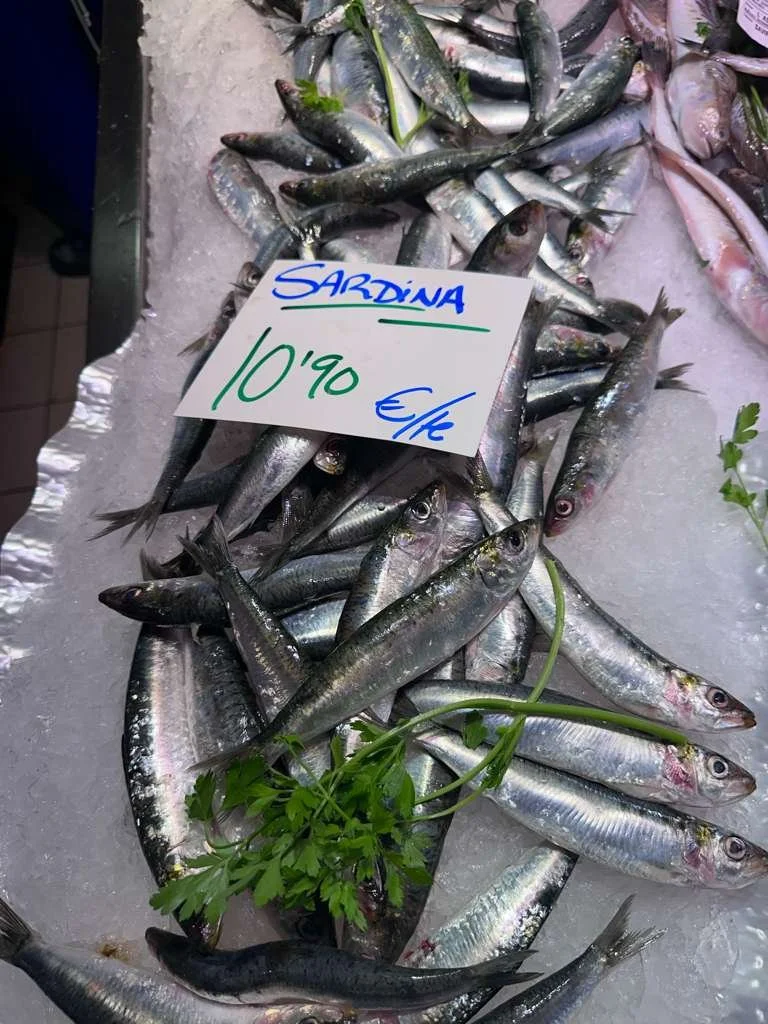
Whole sardines from coastal Mediterranean, Atlantic, and Pacific waters — grilled, pickled, confited, or roasted, served with bright herb sauces and ripe seasonal accompaniments. Small, oily, silver-blue, and packed with more nutrient density per gram than almost anything else from the sea.
Yield: Each recipe serves 4 as appetizer or 2 as main
Active: 15–30 min per recipe
Climate fit: Coastal Atlantic, Mediterranean, Pacific, year-round (peak: late spring through autumn)
A note from the kitchen
Sardines are one of the most nutritionally extraordinary foods on the planet. Most people have only eaten sardines from tins — salt-packed flat-pull-tab cans — and many eat them reluctantly for the "health benefits" without enjoying true fresh sardines. This article will guide you to making delicious fresh sardines if you have access to them, but will also guide you on sourcing the best canned sardines (ideally with skin and bones intact) and on delicious recipes that turn tinned sardines into something genuinely beautiful.
Fresh sardines, grilled simply over wood or seared on a hot cast-iron or stainless steel pan, are one of the most delicious and structurally satisfying foods.
Sardines sit near the base of the marine food chain. They eat plankton and microalgae. This means they accumulate almost none of the mercury, PCBs, and microplastic contamination that larger predatory fish (tuna, swordfish, shark, larger salmon) carry from years of bioaccumulation. A sardine lives 4–6 years, eats simple food, and dies young. The result is a fish that is structurally one of the cleanest, most nutrient-dense, and most omega-3-rich foods available — a structural inversion of the "bigger fish equals better fish" assumption that modern marketing has trained Western consumers to believe.
The nine recipes below cover the full sardine cooking spectrum. The first six are traditional preparations using whole fresh sardines — skin, bones, head, and all. The bones are tiny and dissolve into the flesh during cooking; they are structurally part of the dish and the primary source of the bioavailable calcium that makes sardines such a uniquely complete food. The final three recipes are creative modern pairings designed for the homecook who wants to push beyond traditional preparations into fun and unique combinations. Each recipe takes 15–30 minutes of active cooking. A separate section follows with ideas for tinned sardines so they're never boring.
A note on freshness
Fresh sardines should smell of clean ocean — never fishy or ammonia-like. The skin should be silver-bright with no dullness; the eyes should be clear and slightly bulging; the gills should be deep red, never brown or gray. Press a finger into the flesh — it should spring back. Use within 24 hours of purchase. Sardines deteriorate faster than almost any other fish because of their high oil content; the same omega-3 fatty acids that make them so nutritious are also the most prone to oxidative degradation. Buy from a busy fishmonger, never a slow-moving supermarket counter.
Regional sardines — Spanish, Portuguese, Mediterranean, Pacific, and Mexican
Spanish sardines (sardina pilchardus) tend to be smaller (4–6 inches) and more delicate, with a fine bone structure that disappears entirely in cooking. Particularly well-suited to the grilled, confit, and stuffed preparations.
Portuguese sardines (same species, slightly different waters) are typically larger and oilier than Spanish sardines, with a more pronounced fish flavor. The traditional sardine of Lisbon, Porto, and the Algarve coast — most famously grilled over wood fires during the summer street festivals. Hold up beautifully to the wood-grilled and herb-topped preparations.
Mediterranean sardines are slightly smaller than Atlantic sardines, often with a more delicate, briny flavor. Beautiful for the simpler plancha and confit preparations.
Pacific sardines (Sardinops sagax) are a structurally similar small oily fish, native to the Pacific coast from Alaska down through California and Baja California. Interchangeable with Mediterranean sardines in any of these recipes. Look for sustainably caught Pacific sardines at West Coast fishmongers and specialty markets.
Mexican sardines. The same Pacific sardine species (Sardinops sagax caeruleus) is harvested in significant quantities off the Pacific coast of Mexico, particularly off Baja California and the Sea of Cortez. Mexican coastal cooking has its own tradition with these fish — typically grilled whole over charcoal with lime, chile, and cilantro, or pan-seared and served with a fresh salsa of tomato, onion, and serrano. Mexican fresh sardines (sardinas frescas) are increasingly available at Latin American fishmongers in the U.S., and the cooking tradition translates beautifully to Mediterranean techniques. The Baja-style preparation with lime, chile, and avocado is one of the great underutilized sardine traditions in Western cooking.
Part One — Traditional Preparations
Recipe 1 · Foundational Plancha Sardines
The simplest possible sardine preparation — small sardines, sweated with coarse sea salt, seared hard on the plancha, finished with lemon and an optional garlic-sherry-vinegar refrito.
Yield: 4 as appetizer · Active: 10 min · Total: 25 min (with salt sweat)
Ingredients
2 lb small fresh sardines (sardinillas), scaled and gutted
2 tbsp coarse sea salt
2 lemons, cut into wedges
For the optional refrito: 3 tbsp high-quality extra-virgin olive oil + 3 cloves thinly sliced garlic + 1 tbsp aged sherry vinegar
Method
Salt the sardines. Lay them in a single layer on a tray and sprinkle generously with coarse sea salt. Let them sweat 15 minutes — this draws out a small amount of moisture, firms the texture, and seasons the fish through to the bones.
Pat dry thoroughly. Dry fish is essential for a clean sear — wet fish steams instead of crisping.
Heat the plancha or a heavy cast-iron pan until smoking. Lay the sardines down — they should sear, not steam. Cook 2 minutes per side. The skin will blister; the eyes will turn opaque.
Plate immediately, squeeze fresh lemon over.
Optional refrito: In a small skillet, gently warm the olive oil with the sliced garlic until just golden (about 1 minute — don't burn). Off heat, add the sherry vinegar (it will sizzle). Drizzle over the sardines.
Serve with crusty cucumber rounds, sliced fennel, and sprouted sourdough bread for the gluten-tolerant folks.
Recipe 2 · Grilled Sardines with Salsa Verde
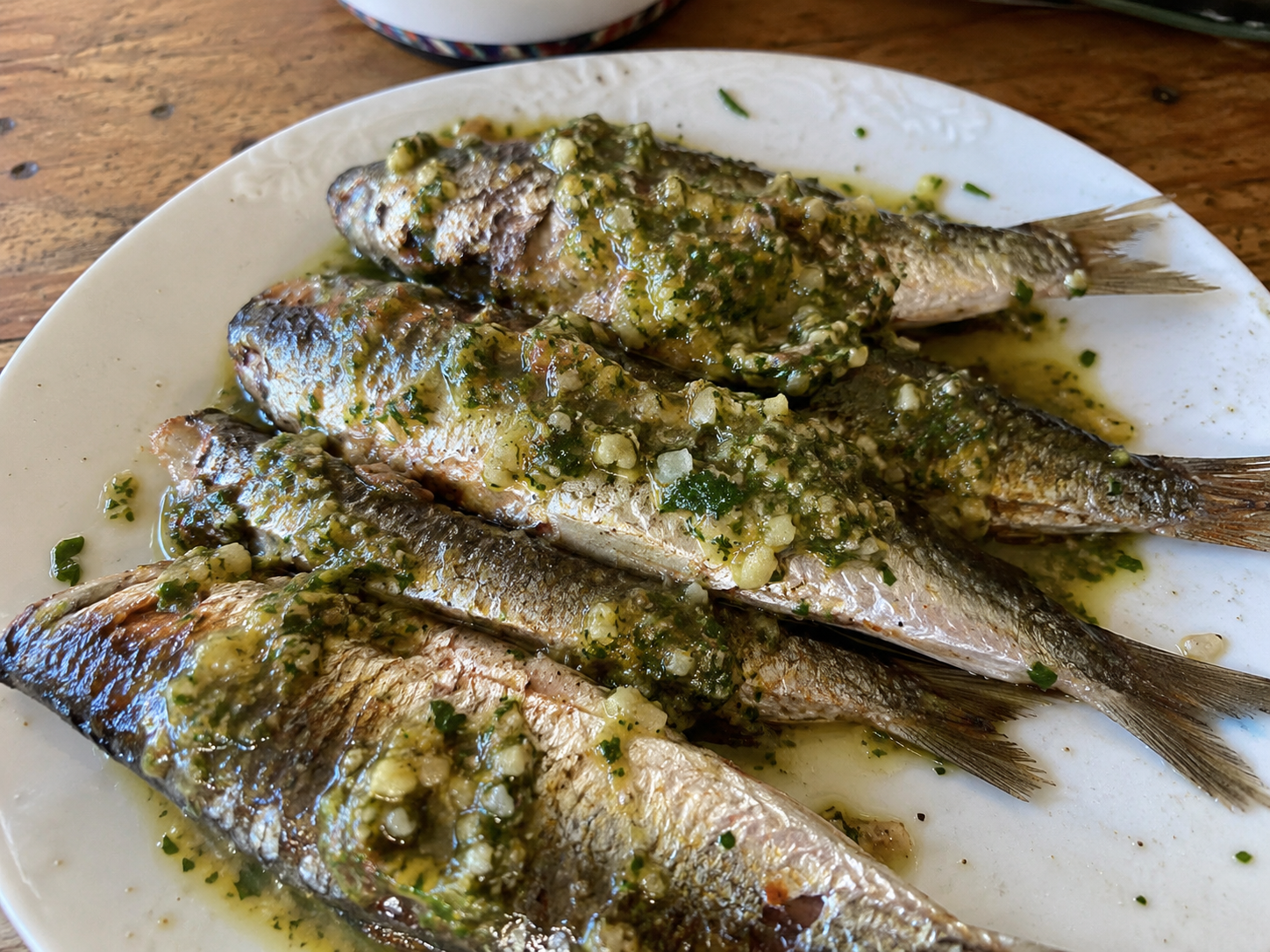
Grilled fresh sardines with the classic herb sauce — parsley, garlic, olive oil, lemon, optional capers. A foundational sardine preparation.
Yield: 4 as appetizer / 2 as main · Active: 15 min · Total: 25 min
Ingredients
For the sardines:
12 fresh whole sardines (about 2 lb), scaled and gutted (heads on for traditional presentation)
2 tbsp high-quality extra-virgin olive oil
1 tbsp sea salt (Baja Gold or equivalent)
Freshly cracked black pepper
2 lemons, halved (for serving)
For the salsa verde:
½ cup fresh flat-leaf parsley, finely chopped
4 cloves garlic, finely minced
½ cup high-quality extra-virgin olive oil
2 tbsp fresh lemon juice
¼ cup chopped fresh chives
1 tbsp capers, rinsed and chopped (optional)
Sea salt and freshly cracked black pepper to taste
Method
Heat a plancha, cast-iron skillet, or grill pan to high. The pan should be smoking before the fish touches it. Pat the sardines completely dry — dry fish is essential for a clean sear.
Brush the sardines lightly with olive oil and season generously with sea salt and black pepper.
Sear 2–3 minutes per side until the skin is crisp and blistered, and the flesh just begins to flake. Don't overcook — sardines are delicate. The eyes should turn opaque and the skin should char in places.
While the fish cooks, whisk together all the salsa verde ingredients in a small bowl. Taste and adjust salt, lemon, and oil as needed.
Plate the sardines on a warm platter. Spoon salsa verde generously over each. Serve immediately with charred lemon halves alongside.
Eat with your hands or a fork. The bones soften during cooking and dissolve into the flesh — the entire fish is edible.
Recipe 3 · Pickled Sardines (Escabeche style)
The traditional Spanish vinegar pickle preparation — sardines pan-seared then steeped in a warm bath of olive oil, vinegar, bay, garlic, and smoked paprika. Keeps in the refrigerator for several days and improves with time.
Yield: 6 servings · Active: 20 min · Total: 4 hr minimum (refrigerator marinate), ideally overnight
Ingredients
12 fresh sardines, scaled and gutted
3 tbsp high-quality extra-virgin olive oil (for searing)
½ tsp sea salt
For the escabeche brine:
½ cup high-quality extra-virgin olive oil
⅓ cup aged sherry vinegar (or white wine vinegar)
4 cloves garlic, thinly sliced
2 bay leaves
1 tsp sweet smoked paprika
½ tsp whole black peppercorns
1 small carrot, thinly sliced
1 small yellow onion, thinly sliced into rings
1 strip lemon peel (no white pith)
Pinch sea salt
Method
Sear the sardines. Pat sardines dry. Heat the olive oil in a heavy skillet over medium-high heat. Sear sardines 1–2 minutes per side until just opaque (they will finish in the brine). Transfer to a glass dish in a single layer.
Build the escabeche brine. In a small saucepan, combine all the brine ingredients except the salt. Bring to a gentle simmer over medium-low heat. Cook 5 minutes until the onion and carrot soften slightly but retain bite. Season with a small pinch of salt.
Pour the warm brine over the sardines in the dish, making sure each fish is submerged or near-submerged. The brine should be aromatic, slightly tangy, and warm (not boiling).
Cool to room temperature, then cover and refrigerate at least 4 hours, ideally overnight. The flavor improves significantly over 24–48 hours as the vinegar penetrates the flesh and the spices integrate.
Serve cold or at room temperature, drizzled with a spoonful of the brine, alongside sliced cucumber, soft greens, or a small parsley-caper salad.
Storage: Keeps in the refrigerator up to 5 days, fully submerged in the brine.
Recipe 4 · Confit Sardines
The slow olive-oil poach method — sardines cooked at very low temperature (160°F) in a bath of olive oil with thyme, lemon peel, garlic, and peppercorns. Produces the silkiest, most luxurious sardine texture possible.
Yield: 4 servings · Active: 15 min · Total: 45 min
Ingredients
8 fresh whole sardines, scaled, gutted, and filleted (or 16 sardine fillets)
2 cups high-quality extra-virgin olive oil
4 sprigs fresh thyme
2 strips lemon peel (no white pith)
4 cloves garlic, lightly smashed
1 tsp whole black peppercorns
2 bay leaves
Sea salt to taste
Optional: 1 small dried red chile
Method
Pat the sardine fillets completely dry. Season lightly with sea salt and let rest 10 minutes.
In a small heavy-bottomed saucepan, combine the olive oil, thyme, lemon peel, garlic, peppercorns, bay leaves, and optional chile. Warm gently over the lowest heat possible until the oil reaches 160°F / 70°C (use a thermometer — this is structurally important). Do not let it bubble.
Slip the sardine fillets carefully into the warm oil, submerging them fully. Maintain the 160°F temperature for 15–20 minutes until the fillets are just opaque and silky-tender. The oil should never simmer or bubble actively — just shimmer slightly.
Remove the saucepan from the heat. Let the sardines cool in the oil to room temperature, then transfer everything (fish + oil + aromatics) to a glass jar.
Refrigerate. The sardines will keep in their oil bath for up to 1 week.
Serving: Lift fillets out of the oil. Serve over a small salad of bitter greens, on sliced cucumber, with soft-cooked egg, or alongside roasted peppers. Drizzle a small amount of the infused oil over the top.
The infused oil itself is precious — use it as a finishing oil for salads, vegetables, or to drizzle over additional fish dishes.
Recipe 5 · Roasted Sardines with Summer Vegetables and Peppers
A simple summer one-pan preparation — sardines roasted on a sheet pan with charred red peppers, zucchini, summer squash, eggplant, large tomatoes, and chunked onion, garlic, lemon, and herbs. Beautiful for casual dinner parties or weeknight cooking.
Yield: 4 servings · Active: 15 min · Total: 30 min
Ingredients
12 fresh sardines, scaled and gutted
4 red bell peppers (or piquillo peppers if available), seeded and cut into thick strips
1 medium zucchini, cut into thick rounds or matchsticks
1 yellow summer squash, cut into thick rounds or matchsticks
1 small eggplant, cut into chunky cubes
2 large heirloom tomatoes, cut into thick wedges
1 large red onion, cut into thick wedges
6 cloves garlic, smashed
2 lemons (1 sliced into rounds, 1 cut into wedges for serving)
⅓ cup high-quality extra-virgin olive oil
2 sprigs fresh rosemary
4 sprigs fresh thyme
1 tsp sweet smoked paprika
Sea salt and freshly cracked black pepper
2 tbsp fresh parsley, chopped, for finishing
Method
Preheat the oven to 425°F.
Roast the vegetables. On a rimmed sheet pan (or two pans if needed — don't crowd the vegetables), toss the pepper strips, zucchini, summer squash, eggplant, tomatoes, and onion with 3 tbsp olive oil, the smashed garlic, smoked paprika, sea salt, and pepper. Spread in a single layer.
Roast 12–15 minutes until the peppers begin to soften and char at the edges and the other vegetables are tender.
Add the sardines. Remove the pan from the oven. Make space for the sardines among the vegetables. Lay the sardines on the pan, nestle the lemon rounds and herb sprigs around them, and drizzle the remaining olive oil over the fish. Season with sea salt and pepper.
Return to the oven and roast another 8–10 minutes until the sardines are opaque, the skin is blistered, and the peppers are deeply charred.
Plate directly from the sheet pan. Shower with chopped parsley and serve with charred lemon wedges.
Serve family-style, with crusty grain-free crackers or simple cucumber slices for sopping up the vegetable-infused oil.
Recipe 6 · Sardines with Herb-Nut Topping
Sardines topped with pine nuts, raisins, parsley, lemon zest, and garlic, then baked — finished with shaved aged Parmesan.
Yield: 4 servings · Active: 30 min · Total: 45 min
Ingredients
12 fresh sardines, butterflied (heads and spines removed, fish opened flat)
3 tbsp high-quality extra-virgin olive oil
¼ cup pine nuts, lightly toasted
¼ cup raisins (preferably Málaga muscatel raisins), roughly chopped
3 cloves garlic, finely minced
¼ cup fresh flat-leaf parsley, finely chopped
1 tsp finely grated lemon zest
2 tbsp blanched almond flour (binder)
Sea salt and freshly cracked black pepper
2 tbsp shaved aged Parmesan, Pecorino, aged Manchego or other raw aged cheese of choice (for finishing)
Lemon wedges, for serving
Method
Preheat the oven to 400°F. Lightly grease a baking dish with olive oil.
Make the topping. In a small bowl, combine the pine nuts, chopped raisins, minced garlic, parsley, lemon zest, almond flour, 2 tbsp olive oil, sea salt, and pepper. The mixture should be moist and clingy.
Lay each butterflied sardine flesh-side up. Place 1–2 tbsp of the topping onto one half of each fish, then fold the other half over to enclose. Arrange the stuffed sardines snugly in the baking dish.
Drizzle the remaining olive oil over the top, season with sea salt and pepper.
Bake 15 minutes until the sardines are opaque and the topping is fragrant and golden.
Finish with shaved aged cheese and serve with lemon wedges and a small bitter greens salad alongside.
Part Two — Creative Modern Pairings for the Adventurous Home Cook
The three recipes that follow are new — modern pairings that honor ancestral nutritional principles in entirely new combinations. Each one is genuinely accessible — no specialty chef equipment, no advanced technique required — but each one delivers a flavor and nutritional combination almost no one is exploring.
Recipe 7 · Fresh SardineS with Figs, Burrata & Basil Oil
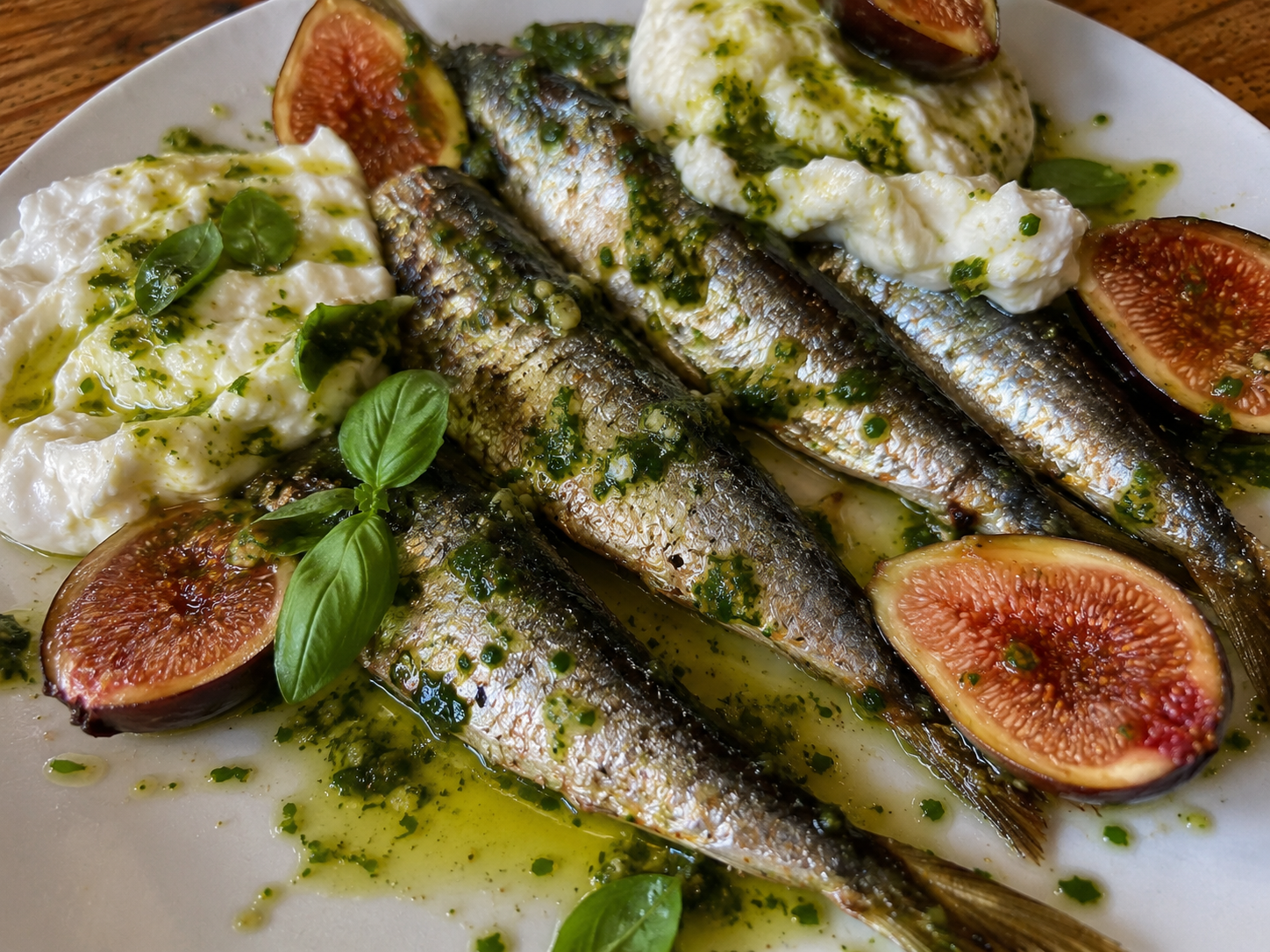
Marine omega-3 + polyphenol-rich figs + raw dairy fat-soluble vitamins (A, D, K2) in a single bite.
Yield: 4 as appetizer
Active: 20 min · Total: 30 min (with 10-min cure)
Late summer
A note on raw sardines
For raw preparations, sourcing matters more than for any cooked recipe. Two paths to safe raw sardines:
Path 1 — Buy from a fishmonger who handles sashimi-grade fish. Tell them you're eating it raw. They'll know what to give you. Use within 12 hours.
Path 2 — Freeze your fresh sardines first. Wrap sardines tightly in plastic and freeze at the coldest setting (ideally below 0°F / -18°C) for at least 7 days. This protocol kills any potential parasites. Thaw overnight in the refrigerator before using.
The 10-minute lemon-and-salt cure in the recipe below also acts as a structural firming — it tightens the flesh and adds a layer of food-safety buffer.
Ingredients
For the cured sardines:
8 very fresh sardines, filleted (skin on or off, your preference)
1 tbsp fresh lemon juice
½ tsp fine sea salt
For the plate:
6 ripe fresh figs (Black Mission, Brown Turkey, or Adriatic), torn into halves or quarters
1 ball fresh burrata (about 8 oz, from raw or minimally-pasteurized grass-fed milk when possible)
3 tbsp high-quality extra-virgin olive oil
1 small handful fresh basil leaves
1 tsp aged balsamic vinegar (the syrupy aged kind, not standard supermarket balsamic)
Flaky sea salt (fleur de sel) for finishing
Freshly cracked black pepper
Method
Cure the sardines. Lay the sardine fillets flat on a plate. Squeeze the lemon juice evenly over them and sprinkle with the fine sea salt. Let them sit for exactly 10 minutes — the flesh will turn opaque at the edges and firm up slightly. Don't go longer than 15 minutes or the texture turns mealy. Pat the fillets dry with paper towels.
Slice the sardines. Lay each fillet flat and slice on a slight diagonal into pieces about ½ inch wide. (Or leave whole if the fillets are small.)
Make the basil oil. Tear the basil leaves roughly. In a small bowl, combine 3 tbsp olive oil with the torn basil. Let it sit while you assemble the plate — this is a 5-minute quick infusion, no blender required.
Assemble. On a large flat platter or 4 individual plates, scatter the torn figs. Tear the burrata into rough pieces with your hands (don't slice — the soft interior should ooze out) and place the pieces between the figs. Drape the sliced sardines over and among the figs and burrata.
Finish. Spoon the basil oil (leaves and all) over everything. Add a thin thread of aged balsamic — just a few drops total, not a flood. Finish with flaky sea salt and freshly cracked black pepper.
Serve immediately. This is best eaten within 15 minutes of assembling. Eat with a small fork, getting a bit of sardine + fig + burrata in each bite.
Why this dish
Raw sardines deliver their full omega-3 DHA load without any heat-damaged oxidation. Ripe figs deliver polyphenols, natural sugars, fiber, and calcium. Raw burrata delivers fat-soluble vitamins A, D, K2, and the Wulzen factor (the "anti-stiffness factor" found only in raw dairy). Together, this single bite delivers structural nutrition from three different ancient food categories — sea, tree, and pasture — in a way almost no modern dish does.
Recipe 8 · Pan-Seared Sardines with Avocado-Kefir Crema
Marine omega-3 meets probiotic gut bacteria meets monounsaturated fats in a 20-minute one-pan plate.
Yield: 4 servings
Active: 20 min · Total: 25 min
Spring through fall
Ingredients
For the sardines:
12 fresh whole sardines, scaled and gutted (or 16 sardine fillets)
2 tbsp high-quality extra-virgin olive oil
½ tsp sea salt
Freshly cracked black pepper
For the avocado-kefir crema:
1 large ripe avocado
½ cup whole-milk raw kefir
2 tbsp fresh lime juice
½ tsp sea salt
1 small clove garlic (optional)
Optional: a small handful of fresh cilantro (for blending into the crema for a green herb crema variation)
For the plate:
8 shishito peppers (or padrón peppers)
1 tbsp high-quality extra-virgin olive oil
Flaky sea salt
1 tsp finely grated lime zest
A small handful of fresh cilantro leaves, torn
Optional: a pinch of Aleppo pepper or red pepper flakes
Method
Make the crema first. Combine the avocado, kefir, lime juice, sea salt, and optional garlic in a high-speed blender. Blend 30 seconds until completely smooth and the texture is loose-pourable like a thick salad dressing. Taste and adjust salt. Refrigerate while you cook the sardines.
Char the peppers. Heat a small cast-iron pan over high heat until smoking. Add the shishito peppers (no oil needed at first). Char dry for 2 minutes, shaking the pan, until blistered on all sides. Drizzle the olive oil over them, sprinkle with flaky salt, and toss for 30 more seconds. Remove from heat and set aside.
Sear the sardines. Pat the sardines completely dry. Heat the olive oil in a large heavy skillet over medium-high heat until shimmering. Sprinkle the sardines with sea salt and pepper. Lay them in the pan in a single layer (work in two batches if needed — don't crowd). Sear 2 minutes per side until the skin is crisp and the flesh is just opaque at the thickest part.
Assemble. Spoon a generous swoosh of the avocado-kefir crema onto each of 4 plates. Lay 3 sardines (or 4 fillets) on top of the crema on each plate. Arrange 2 charred shishito peppers alongside.
Finish. Scatter the lime zest, torn cilantro, and optional Aleppo pepper across each plate. Serve immediately.
Why this dish
Pan-searing on high heat preserves most of the marine omega-3 (only deep-frying or extended high heat truly damages omega-3 oils). The raw kefir delivers 12+ strains of live probiotic bacteria (Lactobacillus, Bifidobacterium, beneficial yeasts) that support gut health and aid digestion of the oily fish. Avocado adds MUFA fats, fiber, magnesium, and potassium. The shishito peppers add capsaicin and vitamin C. Cilantro is one of the most documented chelating herbs for supporting natural detoxification. This is a structurally complete one-plate meal that delivers gut-brain-immune nutrition in 20 minutes.
Sourcing notes
Raw kefir: Whole-milk grass-fed kefir from a small dairy is the gold standard. Increasingly available at health food stores. If unavailable, whole-milk pasture-fed kefir (minimally processed) is the next best choice.
Shishito or padrón peppers: Available at farmers' markets in summer, and increasingly at conventional grocery stores. Mostly mild with the occasional spicy one — Spanish "Russian roulette" peppers.
Recipe 9 · Pan-Seared Sardines over Roasted Winter Squash with Brown Butter, Crispy Sage, and Honey
Yield: 4 servings
Active: 25 min · Total: 50 min
Late autumn through early winter
Ingredients
For the roasted squash:
1 small kabocha, delicata, or kuri squash (about 2 lb) (or sweet potato works)
2 tbsp high-quality extra-virgin olive oil
½ tsp sea salt
Freshly cracked black pepper
For the sardines:
12 fresh whole sardines, scaled and gutted (or 16 sardine fillets)
2 tbsp high-quality extra-virgin olive oil
½ tsp sea salt
For finishing:
4 tbsp grass-fed butter
12–16 fresh sage leaves
¼ cup raw sunflower seeds, lightly toasted in a dry pan (or substitute with pumpkin seeds)
2 tsp raw honey (preferably local, dark, unfiltered)
Flaky sea salt
Fresh thyme leaves (optional)
Method
Roast the squash. Preheat the oven to 425°F. Cut the squash in half, scoop out the seeds. (For delicata squash, the skin is edible and tender; for kabocha or kuri, the skin is also edible after roasting — no need to peel.) Cut the squash into ½-inch thick half-moons or 1-inch cubes. Toss with the olive oil, sea salt, and pepper on a sheet pan. Roast 25–30 minutes, flipping once halfway through, until deeply caramelized at the edges and tender in the center.
While the squash roasts, prep the sardines. Pat the sardines completely dry with paper towels — dry fish is essential for a clean sear. Sprinkle with sea salt.
Make brown butter and crispy sage. In a small saucepan, melt the grass-fed butter over medium heat. Continue cooking, swirling occasionally, until the butter turns a deep golden brown and smells nutty — about 4–5 minutes. The milk solids should be lightly toasted at the bottom of the pan, not burnt. Add the sage leaves and let them crisp in the brown butter for 30 seconds. Remove from heat and pour the brown butter (with sage leaves and toasted milk solids) into a small bowl. Set aside.
Sear the sardines. Heat the 2 tbsp olive oil in a large heavy skillet over medium-high heat until shimmering. Lay the sardines in the pan in a single layer. Sear 2 minutes per side without moving, until the skin is crisp and the flesh is just opaque at the thickest part.
Plate. Arrange the roasted squash across 4 plates. Lay 3 sardines (or 4 fillets) on top of the squash on each plate. Spoon the brown butter (with sage leaves) generously over the sardines and squash. Scatter the toasted sunflower seeds across the plate.
Finish. Drizzle a thin thread of raw honey across each plate (just a few drops per plate — the honey should accent, not coat). Finish with flaky sea salt and a few fresh thyme leaves if using.
Serve immediately. Eat with a knife and fork, getting a bit of squash, sardine, brown butter, and crispy sage in each bite.
Why this dish
Sardines are rarely paired with winter squash, but structurally, they belong together. The deep beta-carotene in heirloom squash converts to vitamin A in the body, which is fat-soluble and needs the marine fat in sardines for proper absorption. The grass-fed brown butter delivers vitamin K2, fat-soluble vitamins A and D, and CLA (conjugated linoleic acid) — which then work with the calcium from the sardine bones to direct minerals into bone and away from soft tissue. Heirloom winter squash adds concentrated fiber, magnesium, and potassium. Crispy sage delivers terpenes with documented anti-inflammatory effects. Raw sunflower seeds contribute vitamin E, magnesium, and selenium. The thread of raw honey adds glucose oxidase and polyphenol compounds. The flavor — buttery roasted squash + crispy sardine skin + nutty brown butter + crispy sage + a thread of honey — is genuinely autumnal and grounding. This is one of the most nutritionally complete single plates in autumn cooking.
Part Three — Tinned Sardines, Done Beautifully
Fresh sardines are the ideal, but tinned sardines remain a structurally legitimate everyday food when sourced properly. The wrong tinned sardine — packed in industrial seed oils, factory-grade fish, sweetened tomato sauce — has given the category an undeserved reputation. The right tinned sardine — small-batch, whole fish with skin and bones intact, packed in single-estate Spanish or Portuguese EVOO — is a pantry staple that delivers near-fresh nutritional density year-round.
What to look for in tinned sardines:
Packed in extra-virgin olive oil (not soybean, sunflower, "vegetable oil," or canola)
Wild-caught, line-caught when possible
Whole fish with skin and bones intact (skinless boneless fillets lose most of the calcium and omega-3)
Small artisan producers from Spain, Portugal, France, or the U.S. West Coast
Single-ingredient list beyond sardines, EVOO, and salt
Glass jars or BPA-free cans when available
What to avoid:
Sardines packed in tomato sauce with added sugar
Industrial seed oils (soybean, sunflower, canola, "vegetable oil")
Skinless, boneless fillets that have lost their structural nutrition
Mass-produced supermarket brands with unclear sourcing
Producers I trust:
Bela (Portuguese, single-estate EVOO, beautiful quality)
Fishwife (modern accessible premium, US-based, sustainable sourcing)
Wild Planet (West Coast, sustainably caught, available at most natural food stores)
Nuri (Portuguese heritage brand, century-old methods)
Matiz (Spanish, Galician sourcing, excellent EVOO)
Conservas Pinhais (Portuguese, century-old factory, hand-packed)
Ortiz (Spanish, sardines in organic EVOO)
Pan do Mar / Antonio Pérez Lafuente (sustainable/controlled Northeast Atlantic inshore fisheries, with organic Spanish EVOO)
Quick recipe ideas for tinned sardines
Sardines on toast/baguette with raw butter and radishes. Spread grass-fed raw butter on a slice of toasted grain-free seed bread or sprouted sourdough. Drape 2–3 tinned sardine fillets across. Top with thinly sliced fresh radishes, flaky salt, and a squeeze of lemon.
Sardine, avocado, and lemon salad on cucumber rounds. Mash one tin of sardines (oil and all) with half an avocado, a squeeze of lemon, a small amount of finely chopped red onion, and fresh dill. Spoon onto thick cucumber rounds. Finish with flaky salt and cracked pepper.
Sardine "rillette" with capers and shallot. Mash one tin of sardines with 2 tbsp softened grass-fed butter, 1 tbsp capers, 1 finely minced shallot, lemon zest, and parsley. Refrigerate 30 minutes. Serve as a spread on cucumber rounds, endive leaves, or grain-free crackers.
Sardines with eggs and harissa. Heat the oil from a tin of sardines in a small skillet. Crack two pasture-raised eggs into the warm oil and let them cook to your liking. Plate the eggs with the sardines, a small spoon of harissa or chile crisp, fresh herbs, and lemon. Breakfast-meets-Mediterranean.
Sardine "putanesca" over zucchini noodles. In a skillet, gently warm one tin of sardines (oil and all) with 2 cloves minced garlic, ½ cup halved cherry tomatoes, 2 tbsp capers, 6 chopped Kalamata olives, red pepper flakes, and lemon zest. Toss with hot zucchini noodles. Finish with fresh parsley and shaved Pecorino Romano.
Sardine sandwich-on-cucumber. Layer tinned sardine fillets between thick cucumber rounds (instead of bread). Add a thin slice of pickled red onion, a leaf of butter lettuce, and a small spoon of homemade aioli or anchovy butter. The grain-free sardine "sandwich."
Nourishment Notes — why sardines are one of the most nutrient-dense foods on Earth
Sardines are structurally extraordinary — small enough to escape the bioaccumulation of contaminants that plagues larger predatory fish, oily enough to deliver meaningful concentrations of marine-grade omega-3s, bony enough to deliver bioavailable calcium without dairy, and complete enough that traditional cultures have relied on them as a foundational source of nourishment for thousands of years.
Marine omega-3 fatty acids (DHA and EPA). A 3.5-oz serving of sardines delivers approximately 1.5–2 grams of long-chain marine omega-3 — among the highest concentrations of any food. DHA is the primary structural fat of the human brain and retina; EPA carries documented anti-inflammatory effects. Eating sardines twice a week delivers more usable DHA/EPA than nearly any other dietary strategy, including salmon and most omega-3 supplements. The omega-3 in sardines is structurally bioavailable, as it comes embedded in whole-food fish oil rather than extracted and oxidized capsule form.
Vitamin D. Sardines are one of the few non-fortified foods that delivers meaningful vitamin D — about 175 IU per 3.5-oz serving. The vitamin D in oily fish is structurally synergistic with the marine omega-3s and the fat-soluble vitamins A and K2 that also occur in the same fish. Vitamin D supports bone health, immune function, mood, and the regulation of more than 200 genes throughout the body.
Vitamin B12. Sardines deliver about 9 micrograms of B12 per 3.5-oz serving — over 350% of the recommended daily intake. B12 is critical for nervous system function, red blood cell production, and DNA synthesis. Plant-based diets struggle to deliver bioavailable B12; sardines deliver it abundantly and inexpensively.
Calcium (from the bones). This is structurally what makes sardines a uniquely complete food. When you eat sardines whole — with the soft, tiny bones that have softened through cooking — you consume approximately 350 mg of bioavailable calcium per 3.5-oz serving, equivalent to a cup of milk. Unlike isolated calcium supplements, the calcium in sardine bones comes embedded in the protein matrix and accompanied by phosphorus, vitamin D, magnesium, and vitamin K2 — the structural cofactors that the body actually needs to deposit calcium into bone tissue rather than soft tissue. Sardines are one of the most concentrated whole-food sources of bioavailable calcium in the entire human diet.
Selenium. Sardines are one of the densest food sources of selenium — about 50 micrograms per 3.5-oz serving (over 70% of the recommended daily intake). Selenium is one of the minerals most commonly deficient in modern diets, particularly in inland populations far from ocean ecosystems. Selenium supports thyroid function, immune defense, and the body's primary antioxidant systems (glutathione peroxidase).
Iodine. As with all ocean fish, sardines deliver bioavailable iodine — critical for thyroid function and chronically under-consumed in non-coastal populations.
CoQ10, taurine, carnitine, and complete protein. Like other oily fish and red meat, sardines deliver these specific compounds that support cardiovascular health, mitochondrial function, and cellular energy production. A 3.5-oz serving contains about 22 grams of complete protein with all essential amino acids.
The structural advantage of small fish. Sardines sit near the base of the marine food chain, eating plankton, microalgae, and tiny crustaceans. They live 4–6 years, consume simple food, and accumulate almost none of the mercury, PCBs, dioxins, and microplastics that plague larger predatory fish (tuna, swordfish, shark, larger salmon). The small-fish approach is genuinely the cleanest, most nutrient-dense way to eat from the sea.
Sardines as one of the most economical real foods. Here is one of the great structural ironies of modern eating: one of the most nutrient-dense foods on Earth is also among the cheapest. Fresh sardines at a coastal fishmonger typically run a fraction of what tuna, salmon, or other "premium" fish cost. The industrial food culture has trained American consumers to pay premium prices for larger fish that are nutritionally less dense and more contaminated, while the small oily fish that deliver the most complete nourishment are sold for almost nothing. Traditional Mediterranean cultures have always known this — sardines and anchovies anchor the coastal Mediterranean diet not because they're "poverty food" but because they're structurally accurate about where ocean nourishment actually lives.
Sourcing
Fresh whole sardines:
Should smell of clean ocean — never fishy, sour, or ammonia-like. This is the single most important indicator of freshness.
Silver-bright skin with no dullness or yellowing. The iridescent blue-green sheen on the back should be vibrant.
Clear, slightly bulging eyes — never cloudy, sunken, or with red discoloration.
Deep red gills — never brown, gray, or pale.
Firm flesh that springs back when pressed gently with a fingertip.
From a small specialty fishmonger, Spanish/Portuguese/Italian/Mediterranean grocer, Latin American fishmonger, or a coastal seafood counter when possible.
Use within 24 hours of purchase. Sardines deteriorate faster than almost any other fish because of their high oil content.
Frozen sardines (acceptable second choice): look for individually quick-frozen (IQF) whole sardines in the freezer section. Thaw overnight in the refrigerator; never use the microwave or hot water.
High-quality extra-virgin olive oil:
Single-estate (one farm, one variety, one harvest), harvest-dated within the last 12 months.
In a dark glass bottle.
Should smell fresh, green, slightly peppery — never musty or rancid.
Spanish single-origin olive oils (Picual, Hojiblanca, Arbequina) are the traditional companion to coastal Spanish fish cookery.
Aged sherry vinegar:
Made from sherry wine, aged in oak barrels minimum 6 months.
Look for "aged" or "reserva" on the label — minimum 2 years for the deeper, more concentrated flavor.
Spanish Jerez-region producers (including those carrying DOP designation) are the traditional gold standard.
Substitutes: aged red wine vinegar (Italian or French) or a small-batch apple cider vinegar.
Capers:
Salt-cured capers (not brined) for the most concentrated flavor. Rinse before using.
Wild-foraged from the Mediterranean when available (look for "Pantelleria" or "Salina" island sources from Italy).
Avoid cheap brined capers in vinegar — the flavor is industrial.
Smoked paprika:
Spanish-style smoked paprika is the structural choice — oak-smoked, deeply aromatic.
Three styles: sweet (dulce), bittersweet (agridulce), and hot (picante).
Should smell intensely of smoked oak.
Pine nuts (for the herb-nut-topped sardines):
Italian or Mediterranean-sourced when possible (Pinus pinea — true Mediterranean pine nuts).
Avoid cheap Chinese pine nuts (Pinus armandii), which can cause a "pine mouth" taste disturbance lasting 1–2 weeks.
Lightly toasted in a dry pan to deepen flavor.
Grass-fed butter (for the brown butter and squash recipe):
From cows on pasture year-round when possible.
Cultured butter (fermented before churning) has the deepest flavor.
Deep yellow color is the visual indicator of grass-fed dairy.
Raw honey (for the brown butter recipe):
Local, unfiltered, single-origin when possible.
Look for honey that's still slightly crystallized — the liquid clarity of conventional honey is often the result of heating, which destroys glucose oxidase and pollen content.
Dark wildflower or buckwheat honeys deliver more antioxidants than clover honey.
Raw kefir (for the avocado-kefir crema):
Whole-milk grass-fed kefir from a small dairy is the gold standard.
Increasingly available at health food stores.
If unavailable, whole-milk pasture-fed kefir (minimally processed) is the next best choice.
Sea salt:
Baja Gold mineral sea salt (third-party tested at 29.5–31.5% sodium, harvested from the Sea of Cortez, solar-dried) or any equivalent unrefined mineral-rich sea salt for cooking.
Fleur de sel for finishing.
What to Serve With Sardines
The richness of sardines wants bright, acidic, herbal, and crisp companions — exactly the structural counterpoints that anchor Mediterranean coastal cooking. The accompaniments below are organized in three sections: bright accompaniments that cut the richness, vegetable companions that round out the plate, and complete plate combinations that demonstrate how the pieces work together.
Bright accompaniments to cut the richness
Salsa verde. Parsley, garlic, capers, anchovy, lemon, olive oil. The classic Basque finishing sauce. Especially beautiful with grilled and pan-seared sardines.
Aioli. Garlic mayonnaise made with egg yolk, lemon, and high-quality olive oil. Beautiful with grilled sardines.
Salmoriglio. Sicilian herb sauce of oregano, garlic, lemon juice, olive oil. Specifically for grilled fish.
Romesco. Roasted red pepper, almond, garlic, sherry vinegar sauce. Beautiful with sheet-pan or grilled sardines.
Fresh tomato salad. Sliced heirloom tomatoes with sea salt, olive oil, fresh basil. Peak summer pairing.
Fennel and citrus salad. Shaved raw fennel, sliced oranges or blood oranges, olives, olive oil, sherry vinegar. Beautiful textural contrast against the oily fish.
Cucumber and red onion. Thinly sliced cucumber, pickled red onion, dill, lemon. Cuts the richness of oily fish.
Charred padrón peppers. Blistered in olive oil with flaky salt. The classic Basque pintxos pairing.
Pickled accents. Capers, cornichons, pickled red onion, quick-pickled radish. The acid cuts the fat directly.
Vegetable companions
Roasted red peppers. Piquillos or charred bell peppers with garlic and olive oil. The smoky sweetness sits beautifully beside the oily fish.
Roasted potatoes. Crispy small potatoes with rosemary, garlic, and sea salt.
Grilled or roasted asparagus. Lightly charred with lemon zest. Peak spring pairing.
Roasted artichoke hearts. Tossed in olive oil with herbs.
Roasted heirloom winter squash. Kabocha, delicata, or kuri — the autumn pairing.
A jammy egg. A 6-minute soft-boiled or fried pasture-raised egg, served alongside grilled or confited sardines — the runny yolk creates a natural emulsion.
Aged sheep cheeses. Shaved aged Manchego, Idiazábal, or Pecorino Romano alongside grilled sardines. Sharp cheese cuts the oily richness beautifully.
Raw burrata. The summer pairing, especially with crudo or with fresh tomato.
Complete plate combinations
Classic Basque sardine plate. Plancha-grilled sardines + salsa verde + charred padrón peppers + a small bitter greens salad with sherry vinegar.
Sicilian summer plate. Sardine crudo with figs and burrata + a small tomato salad + fresh basil + aged balsamic.
Pickled sardine plate. Sardines en escabeche + sliced cucumber + a soft-boiled egg + a small piece of aged Manchego.
Sardine confit picnic. Confited sardines + shaved aged Pecorino + sliced tomatoes + roasted red peppers + fresh figs (in season).
Mediterranean sheet-pan dinner. Roasted sardines with summer vegetables and peppers + a simple arugula salad + crusty grain-free crackers.
Pacific-meets-Galicia plate. Pan-seared sardines + avocado-kefir crema + charred shishito peppers + fresh cilantro + lime wedges.
Autumn coast plate. Pan-seared sardines + roasted winter squash + brown butter and crispy sage + toasted sunflower seeds + a thread of raw honey.
Sicilian-Basque feast. Herb-nut-topped sardines + romesco sauce + roasted artichokes + grilled lemon + arugula salad.
Summer dinner-party menu. Plancha sardines as starter → tomato and burrata salad → grilled lamb chops or seared duck → simple stone fruit dessert.
Storage
Fresh uncooked sardines: Use within 24 hours of purchase. Store in the coldest part of the refrigerator on a bed of crushed ice, draped with a damp cloth.
Cooked sardines: Best eaten same-day. If you must save, refrigerate up to 24 hours in a glass container; eat cold over a salad. Never reheat in the microwave — it degrades the omega-3 oils and destroys the texture.
Sardines en escabeche: Keeps in the refrigerator up to 5 days, fully submerged in the brine. The flavor improves over the first 48 hours.
Sardines confit: Keeps in the refrigerator up to 1 week, fully submerged in the olive oil bath. Use the infused oil as a finishing oil for salads and vegetables.
Avocado-kefir crema: Best made fresh. Keeps in the refrigerator up to 24 hours covered tightly (place plastic wrap directly on the surface to prevent oxidation).
Tinned sardines: Unopened, keep in the pantry up to 2 years. Once opened, transfer leftovers to a glass container, cover with the remaining oil, and refrigerate up to 3 days.
Pairs Well With
For the table: Sparkling water with lemon and fresh herbs, fresh-pressed citrus juice, or a small cup of fresh-pressed cucumber-mint water. Traditional Mediterranean coastal cuisine also pairs sardines with kombucha or water kefir for the digestive enzyme support that helps with rich oily fish.
For a complete coastal feast: Build a Mediterranean progression — start with plancha sardines as the seafood opener, move to a grilled vegetable or roasted pepper course, finish with grilled lamb chops or a slow-braised stew. Add a small aged cheese board to bridge between courses.
For a land-to-sea menu: Pair sardines with the offal hub recipes (the Basque coastal tradition has always interleaved fish and organ meat). Grilled sardines as starter → veal sweetbreads or lamb liver as main → a fresh seasonal fruit dessert like the Blueberry Cheesecake or Raw Caramel Apple Cheesecake.
For seasonal context: Fresh sardines are at their peak from late spring through early autumn in Atlantic and Mediterranean waters (the summer fishing season). In winter, frozen or tinned sardines remain a structurally legitimate everyday food — particularly the tinned confit-style sardines from small Spanish and Portuguese producers.
Why These Fish
Real eating doesn't begin and end with premium muscle cuts of the most-marketed fish. Small oily fish — sardines, anchovies, mackerel, herring — deliver structural nutritional density that larger fish cannot match: high omega-3 DHA and EPA, complete protein, bioavailable calcium from soft bones, vitamin D, vitamin B12, selenium, iodine — all in a structurally clean package free from the heavy metal and microplastic bioaccumulation of larger predatory fish.
Eating sardines the way many cultures around the world eat them — whole, with bones and skin, minimally cooked, paired with bright acid and fresh herbs — is one of the most direct ways to reconnect with whole-food eating, with traditional coastal nutrient density, and with one of the most accessible "superfoods" that exists.
— Anna aka Food Marshall