Duck Tacos with Nixtamalized Corn Tortillas, Purple Cabbage Slaw, and Green Chimichurri
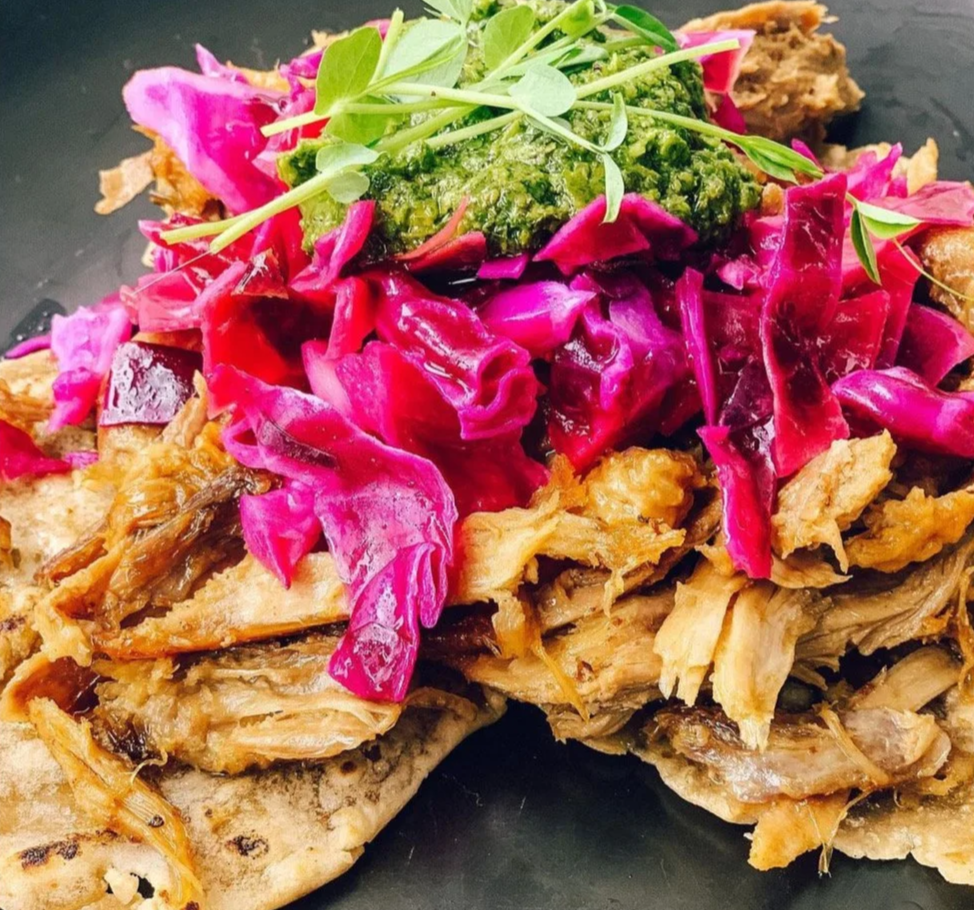
Autumn's most underrated protein, served on the oldest flatbread in the Americas. Herb-butter roasted duck, pulled into tender, crisp-edged shreds, piled onto warm heirloom corn tortillas (purple, blue, or golden) or grain-free cassava tortillas, with a bright marinated purple cabbage slaw, a vivid green chimichurri, and a crisp radish salad.
A Mesoamerican, French, and Argentine harvest fusion
See the IG Post of the recipe here
Yield: Serves 4–6 · Active: 45 min · Total: 2 hr 30 min · Best in North America in fall and early winter · Best eaten: late afternoon or early evening
Ingredients
Roasted duck
1 whole pasture-raised duck (5–6 lb), air-dried if possible
1 tbsp Baja Gold sea salt
1 tsp freshly ground black pepper
4 tbsp raw grass-fed butter, melted (or ghee)
3 garlic cloves, finely grated
1 tbsp each fresh rosemary, tarragon, sage, and thyme leaves, finely chopped
Mexican-spiced (carnitas-style) alternative: In place of the herb butter, use 3 tbsp lard or duck fat mixed with 1 tsp ground Ceylon cinnamon, ½ tsp ground cloves, 1 tbsp dried Mexican oregano, and 4 grated garlic cloves. Tuck a quartered orange into the cavity, and squeeze half of it over the skin. Warm, citrus-bright, and deeply aromatic.
Tortillas: choose one path
Path A: Nixtamalized heirloom corn (ancestral) — makes about 12 tortillas
2 cups heirloom nixtamalized masa harina (yellow, white, blue, or purple corn)
1½ cups warm filtered water
½ tsp Baja Gold sea salt
For deep-purple tortillas, use purple or blue corn masa harina. Their color comes from anthocyanins, the same pigments found in blueberries and purple cabbage.
Path B: Cassava (grain-free and corn-free) — makes about 8 tortillas
1 cup cassava flour (not tapioca flour)
2 tbsp extra virgin olive oil (or melted coconut oil)
½ tsp Baja Gold sea salt
½ cup warm filtered water, plus more as needed
Optional color: 1 tsp beet powder (pink), spirulina (green), turmeric (golden), or purple sweet potato powder (purple)
For a purple cassava tortilla, use purple sweet potato powder to keep them grain-free, or swap 2–3 tbsp of the cassava flour for purple corn masa harina (they'll no longer be grain-free).
Purple cabbage slaw
Make the Marinated Purple Cabbage Slaw with Cilantro and Pepitas below.
Short on time? Quick massaged slaw: Massage 4 cups very thinly sliced purple cabbage and 1 julienned carrot with 2 tbsp raw apple cider vinegar, 2 tbsp extra virgin olive oil, ½ tsp salt, and a pinch of pepper for 2–3 minutes, until the cabbage softens, shrinks by about a third, and turns a deeper magenta. Let it rest at least 10 minutes.
Green herb chimichurri
1 cup fresh cilantro leaves (with tender stems)
½ cup fresh flat-leaf parsley
¼ cup fresh mint leaves
2 garlic cloves
½ tsp Baja Gold sea salt
1 tbsp raw honey
2 tbsp raw apple cider vinegar
1 tbsp fresh lemon juice
½ cup extra virgin olive oil
Optional: a pinch of red chile flakes
Bright radish salad (optional, but a lovely palate cleanser)
1 bunch breakfast radishes or 1 watermelon radish, thinly sliced
¼ red onion, thinly sliced into half-moons
2 tbsp fresh lime juice
1 tbsp extra virgin olive oil
2 tbsp fresh mint, torn, and 1 tbsp fresh tarragon, torn
Pinch of Baja Gold sea salt
To serve
A handful of baby arugula or mixed greens per person
Optional: sliced avocado
Optional: shredded aged grass-fed cheese (Manchego, aged raw cheddar, or cotija)
Fresh cilantro leaves, lime wedges, and flaky sea salt
Method
The game plan: Start the duck first. While it roasts (about 2 hours), make the slaw, chimichurri, tortillas, and radish salad. Everything comes together within 15 minutes of the duck coming out of the oven.
Duck
Prep. Heat the oven to 400°F. Take the duck out of the fridge 30 minutes before roasting, and pat it completely dry, inside and out. Dry skin is what gets crisp.
Prick the skin. Prick the skin all over with a sharp knife, especially over the fatty breast and thighs, without piercing the meat. This lets the fat render out, so the skin crisps instead of staying rubbery.
Season. Season the cavity generously with salt and pepper, then season the outside all over. Don't be shy; a 5-lb duck needs plenty of salt. Mix the melted butter with the garlic and herbs.
Brush with herb butter. Brush about two-thirds of the herb butter all over the duck, getting into the leg crevices and under the loose neck skin, and pour the rest into the cavity. Set the duck breast-side up on a rack in a heavy roasting pan.
Roast at 400°F for about 2 hours, basting with the pan juices every 30–40 minutes, until the thigh reaches 175–180°F and the meat is tender enough to pull apart easily. Pour off and save the rendered fat partway through, so it doesn't smoke.
Crisp the skin. Turn the oven to broil (high). Broil 5 minutes breast-side up, then carefully flip the duck and broil 5 minutes on the back. Watch closely; you want crackling-crisp, not burned.
Rest and pull. Rest the duck on a cutting board, loosely tented with foil, for 15 minutes. Pull the meat from the bones with two forks, and arrange it on a warm platter with a few spoonfuls of pan juices. Save the bones for broth, and save the rendered duck fat, which keeps for months in the fridge.
Corn tortillas (Path A)
Make the dough. Mix the masa harina and salt, then gradually add the warm water, mixing with your hands until the dough comes together. Knead 1–2 minutes. It should feel like soft play dough, holding its shape when pressed without cracking. Add water or masa as needed. Cover with a damp cloth and rest 10 minutes.
Press. Divide the dough into 12 golf-ball-sized pieces, keeping them covered. Press each one between two pieces of parchment in a tortilla press (or with a heavy, flat-bottomed plate) to ⅛ inch thick, thinner than you think.
Cook on a dry cast iron skillet or comal over medium-high heat until very hot, 30–45 seconds per side, until small bubbles form and the edges lift. The tortilla should puff slightly. Stack them in a clean towel or tortilla warmer to stay soft.
Cassava tortillas (Path B)
Make the dough. Whisk the cassava flour, salt, and any color powder, then rub in the olive oil with your fingers. Gradually add the warm water, mixing until the dough comes together, and knead briefly until smooth.
Roll. Divide into 8 balls, and roll each one between two pieces of parchment to about ⅛ inch thick.
Cook on a dry cast iron skillet over medium heat 1–2 minutes per side, pressing gently with a spatula, until light brown spots appear and the tortilla is cooked through but still pliable.
Green chimichurri
Pulse the cilantro, parsley, mint, garlic, and salt in a food processor until finely chopped, using quick pulses so it doesn't turn to purée. (For a more rustic, traditional Argentine texture, chop everything by hand.)
Transfer to a bowl, and whisk in the honey, vinegar, lemon juice, olive oil, and chile flakes (if using). Taste and adjust.
Radish salad (if making)
Toss the radishes and red onion with the lime juice, olive oil, torn herbs, and salt. Let it rest 10–15 minutes, until the radishes soften slightly.
Serve
Set everything in the center of the table: the platter of warm pulled duck, the tortilla warmer, the slaw, the chimichurri, the radish salad, the greens, avocado, cheese, cilantro, and lime wedges. Everyone builds their own: a tortilla, a few greens, pulled duck, a spoonful of slaw, a drizzle of chimichurri, a scatter of radish, and a sprinkle of cheese. Pass the flaky salt.
Storage: Leftover pulled duck keeps 3–4 days refrigerated and reheats beautifully in a little of its own fat. Next-day duck tacos are arguably even better. It also makes a wonderful cold salad with greens and chimichurri. Rendered duck fat keeps 3–4 months refrigerated. The chimichurri keeps 3 days and gets better after the first few hours. The quick massaged slaw is best within a few hours. Tortillas are best fresh, but keep wrapped in a clean towel for several hours.
Nourishment Notes
This dish brings together food traditions from three continents, each with deep ancestral roots.
Duck is one of the most underappreciated proteins in the American kitchen. Pasture-raised ducks forage naturally and spend time in water and sun, and their meat is rich in iron, zinc, B12, selenium, and B vitamins. Its darker color comes from myoglobin, a sign of active muscle. Across the Northern Hemisphere, duck has long been a cold-weather and harvest food, from Chinese Peking duck to French confit de canard to the Yucatán's pato en escabeche. It's richer in fat than chicken, and that's the point: autumn calls for fat. The rendered duck fat in the pan is one of the most prized cooking fats in traditional European cooking. It's mostly monounsaturated oleic acid (the same fat in olive oil), with about a third saturated fat, and it carries fat-soluble vitamins. Don't pour it down the drain; a jar of duck fat will make every roasted vegetable better for the next six weeks.
Nixtamalization, the process behind traditional corn tortillas, is one of the great food technologies in human history. Developed in Mesoamerica at least 3,500 years ago, it means soaking and cooking dried corn in an alkaline solution, traditionally slaked lime (cal) or wood ash. The word comes from the Nahuatl nextli (ashes) and tamalli (dough). It makes the niacin in corn available to the body, improves its protein quality, greatly increases its calcium, and greatly reduces aflatoxin, a toxin produced by molds that can grow on corn. Without nixtamalization, a corn-based diet can cause pellagra, the niacin-deficiency disease that sickened millions in the American South in the early 20th century and killed many thousands, among people who had adopted corn as a staple without the traditional processing. In Mesoamerica, where nixtamalization had been part of food culture for millennia, pellagra was rare. Heirloom purple and blue corn add anthocyanins, the same pigments found in blueberries and purple cabbage.
Cassava, the grain-free alternative, was domesticated in the Amazon basin thousands of years ago and has fed much of South America, Africa, and the Caribbean ever since. It contains resistant starch, a prebiotic fiber that feeds beneficial gut bacteria. Both tortilla paths are traditional foods, not compromises.
Purple cabbage is a brassica, rich in glucosinolates, which convert to sulforaphane and other isothiocyanates when the cabbage is cut and chewed, supporting the liver's Phase 2 detoxification pathways. Its deep color comes from anthocyanins, echoing the purple corn, so the visual harmony of this dish is nutritional harmony too.
The herbs bring vitamin K (parsley is one of the richest sources), vitamin C, and aromatic compounds, and mint is traditionally used to support digestion. Pairing a bright, acidic herb sauce with rich roasted meat is a tradition found around the world, and it's no coincidence: the acidity and herbs balance the richness of the duck.
As a circadian and seasonal food, this plate belongs to the late afternoon or early evening. Duck is rich, and it's best enjoyed while your digestion is still at its most active and there's still light on the table; a late-night version pushes back the body's evening wind-down. Autumn is also the season of deep pigments, and a harvest table built around the anthocyanins of late-season purples is a beautiful way to eat with the season as the light shortens.
Marinated Purple Cabbage Slaw with Cilantro and Pepitas
A Mexican-inspired foundational slaw that upgrades every taco, bowl, and roasted plate.
Yield: About 6 cups (serves 6–8 as a side, or fills 12–16 tacos) · Active: 15 min · Total: 30 min minimum (best after 2 hours or more) · Year-round · Best eaten: any daylight hour, alongside richer meals
Ingredients
Slaw
½ head purple cabbage, cored and very thinly shredded (about 4 cups)
1 large carrot, julienned or shaved into thin ribbons with a peeler
¼ small red onion, very thinly sliced and rinsed briefly in cold water (to soften its bite while keeping its color)
½ cup fresh cilantro leaves, roughly chopped
¼ cup raw pepitas, toasted
Optional: 1 jalapeño, seeded and thinly sliced into rings
Dressing
3 tbsp raw apple cider vinegar (with the mother)
2 tbsp fresh lime juice
3 tbsp extra virgin olive oil
1 tsp raw honey (or maple syrup)
1 tsp Baja Gold sea salt
½ tsp freshly ground black pepper
Optional: 1 small garlic clove, finely grated
Optional: ½ tsp ground cumin, for a warmer note
Optional additions
1 ripe avocado, diced (add just before serving)
Zest of 1 lime
2 tbsp crumbled queso fresco or feta
A small handful of pomegranate arils (in late fall and winter, they're stunning against the purple)
Method
Shred the cabbage. Quarter the cabbage, remove the tough core, and slice each quarter very thinly (about ⅛ inch) with a sharp knife or mandoline. The thinner the better; thick cabbage takes longer to soften.
Toast the pepitas in a dry skillet over medium-low heat for 3–4 minutes, stirring often, until fragrant and lightly popping. Watch closely, since they burn quickly. Let them cool.
Prep the other vegetables. Julienne or shave the carrot. Slice the red onion thinly, rinse it briefly in cold water, and drain well. Chop the cilantro.
Whisk the dressing. Combine the vinegar, lime juice, olive oil, honey, salt, pepper, and garlic and cumin (if using).
Marinate. Toss the cabbage, carrot, and onion with the dressing, massaging the cabbage gently with clean hands for 30–60 seconds to start softening it. The cabbage will release its purple color into the dressing. Cover and refrigerate at least 30 minutes. It's best after 2 hours, and even better the next day.
Finish. Just before serving, fold in the cilantro, toasted pepitas, and any optional additions. Taste and adjust the salt.
Storage: Refrigerated in a covered container up to 4–5 days. It gets even better on days two and three, as the cabbage softens. By day five it's quite soft, but still delicious. Add the pepitas and cilantro within 2 hours of serving, so they stay crisp and bright.
Nourishment Notes
Purple cabbage is one a subtle, exceptional vegetable. A cup of shredded purple cabbage provides about half a day's vitamin C, plus vitamin K, vitamin B6, folate, and fiber. It's also rich in glucosinolates, the sulfur-containing compounds that define the brassica family. When cabbage is chopped, bruised, or chewed, the enzyme myrosinase converts them into isothiocyanates, which are well studied for supporting the liver's Phase 2 detoxification pathways. Its deep-purple anthocyanins are studied for their antioxidant and anti-inflammatory effects.
The acid marinade softens the cabbage's tough cell walls, making it tender and easier to eat while keeping it raw. (This is a marinated slaw, not a fermented one: the vinegar and lime keep it fresh and tangy, but don't make it probiotic. For a fermented version, try a traditional sauerkraut.)
Pepitas have been eaten across Mesoamerica for thousands of years, since squash was one of the first crops domesticated in the Americas. They're one of the richest plant sources of magnesium (about 150 mg per ounce), plus zinc, manganese, copper, iron, and plant protein.
Cilantro brings vitamin K and aromatic compounds. Lime brings vitamin C, plus d-limonene in the zest. Raw apple cider vinegar brings acetic acid, studied for helping moderate blood sugar after meals.
Together, this slaw delivers raw brassica nutrition, minerals from the pepitas, and bright, fresh flavor, in a side that goes with almost any protein. Making a batch on Sunday for the week ahead is one of the easiest habits for getting more raw vegetables into your everyday meals.
Sourcing
Duck — pasture-raised, from a local farm or specialty butcher; air-dried, if possible
Masa harina — heirloom, nixtamalized, and organic when available; Masienda makes heirloom masa harina, including blue corn
Cassava flour — organic, finely ground, with nothing added; Otto's Naturals makes one
Color powders (optional) — organic beet, spirulina, turmeric, or purple sweet potato powder, with nothing added
Purple cabbage, carrots, radishes, red onion, jalapeños, avocado, garlic, herbs, limes, and lemons — organic, from a farmers' market
Pepitas — organic and raw, kept in the fridge
Raw apple cider vinegar — organic, with the mother (Bragg)
Raw honey — organic, local, and unfiltered
Cheese (optional) — aged raw cheddar, Manchego DOP, cotija, or queso fresco, from grass-fed milk
Pomegranates (optional) — organic
Grass-fed butter, ghee, and lard — organic, cultured butter from 100% grass-fed cows; grass-fed ghee; lard from pasture-raised pigs
Spices (Ceylon cinnamon, cloves, Mexican oregano, cumin, black pepper, chile flakes) — organic and non-irradiated
Extra virgin olive oil — organic, single-estate, harvest-dated, in dark glass
Salt — Baja Gold sea salt; Maldon for finishing
— Anna aka Food Marshall