Fennel & Orange Braised Beef Shanks
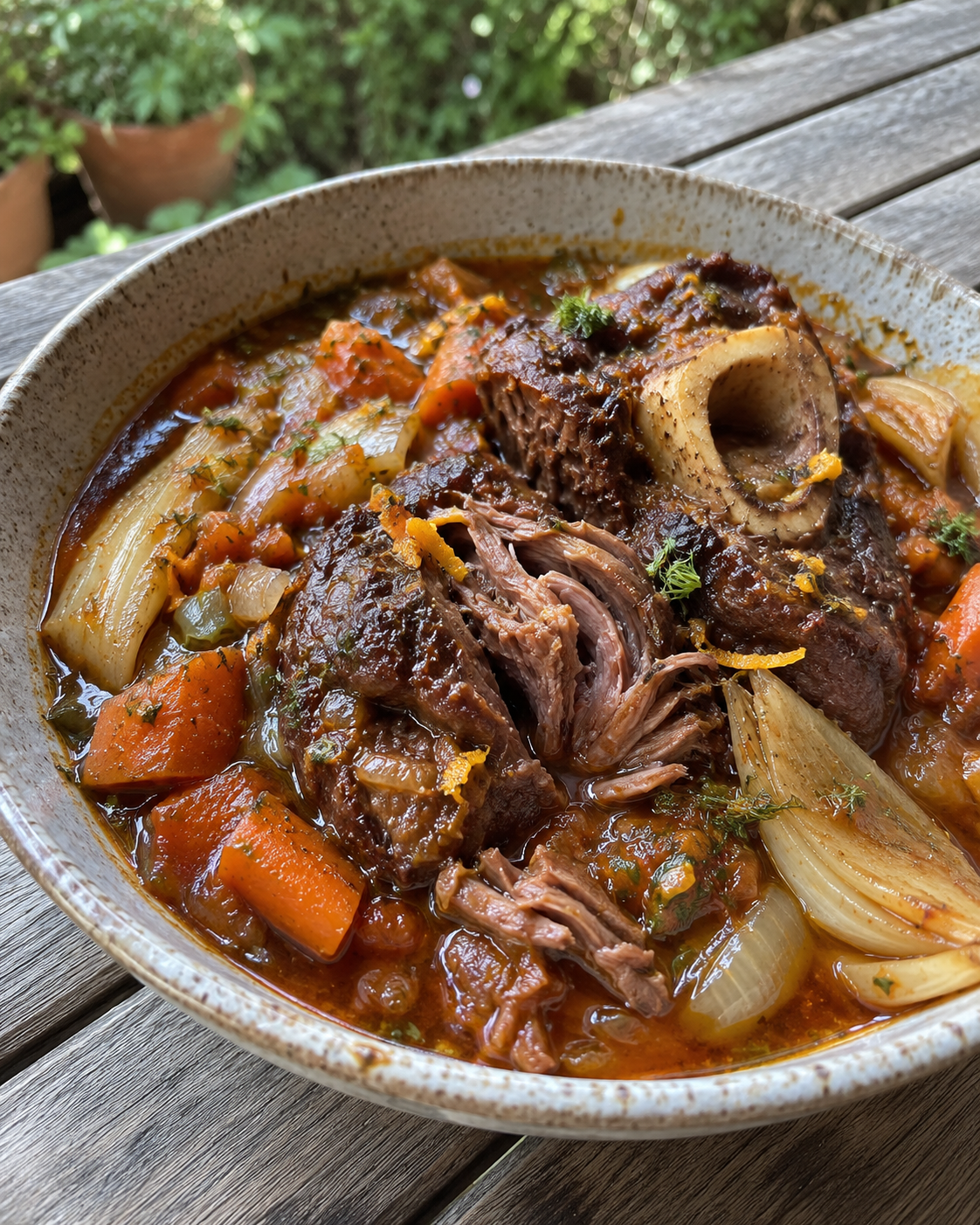
Grass-fed beef shanks slow-cooked with fennel, onion, carrots, smoked paprika, red wine, and fresh orange juice and zest, until the meat falls from the bone into a rich, marrow-glossed sauce.
Yield: Serves 4 · Active: 25 min · Total: 3½ hours · October through March, when fennel is sweetest and blood oranges come into season in Sicily and California · Cuisine: Italian, Sicilian-inspired · Best eaten: early evening, as a fall or winter Sunday supper
This is the marrow-rich cousin of my Red Wine-Braised Short Ribs. Beef shank is the same cut used for osso buco, with a big channel of marrow in the center and meat that pulls apart into long, tender strands. Here, it’s braised slowly with fennel, onion, carrots, orange juice and zest, smoked paprika, and red wine.
As the shanks braise, the bones release marrow and gelatin into the liquid, making one of the most nourishing, deeply flavored sauces you can make.
The shank is one of the most overlooked cuts in American butchery, yet it’s the foundation of some of the world’s most beloved dishes, from Italian osso buco to Vietnamese phở. It’s also one of the most affordable grass-fed cuts.
Ingredients
Beef
4 grass-fed beef shanks, cross-cut (about 1–1½ inches thick)
1½ tsp Baja Gold sea salt
½ tsp black pepper
1 tsp smoked paprika (Pimentón de la Vera)
2 tbsp grass-fed ghee, tallow, or lard
Aromatics
1 fennel bulb, cut into 8 wedges (save the fronds for garnish)
1 large yellow onion, cut into 8 wedges
2 large carrots, cut into quarters
3 garlic cloves, smashed
Braising liquid
1½ cups beef or chicken bone broth, plus more as needed
½ cup dry red wine, like Nero d’Avola or Etna Rosso (or ½ cup more broth plus 1 tbsp balsamic vinegar, for alcohol-free)
Juice and zest of 1 orange (or a blood orange in winter)
To finish
Optional: 2 tbsp cold grass-fed butter
Chopped parsley and the fennel fronds
Swaps:
Lamb shanks: same method; braise 2–2½ hours.
Brisket: braise 3–3½ hours; it turns tender and shreddable instead of pulling into strands.
Pork shoulder: braise about 4 hours.
Method
Prep. Heat the oven to 300°F. Stir together the broth and orange juice.
Season. Pat the shanks dry, and season with the salt, pepper, and smoked paprika.
Sear. Heat the ghee in a Dutch oven over medium-high heat. Sear the shanks until golden on all sides, about 8 minutes total, then set them aside.
Soften the vegetables. In the same pot, cook the carrots, onion, and fennel for 5 minutes, until they start to caramelize. Add the garlic, and cook 30 seconds.
Deglaze. Pour in the wine, and scrape up the browned bits from the bottom of the pot.
Add the liquid. Add the broth-orange mixture and the orange zest. Return the shanks to the pot, and add more broth if needed, until the liquid comes about halfway up the shanks.
Braise. Cover, and bake 3 hours, until the meat is fork-tender and falling from the bone. Check once or twice, and add a splash of broth if it’s getting low.
Reduce the sauce. Lift out the shanks and vegetables, and keep them warm. Strain the liquid, then boil it over high heat for about 10 minutes, until slightly thickened. Whisk in the cold butter, if using, for a glossy finish.
Serve. Set the shanks over the vegetables, spoon the sauce over everything, and scatter with parsley and fennel fronds. Don’t forget the marrow; scoop it out and spread it on bread, or stir it into the sauce.
Serve It With
Cauliflower purée (from my Velvet Vegetable Purées), mashed potatoes, garlicky sautéed greens, or crusty sourdough for soaking up the sauce, if you eat grains. Saffron risotto Milanese, the classic partner for osso buco in Milan, or soft polenta, are lovely too. If you drink, a glass of Nero d’Avola or Etna Rosso is the natural match.
Storage
Refrigerator: up to 4 days. It’s even better on the second day.
Freezer: up to 3 months.
The fat cap: As it chills, the marrow fat rises and firms on top. Leave it as a seal until you’re ready to reheat, or lift it off and save it for roasting vegetables.
To reheat: Warm gently on the stove, with a splash of broth if the sauce has thickened.
For a crowd: For 8, double the recipe and use two Dutch ovens.
Nourishment Notes
Grass-fed beef shank — heme iron, zinc, B12, and complete protein. It’s rich in collagen, which melts into gelatin during the long braise, bringing glycine, proline, and hydroxyproline, amino acids that support the gut lining, joints, and skin. These are the amino acids we get from bones and connective tissue, and they’re often missing from diets built on lean muscle meat alone.
Bone marrow — rich, satisfying fat, mostly monounsaturated oleic acid, plus some fat-soluble vitamins and CLA, especially from grass-fed animals. Marrow has been prized as a nourishing food in nearly every culture that has raised cattle, sheep, or goats.
Fennel — fiber, vitamin C, potassium, manganese, and folate, plus anethole (the same compound in star anise), long used to ease digestion. Pairing fennel with rich meat is an old Mediterranean habit. Braising softens its anise flavor and brings out its sweetness.
Orange juice and zest — vitamin C and bright flavor that lifts the rich sauce. Vitamin C also helps your body absorb the iron in the vegetables.
Carrots and onion — beta-carotene, better absorbed with the marrow fat, plus quercetin.
Smoked paprika — smoky depth and carotenoids.
Bone broth — more gelatin and minerals, deepening the sauce.
Red wine (if using) — depth of flavor. The long braise cooks off most, but not all, of the alcohol.
As a seasonal food, this is a fall and winter Sunday supper: slow, warming, and grounding, the kind of meal that fills the house with good smells all afternoon.
For your cycle: With heme iron, zinc, B12, and gelatin, this braise is especially restorative during and just after your period, and in the late luteal phase, when your body asks for warm, grounding food.
Sourcing
Beef shanks — 100% grass-fed and finished, cross-cut, from a local rancher, US Wellness Meats, or White Oak Pastures
Bone broth — homemade, or Kettle & Fire
Ghee, tallow, or lard — grass-fed ghee or tallow, or pasture-raised lard
Fennel, onions, carrots, garlic, oranges, and parsley — organic, from a farmers’ market (you’re using the orange zest, so organic matters)
Red wine (optional) — organic and low-sulfite, like a Sicilian Nero d’Avola or Etna Rosso
Smoked paprika — Spanish Pimentón de la Vera DOP, sweet (dulce)
Grass-fed butter (optional) — organic, from 100% grass-fed cows
Salt — Baja Gold sea salt
— Anna aka Food Marshall