Grain-free chicken pot pie
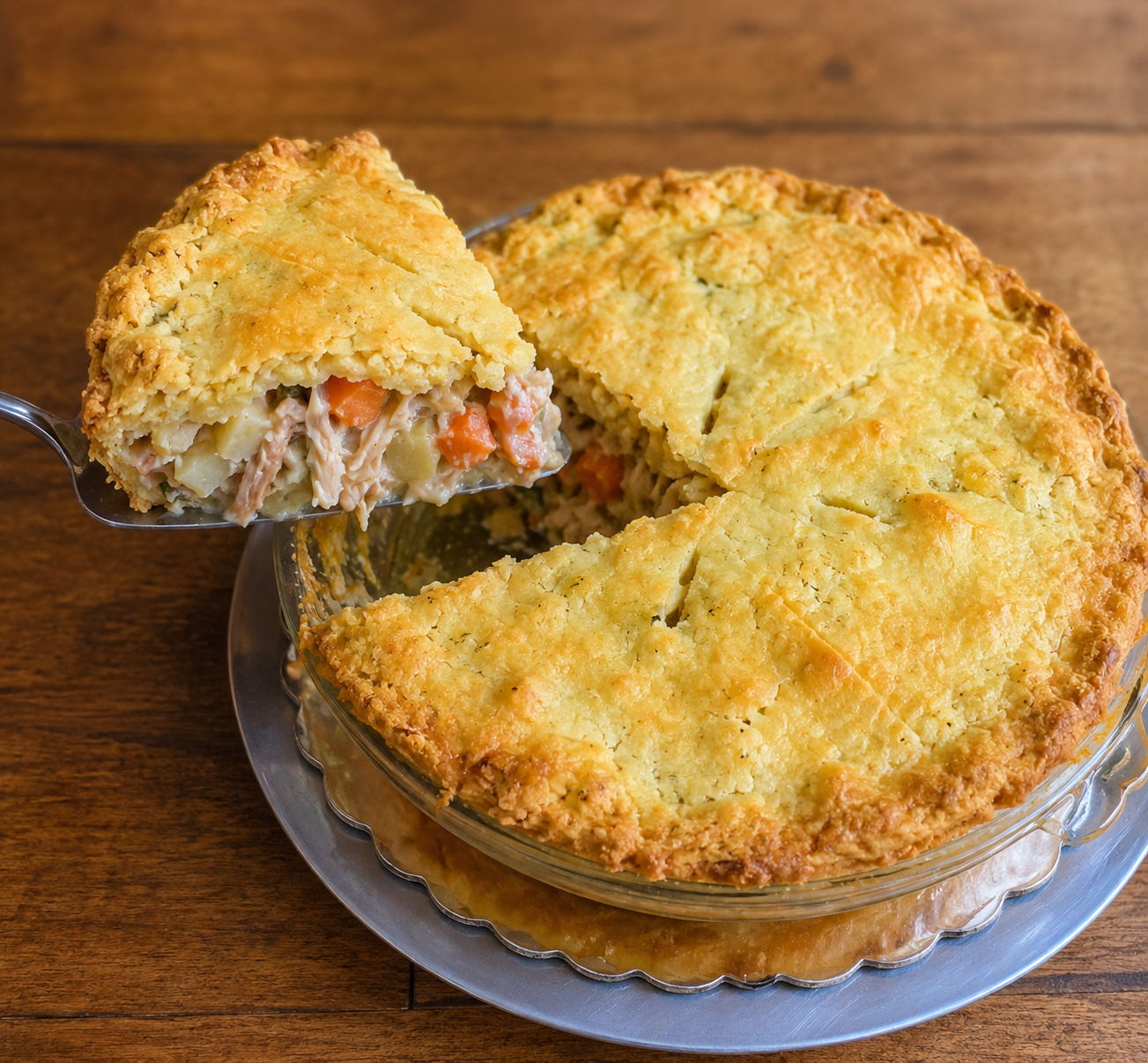
A deeply nourishing autumn-winter classic, rebuilt entirely with grain-free flours, pasture-raised chicken, real aromatics slow-cooked in duck fat, fresh herbs, and a buttery flaky almond-coconut-cassava crust. The kind of pot pie that holds a Sunday dinner table — comfort food at its most ancestral, structurally distinct from anything you'd find in a frozen aisle.
Yield: 6–8 servings (one 9-inch deep pie dish or 9×13 casserole) · Active: 40 min · Total: 1 hr 30 min · Autumn into winter (peak: October–March, when root vegetables and leeks are at their best) · Cuisine: American-French heritage, ancestral rebuild
A note from the kitchen
Chicken pot pie is one of those dishes that conventional American food has structurally compromised — refined wheat flour crusts often made with hydrogenated shortening, factory-farmed chicken in broth made from "natural flavors," frozen carrots and peas with no real seasonal connection, and a baking technique that produces something pale and starchy rather than rich and deeply flavored. The frozen-aisle version has become so far from real food that most people have forgotten what real pot pie actually tastes like.
This is the same beloved dish, rebuilt entirely.
The aromatics get the time they deserve — onions, leeks, celery, and carrots slow-sautéed in duck fat (one of the most stable and nutrient-dense cooking fats in any ancestral kitchen). Three fresh herbs do the structural flavor work: thyme for earthiness, rosemary for woody depth, tarragon for that bright Provençal anise note that distinguishes a great pot pie from a good one. Real garlic. Real nutmeg. Real raw cream (or gelatin, or arrowroot — your choice) to thicken into something silky and rich.
The chicken is rotisserie or freshly roasted from a whole pasture-raised bird — heritage breed when you can find one. The bones and any leftovers go straight into a stockpot for the next batch of bone broth, completing the ancestral cycle that traditional kitchens always understood.
The crust is the brand-distinguishing detail. Three grain-free flours — almond, coconut, cassava — each doing its own structural work. Almond brings protein and richness. Coconut brings tender structure and gentle sweetness. Cassava brings the elasticity that pure almond flour lacks (the elasticity that makes the crust roll out and hold together). Together they create a crust that genuinely satisfies the texture memory of conventional pot pie while staying entirely grain-free.
Ingredients
For the filling:
3–4 cups cooked pasture-raised chicken, shredded or chopped (from a whole roasted chicken or a quality rotisserie — see sourcing)
3 stalks celery, chopped
3 medium carrots, chopped (rainbow if possible)
1 medium yellow onion, chopped
2 leeks, white and pale-green parts only, halved lengthwise, sliced into half-moons, and rinsed thoroughly
3 cloves garlic, finely chopped
2 tbsp duck fat (or grass-fed butter, ghee, or unrefined coconut oil for dairy-free)
4 sprigs fresh thyme (leaves stripped) or 1 tsp dried thyme
2 sprigs fresh rosemary (leaves finely chopped) or ½ tsp dried rosemary
2 sprigs fresh tarragon (leaves chopped) or 1 tsp dried tarragon
1 cup chicken bone broth (preferably homemade — see sourcing)
½ cup raw heavy cream from grass-fed cows OR ¼ cup raw cashew cream OR full-fat canned coconut milk (see thickening options below)
¼ tsp freshly grated nutmeg
1 tsp sea salt (or to taste)
½ tsp freshly cracked black pepper
For the thickener (choose ONE — each works structurally):
2 tbsp arrowroot powder whisked into ¼ cup cold bone broth (classic ancestral thickener) — OR
2 tbsp grass-fed beef gelatin powder bloomed in ¼ cup cold bone broth for 5 min, then warmed gently (adds collagen, structurally rich) — OR
Reduce the broth by half during cooking and let the raw cream itself create the body (the purest version — no added thickener)
Optional vegetable additions:
1 cup wild mushrooms (oyster, maitake, chanterelle, cremini — sliced)
1 cup small cauliflower or broccoli florets (blanched 2 min, drained)
1 cup green peas (fresh or frozen organic)
1 cup chopped kale or Swiss chard (added in the last few minutes)
1 cup chopped asparagus tips (spring version)
1 medium yellow potato or 1 cup diced sweet potato, peeled and diced (boiled separately until tender, then folded in)
For the three-flour grain-free crust:
1 cup almond flour (finely-ground, blanched)
¼ cup coconut flour (sifted)
¼ cup cassava flour (sifted)
3–4 tbsp grass-fed butter, melted (or unrefined coconut oil for dairy-free)
2 large pasture-raised eggs
Pinch sea salt
Optional: 1 tbsp fresh thyme leaves or chopped fresh herbs stirred into the dough
For the egg wash (optional):
1 large pasture-raised egg, beaten with 1 tsp filtered water
For finishing:
Fresh thyme sprigs
A pinch of flaky sea salt
A drizzle of high-quality extra-virgin olive oil
Freshly cracked black pepper
Method
Preheat the oven to 350°F.
Make the chicken (if not using rotisserie). If starting from raw, roast a whole pasture-raised chicken (about 3–4 lb) at 425°F for 50–60 min until the internal temperature reaches 165°F at the thigh. Let rest 15 min, then shred the meat into bite-sized pieces. You need 3–4 cups of shredded cooked chicken. Reserve the bones for bone broth.
Sauté the aromatics. In a large cast-iron Dutch oven or wide heavy skillet over medium heat, melt the duck fat. Add the chopped onion, leeks, celery, carrots, and a pinch of sea salt. Cook 8–10 min, stirring occasionally, until the vegetables are softened and just beginning to caramelize at the edges. Add the chopped garlic and cook 30 sec more, until fragrant.
Add the herbs and (if using) mushrooms. Add the chopped fresh thyme, rosemary, and tarragon. If adding mushrooms, add them now and sauté 4–5 min more until they release their moisture and begin to brown. Season with sea salt and black pepper.
Add the bone broth and thicken. Pour in the chicken bone broth. Bring to a gentle simmer. If using the arrowroot or gelatin thickener, whisk the slurry now and stir it in. The mixture should begin to thicken into a silky, light gravy consistency within 2–3 min. If reducing the broth without added thickener, simmer 8–10 min until reduced by half.
Add the cream and nutmeg. Stir in the raw heavy cream (or cashew cream or coconut milk) and the freshly grated nutmeg. Simmer 2–3 min more, stirring gently, until the mixture is silky and creamy. Taste and adjust salt and pepper. If using optional vegetables that need brief warming (peas, blanched cauliflower/broccoli, asparagus tips, kale), fold them in now.
Fold in the chicken. Stir in the cooked shredded chicken. Let everything cook together 2–3 min more, until the chicken is heated through and fully integrated into the sauce.
Transfer to the baking dish. Pour the filling into a 9-inch deep pie dish, a 9-inch deep cast-iron skillet, or a 9×13 casserole dish. Smooth the top gently with a spatula.
Make the crust. In a food processor, combine the almond flour, coconut flour, cassava flour, melted butter, eggs, sea salt, and optional fresh herbs. Pulse 15–20 times, then process for 20–30 sec, until the mixture comes together into a soft, slightly sticky dough. If too dry, add 1 tbsp filtered water. If too wet, add 1 tbsp more almond flour.
Roll out the crust. Form the dough into a flat disk. Place between two sheets of parchment paper (lightly dust the bottom sheet with cassava flour or arrowroot to prevent sticking). Roll out evenly to roughly the shape and size of your baking dish — about ¼-inch thick, slightly larger than the dish to give you edges to fold over.
Transfer the crust to the pie. Peel off the top sheet of parchment paper. Carefully invert the dough over the filling, lining up one edge first and then gently lowering the rest. Peel off the second sheet of parchment paper. Press the edges gently to seal the crust against the rim of the dish. Trim any excess overhang with a knife. (If the dough tears or cracks during transfer, don't worry — almond-flour crusts are forgiving. Simply patch the dough together using slightly damp fingers.)
Vent and brush with egg wash. Cut 3–4 small vent holes in the top crust with the tip of a knife (this lets steam escape during baking). If using egg wash, gently brush the entire top of the crust with the beaten egg + water mixture using a pastry brush.
Bake. Place the pot pie on a baking sheet (to catch any bubbling-over filling) and bake at 350°F for 30–40 min, until the crust is deeply golden brown and the filling is bubbling at the edges. If the crust browns too quickly, loosely cover with strips of aluminum foil (shiny side up) for the last 10 min.
Rest before serving. Remove from the oven and let rest 10 min before slicing. This rest period is structurally important — the filling sets slightly, making it easier to portion. Top with fresh thyme sprigs, a tiny pinch of flaky sea salt, a drizzle of olive oil, and freshly cracked black pepper. Slice and serve.
Variations
Whole-chicken-from-scratch version (the most ancestral): Roast a whole pasture-raised chicken at 425°F for 50–60 min until the internal temperature reaches 165°F. Let rest, shred the meat (you'll get about 3–4 cups), and reserve the carcass + bones to make bone broth for the next batch. The most complete cycle of ancestral kitchen use of a whole bird.
Mashed potato cream variation (lighter, no added thickener): Boil 2 medium yellow potatoes (skins on) in salted water until fork-tender, about 12 min. Drain. Blend the potatoes with 1 cup hot bone broth in a high-powered blender until silky and creamy. Stir this potato cream into the vegetable mixture in place of the arrowroot/gelatin and the heavy cream. Adds body, richness, and a subtle starchy depth.
Spring asparagus version: Substitute the carrots with 1 cup chopped asparagus tips. Use fresh tarragon as the dominant herb. Add a small handful of fresh peas in the last few minutes. Lighter, brighter, beautifully Provençal.
Mushroom-forward variation: Increase the mushrooms to 2 cups (oyster, maitake, chanterelle, or cremini blend). Sauté the mushrooms first in duck fat until deeply browned (this is the structural flavor moment), then proceed with the rest of the recipe. Adds umami depth and earthy autumn character.
Curry bone broth variation (modern twist): Substitute the bone broth with a curry-spiced bone broth — add 1 tsp turmeric, ½ tsp ground coriander, ¼ tsp ground cumin, and 4–6 crushed garlic cloves to the broth as it simmers. Beautiful for cold-weather warmth and gentle anti-inflammatory support.
Dairy-free version: Use duck fat or unrefined coconut oil in place of butter throughout. Substitute the raw heavy cream with full-fat canned coconut milk OR raw cashew cream (blend 1 cup soaked raw cashews with ½ cup water in a high-powered blender until silky). Use coconut oil in place of butter in the crust.
Crustless version (lower-effort weeknight): Skip the top crust entirely. Top the filling with thin slices of sweet potato or yellow potato, brushed lightly with olive oil and salt. Bake at 400°F for 35–40 min, until the potato slices are tender and golden. A beautiful potato-topped shepherd's-pie-style variation.
Double-crust version (more traditional pot pie): Double the crust ingredients. Roll out the bottom crust and press into a deep 9-inch pie dish, pre-baking it lightly for 10 min at 350°F before filling. Pour the filling into the par-baked crust, then top with the second rolled-out crust. Press the edges to seal, vent the top, and bake at 350°F for 40–50 min. Adds about 15 min to total time but produces a classic two-crust pot pie experience.
Mini pot pies (for portioned meal prep): Press the crust into individual ramekins (4–6 oz size) or mini cast-iron skillets. Fill with the chicken mixture. Top with smaller rounds of crust. Bake at 350°F for 25–30 min, until the crusts are deeply golden. Makes 6–8 individual pot pies — perfect for portioning, freezing, or gifting.
Different proteins — same preparation works beautifully with:
Pasture-raised turkey (use leftover holiday turkey)
Wild duck meat (rich, gamey, deeply autumnal)
Pheasant or pigeon (luxury heritage game birds)
Lamb shoulder or stewing lamb (heartier, more autumnal)
Wild salmon or other firm fish (for a seafood pot pie — substitute the cream with coconut milk + dijon mustard)
With seasonal vegetable additions: See the optional vegetable list in Ingredients. Most beautiful combinations:
Autumn: mushrooms + parsnips + butternut squash
Winter: mushrooms + Brussels sprouts + kale
Spring: asparagus + peas + leeks (the classic French Provençal version)
Summer: peas + chard + fresh fava beans
Sourcing
Pasture-raised chicken: What to look for:
Pasture-raised, not "free-range" or "cage-free." Pasture-raised hens foraged on grass, bugs, and seeds outdoors. The weaker industry terms often mean very little real outdoor time.
Heritage breed (Buckeye, Plymouth Rock, Rhode Island Red, Dominique, Delaware) when available — heritage breeds have dramatically more flavor, better fat distribution, and slower growth than commercial Cornish Cross broilers.
Deep yellow-orange skin and yolks (if dressed with the giblets) — the visual indicator that the bird actually foraged on insects and natural feed.
Small local farm or rancher you know is the gold standard. Ask the farmer how the birds were raised, what they ate, and whether they had outdoor access year-round.
For rotisserie chicken at the store: Look for organic, pasture-raised rotisserie options — these are increasingly available at small natural grocers. The ingredient list should be just chicken, salt, and (maybe) a few herbs. Avoid rotisserie chickens with "natural flavor," dextrose, MSG, sodium phosphate, or other industrial additives in the seasoning.
Avoid generic supermarket chicken (factory-farmed Cornish Cross broilers raised in confinement), anything labeled only "natural," and chickens injected with "broth solutions" or "saline solutions" (these are common in commercial birds and add up to 15% by weight of industrial salt water).
Bone broth: What to look for:
Homemade is structurally superior. Simmer pasture-raised chicken bones (along with the carcass from this recipe!) with onion, carrot, celery, garlic, bay leaf, and a splash of apple cider vinegar for 12–24 hours. The vinegar pulls minerals from the bones.
If buying: Look for grass-fed/pasture-raised bones, gentle long simmering, no "natural flavors," no yeast extract, no MSG, no commercial bouillon shortcuts. Real bone broth gels when refrigerated — this is the structural marker of collagen extraction.
In glass containers when possible (BPA-free packaging at minimum).
Avoid anything labeled "bone broth" that's actually flavored stock with added gelatin or yeast extract, and any commercial broth in cardboard cartons with corn syrup or "natural flavor."
Duck fat: What to look for:
From pasture-raised heritage-breed ducks (Pekin, Muscovy, Moulard) when possible.
Pure rendered duck fat — the only ingredient on the label should be "duck fat."
In a glass jar rather than plastic — fats pull plasticizers from packaging over time.
Solid at refrigerator temperature, soft at room temperature, liquid at 90°F+. This is one of the most ancestral and stable cooking fats — roughly 50% monounsaturated (similar to olive oil), 35% saturated, and only 15% polyunsaturated.
The best version is the duck fat you render yourself after roasting a whole duck (see the Crispy Duck with Fig-Cider Glaze recipe in the companion Basque dinner collection). Keeps refrigerated 3 months.
Avoid commercial duck fat sold in plastic tubs with added preservatives or "natural flavor."
Pasture-raised eggs: What to look for:
"Pasture-raised," not "free-range" or "cage-free." Pasture-raised means the hens foraged outdoors on grass, bugs, and seeds.
Deep orange yolks — the visual indicator that the hens actually foraged.
From a local farmer at the farmers' market when possible — ask about the hens' diet, breed, and outdoor access.
Avoid generic supermarket eggs and eggs with weak watery whites.
Raw heavy cream from grass-fed cows: What to look for:
Raw from grass-fed cows when legally available through state-legal raw milk sources, herd-share programs, or licensed raw dairy producers (realmilk.com directory).
If raw isn't accessible: minimally-pasteurized (vat-pasteurized) grass-fed heavy cream. Never ultra-pasteurized — the high heat destroys the enzymes, proteins, and fat-soluble vitamins.
Deep yellow tint — the visual indicator of grass-fed dairy.
Avoid commercial ultra-pasteurized cream from confined-feedlot dairies.
Grass-fed butter: What to look for:
From cows on pasture year-round when possible.
Cultured (fermented before churning) for the deepest flavor — but uncultured works too.
Deep yellow color — the visual indicator of grass-fed butter.
High butterfat percentage (84%+ is European-style; 80% is standard American).
A small local farm or creamery you know is the gold standard.
Almond flour: What to look for:
Finely-ground, blanched (not almond meal — which is coarser and contains the skins, structurally different for crusts).
Organic when possible — almonds are a heavily-sprayed crop conventionally.
Recently milled — almond flour goes rancid fast. Smell test: should smell sweet and faintly nutty, never musty or bitter.
Stored cool in the refrigerator or freezer once opened.
Avoid pre-mixed "almond flour blends" with added starches, gums, or fillers.
Coconut flour: What to look for:
Pure coconut flour — the only ingredient on the label should be "coconut flour" or "organic coconut flour."
Organic when possible.
Recently produced. Coconut flour absorbs moisture aggressively — store in an airtight glass container in a cool, dry place.
Avoid coconut flour blends with added sweeteners, starches, or "natural flavors."
Cassava flour: What to look for:
100% cassava root (yuca) flour — the only ingredient should be "cassava flour" or "cassava root flour."
NOT tapioca starch (these are different products — cassava flour is the whole root ground; tapioca starch is the extracted starch). Both come from the same plant but behave structurally differently in baking.
Organic and fair-trade when possible.
Pale ivory color, finely ground.
Stored cool in a sealed glass container.
Carrots, celery, leeks, onions, garlic: What to look for:
Local farmers' market or CSA during peak season (most root vegetables are at their best October–March).
Firm, vibrant, unblemished, fragrant — every vegetable should look and smell alive.
Rainbow carrots (purple, yellow, white, orange) for varied phytonutrient profiles.
Heirloom varieties for deeper flavor when available.
Leeks always rinsed thoroughly — they grow in sandy soil and the layers trap grit.
Heirloom hardneck garlic from local farms during peak season (July–September).
Avoid pre-cut or pre-washed bagged vegetables with extended shelf life — these are typically treated with preservatives.
Fresh herbs (thyme, rosemary, tarragon): What to look for:
Fresh, fragrant, bright green — wilted, yellowed, or brown herbs have lost their volatile oils.
Whole bunches with stems rather than pre-packaged plastic containers.
From a local farmers' market, your own windowsill garden, or a CSA.
Tarragon especially — French tarragon is structurally different from Russian tarragon (which is flavorless). Look for fresh French tarragon at a quality grocer or grow your own.
Dried herbs work in a pinch (use ⅓ the amount of fresh) but won't carry the same brightness.
Arrowroot powder (for thickening): What to look for:
Pure arrowroot starch — the only ingredient on the label should be "arrowroot powder" or "arrowroot starch."
Organic when possible.
Stored cool in a sealed glass container — arrowroot loses thickening potency if exposed to humidity or stored too long.
Avoid corn starch as a substitute (genetically modified, structurally different) — arrowroot is the ancestral root-based thickener used for centuries before corn starch.
Avoid "tapioca starch" labeled as arrowroot — they're different products.
Grass-fed beef gelatin powder (alternative thickener): What to look for:
From 100% grass-fed, pasture-raised cows — the source of the bones determines the quality of the gelatin.
Unflavored, unsweetened — the only ingredient should be "beef gelatin" or "bovine gelatin."
Granular or powder form (not the silver-leaf sheets).
Bloom strength matters — higher bloom (around 240–250) means stronger gelling.
Avoid commercial gelatin from conventional confined-feedlot cattle, which carries antibiotic and pesticide residues, and gelatin with added sugars or stabilizers.
Whole nutmeg: What to look for:
Whole nutmeg pods (not pre-ground) — the volatile oils degrade rapidly once ground.
Single-origin from Indonesia, Sri Lanka, or Grenada for the deepest flavor.
Grated fresh on a microplane just before adding to the recipe.
Sea salt: What to look for:
Unrefined, solar-dried or hand-harvested. No anti-caking agents, no bleaching, no chemical processing.
For cooking and seasoning: Baja Gold mineral sea salt (third-party tested at 29.5–31.5% sodium, harvested from the Sea of Cortez, solar-dried) or any equivalent mineral-rich sea salt.
For finishing: fleur de sel — hand-harvested by skimming the delicate top layer of French salt pans.
Avoid iodized table salt, kosher salt (no mineral content), and mass-produced "Pink Himalayan."
Extra-virgin olive oil: What to look for:
First cold-pressed, harvest-dated within the last 12 months.
In a dark glass bottle.
Single-estate when possible.
Smell test: should smell grassy, peppery, fruity, slightly bitter — never rancid.
Storage
Refrigerator: Up to 5 days, sealed in a glass container or wrapped tightly. The flavors deepen overnight — the pot pie is genuinely better on day 2 as the flavors integrate throughout.
Freezer: Up to 3 months, wrapped tightly in beeswax wrap, then in a sealed freezer container. Thaw overnight in the refrigerator before reheating. For meal prep: make a double batch, portion into individual ramekins or oven-safe glass containers, and freeze for ready-to-bake weeknight dinners.
To reheat: Always use the oven (350°F for 20–25 min until heated through, covered loosely with foil for the first 15 min to prevent the crust from over-browning), never the microwave — microwave reheating makes the crust soggy and damages the raw cream's enzymes and proteins.
For meal prep: This is one of the best meal-prep recipes in the Food Marshall library. Make a full pie, slice into 6–8 portions, refrigerate or freeze, and reheat individually throughout the week. Each slice reheats in 12–15 min in a 350°F oven.
Pairs Well With
For the table: A pot of strong herbal tea (chamomile, rooibos, lavender, lemon balm) for a gentle pairing, or a fresh-pressed juice (carrot-ginger-turmeric, beet-apple-lemon) for energizing brightness. For something colder, sparkling water with a slice of cucumber and fresh thyme, or a mug of warm bone broth as a separate sipping course alongside the pie.
For a complete dinner: Serve alongside a simple fresh seasonal salad — arugula with shaved fennel, sliced apples or pears, toasted walnuts, and a lemon-olive-oil-and-Dijon vinaigrette. The bright bitter salad cuts the richness of the pot pie beautifully and aids digestion of the cream-and-fat-anchored filling.
For the gathering: This is a Sunday dinner-party centerpiece. Make ahead in the morning, refrigerate, then warm in the oven 30 min before guests arrive. Serve alongside a fresh seasonal salad, a small board of cured meats and aged cheeses, and a simple grain-free dessert (the Chamomile Cake with Berries or the Blueberry Cheesecake from the companion summer dessert collection).
For the meal context: This is a complete autumn-winter dinner as written — protein, fat, vegetables, broth, herbs all in one dish. For a heartier family dinner, serve alongside roasted root vegetables (carrots, parsnips, sweet potatoes with rosemary). For a lighter lunch, serve smaller portions with just the fresh salad.
For seasonal context: This is a cold-weather dish at its most ancestral. Make it when the days are short, the body is asking for warmth and depth, and a slow Sunday afternoon in the kitchen feels right. October through March is the natural season; pair the timing with whatever root vegetables, leeks, mushrooms, and dark greens are at peak from the farmers' market.
Why This Dish
Chicken pot pie is one of those dishes that the conventional American food system has structurally hollowed out — the frozen-aisle version made with refined wheat, hydrogenated shortening, factory-farmed chicken, and broth from "natural flavors" has become so far from real food that it's structurally a different category of thing entirely. What people remember when they think "chicken pot pie" is mostly nostalgia for something that never actually was.
This is the same dish, rebuilt entirely from real ingredients. This is what comfort food looks like when it's built on real ingredients — beautiful, deeply nourishing, structurally distinct from anything you'd find at a conventional bakery or frozen aisle. Real pasture-raised chicken from heritage-breed birds that foraged outside. Real bone broth made from real bones simmered slowly for 12–24 hours. Real aromatics — onion, leek, celery, carrot, garlic — slowly sautéed in real duck fat. Real fresh herbs from a garden or farmers' market. Real raw cream from real grass-fed cows. Real arrowroot or grass-fed gelatin to thicken. Real almond, coconut, and cassava flours for a crust that genuinely satisfies the texture memory.
The three-fresh-herb combination — thyme, rosemary, and tarragon — is the brand-distinguishing detail. Most pot pie recipes default to just thyme, or "Italian seasoning blend," or worse, no fresh herbs at all. The full trio is what creates the depth that distinguishes a great pot pie from a forgettable one. Thyme brings earthiness. Rosemary brings woody depth. Tarragon brings that bright Provençal anise note that's the secret structural detail of all the great French versions.
— Anna aka Food Marshall