Wild Cod with Pistachio Pesto, Carrot Ribbons & Roasted Fennel-Leek
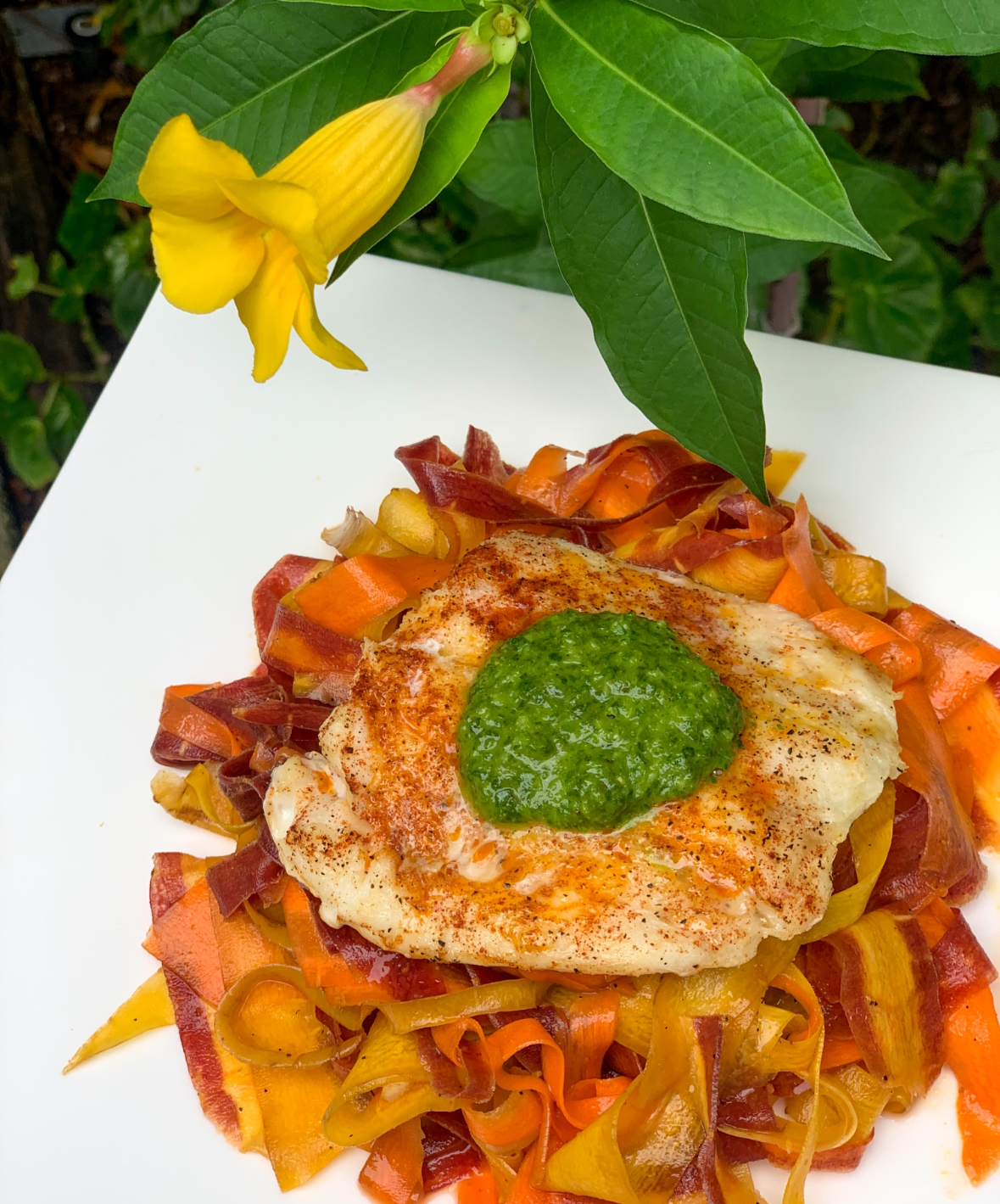
Pan-seared wild cod over a bright pistachio-basil pesto, plated with caramelized roasted fennel and leeks, fresh shaved carrot ribbons, and toasted pistachios. The kind of weeknight-elegant dinner that tastes restaurant-plated but comes together in 35 minutes — clean fish, bright herbs, real olive oil, real cheese, real seasonal vegetables. Gluten-free, grain-free, refined-sugar-free, deeply nourishing.
Yield: 2 servings (easily doubles for 4) · Active: 25 min · Total: 35 min · Year-round (peak fennel: October–April; peak carrots & leeks: October–March; peak basil: June–September) · Cuisine: Mediterranean-Italian, modern coastal
A note from the kitchen
There's a quiet magic in pairing clean white fish with bright herbal pesto and slow-roasted alliums. The cod is gentle, mineral, mild. The pesto carries the brightness — fresh basil and parsley pounded with toasted pistachios, real lemon zest, aged sheep cheese, and good olive oil. The fennel and leeks roast slowly until their natural sugars deepen into something jammy and caramelized. The carrot ribbons add brightness, crunch, and color — barely dressed with lemon, olive oil, and salt so they soften slightly while staying crisp.
What makes this work is restraint. Don't overblend the pesto — it should be textured and slightly rustic, not smooth and uniform. Don't overcook the cod — it should just begin to flake when a fork is pressed gently into the center. Don't crowd the roasting pan — fennel and leeks need space to caramelize rather than steam. Each component is doing its own structural work; together they create a plate that's bright, deep, herbal, and unmistakably Mediterranean.
The pistachios are the brand-distinguishing detail. Most American pesto recipes default to pine nuts (which have become increasingly expensive and are often sourced from China with no traceability). Pistachios bring a deeper, more luxurious flavor and substantially more mineral density. Toasted whole, they also become the structural finishing garnish that ties the whole plate together.
Thirty-five minutes from prep to plate. Restaurant-elegant, deeply nourishing, the kind of dinner that proves clean food can be the most beautiful food.
Ingredients
For the cod:
2 wild-caught cod fillets, about 6–8 oz each (Atlantic or Pacific — see sourcing)
Sea salt
Freshly cracked black pepper
1 tbsp extra-virgin olive oil
Optional: 1 tbsp grass-fed butter or ghee for finishing, ½ tsp smoked paprika
For the pistachio-basil pesto:
2 packed cups fresh basil leaves (large stems removed)
½ cup fresh flat-leaf parsley (large stems removed)
⅓ cup raw shelled pistachios, toasted (see method)
1 small clove garlic, peeled
Zest of 1 organic lemon
⅓ cup high-quality extra-virgin olive oil
¼ cup aged sheep's milk cheese (Pecorino Romano, aged Manchego, or aged Pecorino Toscano), finely grated
Sea salt to taste
Optional: 1 tsp fresh lemon juice for brightness
Optional: a small pinch of red pepper flakes for gentle heat
For the roasted fennel and leeks:
1 large fennel bulb, trimmed and sliced into ½-inch wedges (reserve fronds for garnish)
1 large leek, white and pale-green parts only, sliced into ½-inch rounds and rinsed thoroughly
1 tbsp extra-virgin olive oil
½ tsp sea salt
Freshly cracked black pepper
Optional: a few sprigs of fresh thyme or 2 cloves garlic, smashed
For the carrot ribbons:
3 medium carrots (rainbow if possible — purple, yellow, white, orange)
1 tsp fresh lemon juice
½ tsp extra-virgin olive oil
Pinch sea salt
For finishing:
2 tbsp toasted pistachios, roughly chopped
Fresh dill, basil, or parsley leaves
Reserved fennel fronds
1 lemon, cut into wedges OR charred lemon halves (see method)
Microgreens (optional)
Flaky sea salt
A drizzle of high-quality extra-virgin olive oil
Method
Preheat the oven to 425°F. Line a rimmed baking sheet with parchment paper.
Roast the fennel and leeks. Toss the fennel wedges and leek rounds with 1 tbsp olive oil, sea salt, black pepper, and optional thyme or smashed garlic. Spread evenly on the baking sheet — don't crowd the pan (use two sheets if needed; overcrowding will steam rather than caramelize). Roast 25–35 minutes, turning once halfway through, until the vegetables are deeply caramelized at the edges, tender in the center, and slightly sweet.
Toast the pistachios. While the vegetables roast, preheat a small dry skillet over medium-low heat. Add the raw shelled pistachios and toast 4–6 minutes, shaking the pan frequently, until fragrant and lightly golden. Don't let them burn — pistachios go from toasted to bitter quickly. Transfer to a plate to cool. (Reserve 2 tbsp toasted and chopped for finishing; the rest goes into the pesto.)
Make the pesto. To a food processor or large mortar and pestle, add the fresh basil, parsley, ⅓ cup toasted pistachios, garlic clove, lemon zest, and a pinch of sea salt. Pulse 8–10 times to break everything down into a coarse texture. With the processor running on low, drizzle in the olive oil slowly. Pulse a few more times — the pesto should be textured and slightly rustic, NOT smooth and uniform. Stir in the grated sheep's cheese by hand (don't process it in — the heat of the blades can make the cheese gummy). Taste and adjust salt. Add optional lemon juice for extra brightness or a pinch of red pepper flakes for gentle heat. Cover and set aside.
Prepare the carrot ribbons. Using a vegetable peeler, shave the carrots lengthwise into long thin ribbons (work over a cutting board, rotating the carrot as you peel to keep the ribbons even). In a small bowl, toss the ribbons with 1 tsp lemon juice, ½ tsp olive oil, and a pinch of sea salt. Let sit while you cook the fish — the carrots will soften slightly while staying crisp.
Prep the cod. Pat the cod fillets completely dry with paper towels — dry fish is the structural key to a good sear. Season both sides generously with sea salt and freshly cracked black pepper.
Optional: Char the lemon halves. If you want the charred lemon presentation, cut 1 lemon in half across the equator. Heat a small skillet over medium-high heat (no oil). Place the lemon halves cut-side down and char 2–3 minutes, until deeply golden and caramelized. Set aside.
Sear the cod. Heat 1 tbsp olive oil in a wide cast-iron or stainless steel skillet over medium-high heat until shimmering. Place the cod fillets in the pan (presentation-side down — the smoother side that was against the skin). Sear undisturbed for 3–4 minutes, until the underside is deeply golden and releases easily from the pan. Carefully flip with a fish spatula and cook 2–4 more minutes on the second side, depending on thickness, until the fish just begins to flake when pressed gently with a fork.
Finish the cod (optional). Reduce heat to low. Add 1 tbsp grass-fed butter or ghee to the pan. As it foams, tilt the pan slightly and spoon the melted butter over the cod for 30 seconds. This adds richness and a glossy finish.
Assemble the plate. Warm two dinner plates. On each plate:
Base: Spread 2–3 generous spoonfuls of the pistachio pesto across the center of the plate in a wide circle.
Fish: Place a cod fillet directly on top of the pesto, slightly off-center.
Vegetables: Arrange the roasted fennel wedges and leek rounds on one side of the plate.
Carrot ribbons: Twist the dressed carrot ribbons into loose nests and place on the opposite side of the plate.
Finishing: Scatter toasted chopped pistachios across the entire plate. Add fresh dill or basil leaves, reserved fennel fronds, optional microgreens, a small drizzle of high-quality olive oil, and a tiny pinch of flaky sea salt. Place a charred lemon half (or lemon wedge) on the plate for squeezing at the table.
Serve immediately while the fish is warm and the vegetables are still steaming.
Variations
Whipped goat cheese base (restaurant-style enrichment): Whip ½ cup fresh raw goat cheese (chèvre) with 1 tbsp olive oil, 1 tsp lemon juice, and a pinch of sea salt until smooth and fluffy. Spread under the vegetables instead of (or in addition to) the pesto. The goat cheese adds rich creaminess that turns this from "weeknight dinner" into "Sunday dinner-party plate."
Different fish — same preparation works beautifully with:
Halibut (firmer, meatier, more luxurious)
Black cod / sablefish (richer, buttery, higher in omega-3s)
Sea bass (delicate, slightly sweet)
Trout (freshwater, lighter)
Wild salmon (especially beautiful with pistachio pesto — the pink-and-green color combination is stunning)
Arctic char (mid-point between salmon and trout)
Different pesto — same technique works with:
Pine nut pesto (classic) — substitute toasted pine nuts for pistachios. Lighter, more traditional Italian.
Walnut pesto — substitute soaked-and-toasted walnuts. Deeper, more rustic.
Almond pesto — substitute toasted Marcona almonds. Spanish-leaning.
Sunflower seed pesto (nut-free) — substitute toasted raw sunflower seeds. Slightly grassier flavor but structurally identical.
Cilantro-pumpkin seed pesto — substitute cilantro for basil, pumpkin seeds for pistachios. Latin American flavor profile, beautiful with white fish.
Different vegetable architecture — beautiful seasonal substitutions:
Spring: Substitute fennel/leeks with blanched asparagus tips and fresh peas; substitute carrot ribbons with shaved radish or watermelon radish.
Summer: Substitute fennel/leeks with grilled zucchini ribbons and halved cherry tomatoes; keep the carrot ribbons.
Autumn: Add roasted delicata squash rings or roasted butternut squash cubes alongside the fennel.
Winter: Substitute fennel/leeks with roasted Brussels sprouts and roasted parsnip wedges.
Additional vegetable enhancements:
Crispy fingerling potatoes with rosemary: Halve 8 oz fingerlings, toss with 1 tbsp olive oil + rosemary + sea salt, roast at 425°F for 25 min. Adds carbohydrate weight for a heartier meal.
Charred asparagus: Heat a grill pan or cast-iron skillet to high. Toss 1 bunch trimmed asparagus with olive oil and sea salt. Char 4–6 minutes. Beautiful spring addition.
Grilled broccolini with lemon: Toss 1 bunch broccolini with olive oil and sea salt. Grill 4–5 minutes until lightly charred and tender. Squeeze fresh lemon over.
Roasted cherry tomatoes: Halve 1 cup cherry tomatoes, toss with olive oil and sea salt, roast at 425°F for 15 minutes until blistered. Beautiful for summer.
Wilted spinach or chard: Sauté 4 cups baby spinach in 1 tbsp olive oil with a pinch of salt until just wilted. Adds extra greens and mineral density.
Cheese pairings (used sparingly on the plate alongside or under the fish — a little goes a long way):
Fresh raw goat cheese (chèvre) — softer, tangier, brand-aligned
Whipped ricotta (raw or homemade from raw whole milk) — light and creamy
Aged Manchego — Spanish sheep, mineral-rich, holds up beautifully
Aged Pecorino Romano or Pecorino Toscano — Italian sheep, sharp and salty
Aged Parmigiano-Reggiano — classic Italian cow, the standard
Aged Idiazábal — Basque smoked sheep cheese for a deeper, smokier version
Crustless meal-prep variation: Pan-sear the cod and roast the vegetables ahead. Make the pesto separately and store in a glass jar with a thin layer of olive oil on top (keeps refrigerated 1 week). Assemble plates within 5 minutes — beautiful for quick weeknight dinners.
Quick Sourcing
Wild cod: What to look for:
Wild-caught Atlantic or Pacific cod, never farmed. Farmed Atlantic cod (rare but increasingly common) has nutritional and environmental issues.
Pacific cod or wild Alaskan cod is the most sustainable option in the U.S. — well-managed fisheries with healthy population levels.
Firm, glistening white flesh with no fishy smell. Should smell faintly of the ocean, never strong or sour.
Day-of from a fishmonger you trust is the gold standard. Ask when the fish was caught and where.
Frozen wild cod (flash-frozen on the boat or shortly after landing) is often fresher than "fresh" cod that's been on ice for several days. Don't avoid frozen — it can be structurally better.
Avoid generic supermarket cod with no provenance, anything labeled only "white fish," and "Chilean sea bass" (which is actually Patagonian toothfish — typically not sustainable).
Fresh basil: What to look for:
Bright green, fragrant, unblemished leaves — wilted, yellowed, or black-spotted basil has lost its volatile oils.
Whole bunches with stems rather than pre-packaged plastic containers (which oxidize fast).
From a local farmers' market, your own garden windowsill, or a CSA during peak season (June–September).
Genovese basil (the classic Italian variety) is structurally best for pesto. Thai basil, lemon basil, and purple basil all have distinctive flavors but produce different pestos.
Store fresh basil at room temperature with the stems in a glass of water (like flowers) — refrigeration turns the leaves black.
Avoid dried basil for pesto — it's an entirely different ingredient.
Fresh flat-leaf parsley: What to look for:
Italian flat-leaf parsley (not curly parsley) — deeper flavor and more tender texture.
Bright green, firm, fragrant leaves with stems intact.
From a local farmers' market, garden, or CSA.
Avoid wilted or yellowing parsley.
Raw shelled pistachios: What to look for:
Raw and unsalted — most commercial pistachios are salted and roasted, which is structurally different. For pesto, you want raw.
Whole, not pieces or "kernels" that have oxidized.
Organic when possible — pistachios can carry aflatoxins if grown conventionally with poor storage.
Recently harvested — smell test: should smell sweet and faintly grassy, never musty or rancid.
California-grown or Iranian-grown are the two main world sources. California pistachios are often slightly milder; Iranian pistachios are more intense and floral.
Refrigerate or freeze once opened — pistachios go rancid faster than people realize.
Avoid dyed pistachios (the bright red ones sold at convenience stores) — these are dyed with industrial colorants.
Aged sheep's milk cheese: What to look for:
Pecorino Romano, aged Manchego, Pecorino Toscano, or Idiazábal DOP — all real aged sheep's milk cheeses with mineral-rich, sharp-salty flavor profiles that pair beautifully with pesto.
Raw milk if available — preserves the enzymes and flavor compounds destroyed by pasteurization.
Aged at least 6 months, ideally longer.
From a local cheesemonger who can tell you the producer, age, and milk source.
Avoid pre-grated "Parmesan" in green canisters (this is industrial cellulose-coated dairy product, structurally unrelated to real cheese).
Carrots: What to look for:
Local farmers' market or CSA during peak season (October–March is peak storage carrot season; spring/summer for fresh-pulled).
Rainbow carrots (purple, yellow, white, orange) for visual impact and varied phytonutrient profiles.
Heirloom varieties for deeper flavor — Nantes, Danvers, Chantenay, Cosmic Purple, Atomic Red.
With tops attached is a freshness indicator (though cut the tops off when you get home — they pull moisture from the root).
Firm and unblemished — no soft spots, splitting, or hairy roots.
Organic when possible — carrots are on the moderate-risk list for pesticide residue.
Fennel: What to look for:
Firm, unblemished bulbs with intact green fronds — the fronds are an indicator of freshness and add structural beauty as a garnish.
Pale green-white bulb with no brown spots or discoloration at the cut end.
Heavy for size — light fennel is dry inside.
Local farmers' market or CSA during peak season (October–April in most U.S. regions).
Avoid fennel without fronds (already trimmed for long shelf life — older).
Leeks: What to look for:
Long white and pale-green shanks (the white-and-pale-green portion is what you'll use). The deeper green tops are tough but excellent for stocks and broths.
Firm, straight, unblemished — wilted or yellowing tops indicate age.
Local farmers' market or CSA during peak season (October–March).
Always rinse thoroughly — leeks grow in sandy soil and the layers trap grit. Slice first, then rinse the rounds under running water in a strainer.
Avoid pre-cleaned, pre-sliced leeks in plastic packaging.
Lemons: What to look for:
Organic and unwaxed — since you're using the zest, you want the peel free of pesticides and food-grade wax.
Heavy for their size with thin, smooth skin — heavier lemons have more juice.
Freshly squeezed juice always over bottled (bottled lemon juice contains preservatives and has lost most of its volatile aromatics).
Meyer lemons (sweeter, more floral) are a beautiful alternative when in season.
Extra-virgin olive oil: What to look for:
First cold-pressed (the only legitimate EVOO designation).
Harvest-dated within the last 12 months — this is the most important indicator of quality. EVOO degrades over time, and most rancid olive oils on shelves are simply old.
In a dark glass bottle (light degrades oil rapidly).
Single-estate (one farm) is structurally better than blended industrial olive oil.
For pesto specifically: a milder, fruitier olive oil works best — peppery or intensely grassy olive oils can overpower the basil. Sicilian, Andalusian, or California EVOOs tend to be milder. Tuscan and Greek EVOOs are more peppery.
Smell test: should smell grassy, peppery, fruity, slightly bitter — never rancid or like crayons.
Avoid "light" or "extra-light" olive oil (refined) and any oil in clear plastic bottles.
Grass-fed butter or ghee (optional, for finishing): What to look for:
From cows on pasture year-round when possible.
Cultured (fermented before churning) for the deepest flavor.
Deep yellow color — the visual indicator of grass-fed dairy.
For ghee: organic, grass-fed source, made by slowly clarifying butter until the milk solids brown lightly (giving ghee its nutty flavor and shelf stability).
Garlic: What to look for:
Heirloom hardneck garlic from a local farmers' market during peak season (July–September). German Extra-Hardy, Music, Spanish Roja varieties carry the deepest flavor.
Firm, plump cloves with intact paper wrapping.
Avoid sprouting garlic (older, bitter) and pre-peeled garlic in plastic tubs (oxidized).
Sea salt: What to look for:
Unrefined, solar-dried or hand-harvested. No anti-caking agents, no bleaching, no chemical processing.
For cooking and seasoning: Baja Gold mineral sea salt (third-party tested at 29.5–31.5% sodium, harvested from the Sea of Cortez, solar-dried) or any equivalent mineral-rich sea salt.
For finishing: fleur de sel — hand-harvested by skimming the delicate top layer of French salt pans (traditionally from Guérande, Île de Ré, or Camargue).
Avoid iodized table salt, kosher salt (no mineral content), and mass-produced "Pink Himalayan" (often counterfeited and dyed).
Storage
Best the day made. The cod is at its peak immediately after cooking. The roasted vegetables refrigerate 3 days. The pesto refrigerates 1 week in a glass jar with a thin layer of olive oil on top (this prevents oxidation). The carrot ribbons are best dressed and eaten the same day.
To reheat leftovers: Always use the oven (300°F for 8–10 minutes), never the microwave — microwave reheating makes fish rubbery and damages the volatile aromatics in the pesto and olive oil.
For meal prep: Make the pesto and roast the vegetables 1–2 days ahead. Sear the cod and shave the carrots fresh at serving time. Total assembly time is then about 8 minutes from start to plate.
Pairs Well With
For the table: A pitcher of cold sparkling water with thin slices of cucumber, lemon, and fresh basil. For something warm, a small pot of fresh herbal tea (lemon balm, mint, lemon verbena, or rooibos). For a more elaborate pairing, fresh-pressed lemon-basil sparkling water or a tall glass of cold hibiscus tea with mint.
For a complete dinner: Serve as written — the cod, pesto, roasted vegetables, and carrot ribbons together form a complete, balanced plate. For a heartier meal, add crispy fingerling potatoes with rosemary or roasted sweet potato wedges.
For the gathering: This works beautifully as a dinner-party main course for 4 (double the recipe). Serve alongside a fresh seasonal salad (arugula with shaved fennel, lemon, and olive oil; or a Caprese in summer), a small board of cured meats (jamón ibérico, lomo, prosciutto) for those who eat them, and a simple grain-free dessert (the Blueberry Cheesecake or one of the Blueberry Pies from the companion posts).
For the meal context: This is a complete weeknight dinner as written. For a celebratory dinner, add a starter course of Cantabrian Anchovies Three Ways or seared scallops from the companion Northern Spain collection. For a lighter lunch, serve smaller portions of cod (4 oz fillets) with all the components.
A timing note: This is genuinely an afternoon-into-evening dinner — the lightness of the fish, the brightness of the pesto, and the absence of heavy red meat make it ideal for warm weather or for evenings when you want to eat substantially without weighing down the body's natural circadian wind-down toward sleep.
Why This Dish
The conventional weeknight fish dinner has become either over-engineered (a restaurant plate with too many components and an hour of preparation) or under-engineered (a piece of fish baked plain in foil with a squeeze of lemon — fine, but forgettable). This is the middle path — every component does structural work, but the whole plate comes together in 35 minutes of mostly hands-off time.
What makes it brand-aligned is the integrity of each ingredient. Wild cod from a fishmonger you trust — not the generic supermarket fillet that's been frozen, thawed, and re-frozen with no traceability. Fresh basil and parsley from your windowsill garden or the farmers' market — not the wilted plastic-clamshell herbs that have been sitting under fluorescent supermarket lights for a week. Real toasted pistachios — not pre-roasted salted pistachios full of industrial seed oils. Real aged sheep's cheese — not pre-grated industrial "Parmesan." Real single-estate olive oil with a recent harvest date — not the rancid generic supermarket oil that's been on the shelf for two years.
Pesto is one of the world's great structural condiments. Made well — vibrant, textured, slightly rustic — it transforms whatever it touches into something deeply Italian and deeply nourishing. The pistachio variation (instead of the classic pine nut) is the brand-distinguishing detail. Pistachios bring magnesium, copper, B6, and the same monounsaturated fats that make olive oil heart-protective. Paired with fresh herbs, real cheese, real garlic, and real olive oil, the pesto becomes nutritionally complete in a single condiment.
— Anna aka Food Marshall