Goat Cheese, Caramelized Onion & Bacon Quiche
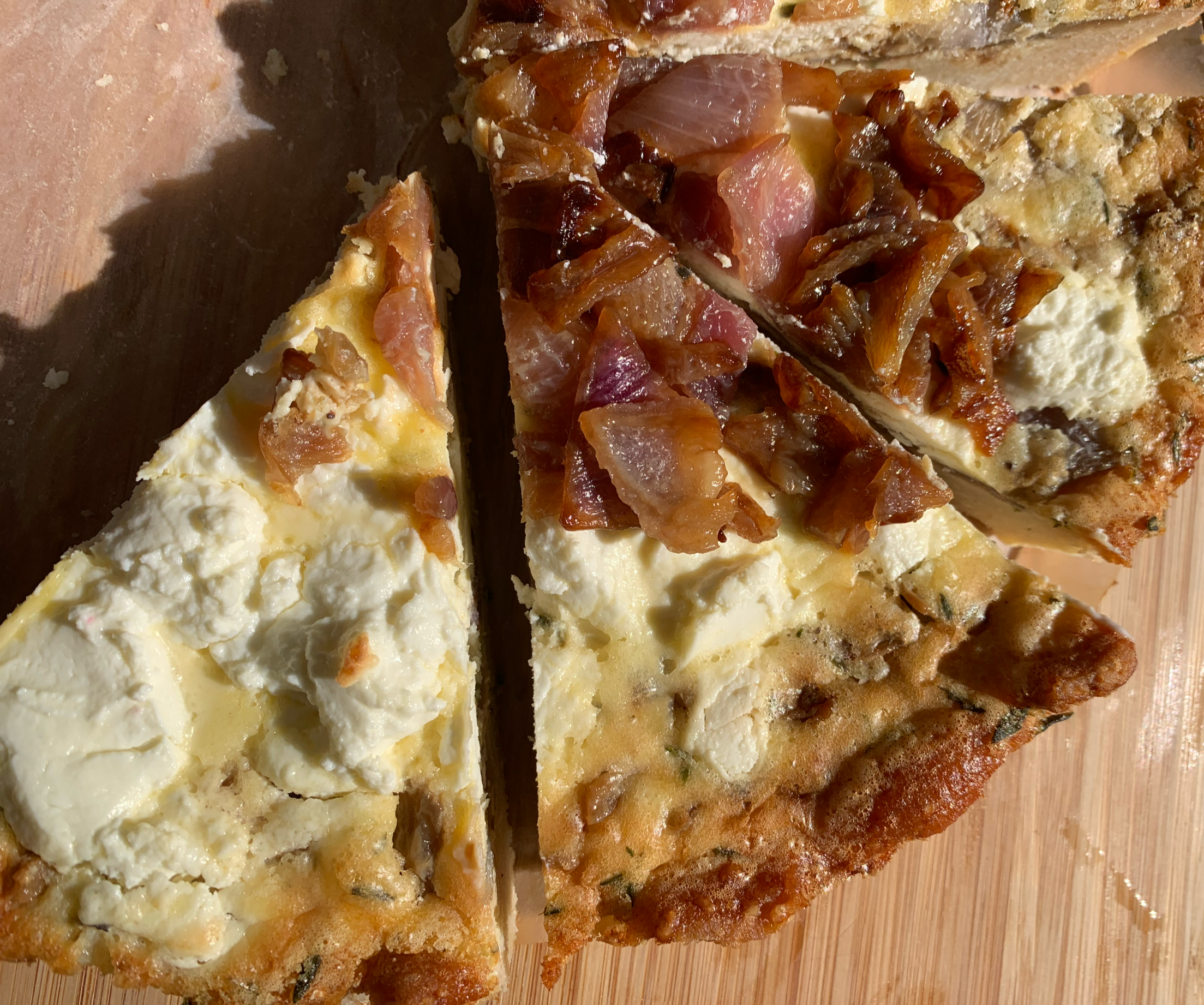
A grain-free quiche built on a press-in almond flour crust, filled with slow-caramelized onions, crisp pasture-raised bacon, and creamy raw goat cheese, all suspended in a silky raw cream and pasture-raised egg custard finished with fresh thyme.
Yield: 8 generous slices (one 9-inch pie plate) · Active: 45 min · Total: 2 hr 15 min (incl. caramelizing) · Year-round, with seasonal vegetable variations · Cuisine: Grain-free, ancestral, French-leaning
A note from the kitchen
Quiche is one of those dishes that the conventional bakery has structurally ruined — refined wheat flour crusts often made with hydrogenated shortening, ultra-pasteurized cream, conventional grain-fed cheese full of stabilizers, and bacon cured with nitrates and sodium phosphates. This is the same beloved dish, rebuilt entirely.
The base is a press-in almond flour crust — no rolling pin, no chilling steps, no pastry technique required. Just whisk, press, bake. The filling is built on three flavor anchors that earn their place: properly slow-caramelized onions (45 minutes in butter and a pinch of salt, until the natural sugars convert and deepen into something jam-like), crisp pasture-raised bacon, and tangy raw goat cheese — softer, mineral-richer, more digestible than commercial cow-milk cheese. The custard is real pasture-raised eggs and raw heavy cream, finished with fresh thyme and good sea salt.
The Provençal-leaning flavor profile (goat cheese + caramelized onion + thyme) shifts this away from the classic Quiche Lorraine and into something more elegant. The caramelization step is non-negotiable — it's what separates a quiche that nourishes from one that just fills you up. Don't rush it.
Ingredients
For the savory almond flour crust:
1½ cups (160 g) almond flour (finely-ground, blanched)
½ tsp sea salt
½ tsp garlic powder (optional, deepens the savory profile)
¼ tsp dried thyme or dried herbes de Provence
¼ cup (57 g) grass-fed butter, melted (OR unrefined coconut oil for dairy-free)
1 large pasture-raised egg yolk (helps bind the crust and adds richness)
For the caramelized onions:
2 medium yellow onions (about 2 cups thinly sliced)
2 tbsp grass-fed butter
1 tbsp extra-virgin olive oil
¼ tsp sea salt
Pinch of fresh thyme leaves
For the bacon:
6 oz (about 6 slices) pasture-raised bacon — uncured, no added sugars or nitrates (see sourcing)
For the custard:
6 large pasture-raised eggs
¾ cup raw heavy cream from grass-fed cows (OR minimally-pasteurized — never ultra-pasteurized)
¼ cup filtered water (loosens the texture slightly)
½ tsp sea salt
Freshly cracked black pepper to taste
1 tsp fresh thyme leaves (or ¼ tsp dried thyme)
Pinch of freshly grated nutmeg (optional, classic quiche aromatic)
For the cheese:
4 oz (about 1 cup) raw goat cheese, crumbled (chèvre OR aged goat cheese — see sourcing)
Optional: 2 oz raw Gruyère, Swiss, or aged white cheddar, shredded (for a more melted-cheese profile)
For finishing:
Fresh thyme sprigs
Freshly cracked black pepper
A drizzle of high-quality extra-virgin olive oil
A pinch of flaky sea salt
Method
Start the caramelized onions FIRST. This is the slowest step and runs in the background while you do everything else. Peel and thinly slice the onions. Heat the butter and olive oil in a wide heavy skillet over medium-low heat until the butter melts and foams. Add the sliced onions and sea salt. Stir to coat. Reduce the heat to LOW. Let the onions cook for 30–45 minutes, stirring every 5–7 minutes to prevent sticking or burning. Don't rush this — proper caramelization happens slowly as the natural sugars convert. The onions should turn deep amber-brown, soft, sweet, and jammy. Add a pinch of fresh thyme leaves in the last 5 minutes. Set aside off heat.
While the onions caramelize, make the crust. Preheat the oven to 350°F. In a medium bowl, whisk together the almond flour, sea salt, garlic powder (if using), and dried thyme. Stir in the melted butter and egg yolk until the dough comes together and resembles coarse, slightly sticky crumbs.
Press the crust into the pan. Turn the dough out into a 9-inch glass or ceramic pie plate (NOT a metal pan — metal browns the crust too quickly, before the custard sets). Press firmly with your fingers into the bottom and up the sides, going all the way to the rim. Use a flat-bottomed glass or measuring cup to even out the bottom. Prick the bottom several times with a fork.
Par-bake the crust. Place the pie plate in the preheated oven and bake for 10–12 minutes, until the edges are just beginning to turn golden. Remove from the oven and let cool slightly while you prepare the filling. If the crust has puffed in any spots, gently press it back down.
Cook the bacon. While the crust bakes, chop the bacon into ½-inch pieces. Place in a cold cast-iron or stainless steel skillet, then turn the heat to medium. (Starting in a cold pan renders the fat more thoroughly.) Cook 6–8 minutes, stirring occasionally, until browned and crisp. Transfer to a paper towel-lined plate to drain. Reserve about 1 tbsp of the rendered bacon fat in the pan — you can use this to roast vegetables later or store in a glass jar in the refrigerator (it keeps 3 months and is one of the most flavorful cooking fats in any kitchen).
Make the custard. In a medium bowl, whisk together the eggs, raw heavy cream, filtered water, sea salt, black pepper, fresh thyme leaves, and optional nutmeg. Whisk until completely smooth and slightly frothy.
Assemble the quiche. With the crust par-baked and slightly cooled, layer the fillings in this order: First, scatter half of the crumbled raw goat cheese evenly across the bottom of the crust. Next, distribute the caramelized onions in a thin even layer. Then scatter half of the crisp bacon. Add another thin layer of remaining cheese (and optional shredded Gruyère if using). Top with the remaining bacon. Pour the egg custard slowly and evenly over the layered fillings. The custard should reach about ¼ inch from the rim of the crust.
Bake. Place the assembled quiche in the preheated 350°F oven and bake for 35–45 minutes, until the edges are deeply golden, the crust is set, and the center of the custard is mostly set but still jiggles slightly when the pan is gently shaken. (Just like any custard, the center should NOT be fully firm at this stage — it sets fully as it cools.) If the crust edges brown too quickly, loosely cover them with strips of aluminum foil (shiny side up) or a pie shield for the last 15 minutes.
Cool. Remove the quiche from the oven and let cool on a wire rack for at least 30 minutes before slicing. This rest period is structurally important — the custard finishes setting as it cools, and slicing too early will cause the filling to run.
Finish and serve. Top with fresh thyme sprigs, a few cracks of black pepper, an optional drizzle of high-quality olive oil, and a pinch of flaky sea salt. Slice into 8 wedges with a sharp knife. Serve warm, at room temperature, or even cold the next day (the flavors deepen overnight).
Variations
Crustless version: Skip the crust entirely. Grease the pie plate well with butter or olive oil. Pour the filling and custard directly into the greased pan. Bake at 350°F for 25–35 minutes — start checking at 25 minutes since it cooks through faster without a crust. A beautiful low-effort weeknight version.
Different cheese variations: Substitute the goat cheese with raw Gruyère, raw Swiss, raw aged Manchego (sheep), raw sharp white cheddar, or aged Comté. Each cheese gives a structurally different quiche. For Provençal: stick with goat cheese. For classic Lorraine: use Gruyère. For Alpine: use Comté.
Different meat variations: Substitute the bacon with prosciutto, pancetta, pasture-raised diced ham, or smoked salmon. For a vegetarian version, replace the meat with 1 cup sautéed wild mushrooms (chanterelles, oyster, maitake, or cremini), or 1 cup blanched asparagus tips and fresh peas.
With vegetables (seasonal additions):
Spring: Add 1 cup blanched asparagus tips, fresh peas, and a handful of pea shoots.
Summer: Add 1 cup halved cherry tomatoes, sautéed zucchini, or roasted red bell pepper.
Autumn: Add 1 cup sautéed wild mushrooms, roasted butternut squash cubes, or sautéed leeks.
Winter: Add 1 cup sautéed kale, Swiss chard, or roasted Brussels sprouts.
With fresh herbs: Substitute the thyme with fresh tarragon, chives, dill, or chervil. Each brings its own elegant herbal note.
Mini quiches (for brunch boards): Press the crust into mini muffin tins lined with parchment liners. Divide the filling and custard evenly. Bake at 350°F for 18–22 minutes. Makes about 12 mini quiches, perfect for a picnic or party tray.
Nut-free version: Substitute the almond flour with sunflower seed flour or pumpkin seed flour. The crust will be slightly grey-green from the seed pigments (sunflower) or olive-green (pumpkin) — visually distinctive but absolutely delicious.
Dairy-free version: Use unrefined coconut oil in place of butter in the crust. Substitute the heavy cream with full-fat canned coconut milk in the custard. Skip the cheese, or use a small amount of dairy-free almond-based "cheese" alternative. The flavor profile shifts toward Mediterranean-coconut, but still structurally beautiful.
Make-ahead and meal prep: Bake the quiche fully, cool completely, then refrigerate up to 5 days or freeze up to 2 months. Reheat slices in a 300°F oven for 8–10 minutes until warmed through (never microwave — it makes the crust soggy and damages the raw cream). Beautiful for weeknight meal prep.
Quick Sourcing
Remember, the best version of any ingredient comes from a producer you know personally — a local farmer, rancher, dairy farmer, or butcher whose name you can speak.
Pasture-raised bacon: What to look for:
Pasture-raised, not "free-range" or "humanely raised" — pasture-raised pork foraged on grass, roots, acorns, and bugs has a structurally different fat profile than conventional confined pork.
Uncured or naturally cured — no added sodium nitrite, sodium nitrate, sodium phosphate, or "natural flavors."
No added sugars — most commercial bacon includes cane sugar, dextrose, or maple syrup. Look for bacon with just pork, salt, and (optionally) celery powder or a natural smoke.
Heritage breed pork (Berkshire, Mangalitsa, Tamworth, Red Wattle) when available — these breeds have dramatically more flavor and fat marbling than commercial Yorkshire-Landrace crosses.
From a small local farm or rancher you know personally is structurally the gold standard. Ask the farmer how the pigs were raised, what they foraged on, and whether they had outdoor access year-round.
At the farmers' market, look for vendors who can tell you the pig's breed and feed.
Avoid generic supermarket bacon, anything labeled only "natural," and bacon with multiple ingredients listed beyond pork, salt, and a natural cure.
Raw goat cheese (chèvre): What to look for:
Raw goat milk if available in your state (legal status varies — check realmilk.com for state-by-state legal status), or minimally-pasteurized otherwise.
From pasture-grazed goats when possible. Goats are natural browsers (they eat brush, herbs, and leaves rather than just grass), so "pasture-raised" looks different than for cows.
The shortest possible ingredient list — ideally just cultured goat milk, salt, and cultures. Avoid goat cheese with gums, stabilizers, or "natural flavors."
Fresh, soft chèvre (the classic log) is the easiest to crumble. Aged goat cheese (firmer, more concentrated) also works beautifully and provides deeper flavor.
From a small local creamery or dairy farmer when possible — ask at the farmers' market or local cheesemonger.
Avoid mass-produced flavored goat cheese with herb blends, dried fruit, or honey added — for this recipe, plain chèvre is structurally what you want.
Raw heavy cream from grass-fed cows: What to look for:
Raw from grass-fed cows when legally available through state-legal raw milk sources, herd-share programs, or licensed raw dairy producers (realmilk.com directory).
If raw isn't accessible: minimally-pasteurized (vat-pasteurized) grass-fed heavy cream. Never ultra-pasteurized — the high heat destroys the enzymes, proteins, and fat-soluble vitamins that make real cream nourishing.
Deep yellow tint — the visual indicator of grass-fed dairy (yellow comes from beta-carotene in fresh grass).
"Cream line" milk where available — the cream rises to the top naturally rather than being homogenized in.
Avoid commercial ultra-pasteurized cream from confined-feedlot dairies (pale white, denatured proteins, structurally compromised).
Pasture-raised eggs: What to look for:
"Pasture-raised," not "free-range" or "cage-free." Pasture-raised means the hens foraged on grass, bugs, and seeds outdoors. The weaker industry terms often mean very little real outdoor time.
Deep orange yolks — the visual indicator that the hens actually foraged. Pale yellow yolks indicate confined hens on commercial feed.
From a local farmer at the farmers' market when possible — ask about the hens' diet, breed, and outdoor access.
Brown, blue, green, or speckled shells are signs of heritage hen breeds (though shell color alone isn't a quality indicator).
Avoid generic supermarket eggs, anything labeled only "natural," and eggs with weak watery whites.
Almond flour: What to look for:
Finely-ground, blanched (not almond meal — which is coarser and contains the skins, structurally different for baking).
Organic when possible — almonds are a heavily-sprayed crop conventionally.
Recently milled — almond flour goes rancid faster than people realize. Smell test: should smell sweet and faintly nutty, never musty or bitter.
Stored cool in the refrigerator or freezer once opened.
Avoid pre-mixed "almond flour blends" with added starches, gums, or non-almond fillers.
Grass-fed butter: What to look for:
From cows on pasture year-round when possible (grass-fed in spring/summer and hay-fed in winter is acceptable).
Cultured (fermented before churning) for the deepest flavor — but uncultured works too.
Deep yellow color — the visual indicator of grass-fed butter.
High butterfat percentage (84%+ is European-style; 80% is standard American).
A small local farm or creamery you know is the gold standard.
Avoid commercial supermarket butter from confined-feedlot dairies.
Yellow onions: What to look for:
Firm, dry-skinned, heavy for their size — a fresh onion is dense; an old onion is light and dry.
Yellow onions (the workhorse) are ideal for caramelization. Sweet onions (Vidalia, Walla Walla) also work beautifully and caramelize faster.
Local farmers' market or CSA during peak season (storage onions available year-round; fresh-pulled summer onions late spring through autumn).
Avoid any onion with green sprouting tops (past its prime), soft spots, or mold at the root end.
Fresh thyme: What to look for:
Bright green leaves on woody stems, fragrant when rubbed.
From a local farmers' market, your own garden windowsill, or a CSA.
Avoid dry, brown, or yellowing thyme — it has lost its volatile oils.
Garlic powder: What to look for:
Single-ingredient — just dehydrated garlic. No anti-caking agents, no fillers.
Organic, single-origin when possible.
Recently produced — pre-ground spices lose potency quickly.
Avoid commercial "garlic salt" or "garlic seasoning blends" with added salt, fillers, or "natural flavors."
Sea salt: What to look for:
Unrefined, solar-dried or hand-harvested. No anti-caking agents, no bleaching, no chemical processing.
Naturally moist — this is the visual indicator of preserved minerals.
Lower sodium content (under 35% sodium chloride).
For cooking and seasoning: Baja Gold mineral sea salt (third-party tested at 29.5–31.5% sodium, harvested from the Sea of Cortez, solar-dried) or any equivalent mineral-rich sea salt.
For finishing: fleur de sel — hand-harvested by skimming the delicate top layer of French salt pans (traditionally from Guérande, Île de Ré, or Camargue).
Avoid iodized table salt, kosher salt (no mineral content), and mass-produced "Pink Himalayan."
Whole nutmeg (optional): What to look for:
Whole nutmeg pods (not pre-ground) — the volatile oils degrade rapidly once ground.
Single-origin from Indonesia, Sri Lanka, or Grenada for the deepest flavor.
Grated fresh on a microplane just before adding to the recipe.
Extra-virgin olive oil: What to look for:
First cold-pressed (the only legitimate EVOO designation).
Harvest-dated within the last 12 months — this is the most important indicator of quality.
In a dark glass bottle (light degrades oil rapidly).
Single-estate (one farm) is structurally better than blended industrial olive oil.
Smell test: should smell grassy, peppery, fruity, slightly bitter — never rancid or like crayons.
Avoid "light" or "extra-light" olive oil (refined) and any oil in clear plastic bottles.
Storage
Refrigerator: Up to 5 days, sealed in a glass container or wrapped tightly. The flavors deepen overnight — the quiche is genuinely better on day 2 as the custard fully sets and the caramelized onion's sweetness integrates throughout.
Freezer: Up to 2 months, wrapped tightly in beeswax wrap, then in a sealed freezer container. Thaw overnight in the refrigerator before reheating.
To reheat: Always use the oven, never the microwave. Microwave reheating makes the crust soggy and damages the raw cream's enzymes and proteins. For individual slices, warm in a 300°F oven for 8–10 minutes until heated through. For the whole quiche, cover loosely with foil and warm at 300°F for 20–25 minutes.
For brunch entertaining: Bake the day before, refrigerate overnight, and warm gently in a 300°F oven for 20 minutes before serving. The flavors integrate beautifully overnight.
Pairs Well With
For the table: A pot of strong herbal tea (chamomile, lemon balm, rooibos) for a gentle morning pairing, or a fresh-pressed juice (carrot-ginger-turmeric, beet-apple-lemon, or fresh celery juice) for a more energizing brunch. For something colder, sparkling water with a slice of cucumber, lemon, or fresh herbs. A small pot of strong matcha or pour-over coffee works beautifully for the bitter-aromatic contrast to the rich quiche.
For a complete brunch table: Serve alongside a fresh seasonal salad — arugula or watercress with shaved fennel, sliced radishes, fresh herbs, and a simple lemon-olive-oil-and-Dijon vinaigrette. Add a bowl of fresh whole fruit (sliced peaches, fresh berries, halved figs in season), a small board of cured meats (jamón ibérico, prosciutto, lomo), and a bowl of raw goat or sheep yogurt with raw honey.
For a complete brunch experience for 6–8: Pair this quiche with a fruit board, a green salad, sourdough-free seed bread or jicama rounds, and a fresh herbal pitcher (mint cucumber water, hibiscus-rose tea, or lemongrass-ginger infusion). Beautiful for a Sunday gathering, baby shower, or Easter/Mother's Day brunch.
For the meal context: This is a complete meal as written. For a heartier dinner, serve alongside roasted seasonal vegetables (asparagus in spring, zucchini in summer, butternut squash in autumn, Brussels sprouts in winter). For a lighter lunch, serve with just a simple green salad.
Why This Quiche
The conventional bakery quiche has structurally become something the body doesn't recognize as food — bleached refined wheat flour crust often made with hydrogenated shortening, ultra-pasteurized supermarket cream (the high-heat process destroys the enzymes and fat-soluble vitamins), conventional grain-fed cheese full of stabilizers and anti-caking agents, and commercial bacon cured with nitrates, nitrites, and corn syrup. The classic Quiche Lorraine has been served at brunches for a hundred years, and somewhere along the way the ingredients stopped being food.
This is the same beloved dish, rebuilt entirely. Real almond flour for the crust — protein, fat, fiber. Real grass-fed butter (or unrefined coconut oil) for fat-soluble vitamins. Real pasture-raised eggs from real hens that actually foraged. Real raw heavy cream from real grass-fed cows. Real raw goat cheese from real pasture-grazed goats. Real pasture-raised bacon from real heritage-breed pork — no nitrates, no sugar, no "natural flavors." Real onions slow-caramelized in real butter until the sugars convert and deepen. Real fresh thyme. Real freshly-grated nutmeg.
Properly slow-caramelized onions are the structural moment of this dish. Take the time. Don't rush. Forty-five minutes of low-heat patience converts ordinary onions into something deeply jammy and sweet — and that depth is what carries the quiche from "a brunch dish" to "a true ancestral plate." Pair that depth with the tangy mineral richness of raw goat cheese and the salty smokiness of real pasture-raised bacon, and you have a quiche that holds the table.
— Anna aka Food Marshall
Inspired by Carolyn Ketchum's Keto Quiche Lorraine at All Day I Dream About Food. The crust technique (press-in almond flour, par-bake, pour custard) comes from her foundational recipe, rebuilt here with savory herbs, ancestral fats, and a Provençal-leaning goat cheese profile. Credit and gratitude to the original recipe creator.