Raw neapolitan Cake and raw neapolitan brownies
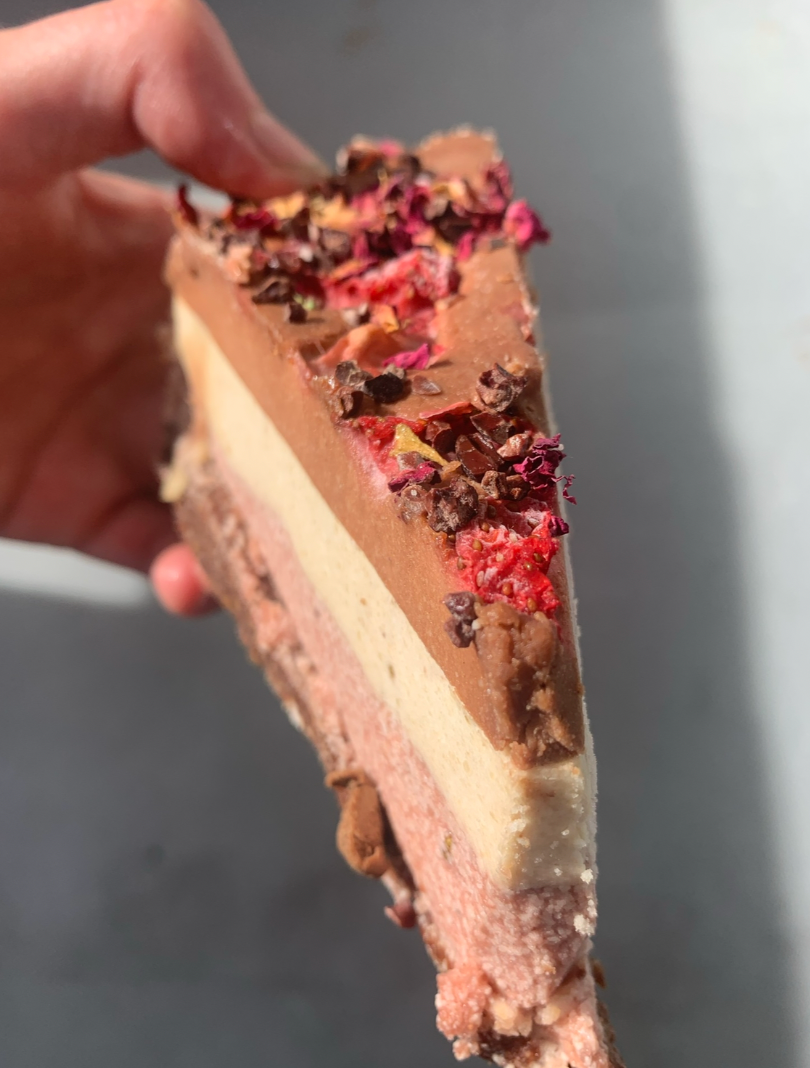
A three-layer raw cake — chocolate, berry, and vanilla — on a deep chocolate almond-date base, finished with fresh berries, edible flowers, and a dark chocolate drizzle. The classic Neapolitan ice-cream trio reborn as a structurally elegant raw celebration cake. Soaked cashews, fresh berries, raw cacao, coconut milk, and cacao butter — the kind of cake that holds together a dinner party without weighing it down.
Yield: 12–16 slices (one 9-inch springform) · Active: 45 min · Total: 8–12 hr (incl. overnight setting) · Late spring into summer (peak berry season: May–August) · Cuisine: Raw, grain-free, ancestral celebration
A note from the kitchen
If the Raw Neapolitan Brownies are the casual afternoon companion, this is their architectural older sibling — a true three-layer raw celebration cake built on the classic Neapolitan ice-cream trio (chocolate / berry / vanilla) stacked on a deep chocolate almond-date base. The kind of dessert that holds the table at a late-spring birthday, an early-summer wedding, an afternoon dinner party where the meal is the gathering.
The structure is genuinely elegant: a fudgy chocolate base anchors everything, then three distinct cream layers stack horizontally — dark chocolate, rosy berry, ivory vanilla — each one set briefly in the freezer before the next is poured. The whole cake comes together over a single afternoon of mostly hands-off freezing, and gets better overnight as the layers tighten and the flavors marry.
This is a cashew-and-coconut architecture, and that matters more than it might appear. Soaked raw cashews give each layer a fat-rich, mineral-dense base — magnesium, copper, zinc, and the saturated and monounsaturated fats that allow the fat-soluble compounds in cacao, vanilla, and berries to actually be absorbed by the body. Coconut oil and cacao butter add medium-chain saturated fats that are stable, slow-burning, and metabolically clean — the kind of fat that fueled tropical ancestral diets without inflaming them.
Each colored layer carries its own pigment chemistry. The cacao layer brings polyphenols and theobromine — the gentle, sustained stimulant that traditional Mesoamerican cultures treated as ceremonial food. The berry layer carries anthocyanins, the same dark-pigment antioxidants found in cherries, beets, and elderberries, which the body uses to manage oxidative stress through stronger-light seasons. The vanilla layer is the quiet anchor — real vanilla bean (not extract), contributing aromatic compounds that historically have been valued as a calming, nervous-system-settling food.
A timing note: raw cacao at the base of this dessert means it lands best as an afternoon or early-evening dessert, not a late-night one. Theobromine's effect lingers, and the body's circadian clock reads stimulant compounds differently after sundown. The same cake eaten at 4 p.m. and at 10 p.m. is two different physiological events. A late-spring birthday lunch, an early-summer celebration, an afternoon dinner party — these are the moments this cake was built for.
— Anna aka Food Marshall
Ingredients
For the chocolate almond-date base:
2 cups raw almonds (or substitute with 1 cup raw almonds + 1 cup raw sunflower seeds, or 2 cups oats blended with ½ cup almonds)
2 cups pitted Medjool dates, soaked in warm filtered water for 30 minutes and drained
½ cup raw cacao powder
1 tbsp unrefined coconut oil, melted
Pinch sea salt
½ tsp pure vanilla extract (optional)
For the chocolate layer:
1½ cups raw cashews, soaked 4–6 hours in cold filtered water and drained
1 cup full-fat coconut milk (canned, shaken well)
¼ cup unrefined coconut oil, melted
¼ cup food-grade cacao butter, melted
½ cup raw cacao powder
¼ cup pure maple syrup (Grade A Dark Robust)
1 tsp pure vanilla extract
Pinch sea salt
For the berry layer:
1½ cups raw cashews, soaked 4–6 hours and drained
1 cup fresh or fresh-frozen berries, thawed (strawberries, raspberries, or a blend — see variations)
½ cup unrefined coconut oil, melted
½ cup full-fat coconut milk (canned, shaken well)
¼ cup fresh lemon juice
⅓–½ cup pure maple syrup, to taste (start with ⅓ cup; add more if your berries are tart)
1 tsp finely grated lemon zest
Pinch sea salt
For the vanilla layer:
2 cups raw cashews, soaked 4–6 hours and drained
1 cup full-fat coconut milk (canned, shaken well)
¼ cup unrefined coconut oil, melted
¼ cup food-grade cacao butter, melted
¼ cup pure maple syrup
1 tsp vanilla bean paste (or seeds scraped from 1 fresh vanilla bean pod)
Pinch sea salt
For decoration:
1 cup fresh strawberries, raspberries, or mixed berries (whole or halved)
Dark chocolate drizzle: ¼ cup raw cacao paste melted with 2 tbsp unrefined coconut oil and 1 tbsp raw honey
Cacao nibs (a small handful)
Food-grade dried rose petals and dried cornflowers (see sourcing — must be culinary-grade, not decorative)
Fresh mint leaves (optional)
Method
Soak the cashews. At least 4 hours ahead (or the night before), place all the cashews together in a large bowl (about 5 cups total) and cover generously with cold filtered water. They'll all be drained at the same time and divided as needed. Drain and rinse before using.
Soak the dates. Place the pitted Medjool dates in a small bowl and cover with warm filtered water. Let soak 30 minutes, then drain (reserve the soaking water for another use — it's a beautiful natural sweetener for smoothies).
Prep the pan. Line the bottom of a 9-inch springform pan with a circle of parchment paper. Lightly grease the sides with coconut oil. For easier release, line the sides with strips of parchment paper that extend slightly above the rim.
Make the chocolate almond-date base. In a food processor, pulse the almonds (or seed/oat blend) to a coarse meal — keep some texture, do not over-process into nut butter. Add the soaked drained dates, raw cacao powder, melted coconut oil, sea salt, and optional vanilla. Process for 30–45 seconds, until the mixture clumps and holds together when pinched between your fingers.
Press the base into the pan. Transfer the mixture to the prepared springform pan. Using slightly damp fingers or the back of a measuring cup, press the base into an even, firm layer across the bottom of the pan. Press very firmly so it holds together when sliced. Place the pan in the freezer while you make the layers.
Make the chocolate layer. Drain and rinse 1½ cups of the soaked cashews. Add them to a high-powered blender along with the coconut milk, melted coconut oil, melted cacao butter, raw cacao powder, maple syrup, vanilla extract, and pinch of sea salt. Blend on high for 1–2 minutes, scraping down the sides as needed, until completely silky-smooth and pourable. Taste and adjust — more maple syrup for sweetness, more cacao for depth.
Pour and set the chocolate layer. Remove the springform pan from the freezer. Pour the chocolate layer slowly and evenly over the chocolate base. Smooth the top gently with an offset spatula. Tap the pan firmly against the counter 2–3 times to release air bubbles. Return to the freezer for 30–45 minutes, until the chocolate layer is just set on top — firm enough to support the next layer without sinking.
Make the berry layer. While the chocolate layer sets, rinse out the blender. Drain another 1½ cups of soaked cashews. Add them to the blender along with the berries (and their juice if using thawed frozen), melted coconut oil, coconut milk, lemon juice, lemon zest, maple syrup, and pinch of sea salt. Blend on high for 1–2 minutes, until completely silky-smooth and a deep true pink. Taste and adjust sweetness — fresh in-season berries need less; out-of-season frozen needs more.
Pour and set the berry layer. Remove the pan from the freezer. Pour the berry layer evenly over the set chocolate layer. Smooth gently with an offset spatula. Return to the freezer for 30–45 minutes, until just set on top.
Make the vanilla layer. Rinse out the blender. Drain the remaining 2 cups of soaked cashews. Add them to the blender along with the coconut milk, melted coconut oil, melted cacao butter, maple syrup, vanilla bean paste, and pinch of sea salt. Blend on high for 1–2 minutes, until completely silky-smooth and pourable.
Pour and set the vanilla layer. Remove the pan from the freezer. Pour the vanilla layer evenly over the set berry layer. Smooth the top with an offset spatula. Tap the pan firmly against the counter 2–3 times. Return to the freezer for 6–8 hours, or preferably overnight, until completely firm throughout.
Make the chocolate drizzle (just before serving). Gently melt the cacao paste with the coconut oil over a double boiler (a heatproof bowl set over a small saucepan of barely-simmering water). Stir gently until completely smooth. Off heat, whisk in the raw honey. Let cool 5 minutes — pouring too-hot chocolate over the frozen cake will cause it to crack.
Release and decorate. Remove the cake from the freezer 20–30 minutes before serving to soften slightly. Run a hot, dry knife around the inside of the springform to loosen, then release the ring. Carefully slide the cake onto a serving plate or pedestal. Drizzle the dark chocolate-coconut mixture in thin lines across the top, letting some drip down the sides. Crown with fresh berries, scatter cacao nibs, and finish with food-grade dried rose petals, cornflowers, and optional mint leaves.
Slice and serve. Run a sharp knife under hot water, dry it off, and slice the cake into 12–16 wedges. Wipe the knife clean between each cut for clean three-layer cross-sections. Serve immediately while still cold and firm.
Variations
Strawberry variation: Use 1 cup strawberries for the berry layer. The pink will be the brightest and lightest — most classically "Neapolitan."
Raspberry variation: Use 1 cup raspberries. The color will be deeper and more magenta, with a sharper tart-sweet profile.
Mixed berry variation: Use a blend of strawberries, raspberries, and a few blackberries. The deepest, most complex color and flavor.
Cherry-pink variation: Substitute the berries with ¾ cup fresh frozen pitted cherries + their juice. Closer in color profile to the brownie companion recipe and beautifully seasonal in late spring.
Mango-passion fruit (tropical version): Substitute the berry layer entirely with 1 cup ripe mango chunks + the pulp of 2 passion fruits. The pink becomes a deep gold-orange. Beautiful for high summer.
Mexican chocolate variation: Add 1 tsp ground Ceylon cinnamon and a pinch of cayenne to the chocolate layer. Adds warmth and complexity — surprisingly perfect with the berry layer.
Layered like a checkerboard: Pour each layer in halves (chocolate-half, berry-half, vanilla-half, then chocolate-half on top of berry, berry-half on top of vanilla, etc.) for a more intricate cross-section pattern when sliced. Genuinely beautiful but adds 20 minutes of work and patience.
Dairy variation: Substitute the coconut milk in each layer with raw heavy cream from grass-fed cows. Creates a richer, denser cake structurally closer to traditional cheesecake. Adjust sweetener slightly — cream is tangier than coconut milk.
Mini cakes / cupcakes: Press the base into the bottoms of 12 muffin tins lined with parchment paper liners. Layer the three creams in each. Freeze 4–5 hours. Makes individual portions perfect for a brunch board or wedding.
Gluten-free certified for celiac: Use a base of 2 cups raw almonds (no oats). The recipe is naturally gluten-free, but oats can carry cross-contamination unless specifically certified.
Quick Sourcing
Raw almonds (or seed/oat blend) for the base: What to look for:
Raw, unsalted, whole (not pieces).
Organic when possible — almonds are heavily-sprayed conventionally.
Smell test: should smell sweet and faintly nutty, never musty or rancid.
For a soy-allergic / nut-free version: substitute with raw sunflower seeds (organic, raw, hulled).
Refrigerate or freeze once opened.
Raw cacao butter (for the chocolate and vanilla layers): What to look for:
Food-grade, raw, unrefined cacao butter.
Organic and fair-trade when possible — cacao supply chains have historical labor issues.
Single-origin (Ecuador, Peru, Ivory Coast, Dominican Republic) for traceability.
Pale ivory-yellow color with a faintly chocolate-cocoa aroma.
Solid at room temperature, melts at body temperature.
Avoid deodorized cacao butter (used for cosmetics — structurally less ancestral) and "cocoa butter" used industrially.
Raw cacao powder (for the chocolate layer and base): What to look for:
Raw, unprocessed cacao powder — labeled "raw" or "cold-pressed" cacao, NOT "dutched" or "alkalized" cocoa (which is heated and chemically treated, destroying polyphenols).
Organic and fair-trade when possible.
Single-origin (Ecuador, Peru, Ivory Coast, Dominican Republic) for traceability and deeper flavor.
Deep reddish-brown color with a rich chocolate aroma. Pale cacao indicates lower-quality beans or excess processing.
Stored cool in a sealed glass container.
Raw cacao paste (for the drizzle): What to look for:
100% cacao mass — the only ingredient on the label should be "cacao" or "cocoa." No sugar, no soy lecithin, no "natural flavors."
Raw, single-origin, fair-trade, organic when possible.
Solid at room temperature, melts at body temperature.
Avoid "baking chocolate" with added soy lecithin or industrial vanillin.
Medjool dates: What to look for:
Soft, plump, slightly wrinkled, dark mahogany-brown color — the structural indicators of fresh, properly-stored dates.
Sticky to the touch (not dry or hard).
Organic when possible — dates concentrate pesticide residues if grown conventionally.
Whole dates with the pit still in are typically fresher than pre-pitted.
Refrigerate to extend shelf life.
Avoid commercial "baking dates" (often deglet noor variety — drier, less sweet, structurally different from Medjool).
Fresh or fresh-frozen berries (for the berry layer): What to look for:
Strawberries: deeply red throughout (not pale at the core), fragrant, with intact green tops. Local farmers' market or pick-your-own during peak season (May–June).
Raspberries: plump, intact, with no leaking juice or mold. Peak season July–September.
Mixed berries: any combination of strawberries, raspberries, blackberries, or cherries at their peak.
Organic when possible — strawberries and raspberries are on the Dirty Dozen list.
Frozen wild or organic berries are an excellent off-season option — thaw before blending to release their juice.
Avoid commercial berries with green/pale tips, leaking juice, or any visible mold.
Vanilla bean paste OR fresh vanilla beans (for the vanilla layer): What to look for:
Vanilla bean paste: real vanilla bean seeds suspended in a small amount of glycerin or alcohol with vanilla extract. The visible seeds are the indicator that it's real (not flavoring with caramel color). Madagascar Bourbon, Tahitian, or Mexican origin for deepest flavor.
Fresh vanilla beans: plump, oily, fragrant pods (not dry or brittle). Madagascar Bourbon is the classic for cheesecake. Slice the pod lengthwise and scrape the tiny seeds into the cream.
Avoid "vanilla flavoring," imitation vanilla, or vanillin-based pastes.
Food-grade dried edible flowers (for decoration): What to look for:
"Culinary grade" or "food-grade" specifically on the label — not "decorative" or "craft."
Organic and pesticide-free.
Sealed in glass or food-grade packaging to preserve aroma.
Single-variety, not blended (rose petals separate from cornflowers separate from lavender for the cleanest preparation).
For rose petals: deep crimson or burgundy color (dried), with intact petal shape and faint floral aroma.
For cornflowers: vibrant deep blue color (dried), with intact whole blossoms.
Avoid flowers from non-food suppliers (decorative florists, craft stores) — these are sprayed with non-food-grade preservatives and should not be eaten.
Source from herbal apothecaries, organic tea suppliers, or specialty herb shops with explicit culinary-grade labeling.
Sea salt: For this recipe, use a fine-grain unrefined sea salt — Baja Gold mineral sea salt (third-party tested at 29.5–31.5% sodium, harvested from the Sea of Cortez, solar-dried) or any equivalent mineral-rich sea salt. Avoid iodized table salt and kosher salt.
Storage
Freezer: Up to 1 month, well-sealed in a glass container or wrapped in beeswax wrap. The cake genuinely tastes better the day after assembly — the layers tighten and the flavors marry overnight.
Refrigerator: 5 days, sealed. The texture is firm but sliceable directly from the refrigerator.
For events: Assemble 24–48 hours ahead, store frozen, and decorate just before serving. The drizzle and flowers should be added within 1–2 hours of serving for the freshest visual impact.
Slicing tip: Always slice from frozen, running your knife under hot water and drying it off between each cut for clean three-layer cross-sections.
For traveling or gifting: Slice the frozen cake into individual portions, wrap each in parchment paper, and place in a freezer-safe container. Perfect for a wedding favor, birthday gift, or contribution to a summer dinner party.
Pairs Well With
For the table: A pot of strong herbal tea (rooibos, chamomile, lavender, lemon balm, peppermint) is the gentle classic. For something colder, sparkling water with fresh berries and a sprig of mint, or fresh-pressed strawberry-basil lemonade.
For an afternoon celebration: This cake is genuinely a centerpiece. Serve as the main dessert at a late-spring birthday lunch, an afternoon dinner party, a baby shower, or a small wedding. Pair with a fresh fruit board (sliced melon, fresh whole berries, halved figs in season), a small bowl of cacao nibs, and a pitcher of cold rooibos tea.
For a complete celebratory dessert table: Pair with the companion Raw Neapolitan Brownies (for a casual bite alternative) or one of the Blueberry Pies (for a baked contrast). Three desserts, one color story, multiple textures — a complete summer celebration table.
A timing note: Because of the raw cacao in the base and chocolate layer, this cake sits best in the afternoon or very early evening rather than late at night. Serve at 4 p.m. as the centerpiece of a long lunch or afternoon tea. Avoid serving past 7 p.m. — the theobromine in raw cacao can fragment sleep architecture in sensitive people, even when its effect feels subtle.
Why This Cake
The conventional birthday cake has structurally become something the body doesn't recognize as food — bleached refined wheat flour, hydrogenated shortening, white sugar (often 2+ cups per cake), artificial colors and flavors, industrial frosting full of trans fats and corn syrup, and a baking technique that requires precise temperature management.
This is the same celebration cake form, rebuilt entirely. Real soaked raw cashews for body and creaminess. Real raw cacao — polyphenols and theobromine genuinely active. Real fresh berries at their seasonal peak — anthocyanins, vitamin C, real fruit pigment chemistry. Real coconut milk and coconut oil — medium-chain fats your body recognizes and metabolizes cleanly. Real cacao butter and food-grade cacao paste — the structural fat that gives raw chocolate desserts their snap and silkiness. Real raw honey or pure maple syrup. Real vanilla bean. Real edible flowers and cacao nibs for decoration.
Three layers, one base, one drizzle, one celebration. The kind of cake that holds the table for an afternoon birthday lunch, an early-summer wedding, a dinner party where dessert is the centerpiece rather than an afterthought. Make it the day before — it tightens, marries, becomes genuinely better. Then bring it out, drizzle it with dark chocolate, crown it with berries and rose petals, and let it be the structural heart of the gathering it was built for.
This is what celebration food looks like when it's built on real ingredients — beautiful, deeply nourishing, structurally distinct from anything you'd find at a conventional bakery.
— Anna aka Food Marshall
Raw Neapolitan Brownies
A three-layer raw bar that translates summer's classic ice-cream trio into a no-bake dessert: a chewy almond-walnut brownie base, a pink cherry cream middle layer, and a silky vanilla cashew cream top, finished with an optional dark chocolate drizzle and chopped almonds. Sprouted nuts, soaked cashews, fresh cherries, raw cacao — the kind of bar that nourishes through cherry season rather than spikes.
Yield: 12–16 squares (one 8×8 pan) · Active: 30 min · Total: 4–6 hr (mostly setting) · Late spring into summer (peak cherry season: May–July) · Cuisine: Raw, grain-free, ancestral
A note from the kitchen
There's a quiet bio-rhythm reason why this dessert lives in late spring and early summer. Cherries are one of the only whole foods that contain measurable melatonin, alongside a deep load of anthocyanins — the same dark-pigment polyphenols that give berries, beets, and red cabbage their color and their anti-inflammatory weight. Eating cherries through their short seasonal window is one of the cleanest examples of seasonal eating delivering exactly what the body needs as days lengthen and the sun climbs: pigment-dense fruit that supports the same antioxidant pathways the body is asking for under stronger UV light.
Two cream layers, one base, optional drizzle. Thirty minutes of active work. Four to six hours in the freezer. The most rewarding raw bar you'll make all summer.
Ingredients
For the almond crunch brownie base:
1 cup rolled oats (gluten-free certified) OR ½ cup sprouted almonds + ½ cup pecans or walnuts (grain-free alternative)
½ cup sprouted almonds
1 cup raw walnuts, soaked 4–6 hours and lightly toasted (see method)
¼ cup raw cacao powder (optional — omit for a blondie-style base)
3 tbsp coconut sugar
1 tbsp coconut aminos (or tamari, if you tolerate soy)
⅓ cup raw almond butter (about 5 tbsp)
3 tbsp unrefined coconut oil, melted
4 fresh Medjool dates, pitted
1–2 tbsp filtered water (as needed for texture)
Pinch sea salt
¼ cup activated almonds OR honey-candied almonds, roughly chopped (for topping — see method)
For the vanilla cashew cream (used for BOTH the cherry layer base and the top layer):
1⅔ cups raw cashews, soaked in cold filtered water 4–6 hours and drained
⅓ cup pure maple syrup (Grade A Dark Robust)
¼ cup fresh lemon juice
½ cup unrefined coconut oil, melted and cooled
1 tsp vanilla bean paste (or 2 tsp pure vanilla extract)
Pinch sea salt
For the cherry cream layer (blended into ⅓ of the vanilla cream):
½ cup fresh frozen pitted cherries + their juice (preferred for the deeper Neapolitan signature) OR ¼ cup freeze-dried tart cherries
1 tsp beetroot powder (optional — only if needed to deepen the pink)
2 tbsp chia seeds
1–2 tbsp filtered water (only if needed to blend)
For the optional chocolate-almond drizzle:
½ cup raw cacao paste, melted (OR ¼ cup raw cacao powder + 2 tbsp extra coconut oil)
¼ cup unrefined coconut oil
3 tbsp raw honey OR pure maple syrup
¼ cup raw almonds, roughly chopped (for scattering)
Pinch sea salt
For finishing:
Fresh whole cherries (a small handful)
Cacao nibs (optional)
Flaky sea salt
Fresh mint leaves (optional)
Method
Soak the cashews and walnuts. At least 4 hours ahead (or the night before), place the cashews in one bowl and the walnuts in another. Cover both with cold filtered water. Drain and rinse before using. Soaking deactivates the enzyme inhibitors and phytic acid in raw nuts — the structural step that makes their minerals (magnesium, zinc, manganese) bioavailable rather than locked away.
Toast the walnuts (lightly). After soaking, drain the walnuts and pat dry. Spread on a baking sheet and toast in a 325°F oven for 8–10 minutes, until fragrant and slightly darker. Cool completely before using. (Skip this step entirely if you want a fully raw version — the bars will be slightly softer in the base.)
Prep the activated almonds. The "activated" technique means soaking raw almonds in salted water for 12 hours, then dehydrating at low temperature (a dehydrator at 115°F for 12–24 hours, or your oven's lowest setting for 4–6 hours). The result is a crunchy almond with reduced phytic acid. Alternative: honey-candied almonds — toss ¼ cup raw almonds with 1 tbsp raw honey + ¼ tsp sea salt and toast at 325°F for 8 minutes, until deeply golden. Cool completely (the honey will harden and create candied clusters).
Line the pan. Line an 8×8 baking pan with parchment paper, leaving 2 inches of overhang on two opposite sides — this is your lift-out handle for clean removal later.
Make the brownie base. In a food processor, pulse the oats (or nut blend), sprouted almonds, and lightly-toasted walnuts to a coarse meal — keep some texture, do not over-process into nut butter. Add the cacao powder (if using), coconut sugar, coconut aminos, almond butter, melted coconut oil, pitted dates, and sea salt. Process 30–45 seconds, until the mixture holds together when pinched between your fingers. If too dry, add filtered water 1 tbsp at a time until it just comes together.
Press into the pan. Transfer the brownie mixture to the prepared pan. Using slightly damp fingers or the back of a measuring cup, press the mixture into an even, firm layer across the entire bottom of the pan. Scatter the activated or candied almonds across the top and press in lightly. Place the pan in the freezer while you make the creams.
Make the vanilla cashew cream. Drain and rinse the soaked cashews. Add them to a high-powered blender along with the maple syrup, lemon juice, melted coconut oil, vanilla bean paste, and sea salt. Blend on high for 1–2 minutes, scraping down the sides as needed, until completely silky-smooth and pourable. Pour ⅔ of the cream (about 1¼ cups) into a separate bowl and reserve — this will be the top layer. Leave the remaining ⅓ (about ⅔ cup) in the blender for the cherry layer.
Make the cherry cream layer. To the cashew cream remaining in the blender, add the cherries (and their juice, if using fresh frozen), beetroot powder (only if needed for deeper color), and chia seeds. Blend until smooth and a deep rosy pink. If the mixture seizes, add 1–2 tbsp filtered water and blend again until silky. Taste — adjust with a touch more maple syrup if your cherries are tart.
Layer the cherry cream. Remove the chilled brownie base from the freezer. Pour the cherry cream evenly over the brownie base. Smooth the top with an offset spatula. Tap the pan firmly against the counter 2–3 times to release air bubbles. Return to the freezer for 30–45 minutes, until the cherry layer is just set on top — firm enough to support the next layer without sinking.
Layer the vanilla cream. Remove the pan from the freezer. Pour the reserved vanilla cashew cream evenly over the set cherry layer. Smooth the top gently with an offset spatula. Return to the freezer for at least 3–4 hours (or overnight) until completely firm.
Make the chocolate-almond drizzle (optional). Once the bars are fully set, gently melt the cacao paste with the coconut oil over a double boiler (a heatproof bowl set over a small saucepan of barely-simmering water). Stir gently until completely smooth. Remove from heat. Whisk in the raw honey or maple syrup and pinch of sea salt until glossy and pourable. (Don't use the microwave — direct microwave heat damages raw cacao's polyphenols and structured water.)
Drizzle and finish. Remove the bars from the freezer. Use a spoon to drizzle thin lines of the chocolate-almond mixture across the top in a crosshatch pattern. Immediately scatter chopped almonds across the wet drizzle so they adhere. Return to the freezer for 10 minutes to set the drizzle.
Slice and serve. Lift the entire slab out of the pan using the parchment overhang. Place on a cutting board. Run a sharp knife under hot water, dry it off, and slice the slab into 12–16 squares (cutting a 3×4 or 4×4 grid). Wipe the knife clean between each cut for clean three-layer cross-sections. Top with fresh whole cherries, cacao nibs, a few flakes of finishing sea salt, and optional mint leaves.
Variations
Strawberry version: Substitute the cherries with ½ cup fresh frozen pitted strawberries + their juice (OR ¼ cup freeze-dried strawberries). Cleaner, brighter, more spring-feeling than cherry.
Mixed berry version: Use a combination of cherries, strawberries, and raspberries (about ½ cup total fresh frozen). The pink will be deeper and more complex.
Blondie-style base (no cacao): Omit the raw cacao powder from the brownie base entirely. The base becomes pale golden, with the same chewy almond-walnut crunch. Beautiful contrast against the dark drizzle.
Full chocolate enrobing (celebration variation): Instead of drizzling, fully coat each cut bar by dipping the top into the warm chocolate-almond mixture, then placing on parchment to set. Genuinely a showstopper for a birthday or holiday table.
Grain-free version: Use the alternative base of ½ cup sprouted almonds + ½ cup pecans or walnuts in place of the rolled oats. Same texture, no grains.
Nut-free version: Substitute the almonds and walnuts with sprouted sunflower seeds and soaked pumpkin seeds. Use sunflower seed butter instead of almond butter. The texture is slightly looser but still cohesive.
Cinnamon-chai variation: Add 1 tsp ground Ceylon cinnamon, ½ tsp ground cardamom, and ¼ tsp ground ginger to the brownie base. Beautiful for autumn-winter when cherries are out of season — pair with frozen cherries from peak-season harvests.
Mini brownies / bite-sized: Press the brownie mixture into a mini muffin tin lined with parchment paper liners. Layer the creams on top. Makes about 24 individual bites, perfect for a brunch board or picnic.
Quick Sourcing
The best version of any ingredient comes from a producer you know personally — a local grower, beekeeper, or maple-syrup producer whose name you can speak. Most overlapping sourcing (almond flour, raw honey, pure maple syrup, lemons, vanilla, sea salt, raw cashews, coconut oil) is covered in detail in the companion Blueberry Cheesecake and Blueberry Pies posts. Below are the ingredients specific to this recipe.
Sprouted almonds: What to look for:
"Sprouted" or "germinated" on the label — these have been soaked, sprouted briefly, and then dehydrated at low temperature, which deactivates the phytic acid and enzyme inhibitors that lock up minerals in raw almonds.
Organic when possible — almonds are a heavily-sprayed crop conventionally.
Recently produced — sprouted nuts oxidize faster than dry-raw nuts because the activation increases their fat-cell vulnerability. Smell test: should smell sweet and faintly nutty, never musty or rancid.
Stored cool in the refrigerator or freezer.
Homemade option: soak raw almonds in salted filtered water for 12 hours, drain, then dehydrate at 115°F for 12–24 hours (dehydrator) or in your oven's lowest setting for 4–6 hours, until fully dry and crunchy.
Raw walnuts: What to look for:
Raw, unsalted, whole halves (pieces oxidize faster).
Organic when possible — walnuts can carry mold and pesticide residue conventionally.
Recently harvested (within the last year) — walnuts are one of the fastest nuts to go rancid. Smell test: should smell sweet and faintly buttery, never bitter or fishy (the fishy smell indicates rancid omega-3 fats).
California or European-grown for the deepest flavor.
Refrigerate or freeze once opened.
Fresh frozen pitted cherries (or freeze-dried tart cherries): What to look for:
For fresh frozen: organic, pitted, whole sour or sweet cherries — no added sugar, no syrup, no "natural flavors." Frozen at peak ripeness preserves the anthocyanin content beautifully.
For freeze-dried: 100% cherries, ideally tart Montmorency variety for the deepest flavor compounds and melatonin content. No added sugar, no sulfites, no preservatives.
Local farmers' market during peak season (May–July) is the gold standard — buy in bulk and freeze yourself.
Avoid maraschino cherries (industrial bleached and dyed product, structurally not real food).
Raw cacao powder: What to look for:
Raw, unprocessed cacao powder — labeled "raw" or "cold-pressed" cacao, not "dutched" or "alkalized" cocoa (which is heated and chemically treated, destroying polyphenols).
Organic and fair-trade when possible — cacao supply chains have historical labor issues.
Single-origin (Ecuador, Peru, Ivory Coast, Dominican Republic) for traceability and deeper flavor.
Deep reddish-brown color, with a rich chocolate aroma. Pale cacao indicates lower-quality beans or excess processing.
Stored cool in a sealed glass container.
Raw cacao paste (for the drizzle): What to look for:
100% cacao mass — the only ingredient on the label should be "cacao" or "cocoa." No sugar, no soy lecithin, no "natural flavors."
Raw, single-origin, fair-trade, organic when possible.
Solid at room temperature, melts at body temperature.
Avoid "baking chocolate" with added soy lecithin or industrial vanillin.
Coconut sugar: What to look for:
100% pure coconut palm sugar — the only ingredient should be "coconut sugar" or "coconut palm sugar."
Organic and fair-trade when possible.
Light to medium caramel color, with a faintly molasses-like aroma.
Slightly lower glycemic impact than cane sugar (about 35 GI vs 65 GI), but still a sweetener — use sparingly.
Avoid "coconut blend" sugars cut with cane sugar.
Raw almond butter: What to look for:
100% almonds (sometimes with a small amount of sea salt) — the only ingredient list should be that short.
Raw and unroasted for the truly raw version. Lightly-toasted almond butter is acceptable but structurally different.
Stir-required (natural separation with oil rising to the top) — this is the visual indicator of real almond butter without added stabilizers.
Organic when possible.
Avoid "almond spreads" with added sugars, palm oil, hydrogenated fats, or "natural flavors."
Coconut aminos (or tamari): What to look for:
For coconut aminos: 100% coconut blossom sap with sea salt — the most ancestral option, soy-free, slightly sweet-salty profile.
For tamari (if you tolerate soy): organic, gluten-free tamari from naturally-fermented soybeans. Avoid commercial soy sauce (often contains caramel color, MSG, and corn syrup).
Beetroot powder (optional): What to look for:
100% organic beetroot powder — the only ingredient should be "beetroot" or "beet root powder."
Vibrant deep magenta-red color (not dull brownish).
Recently produced and stored cool.
Chia seeds: What to look for:
Organic when possible.
Black or white chia — both are structurally equivalent.
Recently harvested — smell test should be neutral, never musty or rancid.
Sea salt: For this recipe, use a fine-grain unrefined sea salt — Baja Gold mineral sea salt (third-party tested at 29.5–31.5% sodium, harvested from the Sea of Cortez, solar-dried) or any equivalent mineral-rich sea salt. Avoid iodized table salt and kosher salt.
Storage
Refrigerator: Up to 1 week, sealed in a glass container. The texture is firm but sliceable directly from the refrigerator.
Freezer: Up to 1 month, sealed in a glass container with parchment between layers if stacking. The bars genuinely taste better frozen — the cream layers are firmer and more ice-cream-like.
Serving from frozen: Remove from the freezer 10–15 minutes before serving for the cleanest cut and the most pleasant texture.
For traveling, picnics, or gifting: Slice the frozen bars and wrap each in parchment paper. Pack in a small insulated cooler with an ice pack. The bars thaw to perfect texture in 10–15 minutes.
Pairs Well With
For the table: A cup of hot or iced rooibos, chamomile, or lemon balm tea — gentle, non-stimulating, perfect for an afternoon pause. For something colder, sparkling water with a slice of lemon and a few fresh cherries muddled in, or fresh-pressed cherry-lime spritzer (sparkling water + 2 tbsp tart cherry juice + lime).
For an afternoon snack: One bar alongside a small handful of fresh whole cherries and a cup of rooibos tea makes a satisfying mid-afternoon pause. The bar is rich enough to be a complete dessert moment without needing anything else.
For a brunch board: Slice the bars into small bite-sized squares and arrange alongside fresh whole cherries, raw goat or sheep yogurt with a drizzle of raw honey, fresh berries, and a small bowl of cacao nibs. The bars become the structural anchor of a complete summer brunch dessert spread.
For the gathering: Beautiful for summer dinner parties, birthdays, garden gatherings, or any afternoon celebration. Make ahead 1–2 days, store in the freezer, slice and finish just before serving.
A timing note: Because of the raw cacao in the base, these bars sit best in the early-to-mid afternoon rather than after dinner. Serve at 3 p.m. as the centerpiece of an afternoon tea or as a midday dessert. Avoid serving past 6 p.m. — the theobromine in raw cacao can quietly fragment sleep architecture in sensitive people, even when its effect feels subtle.
Why These Brownies
The conventional bakery brownie has become a structural disaster — refined wheat flour, hydrogenated shortening, white sugar, dutched cocoa powder (heated and alkalized into nutritional irrelevance), corn syrup, "natural flavors," and a baking technique that requires precise temperature management.
These are the same beloved dessert form, rebuilt entirely. Real sprouted almonds and soaked walnuts for the base — minerals actually bioavailable. Real soft Medjool dates for sweetness — fiber matrix intact, slow-release glucose. Real raw cacao powder — polyphenols and theobromine genuinely active. Real soaked raw cashews for the cream layers — fat-rich, mineral-dense, silky. Real fresh cherries — anthocyanins, melatonin, the deep purple-red pigment chemistry that the body uses to manage oxidative stress through stronger-light seasons. Real raw honey or pure maple syrup — gentle sweetness without refined sugar.
— Anna aka Food Marshall