Grain-Free Empanadas — Meat & Seafood Varieties
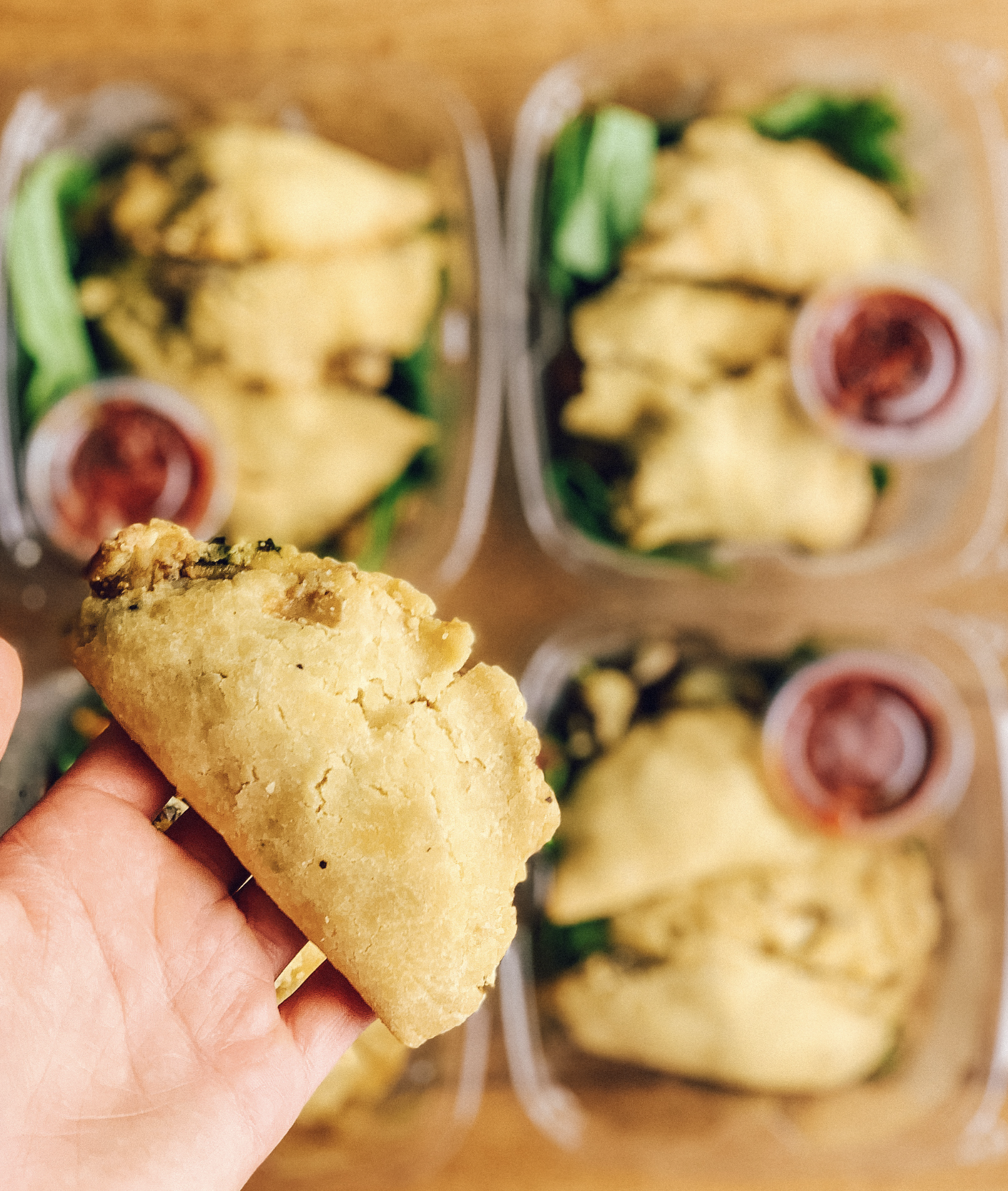
Meat-and-seafood empanadas built on a foundational grain-free pastry: a beef empanada with cumin and smoked paprika, a shrimp empanada with cotija and parsley, and a picadillo-style with green olives and raisins. The classic Latin American hand pie reconstructed entirely with grain-free flours, grass-fed beef, wild-caught shrimp, and traditional spice profiles.
Yield: 12 empanadas per variation
Active: 1 hr · Total: 3 hr (includes pastry chilling time) ·
A note from the kitchen
Empanadas are foundational across Latin America, Spain, and Portugal — small hand pies with infinite filling variations. The word comes from the Spanish empanar (to wrap in bread), and the format traces back to medieval Iberian cooking before traveling with Spanish colonization across the Americas, where it absorbed local ingredients into regional variations. Argentine, Chilean, Peruvian, Mexican, Cuban, and Puerto Rican empanadas all share the same basic structure and diverge in filling, spice profile, and dough.
The Beef Empanada is the classic — grass-fed ground beef with cumin, smoked paprika, onion, garlic, and fresh parsley, drained of excess fat so the pastry holds together in the oven. The most direct lineage to medieval Spanish meat pies.
The Shrimp Empanada is the seafood variation — wild-caught shrimp with onion, spinach, parsley, and a hint of cotija cheese.
Foundational Grain-Free Pastry Dough
Empanadas can be made using the following Grain-Free Pastry Dough recipe. Each variation below uses 1 full recipe of the pastry dough (which yields about 12 four-inch rounds when rolled to ⅛-inch thick).
You can make the pastry up to 5 days ahead and refrigerate, or up to 3 months ahead and freeze (thaw overnight in the refrigerator before rolling).
Yield: One 12-inch rolled square (enough for 9 large or 12 small empanadas) · Active: 30 min · Total: 2 hr 30 min (mostly chilling) · Year-round
A note from the kitchen
This is the cassava-and-arrowroot version of rough puff pastry that can serve as a structural foundation for many grain-free pastry recipes. Cassava flour brings body and a slight chew that almond flour alone cannot. Arrowroot brings the clean starch that absorbs moisture during baking and helps prevent the dough from cracking when folded.
The fat is ghee rather than butter. Ghee is butter with the milk solids removed, which gives it a higher smoke point and produces a flakier pastry that doesn't burn at the edges. It also keeps better unrefrigerated than fresh butter. For this recipe specifically, the ghee creates discrete pockets of fat in the dough that vaporize into steam during baking, lifting the layers and creating the lamination that defines a good puff. That being said, cold butter works too.
Ingredients
1 cup cassava flour (sifted)
¼ cup arrowroot powder, plus more for dusting
¼ tsp sea salt
½ cup ghee, cold and cubed (about 4 oz)
Plus 5 tbsp cold ghee, cubed (this is added in a separate stage — see method)
10–12 tbsp ice water (cold filtered water with ice cubes added)
For ghee prep: Refrigerate your ghee for at least 30 minutes before starting, then cube it directly out of the refrigerator. Cold fat is structurally essential — warm or room-temperature ghee will incorporate too fully into the flour and you'll lose the lamination layers entirely.
Method
Prep the cold ghee. Cut the chilled ghee into small cubes (about ¼-inch each). Return the cubes to the refrigerator while you measure the dry ingredients. You want the ghee genuinely cold when it hits the flour.
Sift the dry ingredients. In a medium bowl, sift the cassava flour, arrowroot powder, and sea salt together. Sifting is structurally important here — cassava flour clumps easily, and uneven flour distribution will create dense spots in the finished pastry.
Cut in the ghee. Add ½ cup of the cold cubed ghee to the sifted flour mixture. Using a pastry cutter, two butter knives, or your fingertips (work fast so the ghee doesn't warm), cut the ghee into the flour until the mixture looks like coarse breadcrumbs with some pea-sized chunks of ghee still visible. You want to see distinct ghee pieces — don't blend it in fully.
Add the remaining 5 tbsp cold cubed ghee whole. Don't cut these in — just toss the cubes through the dough so they remain as discrete pieces. These larger ghee chunks are what create the flaky layers during folding and baking.
Add the ice water gradually. Drizzle 5 tbsp ice water over the flour mixture and stir gently with a fork to begin combining. Don't overwork the dough.
Test the hydration. Squeeze a small handful of dough — if it holds together when pressed, the hydration is correct. If it crumbles, add 1 more tbsp ice water and test again. Keep adding water 1 tbsp at a time until the dough barely holds together (you should be able to use up to 10–12 tbsp total, depending on humidity and flour brand).
Shape into a square and rest. Turn the dough out onto a clean surface dusted with arrowroot. Gently press into a 5-inch square — don't knead, just compress. Wrap in parchment paper or beeswax wrap. Refrigerate at least 30 minutes, until firm.
First fold. Place a large piece of parchment paper on a flat work surface. Lightly dust with arrowroot. Unwrap the dough and place it on the parchment. Place a second sheet of parchment on top. Using a rolling pin, roll the dough out into a 15 × 8-inch rectangle (long side facing you). If the dough cracks at the edges, gently press it back together with your fingers and continue rolling.
Fold like a letter (single fold). Fold the short right side of the rectangle into the center, then fold the short left side over the top — like folding a letter into thirds. Wrap the dough in parchment and refrigerate at least 30 minutes.
Second fold. Repeat the process. Place the dough back on the parchment, dust with arrowroot, top with second parchment, and roll out again to 15 × 8 inches. Fold into thirds again like a letter. Wrap and refrigerate at least 30 minutes.
Third fold. Repeat one more time. Roll out, fold, wrap.
Final rest. Refrigerate the folded dough at least 1 hour before using — overnight is even better. The longer the final rest, the more the starches relax and the better the dough will roll out without cracking.
Roll and shape. When ready to use, place the dough between two sheets of parchment paper dusted with arrowroot. Roll out to the size and thickness your recipe specifies (typically ⅛-inch for hand pies and empanadas). Cut into the shapes needed for your specific recipe. Use immediately or re-chill briefly if the dough warms during shaping.
Variations
Butter version (if ghee isn't available): Substitute the ghee with cold cultured grass-fed butter. The dough may brown slightly faster at the edges during baking — watch carefully and reduce oven temperature by 25°F if it browns too quickly. Use European-style butter (84%+ butterfat) for the best results.
Coconut oil version (for dairy-free): Substitute the ghee with cold, solid unrefined coconut oil. The dough will be slightly less rich but still flaky. Keep the coconut oil very cold throughout the entire process — it melts faster than ghee and creates a softer dough.
Lard version (traditional pasty pastry): Substitute the ghee with cold pasture-raised pork lard. Creates the most traditional Cornish-pasty-style flakiness — denser, more savory, more deeply flaky than the ghee version. Use for meat empanadas, savory turnovers, or game-meat hand pies.
Duck fat version (game-meat hand pies): Substitute the ghee with cold rendered duck fat. Produces a deeply rich, slightly gamey pastry that's exceptional for game-bird empanadas, wild duck pasties, or pheasant hand pies.
Herb-infused version: Add 1 tbsp finely chopped fresh herbs (thyme, rosemary, oregano, or sage) to the flour mixture before cutting in the ghee. Beautiful for savory hand pies — fresh thyme is especially complementary to mushroom or root-vegetable fillings.
Sweet version (for dessert hand pies): Reduce the salt to a small pinch and add 2 tbsp coconut sugar or pure maple syrup to the flour mixture. Lightly sweetens the pastry without making it cloying — perfect for fruit hand pies, apple turnovers, or sweet empanadas.
Sourcing
Cassava flour:
100% cassava root (yuca) flour — the only ingredient on the label should be "cassava flour" or "cassava root flour."
NOT tapioca starch. These are different products. Cassava flour is the whole peeled cassava root ground into a fine flour with the natural fiber intact. Tapioca starch is the extracted starch only, with the fiber and most of the nutrients removed. Both come from the same plant but behave structurally differently in baking. Cassava flour gives this dough its body and slight chew; tapioca starch alone would produce a gummy, brittle dough.
Organic and fair-trade when possible.
Pale ivory color, finely ground.
Stored cool in a sealed glass container — cassava flour absorbs moisture from the air and clumps if exposed.
Avoid pre-mixed grain-free flour blends with multiple added gums and starches.
Arrowroot powder:
Pure arrowroot starch — the only ingredient on the label should be "arrowroot powder" or "arrowroot starch."
Organic when possible.
Stored cool in a sealed glass container — arrowroot loses thickening potency if exposed to humidity or stored too long.
Avoid corn starch as a substitute (genetically modified, structurally different). Arrowroot is the ancestral root-based thickener used for centuries before corn starch.
Ghee:
From pasture-raised, grass-fed cows. Real ghee is butter that has been slowly simmered until the milk solids brown lightly and separate from the butterfat, then strained off — producing a pure, shelf-stable, lactose-free cooking fat with a distinctive nutty aroma.
Organic when possible.
In a glass jar (not plastic — ghee pulls plasticizers from packaging over time).
Deep yellow-gold color — the visual indicator of grass-fed source dairy.
Should smell faintly nutty and caramelized, never rancid.
Solid at refrigerator temperature, soft at room temperature.
Avoid commercial "clarified butter" sold in plastic tubs with added preservatives.
Homemade ghee: simmer 1 lb cultured grass-fed butter over low heat until the milk solids brown and sink (about 20 min), then strain through cheesecloth into a glass jar. Keeps refrigerated 6 months.
Grass-fed butter (for the butter variation):
From cows on pasture year-round when possible.
Cultured (fermented before churning) for the deepest flavor.
Deep yellow color — the visual indicator of grass-fed dairy.
High butterfat percentage (84%+ is European-style; 80% is standard American).
A small local farm or creamery you know is the gold standard.
Pasture-raised pork lard (for the lard variation):
Rendered from pasture-raised heritage-breed pork (Berkshire, Mangalitsa, Tamworth, Red Wattle) when possible.
Leaf lard (from around the kidneys) is the cleanest, mildest, and best for pastry — back fat lard is acceptable but slightly more porky in flavor.
Pure white color, faintly meaty aroma, no rancidity.
In a glass jar.
Avoid commercial hydrogenated lard from confined-feedlot pork.
Sea salt:
Unrefined, solar-dried or hand-harvested. No anti-caking agents, no bleaching, no chemical processing.
Naturally moist — the visual indicator of preserved minerals.
For this recipe, a fine-grain unrefined sea salt — Baja Gold mineral sea salt (third-party tested at 29.5–31.5% sodium, harvested from the Sea of Cortez, solar-dried) or any equivalent mineral-rich sea salt.
Avoid iodized table salt, kosher salt (no mineral content), and mass-produced "Pink Himalayan."
Storage
Refrigerator: Up to 5 days, well-wrapped in parchment or beeswax wrap and sealed in a glass container. The dough actually improves with overnight resting — the starches relax and the dough rolls out more easily on day 2.
Freezer: Up to 3 months, well-wrapped. Thaw overnight in the refrigerator before rolling. Do not thaw at room temperature — the ghee will warm too fast and lose its lamination structure.
For meal prep and batch baking: Make a double batch, divide into two 5-inch squares, and freeze one. You're then set up for empanadas, sweet hand pies, or pasties at any moment over the next three months.
Working with the dough
A few structural notes for handling grain-free rough puff successfully:
The dough is more fragile than wheat-based puff. Crack repair is expected — if it tears during rolling, simply press the dough back together with damp fingers. The folds will integrate any patches.
Keep the dough cold. If the dough warms during rolling or shaping, return it to the refrigerator for 10 minutes before continuing. Warm fat = no lamination = no flaky layers.
Don't overwork. The fewer times you roll and stretch the dough, the more delicate the final pastry. Three folds is the structural maximum — more will make the dough tough.
Always roll between parchment paper. The dough sticks easily to direct surfaces. Two sheets of parchment dusted with arrowroot is the cleanest technique.
For the third roll-out (when shaping into final pastries), roll slightly thinner than you think — about ⅛ inch. The dough puffs and rises during baking, so thinner is better than thicker.
Recipe inspired from the rough puff pastry technique in Sweet Laurel Savory by Laurel Gallucci and Claire Thomas.
Foundational Low-Carb Mozzarella Pastry Dough
The lower-carb pastry pathway — chewy, flexible, holds together beautifully, faster to make. No chilling cycles required. Made entirely on the stovetop using a double-boiler technique.
Yield: Enough dough for 12 empanada rounds (3½-inch) · Active: 25 min · Total: 35 min · Year-round · Cuisine: Grain-free, lower-carb pantry foundation
A note from the kitchen
This is the lower-carb pastry option in this collection. It works because melted mozzarella has natural elasticity from its protein matrix (caseins arranged in long chains), which allows the dough to be rolled and folded the way wheat-gluten dough can. The almond flour adds bulk and absorbs moisture; the egg binds.
Per empanada, this dough delivers roughly half the carbohydrates of the rough puff version — beautiful for readers managing carbs more strictly, or those who simply want a faster pastry without the rolling and folding cycles. It also produces a structurally different finished empanada — chewy and flexible rather than flaky and laminated.
This version uses a stovetop double boiler rather than a microwave, which is genuinely the better technique anyway — slower, gentler heat preserves the protein structure of the mozzarella and produces a more elastic, more workable dough. The dough comes together in about 25 minutes from start to ready-to-roll, with no chilling cycles required.
Two structural notes:
Use raw or low-moisture mozzarella, not fresh. Fresh mozzarella (the soft milky balls in water) has too much water content and produces a sticky, unworkable dough. The recipe specifically benefits from a sharper, drier mozzarella, which produces a dough that holds its shape under filling and crisps reliably in the oven.
Work the dough while it's still warm. Unlike rough puff, this dough must be rolled and shaped while it's still slightly warm and pliable — once it fully cools, it becomes firm and harder to work with. If the dough cools too quickly, gently rewarm the bowl over the double boiler for 30 seconds.
Ingredients
1½ cups (6 oz) raw or low-moisture mozzarella cheese, shredded
2 oz raw cream cheese, cubed (optional — adds richness and tenderness; can be omitted)
¾ cup (3 oz) blanched almond flour, finely ground
1 large pasture-raised egg, lightly beaten
¼ tsp sea salt
For preparation:
A medium heatproof bowl (stainless steel or glass)
A small saucepan filled with 1 inch of water (for the double boiler)
A silicone spatula
A clean work surface
Parchment paper for rolling
Mix in the almond flour and salt. Once the cheese is fully melted, remove the bowl from the heat (use oven mitts — the bowl will be hot). Add the almond flour and sea salt directly to the warm cheese. Stir vigorously with the spatula to begin combining. The mixture will look shaggy and resistant at first — keep working.
Add the egg. Pour in the beaten egg. Continue stirring and pressing the mixture together with the spatula until it begins to form a cohesive dough.
Knead by hand. Turn the warm dough out onto a clean work surface. Knead by hand for 1–2 minutes, folding and pressing the dough together until it's smooth, elastic, and slightly sticky. The dough should feel pliable like a soft bread dough. If it's too sticky to handle, sprinkle with 1–2 tablespoons more almond flour and knead in. If it's too dry or crumbly, return it briefly to the warm bowl for 30 seconds and knead in 1 tsp of warm water.
Rest 5 minutes. Let the dough rest at room temperature for about 5 minutes — this allows the almond flour to fully hydrate and the cheese proteins to relax into their final structure. Don't refrigerate — this dough is best rolled while still slightly warm and pliable.
Roll and shape. Place the dough between two sheets of parchment paper. Roll out evenly to about ⅛-inch thickness, dusting with a little additional almond flour if it sticks. The dough should roll easily — if it cracks or feels too firm, return it briefly to the warm bowl to soften, then resume.
Cut into rounds. Cut 3½-inch rounds using a cookie cutter, wide-mouth jar, or sharp knife around a small bowl. Re-roll the scraps once more to get more rounds — this dough is forgiving and tolerates a few rerolls without becoming tough.
Use immediately. The dough is best assembled and baked immediately while still pliable. If it cools and becomes too firm to work with, gently rewarm between your palms or over the double boiler for 20–30 seconds.
Method
Set up the double boiler. Fill a small saucepan with about 1 inch of water. Place a heatproof bowl on top — the bottom of the bowl should not touch the water. Bring the water to a gentle simmer over low heat. The steam from the simmering water gently warms the bowl above without direct heat — this is the slow, controlled melting technique that produces the best dough.
Add the cheese. Place the shredded mozzarella in the bowl. If using cream cheese, scatter the cubes on top of the mozzarella.
Melt slowly. Stir gently with a silicone spatula every 30 seconds or so as the cheese begins to soften. The mozzarella will start to look glossy and stretchy after about 3–4 minutes. Continue stirring gently until the cheese is fully melted, smooth, and homogeneous — usually 5–7 minutes total. Don't rush this step — gentle heat preserves the protein structure that makes the dough workable.
Mix in the almond flour and salt. Once the cheese is fully melted, remove the bowl from the heat (use oven mitts — the bowl will be hot). Add the almond flour and sea salt directly to the warm cheese. Stir vigorously with the spatula to begin combining. The mixture will look shaggy and resistant at first — keep working.
Add the egg. Pour in the beaten egg. Continue stirring and pressing the mixture together with the spatula until it begins to form a cohesive dough.
Knead by hand. Turn the warm dough out onto a clean work surface. Knead by hand for 1–2 minutes, folding and pressing the dough together until it's smooth, elastic, and slightly sticky. The dough should feel pliable like a soft bread dough. If it's too sticky to handle, sprinkle with 1–2 tablespoons more almond flour and knead in. If it's too dry or crumbly, return it briefly to the warm bowl for 30 seconds and knead in 1 tsp of warm water.
Rest 5 minutes. Let the dough rest at room temperature for about 5 minutes — this allows the almond flour to fully hydrate and the cheese proteins to relax into their final structure. Don't refrigerate — this dough is best rolled while still slightly warm and pliable.
Roll and shape. Place the dough between two sheets of parchment paper. Roll out evenly to about ⅛-inch thickness, dusting with a little additional almond flour if it sticks. The dough should roll easily — if it cracks or feels too firm, return it briefly to the warm bowl to soften, then resume.
Cut into rounds. Cut 3½-inch rounds using a cookie cutter, wide-mouth jar, or sharp knife around a small bowl. Re-roll the scraps once more to get more rounds — this dough is forgiving and tolerates a few rerolls without becoming tough.
Use immediately. The dough is best assembled and baked immediately while still pliable. If it cools and becomes too firm to work with, gently rewarm between your palms or over the double boiler for 20–30 seconds.
Variations
Without cream cheese (dairy-leaner): Skip the cream cheese entirely. The dough is slightly less rich and slightly firmer, but structurally still works. This is the version that produces the cleanest, most empanada-traditional result.
With herbs (savory hand pies): Add 1 tbsp finely chopped fresh herbs (thyme, oregano, rosemary, or sage) to the melted cheese before adding the almond flour. Beautiful for meat empanadas, mushroom hand pies, or any savory preparation.
Italian-leaning: Add 1 tsp dried oregano and ½ tsp garlic powder to the dry ingredients. Beautiful for empanadas with Italian-leaning fillings.
Larger batch (double recipe): Double all ingredients. Use a slightly larger bowl on the double boiler. The technique stays the same — just allow an extra 3–5 minutes for the larger batch to fully melt.
Sourcing
Raw or low-moisture mozzarella:
Raw milk mozzarella when legally available in your state (state-by-state legal status varies — check realmilk.com).
Low-moisture mozzarella otherwise — the dry, firm kind sold in blocks (not the fresh milky kind in water).
From cows on pasture year-round when possible.
Whole milk, full-fat — the only ingredient list should be milk, cultures, salt, and possibly enzymes or rennet. Avoid mozzarella with cellulose, anti-caking agents, modified starches, or "natural flavors."
Pre-shredded mozzarella often contains potato starch or cornstarch to prevent clumping — avoid these and shred fresh from a block. Pre-shredded brands also tend to be coated with anti-caking agents that interfere with the melting process.
From a small local creamery or specialty cheesemonger when possible.
Avoid fresh mozzarella in water (too wet for this recipe), shredded "pizza cheese" blends, and "string cheese" sticks.
Raw cream cheese (optional):
From cows on pasture year-round when possible.
Raw if available where it's legally sold, or minimally-pasteurized otherwise.
The shortest possible ingredient list — ideally just cultured cream and salt. Avoid cream cheese with gums, stabilizers, or "natural flavors."
Full-fat (never low-fat or fat-free).
From a small local creamery or grass-fed dairy when possible.
Blanched almond flour:
Finely-ground, blanched (not almond meal — which is coarser and contains the skins, structurally different for this dough).
Organic when possible.
Recently milled — almond flour goes rancid fast. Smell test: should smell sweet and faintly nutty, never musty or bitter.
Stored cool in the refrigerator or freezer once opened.
Pasture-raised eggs:
"Pasture-raised," not "free-range" or "cage-free."
Deep orange yolks — the visual indicator that the hens actually foraged.
From a local farmer at the farmers' market when possible.
Sea salt:
A fine-grain unrefined sea salt — Baja Gold mineral sea salt (third-party tested at 29.5–31.5% sodium, harvested from the Sea of Cortez, solar-dried) or any equivalent unrefined mineral-rich sea salt.
Avoid iodized table salt and kosher salt.
Storage
This dough is best used immediately. Unlike rough puff, it does not freeze or refrigerate well — the cheese protein structure becomes rubbery and difficult to work with after chilling and reheating.
If you must store unbaked dough: Wrap tightly in parchment and refrigerate up to 24 hours. To use, gently rewarm in the double boiler for 1–2 minutes, just until pliable again, then proceed with rolling. The texture won't be quite as good as fresh, but it'll work.
For batch baking: Assemble the empanadas and bake them on the same day the dough is made. Once baked, the finished empanadas refrigerate 3 days and reheat in a 350°F oven for 8–10 minutes.
Working with the dough
A few structural notes for handling this dough successfully:
Work while warm. The dough is most pliable in the first 15–20 minutes after making. If it cools and stiffens, briefly rewarm.
Don't overwork. Kneading for 1–2 minutes is enough — over-kneading toughens the dough by breaking down the cheese protein structure.
Roll slightly thicker than rough puff. Aim for closer to ⅛-inch+ since this dough doesn't puff or rise — too thin and the empanada is structurally fragile.
Pinch and seal carefully. The dough is sticky enough that fork-crimping works beautifully and doesn't require a water-brush along the edges first.
Bake immediately after assembly. Don't let assembled empanadas sit at room temperature for more than 30 minutes before baking — the cheese softens and the structure can collapse.
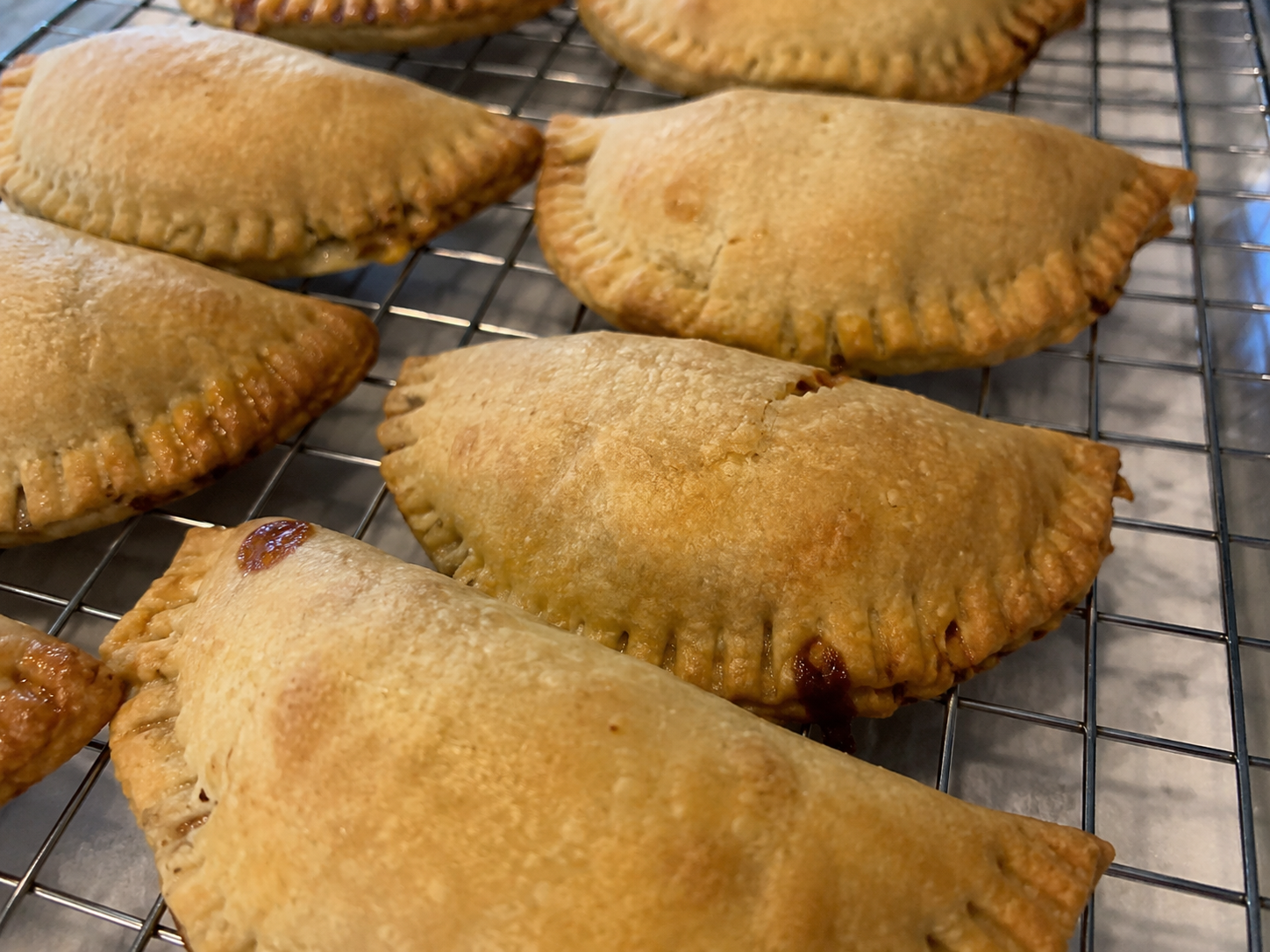
Beef Empanadas
Yield: 12 empanadas · Active: 30 min · Total: 2 hr 30 min (including pastry chilling)
Ingredients
For the filling:
2 tbsp grass-fed butter or ghee
1 small yellow onion, finely chopped (about 4 oz)
1 lb grass-fed ground beef (85% lean / 15% fat)
2 cloves garlic, minced
1 tsp ground cumin
1 tsp smoked paprika
½ tsp sea salt
¼ tsp freshly cracked black pepper
2 tbsp fresh flat-leaf parsley, finely chopped
Optional: 2 tbsp fresh cilantro, finely chopped (for Mexican-leaning variation)
Optional: 1 chopped hard-boiled pasture-raised egg (traditional Argentine inclusion)
For assembly:
1 recipe Grain-Free Pastry Dough — rough puff OR low-carb mozzarella pastry dough (see above)
Arrowroot powder, for dusting
1 large pasture-raised egg, beaten with 1 tbsp water (egg wash)
For serving:
Romesco sauce, chimichurri, or salsa verde
Method
Cook the onion. Heat the butter in a large heavy skillet over medium-high heat. Add the chopped onion and cook 4 minutes, stirring occasionally, until softened and translucent.
Add the beef. Add the ground beef and break it up with a wooden spoon as it cooks. Cook 4–5 minutes, until no pink remains.
Drain the fat. Transfer the beef and onion mixture to a colander set over a bowl and let drain for 1–2 minutes. This is the structural moment of the recipe — grass-fed beef tends to be leaner than industrial grain-fed, but the ground meat still releases enough fat during cooking to soak the dough from the inside if not drained. Reserve the rendered fat for sautéing vegetables later — it keeps refrigerated 1 week.
Bloom the spices. Return the drained beef to the skillet over low heat. Add the minced garlic, cumin, smoked paprika, sea salt, and black pepper. Cook 1 minute, stirring constantly, until fragrant. Cooking the spices into the meat for one minute at the end — rather than adding them to the raw beef from the start — is the technique called blooming. Heating dry spices briefly in fat extracts and concentrates their volatile oils, which are otherwise locked into the seed particles.
Stir in the parsley. Off heat, stir in the chopped fresh parsley (and optional cilantro). Add the optional chopped hard-boiled egg if using.
Cool the filling completely. Transfer to a bowl and cool to room temperature, then refrigerate at least 30 minutes. Warm filling makes the dough split during baking — patience here matters. The filling can be made up to 2 days ahead and refrigerated.
Roll out the pastry. Preheat the oven to 400°F. Line a baking sheet with parchment paper. Roll the chilled rough puff pastry between two sheets of parchment dusted with arrowroot to ⅛-inch thick. Cut 4-inch rounds using a biscuit cutter, the mouth of a wide jar, or a small bowl. Re-roll the scraps once more to get all 12 rounds (don't re-roll twice — over-rolling toughens the pastry).
Fill and seal. Place a heaping tablespoon of the cooled filling on one half of each round, leaving a ½-inch border. Brush the edges with water (helps the dough seal). Fold the dough over to form a half-moon. Press the edges firmly with a fork to seal — the fork tines create the classic empanada-edge pattern and also create a stronger seal than fingers alone.
Place and egg-wash. Arrange the empanadas on the prepared baking sheet, leaving 1½ inches between each. Brush all over with the beaten-egg-and-water mixture. The egg wash gives the finished empanadas their deep golden color.
Bake. Bake at 400°F for 20–25 minutes (rough puff) or 18–22 minutes (mozzarella dough). If the empanadas brown too quickly, loosely cover with foil for the last 5 minutes.
Rest before serving. Remove from the oven and let rest 10 minutes — the filling holds heat longer than the pastry and can scald you if you bite in immediately. Serve warm with chimichurri, salsa verde, or a romesco sauce.
Shrimp Empanadas
Yield: 12 empanadas · Active: 30 min · Total: 2 hr 30 min (including pastry chilling)
Ingredients
For the filling:
2 tbsp extra-virgin olive oil
1 small yellow onion, finely chopped
1 lb wild-caught shrimp, peeled, deveined, and small-diced (about ½-inch pieces)
½ tsp sea salt
¼ tsp freshly cracked black pepper
2 cups fresh spinach, chopped
2 tbsp fresh flat-leaf parsley, finely chopped
2 tbsp tomato paste (optional, for deeper savory color and flavor)
¼ cup cotija cheese, finely crumbled (or substitute aged feta or ricotta salata)
For assembly:
1 recipe Grain-Free Pastry Dough — rough puff OR low-carb mozzarella pastry dough (see above)
Arrowroot powder, for dusting
1 large pasture-raised egg, beaten with 1 tbsp water (egg wash)
For serving:
Romesco sauce, chimichurri, or salsa verde
Method
Cook the onion. Heat the olive oil in a large skillet over medium heat. Add the chopped onion and cook 4 minutes, until softened and translucent.
Add the shrimp. Add the diced shrimp, sea salt, and black pepper. Cook 2–3 minutes, stirring occasionally, until the shrimp turn opaque and pink. Don't overcook — shrimp continue cooking in the residual heat of the pan.
Add the spinach. Add the chopped fresh spinach and cook 2 minutes more, stirring frequently, until the spinach is fully wilted.
Stir in parsley and tomato paste. Off heat, stir in the chopped parsley and the optional tomato paste. Mix well.
Drain the filling. Transfer the mixture to a colander or fine-mesh sieve set over a bowl. Let drain 3–5 minutes — seafood releases significant liquid as it cooks, and wet filling will soak the pastry from the inside. This is doubly important for seafood empanadas. Don't skip this step.
Cool completely and stir in the cotija. Transfer the drained filling to a bowl and cool to room temperature, then refrigerate at least 30 minutes. Once the filling is fully cool, stir in the crumbled cotija — adding it while warm would melt the cheese and change the texture.
Roll out the pastry. Preheat the oven to 400°F. Line a baking sheet with parchment paper. Roll the chilled rough puff pastry between two sheets of parchment dusted with arrowroot to ⅛-inch thick. Cut 4-inch rounds.
Fill and seal. Place a tablespoon of the cooled filling on one half of each round (slightly less than the beef version, since seafood filling is denser). Brush the edges with water. Fold over to form a half-moon. Press the edges firmly with a fork to seal.
Place and egg-wash. Arrange on the prepared baking sheet, 1½ inches apart. Brush all over with egg wash.
Bake. Bake at 400°F for 20–25 minutes (rough puff) or 18–22 minutes (mozzarella dough). The shrimp empanadas cook slightly faster than the beef version because the filling is less dense.
Rest 10 minutes before serving. Serve warm with romesco, chimichurri, or salsa verde — the bright herbal punch cuts through the rich seafood filling beautifully.
A note on cooling seafood empanadas: These are best eaten same-day or the next day. The wild-caught shrimp quality declines faster than meat or vegetable fillings, so don't try to stretch leftovers beyond 2 days.
Picadillo Style Empanadas
Yield: 12 empanadas · Active: 1 hr (longer because of the slow simmer) · Total: 3 hr (including pastry chilling)
Ingredients
For the filling:
2 tbsp grass-fed butter or ghee
1 small yellow onion, finely chopped
2 cloves garlic, finely chopped
1 medium turnip or sweet potato, peeled and small-diced (about 1 cup)
2 bay leaves
1 lb grass-fed ground beef (85% lean / 15% fat)
½ cup pitted green olives (Castelvetrano or Manzanilla), coarsely chopped
½ cup raisins or dried cranberries (refined-sugar-free, organic)
3 tbsp coconut aminos
1 tbsp dried Italian herb seasoning blend (rosemary, thyme, oregano)
1 tsp ground ginger
¼ tsp ground allspice
¼ tsp freshly grated nutmeg
1 tsp sea salt (or to taste)
¼ tsp freshly cracked black pepper
For assembly:
1 recipe Grain-Free Pastry Dough — rough puff OR low-carb mozzarella pastry dough (see above)
Arrowroot powder, for dusting
1 large pasture-raised egg, beaten with 1 tbsp water (egg wash)
For serving:
Romesco, chimichurri, salsa verde, or a quality ketchup
Method
Sauté onion, garlic, and bay leaves. Heat the butter in a large heavy skillet over medium heat. Add the chopped onion, garlic, and bay leaves. Cook 4–5 minutes, stirring occasionally, until the onion is translucent and the garlic is fragrant.
Add the beef. Add the ground beef and break it up with a wooden spoon as it cooks. Cook 4 minutes, until no pink remains.
Drain the fat. Transfer the beef mixture to a colander set over a bowl and let drain for 1–2 minutes (the same critical step as the Argentine version).
Return to the skillet and add the seasonings. Return the drained beef to the skillet over low heat. Add the diced turnip, chopped olives, raisins, coconut aminos, Italian herb seasoning, ground ginger, allspice, nutmeg, sea salt, and pepper. Stir to combine.
Simmer covered. Reduce the heat to low, cover the skillet, and simmer 20–30 minutes, stirring occasionally, until the turnips are tender and the flavors have integrated. The mixture should be deeply savory-sweet, with the raisins plumped and the olives soft.
Taste and adjust. Remove the bay leaves. Taste and adjust salt — the coconut aminos and olives both add saltiness, so you may not need much additional salt.
Cool completely. Transfer to a bowl and cool to room temperature, then refrigerate at least 30 minutes. The filling can be made up to 2 days ahead.
Roll out the pastry. Preheat the oven to 400°F. Line a baking sheet with parchment paper. Roll the chilled rough puff pastry to ⅛-inch thick between two sheets of parchment dusted with arrowroot. Cut 4-inch rounds.
Fill and seal. Place a heaping tablespoon of the cooled filling on one half of each round. Brush edges with water. Fold over to form a half-moon. Press the edges firmly with a fork to seal.
Place and egg-wash. Arrange on the prepared baking sheet. Brush all over with egg wash.
Bake. Bake at 400°F for 20–25 minutes (rough puff) or 18–22 minutes (mozzarella dough). Add a few more minutes as needed because the filling is denser and benefits from full integration of the warm spices into the pastry. The empanadas should be deeply golden brown and the bottoms crispy.
Rest 10 minutes before serving. Serve warm with curried ketchup (especially good with the Picadillo version — the Caribbean spice profile of the ketchup echoes the Moorish spice profile of the filling), chimichurri, or salsa verde.
Variations (Across All Three)
Lamb version: Substitute the ground beef with grass-fed ground lamb in either the Argentine or Picadillo recipe. Lamb's mineral depth pairs beautifully with the cumin-paprika spice profile (especially Moroccan-leaning) and with the sweet-and-savory Picadillo filling.
Chicken version: Substitute the ground beef with cooked shredded pasture-raised chicken (rotisserie or roasted thighs, about 2 cups). Reduce the cooking time accordingly — there's no need to cook the chicken twice.
Chorizo version: Substitute half the ground beef with cured Spanish-style pasture-raised chorizo, finely chopped. Beautiful for the Argentine version — smokier, deeper, more directly Spanish in profile.
Salt cod (bacalao) version: For a traditional Galician empanada gallega flavor, substitute the shrimp with desalted salt cod (bacalao) — about 8 oz, soaked 24–48 hours with several water changes, then flaked into small pieces. Cook with the onion and tomato paste as in the shrimp recipe. The most ancestral seafood empanada.
Crab or lobster version: Substitute the shrimp with fresh wild-caught crab meat or chopped lobster tail (about 12 oz). A luxurious special-occasion empanada.
Game meat versions: The picadillo profile is exceptional with ground venison, wild boar, or bison. Substitute one-for-one for the grass-fed ground beef.
Mini empanadas (for parties): Cut the dough into 3-inch rounds instead of 4-inch, and use 1 teaspoon of filling per empanada. You'll get about 18–20 mini empanadas per recipe. Beautiful for a brunch board or party tray.
Larger format: Roll the pastry into two large rectangles, fill the bottom with a doubled batch of any filling, top with the second rectangle, seal the edges, and bake at 375°F for 35–40 minutes. Cut into squares to serve.
Make-ahead and freezer notes: All these empanada styles freeze beautifully unbaked when using rough puff dough. Arrange assembled, egg-washed empanadas on a parchment-lined sheet pan and freeze until firm (1–2 hours), then transfer to a sealed freezer container or bag. Bake from frozen at 400°F, adding 5–8 minutes to the cook time. (Mozzarella-dough empanadas do not freeze unbaked as reliably — best baked the same day.) The kind of recipe that turns a Sunday afternoon project into 2 months of weeknight dinners.
Sourcing
Grass-fed ground beef:
85% lean / 15% fat is the structural ratio that works for empanadas — lean enough to not soak the pastry, fatty enough to carry flavor.
100% grass-fed and grass-finished from a small local farm or rancher you know personally is the gold standard. Heritage breeds (Angus, Hereford, Highland, Wagyu) when available.
Deep red color, with marbling that looks creamy-white (not bright yellow, which can indicate sulfur compound buildup).
Fresh-ground at the butcher whenever possible.
Avoid generic supermarket "lean ground beef" from confined-feedlot cattle, anything labeled only "natural," and ground beef with extended shelf-life packaging (typically gas-flushed with carbon monoxide to maintain artificial red color).
Wild-caught shrimp:
Wild-caught Gulf shrimp (from the U.S. Gulf of Mexico), wild-caught Atlantic shrimp, or sustainable wild-caught Pacific shrimp.
Avoid all farmed shrimp — environmental issues, antibiotic residues, ethical concerns with Southeast Asian shrimp farming labor practices.
Headless, peeled, deveined, and flash-frozen on the boat is structurally excellent quality. Don't avoid frozen — it can be better than "fresh" shrimp that's been on ice for days.
26/30 or 31/35 count per pound is the right size for empanadas — smaller shrimp can be used whole, larger should be chopped.
Avoid shrimp imported from Southeast Asia (typically farmed under poor conditions), anything labeled only "shrimp" without origin, and "salad shrimp" or "cocktail shrimp" (often dyed and chemically preserved).
Cotija cheese:
Real Mexican cotija is a hard aged cow's-milk cheese, sometimes called "the Parmesan of Mexico" — used grated or crumbled over finished dishes for salt and depth.
From a small Mexican cheesemaker or specialty Latin American grocer. Real cotija has a slight crumble and sharp salty flavor.
Substitutes if unavailable: aged feta (sheep), ricotta salata (Italian), or aged Manchego (Spanish sheep).
Avoid mass-produced "queso fresco" or "cotija-style cheese" with multiple stabilizers and gums.
Wild-caught salt cod (for the bacalao variation):
100% salt-cured wild-caught Atlantic or Pacific cod — the only ingredients should be cod and salt.
Whole salted fillets from Spanish, Portuguese, or Norwegian sources are ideal.
Look for thick fillets with white-cream color, firm texture, salt crystals visible on the surface.
Requires 24–48 hours of soaking with several water changes before cooking.
Green olives:
Castelvetrano olives (Sicilian, bright green, mild and buttery) are the most accessible and delicious choice.
Manzanilla olives (Spanish, smaller, more traditionally Spanish) are also classic.
Look for olives in glass jars in their own brine — the only ingredients should be olives, water, sea salt, and (sometimes) vinegar.
Avoid commercial olives with lactic acid, ferrous gluconate (used to artificially blacken olives), or other additives.
Raisins or dried cranberries:
100% raisins or 100% cranberries — the only ingredient on the label should be the fruit itself.
Organic when possible — both are heavily sprayed conventionally.
Refined-sugar-free. Many commercial dried cranberries contain cane sugar (sometimes 20+g per serving). Even apple-juice-concentrate-sweetened cranberries are typically processed and lose much of their nutrient profile. Look for cranberries unsweetened.
Avoid raisins or cranberries with sulfites, oils, or "natural flavors."
Coconut aminos:
100% coconut blossom sap with sea salt — the most ancestral option, soy-free, slightly sweet-salty profile.
Organic when possible.
A direct substitute for tamari or soy sauce in any recipe, with about half the sodium content.
Turnip:
Firm, heavy for size, with bright greens still attached (the greens are an indicator of freshness).
Local farmers' market or CSA during peak season (October–March).
Avoid soft or wrinkled turnips, and turnips without their tops attached.
Fresh herbs (parsley, cilantro):
Fresh, fragrant, bright green leaves with no wilting or yellowing.
Whole bunches from a local farmers' market, garden, or CSA.
Italian flat-leaf parsley over curly parsley.
Pastry foundationals (cassava flour, arrowroot, ghee, sea salt, grass-fed butter) and condiment foundationals (smoked paprika, garlic, onion, fresh ginger, extra-virgin olive oil): See the companion Grain-Free Rough Puff Pastry and Curried Ketchup foundational posts for detailed criteria.
Storage
Refrigerator: All three baked empanada styles refrigerate 3–4 days, sealed in a glass container. The shrimp version is best eaten same-day or next-day. The beef and picadillo versions are genuinely better on day 2.
Freezer: Rough-puff empanadas freeze beautifully unbaked for up to 2 months (the mozzarella-dough versions are best baked fresh). Arrange assembled, egg-washed empanadas on a parchment-lined sheet pan, freeze until firm (1–2 hours), then transfer to a sealed freezer container or bag. Bake from frozen at 400°F, adding 5–8 minutes to the cook time. The dough actually bakes more reliably from frozen than from refrigerated — less risk of the bottom going soggy.
To reheat: Always use the oven, never the microwave (microwave reheating makes the crust soggy and damages the delicate spice volatile oils). 350°F for 10 minutes for refrigerated, 15 minutes for room-temperature.
Pairs Well With
Chimichurri sauce — bright, herbal, garlic-forward, the ideal pairing for the Beef Empanada and beautiful with all three.
Salsa verde — Mexican-style tomatillo-based green sauce, especially good with the Beef Empanada.
Romesco — Catalan red pepper and almond sauce, particularly beautiful with the Shrimp Empanada.
A simple seasonal salad on the side: arugula or watercress with shaved fennel, sliced radishes, fresh herbs, and a simple lemon-olive-oil-and-Dijon vinaigrette. The bright bitter salad cuts the richness of the meat empanadas beautifully and aids digestion of the protein-and-fat-anchored fillings.
For the table: Sparkling water with a slice of lemon and fresh cilantro or parsley, fresh-pressed citrus juices (orange-grapefruit-lime), or a tall glass of cold hibiscus tea with mint. For warm pairings, a cup of strong herbal tea (chamomile, rooibos, lemon balm, or peppermint).
For the gathering: Empanadas are foundational party food across Latin America — easy to make in advance, beautiful in a basket lined with linen, easy to portion. Serve as the centerpiece of an appetizer course before a heartier dinner, or as the main event of a casual Sunday lunch with a fresh salad and a board of cured meats and aged cheeses.
For seasonal context: These are genuinely year-round dishes — the format is seasonless. The Picadillo version is especially beautiful in autumn-winter when warm spices and dried fruits feel right; the Shrimp version is at its best in summer when wild-caught shrimp is at peak; the Beef version works year-round.
Why These Empanadas
Empanadas are one of those formats that the conventional American food system has largely missed — most U.S. supermarket empanadas are frozen, mass-produced, made with refined wheat flour, and filled with industrial ground beef or processed chicken. The "Latin" food aisle's empanadas have nothing in common with the real ones served at small Argentine, Cuban, Puerto Rican, or Galician restaurants and home kitchens. Most Americans have never tasted a real empanada.
This is the same beloved format, rebuilt entirely. Real grass-fed beef from real heritage-breed cattle that grazed on grass. Real wild-caught shrimp from real ocean fisheries. Two grain-free pastry options that captures most of the layered flakiness of traditional pâte feuilletée. Real spices, dry-toasted and bloomed. Real cotija or aged sheep's cheese. Real fresh herbs from your garden or farmers' market. Real olives and refined-sugar-free dried fruit. Real Caribbean-leaning curried ketchup or bright chimichurri or romesco on the side.
— Anna aka Food Marshall