Grain-free empanadas — vegetable filled (THREE WAYS)
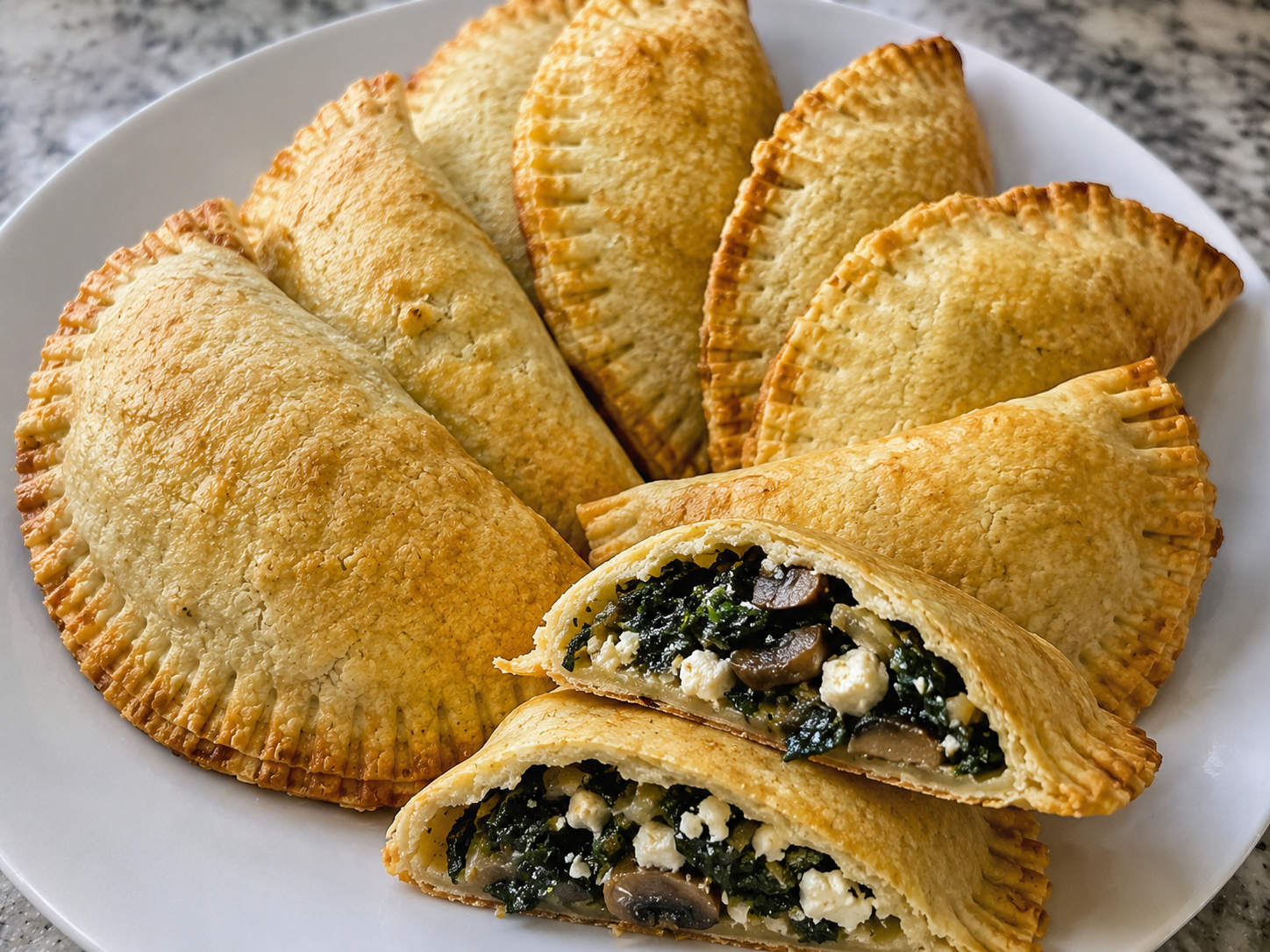
Three vegetable empanadas: a sweet potato and spinach version with mint, thyme, and smoked paprika; a mushroom-spinach-feta version with cumin and nutmeg; and an autumn-winter root vegetable pastry with cinnamon and herbs.
Most use the foundational grain-free rough puff pastry outlined below; the mushroom version uses a slightly simpler enriched almond-cassava dough as an alternative.
You can make the pastry up to 5 days ahead and refrigerate, or up to 3 months ahead and freeze (thaw overnight in the refrigerator before rolling).
Yield: 12–16 empanadas per variation · Active: 1 hr · Total: 3 hr (includes pastry chilling time) · Autumn through spring
Foundational Grain-Free Pastry Dough
Yield: One 12-inch rolled square (enough for 9 large or 12 small empanadas) · Active: 30 min · Total: 2 hr 30 min (mostly chilling) · Year-round
A note from the kitchen
This is the cassava-and-arrowroot version of rough puff pastry that can serve as a structural foundation for many grain-free pastry recipes. Cassava flour brings body and a slight chew that almond flour alone cannot. Arrowroot brings the clean starch that absorbs moisture during baking and helps prevent the dough from cracking when folded.
The fat is ghee rather than butter. Ghee is butter with the milk solids removed, which gives it a higher smoke point and produces a flakier pastry that doesn't burn at the edges. It also keeps better unrefrigerated than fresh butter. For this recipe specifically, the ghee creates discrete pockets of fat in the dough that vaporize into steam during baking, lifting the layers and creating the lamination that defines a good puff. That being said, cold butter works too.
Ingredients
1 cup cassava flour (sifted)
¼ cup arrowroot powder, plus more for dusting
¼ tsp sea salt
½ cup ghee, cold and cubed (about 4 oz)
Plus 5 tbsp cold ghee, cubed (this is added in a separate stage — see method)
10–12 tbsp ice water (cold filtered water with ice cubes added)
For ghee prep: Refrigerate your ghee for at least 30 minutes before starting, then cube it directly out of the refrigerator. Cold fat is structurally essential — warm or room-temperature ghee will incorporate too fully into the flour and you'll lose the lamination layers entirely.
Method
Prep the cold ghee. Cut the chilled ghee into small cubes (about ¼-inch each). Return the cubes to the refrigerator while you measure the dry ingredients. You want the ghee genuinely cold when it hits the flour.
Sift the dry ingredients. In a medium bowl, sift the cassava flour, arrowroot powder, and sea salt together. Sifting is structurally important here — cassava flour clumps easily, and uneven flour distribution will create dense spots in the finished pastry.
Cut in the ghee. Add ½ cup of the cold cubed ghee to the sifted flour mixture. Using a pastry cutter, two butter knives, or your fingertips (work fast so the ghee doesn't warm), cut the ghee into the flour until the mixture looks like coarse breadcrumbs with some pea-sized chunks of ghee still visible. You want to see distinct ghee pieces — don't blend it in fully.
Add the remaining 5 tbsp cold cubed ghee whole. Don't cut these in — just toss the cubes through the dough so they remain as discrete pieces. These larger ghee chunks are what create the flaky layers during folding and baking.
Add the ice water gradually. Drizzle 5 tbsp ice water over the flour mixture and stir gently with a fork to begin combining. Don't overwork the dough.
Test the hydration. Squeeze a small handful of dough — if it holds together when pressed, the hydration is correct. If it crumbles, add 1 more tbsp ice water and test again. Keep adding water 1 tbsp at a time until the dough barely holds together (you should be able to use up to 10–12 tbsp total, depending on humidity and flour brand).
Shape into a square and rest. Turn the dough out onto a clean surface dusted with arrowroot. Gently press into a 5-inch square — don't knead, just compress. Wrap in parchment paper or beeswax wrap. Refrigerate at least 30 minutes, until firm.
First fold. Place a large piece of parchment paper on a flat work surface. Lightly dust with arrowroot. Unwrap the dough and place it on the parchment. Place a second sheet of parchment on top. Using a rolling pin, roll the dough out into a 15 × 8-inch rectangle (long side facing you). If the dough cracks at the edges, gently press it back together with your fingers and continue rolling.
Fold like a letter (single fold). Fold the short right side of the rectangle into the center, then fold the short left side over the top — like folding a letter into thirds. Wrap the dough in parchment and refrigerate at least 30 minutes.
Second fold. Repeat the process. Place the dough back on the parchment, dust with arrowroot, top with second parchment, and roll out again to 15 × 8 inches. Fold into thirds again like a letter. Wrap and refrigerate at least 30 minutes.
Third fold. Repeat one more time. Roll out, fold, wrap.
Final rest. Refrigerate the folded dough at least 1 hour before using — overnight is even better. The longer the final rest, the more the starches relax and the better the dough will roll out without cracking.
Roll and shape. When ready to use, place the dough between two sheets of parchment paper dusted with arrowroot. Roll out to the size and thickness your recipe specifies (typically ⅛-inch for hand pies and empanadas). Cut into the shapes needed for your specific recipe. Use immediately or re-chill briefly if the dough warms during shaping.
Variations
Butter version (if ghee isn't available): Substitute the ghee with cold cultured grass-fed butter. The dough may brown slightly faster at the edges during baking — watch carefully and reduce oven temperature by 25°F if it browns too quickly. Use European-style butter (84%+ butterfat) for the best results.
Coconut oil version (for dairy-free): Substitute the ghee with cold, solid unrefined coconut oil. The dough will be slightly less rich but still flaky. Keep the coconut oil very cold throughout the entire process — it melts faster than ghee and creates a softer dough.
Lard version (traditional pasty pastry): Substitute the ghee with cold pasture-raised pork lard. Creates the most traditional Cornish-pasty-style flakiness — denser, more savory, more deeply flaky than the ghee version. Use for meat empanadas, savory turnovers, or game-meat hand pies.
Duck fat version (game-meat hand pies): Substitute the ghee with cold rendered duck fat. Produces a deeply rich, slightly gamey pastry that's exceptional for game-bird empanadas, wild duck pasties, or pheasant hand pies.
Herb-infused version: Add 1 tbsp finely chopped fresh herbs (thyme, rosemary, oregano, or sage) to the flour mixture before cutting in the ghee. Beautiful for savory hand pies — fresh thyme is especially complementary to mushroom or root-vegetable fillings.
Sweet version (for dessert hand pies): Reduce the salt to a small pinch and add 2 tbsp coconut sugar or pure maple syrup to the flour mixture. Lightly sweetens the pastry without making it cloying — perfect for fruit hand pies, apple turnovers, or sweet empanadas.
Sourcing
Cassava flour:
100% cassava root (yuca) flour — the only ingredient on the label should be "cassava flour" or "cassava root flour."
NOT tapioca starch. These are different products. Cassava flour is the whole peeled cassava root ground into a fine flour with the natural fiber intact. Tapioca starch is the extracted starch only, with the fiber and most of the nutrients removed. Both come from the same plant but behave structurally differently in baking. Cassava flour gives this dough its body and slight chew; tapioca starch alone would produce a gummy, brittle dough.
Organic and fair-trade when possible.
Pale ivory color, finely ground.
Stored cool in a sealed glass container — cassava flour absorbs moisture from the air and clumps if exposed.
Avoid pre-mixed grain-free flour blends with multiple added gums and starches.
Arrowroot powder:
Pure arrowroot starch — the only ingredient on the label should be "arrowroot powder" or "arrowroot starch."
Organic when possible.
Stored cool in a sealed glass container — arrowroot loses thickening potency if exposed to humidity or stored too long.
Avoid corn starch as a substitute (genetically modified, structurally different). Arrowroot is the ancestral root-based thickener used for centuries before corn starch.
Ghee:
From pasture-raised, grass-fed cows. Real ghee is butter that has been slowly simmered until the milk solids brown lightly and separate from the butterfat, then strained off — producing a pure, shelf-stable, lactose-free cooking fat with a distinctive nutty aroma.
Organic when possible.
In a glass jar (not plastic — ghee pulls plasticizers from packaging over time).
Deep yellow-gold color — the visual indicator of grass-fed source dairy.
Should smell faintly nutty and caramelized, never rancid.
Solid at refrigerator temperature, soft at room temperature.
Avoid commercial "clarified butter" sold in plastic tubs with added preservatives.
Homemade ghee: simmer 1 lb cultured grass-fed butter over low heat until the milk solids brown and sink (about 20 min), then strain through cheesecloth into a glass jar. Keeps refrigerated 6 months.
Grass-fed butter (for the butter variation):
From cows on pasture year-round when possible.
Cultured (fermented before churning) for the deepest flavor.
Deep yellow color — the visual indicator of grass-fed dairy.
High butterfat percentage (84%+ is European-style; 80% is standard American).
A small local farm or creamery you know is the gold standard.
Pasture-raised pork lard (for the lard variation):
Rendered from pasture-raised heritage-breed pork (Berkshire, Mangalitsa, Tamworth, Red Wattle) when possible.
Leaf lard (from around the kidneys) is the cleanest, mildest, and best for pastry — back fat lard is acceptable but slightly more porky in flavor.
Pure white color, faintly meaty aroma, no rancidity.
In a glass jar.
Avoid commercial hydrogenated lard from confined-feedlot pork.
Sea salt:
Unrefined, solar-dried or hand-harvested. No anti-caking agents, no bleaching, no chemical processing.
Naturally moist — the visual indicator of preserved minerals.
For this recipe, a fine-grain unrefined sea salt — Baja Gold mineral sea salt (third-party tested at 29.5–31.5% sodium, harvested from the Sea of Cortez, solar-dried) or any equivalent mineral-rich sea salt.
Avoid iodized table salt, kosher salt (no mineral content), and mass-produced "Pink Himalayan."
Storage
Refrigerator: Up to 5 days, well-wrapped in parchment or beeswax wrap and sealed in a glass container. The dough actually improves with overnight resting — the starches relax and the dough rolls out more easily on day 2.
Freezer: Up to 3 months, well-wrapped. Thaw overnight in the refrigerator before rolling. Do not thaw at room temperature — the ghee will warm too fast and lose its lamination structure.
For meal prep and batch baking: Make a double batch, divide into two 5-inch squares, and freeze one. You're then set up for empanadas, sweet hand pies, or pasties at any moment over the next three months.
Working with the dough
A few structural notes for handling grain-free rough puff successfully:
The dough is more fragile than wheat-based puff. Crack repair is expected — if it tears during rolling, simply press the dough back together with damp fingers. The folds will integrate any patches.
Keep the dough cold. If the dough warms during rolling or shaping, return it to the refrigerator for 10 minutes before continuing. Warm fat = no lamination = no flaky layers.
Don't overwork. The fewer times you roll and stretch the dough, the more delicate the final pastry. Three folds is the structural maximum — more will make the dough tough.
Always roll between parchment paper. The dough sticks easily to direct surfaces. Two sheets of parchment dusted with arrowroot is the cleanest technique.
For the third roll-out (when shaping into final pastries), roll slightly thinner than you think — about ⅛ inch. The dough puffs and rises during baking, so thinner is better than thicker.
Recipe inspired from the rough puff pastry technique in Sweet Laurel Savory by Laurel Gallucci and Claire Thomas.
Sweet Potato & Spinach Empanadas
Yield: 12-16 empanadas · Active: 1 hr · Total: 3 hr (including pastry chilling)
Ingredients
For the filling:
4 tbsp extra-virgin olive oil, divided
10 oz fresh spinach
2 tbsp ghee
3 cups sweet potato, peeled and small-diced (about 2 medium sweet potatoes)
1½ cups yellow onion, thinly sliced (about 1 large)
2 cloves garlic, minced
2 tsp smoked paprika (Pimentón de la Vera DOP)
2 tbsp fresh mint, finely chopped
1 tbsp fresh thyme leaves, chopped
1 tsp sea salt (or to taste)
½ tsp freshly cracked black pepper
For assembly:
1 recipe Grain-Free Pastry Dough
Arrowroot powder, for dusting
1 large pasture-raised egg, beaten with 1 tbsp water (egg wash)
For serving:
Romesco sauce or Sicilian tomato sauce (see Variations below for a quick romesco)
Method
Wilt and squeeze the spinach. Heat 2 tbsp olive oil in a large skillet over medium heat. Add the fresh spinach and cook 5–10 minutes, stirring frequently, until completely wilted and excess liquid has evaporated. Transfer to a plate lined with paper towels. Once cool enough to handle, gather the spinach in a clean kitchen towel or your hands and squeeze very firmly to remove every last bit of liquid. This is the single most important step in the recipe — wet spinach trapped in the dough will steam from inside and breach the seam of the pastry. Spinach holds an enormous amount of water relative to its volume; wilted spinach can lose roughly 90% of its weight as water on draining. Don't skip this. Set the squeezed spinach aside on the paper towels.
Cook the sweet potato. Clean the skillet. Return to medium heat and melt the ghee with the remaining 2 tbsp olive oil. Add the diced sweet potato. Cook, stirring occasionally, for about 10 minutes, until the sweet potato is softened and lightly caramelized at the edges.
Add the onion and garlic. Add the sliced onion and minced garlic. Cook 5 minutes more, stirring occasionally, until the onion is translucent and fragrant.
Add the squeezed spinach and seasonings. Add the squeezed-dry spinach to the skillet along with the smoked paprika, mint, thyme, sea salt, and black pepper. Cook 2 minutes more, stirring to integrate everything and bring the flavors together.
Cool completely. Transfer the filling to a bowl and let cool to room temperature, then refrigerate at least 30 minutes. The filling can be made up to 2 days ahead. Don't proceed to assembly until the filling is fully cold.
Roll out the pastry. Preheat the oven to 375°F with one rack in the upper third and one in the lower third of the oven. Line two baking sheets with parchment paper. Take one disk of dough and roll between two parchment sheets dusted with arrowroot to ⅛-inch thick. Cut 4-inch rounds using a biscuit cutter or the mouth of a wide jar. Repeat with the second disk (you should get about 32 rounds total for the 16-empanada yield).
Fill and seal. Moisten the edges of one dough round with warm water. Add about 1 tablespoon of filling to the center of half the round. Fold the unfilled half over the filling. Pinch the edges together to seal and create pleats. If the dough cracks during folding, simply press it back together with a wet finger — the dough is forgiving. Repeat with the remaining rounds and filling.
A method note: For this version, many home cooks find it easier to use their hands to gently shape and pinch the dough around the filling than to roll out and cut rounds. If using this technique, divide the dough into 16 equal balls, flatten each ball with your palm to a small round between parchment sheets, fill the center, and fold over to seal.
Arrange on the prepared sheets, leaving 1½ inches between each. Brush all over with egg wash.
Bake. Bake 30 minutes, rotating the pans halfway through (top to bottom, front to back), until the empanadas are deeply golden brown all over.
Rest 10 minutes before serving. Serve warm or at room temperature with romesco sauce or Sicilian tomato sauce.
Quick romesco sauce: Char 2 red bell peppers under the broiler until blackened, then peel and seed them. Soak in olive oil with 1 clove garlic, 1 tbsp aged sherry vinegar, 1 tsp smoked paprika, and a pinch of sea salt. Blend with ¼ cup raw almonds toasted in a dry skillet. Adjust salt and acid to taste. Beautiful with all three vegetable empanada versions.
Mushroom-Spinach-Feta Empanadas
Yield: 12-16 empanadas · Active: 45 min · Total: 1 hr 30 min · Year-round (with seasonal mushroom variation)
Ingredients
For the empanada dough (slightly enriched):
2 cups blanched almond flour (finely-ground)
½ cup arrowroot or tapioca flour
½ cup cassava flour
1 tsp sea salt
6 tbsp grass-fed butter, cold and cubed
1 large pasture-raised egg
3–5 tbsp cold filtered water
For the filling:
1 lb fresh spinach, washed
8 oz mushrooms (cremini, shiitake, or wild blend like oyster, maitake, chanterelle), finely chopped
1 small yellow onion, finely chopped
4 cloves garlic, minced
2 tbsp grass-fed butter or ghee
1 tsp ground cumin
½ tsp smoked paprika
¼ tsp freshly grated nutmeg
½ tsp sea salt
¼ tsp freshly cracked black pepper
½ cup feta cheese, crumbled (or substitute goat cheese, ricotta salata, or aged Manchego)
Optional: 8 oz grass-fed ground lamb or beef, browned and drained, mixed in with the mushrooms
For assembly:
1 large pasture-raised egg, beaten with 1 tsp water (egg wash)
For serving:
Chimichurri, salsa verde, romesco, or the Curried Ketchup
Method
Make the dough. In a food processor, pulse the almond flour, arrowroot, cassava flour, and sea salt to combine. Add the cold cubed butter and pulse until pea-sized crumbs form. Add the egg and 3 tablespoons cold water; pulse until a dough begins to form. Add more cold water 1 tablespoon at a time if needed until the dough comes together.
Chill the dough. Form into a disk, wrap in parchment paper, and chill at least 30 minutes (or up to 2 days).
Wilt and squeeze the spinach. Heat a large skillet over medium heat (no oil needed at this stage). Add the fresh spinach and cook 4–5 minutes, stirring frequently, until completely wilted. Transfer to a clean kitchen towel and squeeze very firmly to remove all liquid. Set aside.
Cook the mushrooms. Wipe out the skillet and return to medium heat. Add the butter or ghee. Add the chopped onion and cook 5 minutes, until softened. Add the minced garlic and cook 1 minute more, until fragrant.
Add the mushrooms and cook them DRY. Add the chopped mushrooms and cook 8 minutes, stirring occasionally, until deeply golden and any liquid has evaporated entirely. This is the structural moment of the recipe. Mushrooms hold an enormous amount of water — wet mushroom filling will soak the dough from inside and ruin the empanadas. Cook them until they are deeply browned and the pan is dry to the touch.
Add the seasonings. Add the cumin, smoked paprika, nutmeg, sea salt, and pepper. Cook 1 minute more, stirring to integrate.
Add the spinach and (optional) meat. Add the squeezed-dry spinach and the optional cooked ground lamb or beef (if using). Cook 1 minute more, stirring to combine. Remove from heat.
Cool completely and stir in the feta. Transfer the filling to a bowl and cool to room temperature. Once fully cool, stir in the crumbled feta. (Adding feta while warm would melt the cheese and change the texture.)
Roll out the dough. Preheat the oven to 375°F. Line a baking sheet with parchment paper. Divide the chilled dough in half. Roll each half between parchment paper to ⅛-inch thick. Cut 4-inch circles using a bowl or biscuit cutter.
Fill and seal. Spoon 2 tablespoons of filling into the center of each circle. Brush the edges with water. Fold the dough over to form a half-moon. Press the edges firmly with a fork to seal.
Place and egg-wash. Arrange on the prepared baking sheet. Brush all over with egg wash.
Bake. Bake at 375°F for 22–25 minutes, until deeply golden brown.
Rest 5 minutes before serving. Serve warm with chimichurri, salsa verde, romesco, or curried ketchup.
Root Vegetable Pastries (autumn-winter)
Yield: 9 pastries · Active: 1 hr · Total: 2 hr 30 min · Autumn through winter (peak: October–March, when all three roots are at their best)
Ingredients
For the filling:
2 tbsp extra-virgin olive oil
½ cup yellow onion, finely chopped
1 clove garlic, minced
½ cup butternut squash, peeled and finely chopped
½ cup carrot, finely chopped
½ cup turnip, peeled and finely chopped
1 tbsp fresh flat-leaf parsley, finely chopped
2 tsp apple cider vinegar
¼ tsp mustard powder
¼ tsp onion powder
¼ tsp garlic powder
⅛ tsp ground Ceylon cinnamon
2 tbsp Curried Ketchup (see companion foundational post)
⅛ tsp freshly cracked black pepper
Sea salt to taste
For assembly:
1 recipe Grain-Free Pastry Dough
¼ cup cassava flour or arrowroot, for dusting
2 pasture-raised eggs, beaten with 1 tbsp water (egg wash)
For serving:
Extra Curried Ketchup for dipping
Method
Cook the onion. Heat the olive oil in a large skillet over medium heat. Add the chopped onion. Season with sea salt and pepper. Cook 5–6 minutes, until softened and translucent.
Add the garlic and root vegetables. Add the minced garlic, finely chopped butternut squash, carrot, and turnip. Cook 5 minutes more, stirring occasionally, until the vegetables are just tender (not fully soft).
Transfer to a bowl. Pour the cooked vegetables into a bowl and let cool slightly.
Add the seasonings. Stir in the chopped parsley, apple cider vinegar, mustard powder, onion powder, garlic powder, cinnamon, black pepper, and the curried ketchup. Mix well to integrate. Taste and adjust salt if needed.
Cool completely. Let cool to room temperature, then refrigerate at least 30 minutes.
Roll out the pastry. Preheat the oven to 400°F. Line a baking sheet with parchment paper. Roll the chilled rough puff pastry between two sheets of parchment dusted with cassava flour or arrowroot. Roll to a 12-inch square, ⅛-inch thick.
Cut into 4-inch squares. Trim the edges to make a clean 12-inch square, then cut into 9 four-inch squares.
Fill and fold into triangles. Spoon about 1 tablespoon of filling into the center of each square. Brush the edges with egg wash. Fold each square diagonally to form a triangle, lining up the two corners. Press the edges firmly with the tines of a fork to seal — the fork tines create the classic triangle-edge pattern.
Place and egg-wash the tops. Arrange the triangular pastries on the prepared baking sheet. Brush all over with egg wash.
Bake. Bake at 400°F for 15–20 minutes, until deeply golden brown.
Rest 5 minutes before serving. Serve warm with extra Curried Ketchup for dipping.
A method note: The triangle fold is more dramatic visually than the half-moon, and it shows the filling structure beautifully when sliced or bitten into. For a brunch board or party tray, the triangle pastries are particularly elegant alongside the other empanada formats.
Variations (Across All Three)
Different greens: Substitute chard, kale, or escarole for the spinach in any of these recipes. Chop more finely and cook slightly longer to wilt completely. Each green brings its own slight bitter-mineral character.
Different cheeses: Goat cheese (chèvre), aged Manchego, ricotta salata, or aged Pecorino all work in place of feta. Each cheese gives a structurally different finished empanada.
Dairy-free version: Replace the butter in the dough with cold coconut oil. Replace the feta with 1 tablespoon nutritional yeast stirred into the filling for a similar umami-salty depth.
Optional meat addition: Brown 8 oz grass-fed ground lamb or beef with the same spices as the filling, drain, and stir in. Turns the vegetable empanada into a more substantial main course.
Spring-summer vegetable variations: Substitute the autumn-winter roots with fresh peas, asparagus tips, zucchini, or summer squash. Lighter, brighter, more spring-feeling.
Mediterranean leeks-and-feta variation: Sauté 3 cleaned and sliced leeks (white and pale-green parts) in olive oil until soft, season with thyme, salt, and pepper, and use as the filling with crumbled feta. Pulled from the Levantine tradition.
Mediterranean za'atar-and-spinach variation: Substitute the smoked paprika in the sweet potato version with 1 tbsp za'atar (the Levantine herb blend). Add a small handful of toasted pine nuts to the filling. Beautiful for a Levantine-themed dinner.
Mini empanadas (for parties): Cut the dough into 3-inch rounds and use 1 teaspoon of filling per empanada. You'll get about 18–20 mini empanadas per recipe.
Free-form (rustic galette style): Roll the dough into one large round, mound the filling in the center, fold the edges up around the filling without sealing, and bake free-form. A single large rustic vegetable galette beautiful for the table.
Make-ahead and freezer notes: All three vegetable empanada styles freeze beautifully unbaked for up to 3 months. Arrange assembled, egg-washed empanadas on a parchment-lined sheet pan, freeze until firm (1–2 hours), then transfer to a sealed freezer container. Bake from frozen at 400°F, adding 5 minutes to the cook time. The vegetable empanadas freeze even better than the meat versions — vegetables hold their structure cleanly through the freeze-bake cycle.
Sourcing
Sweet potato:
Local farmers' market or CSA during peak season (October–February).
Heritage varieties (Garnet, Beauregard, Murasaki, Japanese, Okinawan purple) for deeper flavor than commercial varieties.
Firm, heavy for size, with no soft spots or sprouting.
Skin-on if scrubbed (the skin holds antioxidants); peeled if smoother texture is desired.
Avoid sweet potatoes labeled as "yams" in U.S. supermarkets — these are actually orange-fleshed sweet potatoes, not true yams (Dioscorea, a tropical tuber). True yams are a different food.
Butternut squash:
Hard, heavy for size, with a matte (not shiny) skin.
Deep tan color, no green patches at the stem end (green = underripe).
Local farmers' market or CSA during peak season (September–February).
Whole and uncut is structurally better — pre-cut butternut squash oxidizes quickly and loses moisture.
Avoid soft spots or any moldy or bruised areas.
Carrots and turnips:
Local farmers' market or CSA during peak season (October–March).
Rainbow carrots for visual impact and varied phytonutrient profiles.
Turnips with bright fresh greens still attached are the freshest.
Avoid soft, wrinkled, or split carrots and turnips.
Fresh spinach:
Bright green, fragrant, firm leaves — wilted, yellowing, or slimy spinach has lost its mineral integrity.
Whole bunches from a local farmers' market, CSA, or your own garden.
Wash thoroughly — spinach holds grit between the leaves and stems.
Avoid pre-washed bagged baby spinach with extended shelf life (typically treated with chlorinated water).
Fresh mushrooms (for the mushroom version):
Wild blends (oyster, maitake/hen-of-the-woods, chanterelle, porcini) when available during their seasons — wild mushrooms carry more flavor, more beta-glucans, and more ergothioneine than cultivated mushrooms.
Shiitake (cultivated but classical) for the Argentine-Peruvian profile.
Cremini or baby portobello for the widely-available backup.
Fresh, dry to the touch, with no slime or odor.
Avoid generic supermarket button mushrooms (waterlogged and flavorless) and pre-sliced mushrooms in plastic containers.
Feta cheese:
Real Greek or Bulgarian feta with the country-of-origin DOP designation — sheep's milk or sheep-and-goat blend.
"American feta-style cheese" is structurally different — typically cow's milk with stabilizers.
From a local cheesemonger or specialty Mediterranean grocer.
Stored in brine for the longest shelf life.
Fresh herbs (mint, thyme, parsley):
Fresh, fragrant, bright green leaves with no wilting or yellowing.
Whole bunches from a local farmers' market, garden, or CSA.
Spearmint (the milder, sweeter mint) over peppermint (which can be aggressive in savory contexts).
Apple cider vinegar:
Raw, unfiltered, with the mother (the cloudy strands of natural fermentation cultures at the bottom of the bottle).
From whole pressed apples, not from concentrate.
Organic when possible.
Mustard powder:
100% mustard seed, finely ground.
Yellow mustard powder is mild; brown mustard powder is sharper.
Stored in a sealed glass container.
Avoid pre-mixed "mustard seasoning" blends with fillers.
Onion powder and garlic powder:
Single-ingredient (just dehydrated onion or garlic).
No anti-caking agents, no fillers.
Organic, single-origin when possible.
Recently produced.
Ceylon cinnamon:
Ceylon cinnamon (Cinnamomum verum, "true cinnamon") over cassia cinnamon — Ceylon has a more delicate flavor and dramatically lower coumarin content.
Single-origin and organic when possible.
Freshly ground when possible.
Pastry foundationals and spice foundationals: See the companion Grain-Free Rough Puff Pastry and Curried Ketchup foundational posts.
Storage
Refrigerator: All three vegetable empanada styles refrigerate 4–5 days, sealed in a glass container. The flavors actually deepen overnight — these are some of the rare empanadas that genuinely improve on day 2 and day 3.
Freezer: All three freeze beautifully unbaked for up to 3 months. Bake from frozen at 400°F, adding 5 minutes to the cook time. The vegetable empanadas are actually structurally easier to freeze than the meat versions — vegetables hold their integrity through the freeze-bake cycle more cleanly than meat fillings.
The filling alone: Each filling keeps refrigerated 4 days as a stand-alone vegetable preparation. Excellent folded into eggs, stuffed into a roasted bell pepper, or piled onto sweet potato toast.
To reheat: Always use the oven (350°F for 10 minutes for refrigerated, 15 minutes for room-temperature), never the microwave.
Pairs Well With
Condiment pairings:
Romesco — Catalan red pepper and almond sauce, beautiful with the Sweet Potato & Spinach Empanadas
Sicilian tomato sauce — long-simmered tomato-onion-garlic sauce, especially good with the Mushroom-Feta Empanadas
Chimichurri — bright herbal Argentine sauce, beautiful with all three
Tzatziki or whipped feta with herbs — Greek-Levantine dipping sauce, beautiful with the Sweet Potato & Spinach Empanadas
For a complete meal: Serve alongside a simple seasonal salad — arugula or watercress with shaved fennel, sliced apples or pears, toasted walnuts, and a simple lemon-olive-oil-and-Dijon vinaigrette. The bright bitter salad cuts the richness of the empanadas beautifully.
For a vegetable-only main: Serve 2–3 empanadas per person alongside a generous salad and a simple soup (mushroom broth, root vegetable broth, or fresh herb-and-garlic broth). Complete dinner.
For the gathering: All three vegetable empanada styles are foundational party food and brunch-board options — easy to make in advance, beautiful arranged in a basket lined with linen, easy to portion. The triangle-folded butternut version is particularly elegant for a more formal table.
For seasonal context: The Sweet Potato & Spinach version is at its best in late autumn through early spring. The Mushroom-Spinach-Feta version works year-round (especially when wild mushrooms are at peak in autumn). The Root Vegetable version is an autumn-winter centerpiece — make them in October through March when all three root vegetables are at their peak from the farmers' market.
Inspired by the vegetable empanada and root-vegetable hand pie recipes in Sweet Laurel Savory by Laurel Gallucci and Claire Thomas